Charly García — natal chart
What does Charly García’s natal chart reveal?
Argentine musician born in 1951 in Buenos Aires. He led Sui Generis, La Máquina de Hacer Pájaros and Serú Girán before his solo career, with albums such as 'Clics modernos' (1983) and 'Piano bar' (1984).
 Share
Share
Birth
1951-10-23 · 11:20 · Buenos Aires, Argentina Reliability: AA · vetted record
The Public Artist: Sun, Saturn, and Neptune in Libra at the Midheaven
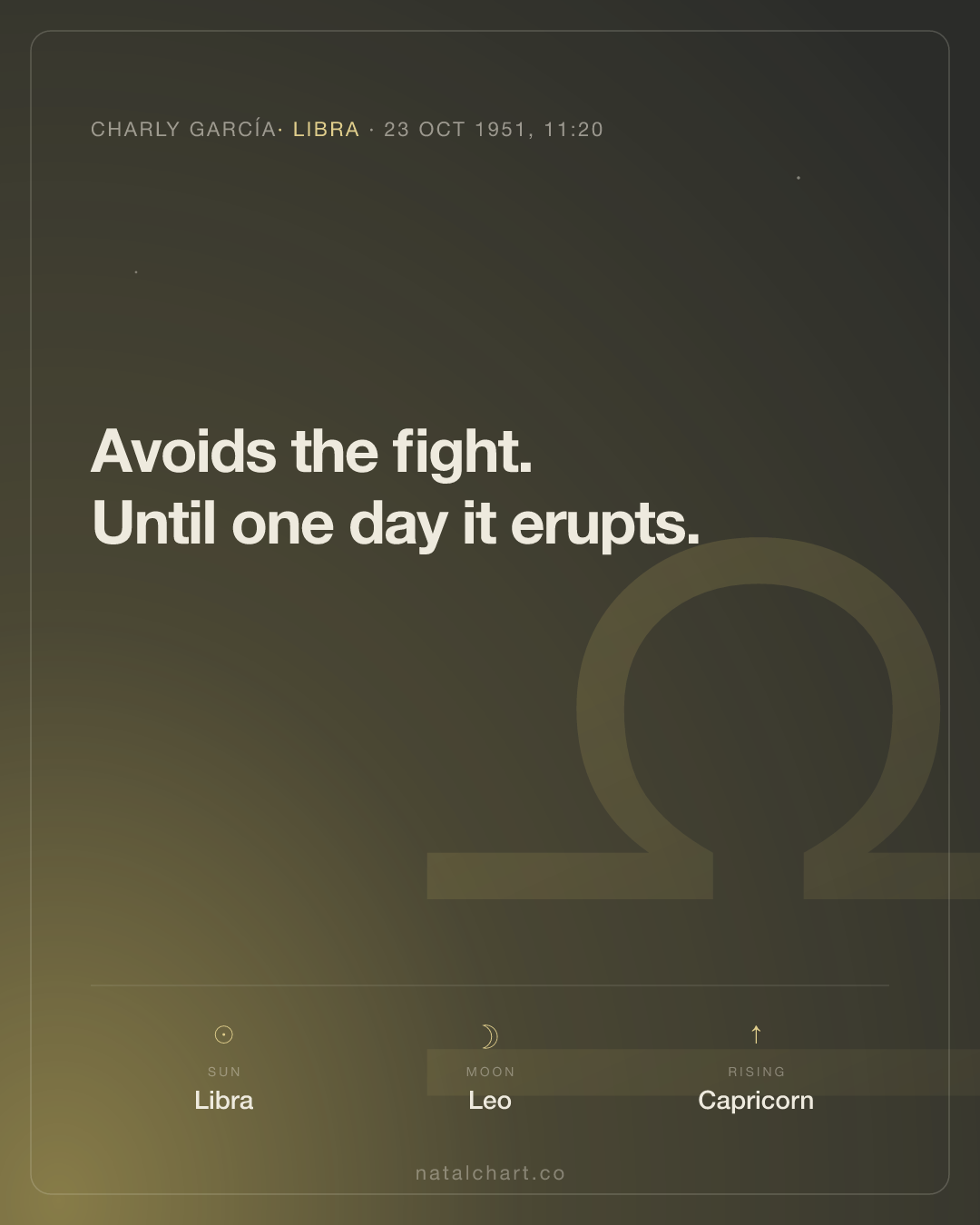
Charly García built his career around a central fact that his chart makes plain: art was never a vehicle for him, it was the destination. Three planets — Sun, Saturn, and Neptune — all sit in Libra and cluster around the Midheaven, the point in a natal chart that describes a person's public life and professional calling. Libra is the sign of balance, aesthetic form, and collaboration. Having the Sun here means identity itself is woven into making things beautiful and coherent. Saturn alongside it adds the structural rigor — the discipline of the craftsman who doesn't consider a song finished until every element is precisely in place. Neptune beside both of them infuses everything with an atmospheric, borderless quality, the sense that a great record doesn't just sound good, it feels like a place. When García led Sui Generis in the early 1970s and later Serú Girán, that combination was audible: melodically elegant, rigorously arranged, and emotionally vast in a way that didn't resolve into easy sentiment.
The Capricorn Face
The Ascendant — the face a person meets the world with, the first impression they project — is Capricorn. Capricorn rising reads as serious, self-contained, and somewhat impenetrable at first encounter. There is authority in the bearing, and a wariness about being underestimated. This fits the public García: formal in his musical ambitions, demanding of collaborators, and unlikely to make small talk when there was work to do. The ruling planet for Capricorn is Saturn, which sits right at the Midheaven in Libra — reinforcing that the serious, structured exterior is completely aligned with the professional persona. What you see is what the work demands.
The Leo Moon and Pluto: Fire in the Deep
Below that controlled Capricorn surface lives something far more volcanic. The Moon — the emotional interior, the inner life that drives without announcing itself — sits in Leo in the eighth house, close to Pluto. The eighth house deals with depth, intensity, and the things that don't get spoken aloud; Leo there has a fierce, theatrical quality that runs underground. This placement describes someone for whom emotional experience is not gentle or moderate — it is big, potentially overwhelming, and inseparable from the need for creative expression. García's most celebrated albums, Clics modernos (1983) and Piano bar (1984), carry this imprint: personal intensity transformed into public art, darkness handled with theatrical flair rather than suppressed. The Pluto conjunction deepens it further — there is a quality of psychological excavation in what he produces, a willingness to go where things get uncomfortable.
Moon Square Mercury: The Tightest Tension
The single tightest aspect in García's chart — less than a tenth of a degree — is the Moon in Leo pulling against Mercury in Scorpio. Mercury is how a person thinks and communicates; Scorpio gives it a probing, uncompromising edge. Moon and Mercury in tension means the emotional world and the intellectual world are not naturally in sync. The feeling wants to be expressed immediately and dramatically (Leo Moon); the mind wants to cut deeper, hold back, and only say something when it reaches the nerve (Scorpio Mercury). In practice, this is one of the most productive frictions a songwriter can have — the discomfort of that gap between what you feel and what you can say is precisely what drives the writing. It's also a description of a person who can be emotionally reactive and analytically withering in the same breath, sometimes within the same lyric.
Mercury in Scorpio, House Eleven: Writing for Movements
The eleventh house covers collective movements, groups, and the wider social world. Mercury here means García has always thought in terms of audiences, generations, and shared experience rather than private confession. Scorpio sharpens this into something forensic — he doesn't just describe what a generation feels, he diagnoses it. Clics modernos captured the disorientation of urban Argentina in the early 1980s with a precision that made it feel like documentary as much as music. That's Mercury in Scorpio in the eleventh house: turning private psychological insight into something a whole generation recognizes as their own map.
Venus and Mars in Virgo: The Obsessive Craftsman
Both Venus and Mars sit in Virgo in the ninth house, close enough to be considered joined (orb 3.5°). Venus in a chart describes values and aesthetic sensibility; Mars describes drive and how a person takes action. Virgo applies both to the work of perfection — the meticulous adjustment of small details, the refusal to leave anything slightly wrong. In the ninth house, which deals with philosophy, travel, and higher learning, this combination points toward an artist who refines his craft with philosophical seriousness, treating music as a discipline with standards as rigorous as any intellectual pursuit. Anyone who has read García's interviews about production and arrangement knows this is accurate: the aesthetic criteria are exacting, the tolerance for sloppiness low. Mars and Venus working together easily with Uranus (orbs 2.7° and 0.8° respectively) adds a streak of genuine originality — the craft isn't conservative, it keeps breaking its own rules in ways that feel earned rather than arbitrary.
Jupiter Opposite Saturn: Freedom Against Structure
Jupiter in Aries sits in the fourth house — the home, roots, and private self — and Saturn in Libra sits in the tenth house, the public and professional self. These two planets pull against each other at a distance of under two degrees. Jupiter in Aries in the fourth house is an impulse toward unconstrained creative expansion, a private self that wants to follow fire wherever it leads. Saturn in Libra in the tenth house is the counterweight: public structures, aesthetic form, professional accountability. This is the central tension in García's artistic biography. The solo records of the mid-1980s pulled toward the Aries-Jupiter extreme — maximalist, experimental, self-willed, sometimes chaotic. The band-era records were shaped more by Saturn's collaborative discipline. Neither pole alone would have produced the catalog; the tension between them did.
Outer Planets and the North Node
Uranus in Cancer in the seventh house describes unconventional partnerships and a tendency to build working relationships that don't follow standard structures — Sui Generis, La Máquina de Hacer Pájaros, and Serú Girán were all bands that operated unusually for their time and context. The North Node — the direction of growth, the thing a chart is leaning toward — sits in Pisces, pointing toward dissolution of boundaries and a kind of artistic transcendence that goes beyond the perfectionist Virgo drive. It's a life that pulls from precise craft toward something boundless. García's later career arc, with its eccentricities and experiments, has that quality: the craftsman who eventually trusts the drift.
Chiron and Lilith: The Hidden Wound
Chiron — in astrology, an old wound that becomes a gift when worked with — sits in Sagittarius in the twelfth house. The twelfth house is what happens below the surface of the personality, the private suffering or doubt that rarely gets spoken. Sagittarius connects to belief, meaning, and exile. A wound here often shows up as a private uncertainty about whether one belongs — to a place, a philosophical framework, an identity. This is not something one can know from the outside; but it may be part of what gives García's music its quality of searching rather than arrival. Lilith in Cancer in the seventh house adds a wild, suppressed quality to close partnerships — relationships where the conventional script doesn't hold, and something untameable keeps surfacing.
The Warm Close
The chart describes someone for whom art and public life are the same thing — not a performance of self, but the actual self, structured and made shareable. The tension between precision and expansiveness, between the controlled Capricorn face and the volcanic Leo interior, between Saturn's form and Jupiter's fire, produced one of the most distinctive voices in Latin American music. What the Moon-Saturn placement at the core also says is this: the discipline was not external, it was emotional — García felt the weight of the work as a personal matter, not a professional one. That's the signature of someone who made records that still sound necessary decades later.
The chart
How to read it →Frequently asked questions
What is Charly García's zodiac sign?
Charly García's Sun sign is Libra — the Sun was in Libra at birth (1951).
What is Charly García's moon sign?
Charly García has the Moon in Leo. The Moon sign describes the emotional and instinctive layer of the chart.
What is Charly García's rising sign?
Charly García's rising sign (ascendant) is Capricorn — the sign on the eastern horizon at the moment of birth.
When and where was Charly García born?
Charly García was born in 1951 in Buenos Aires, Argentina.