Pablo Picasso — natal chart
What does Pablo Picasso’s natal chart reveal?
Pablo Picasso, born Pablo Ruiz Picasso on October 25, 1881, in Málaga, Spain, was one of the most prolific and influential artists of the twentieth century. Together with Georges Braque, he co-founded Cubism around 1907–1908, fundamentally changing the representation of space and form in painting. His major works include Les Demoiselles d'Avignon (1907), Guernica (1937), and the neoclassical portraits of the early 1920s. He passed through Blue, Rose, and Surrealist phases across a career spanning over seven decades. Picasso died in Mougins, France, on April 8, 1973.
 Share
Share
Birth
1881-10-25 · 23:15 · Málaga, Spain Reliability: A · reliable data
The Core
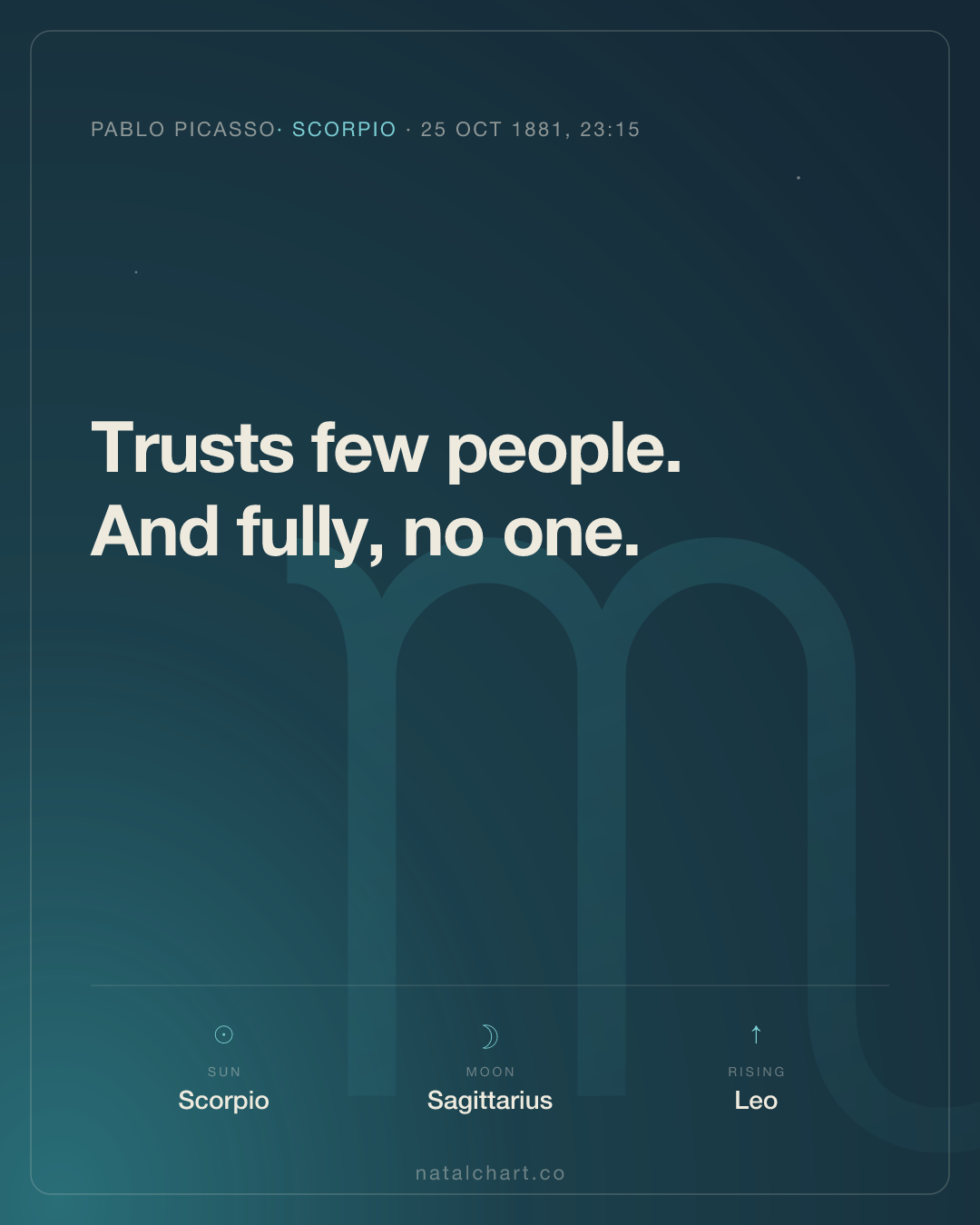
Pablo Picasso's chart is built around a Scorpio Sun in the fourth house, a Leo Ascendant, and a cluster of four planets — Jupiter, Saturn, Neptune, and Pluto — packed together in Taurus in the tenth house. That configuration is not subtle: the private depths (Scorpio fourth house) and the monumental public record (Taurus tenth house) pulled against each other with equal force for over ninety years. What emerged from that tension was one of the most prolific careers in the history of Western art.
The Ascendant (the face one meets the world with) in Leo carries natural theatricality and an instinct for command. Those who knew Picasso described him entering a room with the unmistakable awareness that the room would reorganize itself around him. This was not simply charm — it was structural. Leo rising expects to be at the centre, and the rest of the chart gave him material worth placing there.
The Inner World
The Moon is in Sagittarius in the fifth house — the house of creation, play, and what one makes for the joy of making. A Sagittarius Moon has a perpetual restlessness at its emotional core: it needs new territory, new stimulation, new interpretive frameworks. Picasso never stayed in one style long enough to become comfortable — from the Blue Period to the Rose Period to Cubism to Surrealism to late neoclassicism — and this was not artistic opportunism. It was the Moon's instinct working exactly as it was built to.
The Moon flows easily with Venus (a sextile, a supportive angle between two planets), adding warmth and sensory pleasure to this restlessness. Picasso's appetite for beauty — in women, in objects, in Mediterranean light — was not separate from his emotional life but woven into it.
The Mind
Mercury is in Scorpio in the fourth house, directly across from Jupiter and Pluto in Taurus. This opposition — Mercury on one side, Jupiter and Pluto on the other — is the tightest aspect in the chart (less than a degree separating Mercury and Jupiter). It describes a mind that thinks in total systems, that refuses the partial view, that keeps excavating until it reaches the underlying structure. Picasso co-invented Cubism precisely by refusing to accept that a face could only be seen from one angle; he wanted to show all angles simultaneously — a Mercury-Pluto compulsion made visible on canvas.
The Mercury-Jupiter opposition also makes for sweeping intellectual ambition. Picasso was not interested in solving small problems in painting; he wanted to change what painting was.
Love and Values
Venus is in Libra in the third house — a placement that finds beauty in ideas, in language, in the exchange between minds. The third house rules communication, neighbourhood, the immediate social environment. Picasso's relationships with women were often also intense intellectual partnerships; Dora Maar, Françoise Gilot, Jacqueline Roque each entered a creative world where love and artistic conversation were inseparable.
Venus in easy flow with Pluto (a trine) gives depth and intensity to attraction — but also suggests that Picasso's affections were not light or easily exchanged. They were total, and when they ended, the ending was total too. His treatment of his partners was often documented as controlling and damaging; the same depth that produced Guernica produced private suffering for those closest to him.
Mars and Drive
Mars is in Cancer in the twelfth house — a position that internalizes drive rather than projecting it outward. Cancer Mars is not aggressive in a direct way; it works through feeling, through emotional pressure, through protecting what matters most. In the twelfth house, this Mars worked largely invisibly — the studio as sanctuary, production as a private necessity that happened to become public. Picasso was famously prolific: over 20,000 works across painting, sculpture, ceramics, printmaking. This was not ambition in the conventional sense. It was compulsion rooted in an emotional need so deep it rarely surfaced as conflict — it just kept producing.
Mars flows easily with Saturn and Neptune (both sextiles) in the tenth house, connecting the hidden drive with the massive public structure it built. The studio and the reputation were two faces of the same mechanism.
Jupiter and Saturn
Jupiter and Saturn are both in Taurus in the tenth house, alongside Neptune and Pluto. This concentration in the tenth house — the house of public standing, professional achievement, legacy — is remarkable. Taurus is the sign of tangible, material form: what endures, what can be held, what stands the test of time. Four planets here suggest that Picasso's public life was not a byproduct of his private creativity; it was a co-equal drive. The reputation mattered. The market mattered. He was intensely aware of his place in art history from a relatively young age, and he worked that awareness into his decisions about what to make, what to show, and what to withhold.
Jupiter in Taurus brought expansion through material mastery and the pleasure of craft; Saturn in Taurus brought discipline, structure, and an understanding that a legacy must be built stone by stone.
The Outer Planets
Neptune and Pluto are both in Taurus in the tenth house — a generational signature, but one that falls on Picasso's most public point. Neptune here softens the edges of the reputation into myth; Pluto here makes the legacy something that outlives the person entirely. Picasso understood this consciously: he gave interviews, cultivated his legend, controlled which photographs were taken and which were not. He was building a monument, and the chart placed that monument in Taurus — permanent, tangible, stubborn against time.
Uranus in Virgo in the second house brings an erratic relationship with material resources — income and finances that move in unexpected bursts rather than steady accumulation. Early poverty and later extraordinary wealth describe this placement well.
The Midheaven
The Midheaven (the career and public reputation point) is in Aries — the sign of the pioneer, the one who goes first, who breaks ground before anyone else arrives. Picasso did not refine existing styles; he demolished them and invented new ones. Aries Midheaven puts the stamp of initiation on the public record: the person remembered for beginning things that others then spent decades extending. Co-founding Cubism with Braque in 1907–1908 is the clearest biographical proof of this placement. With Jupiter and Saturn anchoring the tenth house in Taurus, the revolution was also built to last.
Chiron and the North Node
Chiron (an old wound that becomes, over time, a source of skill and understanding) is in Aquarius in the seventh house — the house of partnerships, one-to-one relationships, the mirror that others hold up. The wound sits in the territory of the other person: how Picasso was seen, reflected, challenged, and sometimes failed by the people closest to him. His relationships with partners were documented by those partners themselves as psychologically punishing; Françoise Gilot's memoir is particularly clear-eyed on this. The Chiron in the seventh does not excuse this — but it names it: the deepest wound was in the space between self and other.
The North Node (the direction of growth the life moves toward) is in Sagittarius — toward breadth, philosophical range, the willingness to keep revising one's own view. Picasso's constant movement between styles was not just restlessness; it was the North Node doing its work.
A Final Note
Picasso died in Mougins on April 8, 1973, still working, still in argument with the canvas. The Scorpio Sun in the fourth house suggests a man whose deepest identity was private — what the public saw was the Leo Ascendant's theatre, the tenth-house planets' monument-building. The actual Picasso, the one who was afraid, ambitious, wounded in his intimate relationships, and furiously alive: that one lived in the fourth house, out of the light, and drove everything else.
The chart
How to read it →Frequently asked questions
What is Pablo Picasso's zodiac sign?
Pablo Picasso's Sun sign is Scorpio — the Sun was in Scorpio at birth (1881).
What is Pablo Picasso's moon sign?
Pablo Picasso has the Moon in Sagittarius. The Moon sign describes the emotional and instinctive layer of the chart.
What is Pablo Picasso's rising sign?
Pablo Picasso's rising sign (ascendant) is Leo — the sign on the eastern horizon at the moment of birth.
When and where was Pablo Picasso born?
Pablo Picasso was born in 1881 in Málaga, Spain.