Pelé — natal chart
What does Pelé’s natal chart reveal?
Pelé, born Edson Arantes do Nascimento on October 23, 1940, in Três Corações, Brazil, is widely regarded as the greatest footballer in history. He won the FIFA World Cup three times with Brazil in 1958, 1962, and 1970, the only player ever to do so. During his career at Santos FC (1956–1974), he scored over six hundred goals in official matches. His athleticism, technical skill, and goal-scoring instinct set a standard that shaped the sport globally. He died in São Paulo on December 29, 2022, at age eighty-two.
 Share
Share
Birth
1940-10-23 · 11:15 · Três Corações, Brazil Reliability: A · reliable data
The Core: A Capricorn Frame Holding Scorpio Fire
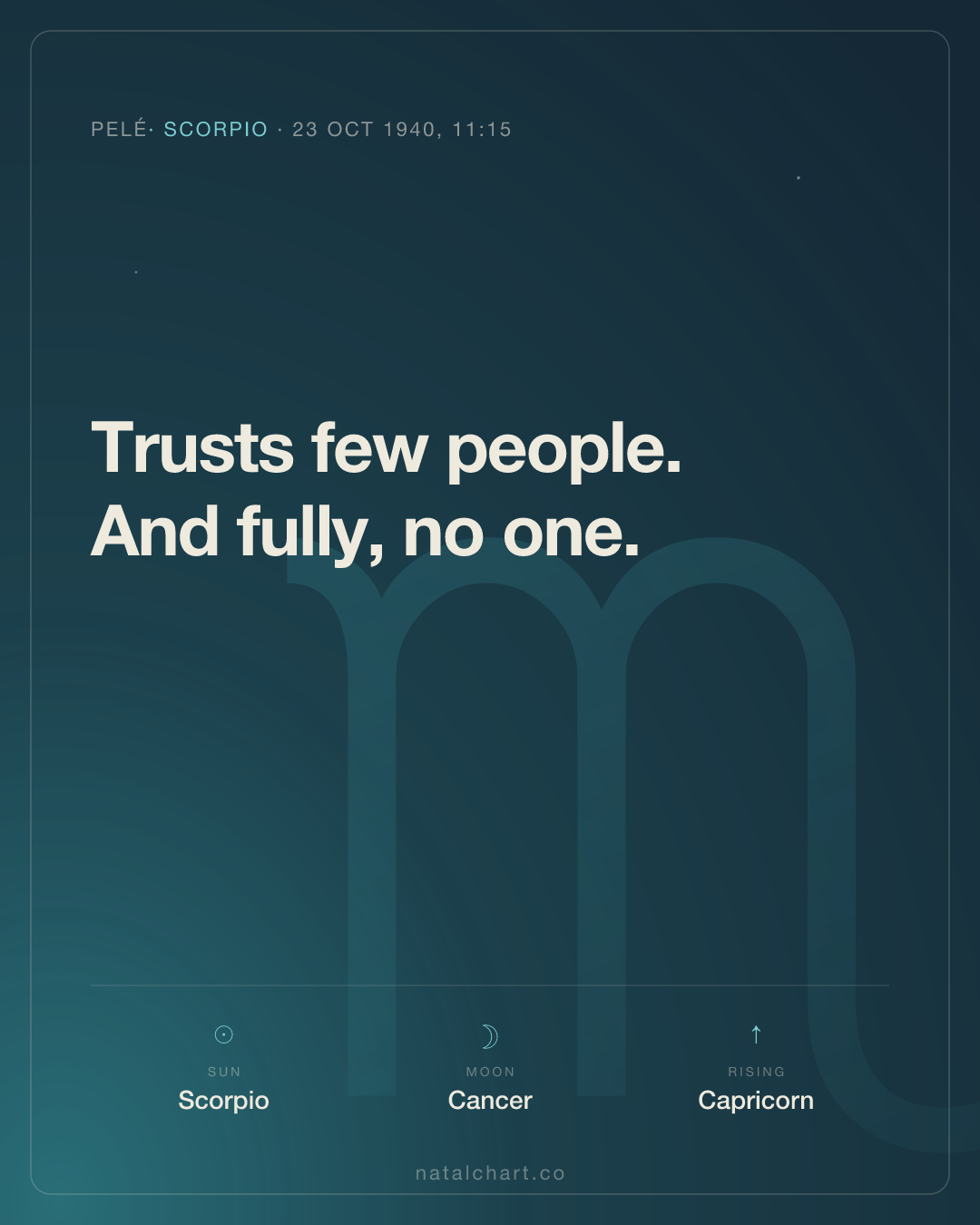
What strikes anyone who watches footage of Pelé is the control under pressure — a player who could move with balletic precision through chaos, who never seemed rattled, who performed his most astonishing moves in World Cup finals with the calm of someone doing something completely ordinary. That quality is written in his Ascendant (the face he met the world with): Capricorn. The outer presentation was composed, hardworking, built for the long game. Capricorn rising brings an instinct for structure, for doing things the right way, for earning rather than inheriting. And Capricorn's ruler is Saturn — which in Pelé's chart sits in an extraordinary position, as we'll see.
Beneath that composed exterior, the Sun sits in Scorpio in the eleventh house — the zone of collective impact, of belonging to something larger than oneself. Scorpio is the sign that needs to go all the way, that finds the surface unsatisfying, that is drawn to what is hidden, difficult, or transformative. In Pelé, this translated into an almost frightening intensity of will. He did not merely win; he changed the meaning of football. The eleventh house amplifies this: Scorpio's drive did not serve personal glory alone — it channelled outward, toward the crowd, toward Brazil as an idea, toward a global audience that had never seen a footballer quite like him.
Mercury also sits in Scorpio in that eleventh house, joining the Sun. His mind worked the same way: penetrating, thorough, strategic. He read the game at a depth that most opponents simply couldn't match.
The Moon: The People Were His Emotional Ground
The Moon — the chart's signature of emotional life, instinct, and where a person truly needs to feel at home — sits in Cancer in the seventh house. Cancer is the Moon's own sign, which means it functions here with unusual depth and sensitivity. The seventh house is the zone of partnerships, one-to-one bonds, and — in the case of a public figure — the relationship with an audience.
Pelé's connection with the public was not performance; it was felt. The roar of the Maracanã, the love of Brazilian fans who called him simply O Rei — The King — was not something external to him. It nourished him. Moon in Cancer in the seventh means that the people, the crowd, the collective embrace of the fans was literally where he felt most at home. He wept openly when he scored in the 1970 World Cup final; he wept again in 1969 when he scored his thousandth career goal at the Maracanã. That emotional transparency was not weakness — it was his Moon doing exactly what it was built for.
The Moon forms an easy flow with Mercury (trine, 2.2°) and a harmonious angle with Venus (sextile, 2.7°), knitting his emotional intelligence with both his sharp thinking and his aesthetic values. He did not experience these as separate compartments. The beauty of a goal and the joy of the crowd arrived together.
Mercury: Seeing the Whole Field at Once
Mercury in Scorpio pulls against Uranus in Taurus (opposition, 1.0°) — one of the tightest aspects in the chart. This axis is worth sitting with. Mercury in Scorpio digs deep, seeks patterns, wants to understand how things are connected beneath the surface. Uranus in Taurus, pulling from the opposite direction, brings flashes of sudden disruption, the unexpected, the brilliant solution that seems to come from nowhere.
In football terms, this is the combination that produces genius: the deep strategic reading of the game (Scorpio Mercury) interrupted by lightning-quick improvisation (Uranus). The _ginga_, the elastic body feint, the overhead kick that nobody in the stadium saw coming — these are Uranus crossing the carefully prepared Scorpio plan. The tension between the two became the creative engine.
Venus: Craft, Service, and the Long Journey
Venus in Virgo in the ninth house speaks to what Pelé valued and how he expressed warmth and loyalty. Virgo refines, improves, disciplines — it is never satisfied with good enough. The ninth house is the zone of international reach, of travelling beyond one's origins, of the world stage. Venus here is the signature of someone who took his craft abroad and earned admiration through meticulous skill rather than spectacle alone.
At Santos, and later at the New York Cosmos, Pelé carried football to new continents. The Virgo quality in his loving of the game was evident in the relentless repetition — the hours of training, the precise technique honed to the point of inevitability. He was not flamboyant for its own sake. Every feint served a purpose.
Mars and the Midheaven: Grace at the Apex of Public Life
Mars sits in Libra in the tenth house — the house of career and public reputation — and the Midheaven (the chart's career and public point) is also in Libra. This alignment is precise and revealing. Mars, the planet of drive and action, is in its least aggressive expression in Libra: it channels ambition through balance, through aesthetic quality, through making things look easy when they are not. And the tenth house is exactly where this plays out publicly.
The result was a style of football that looked, to the uninitiated, almost effortless — a player who seemed to float, whose goals arrived through artistry as much as force. The Libra quality domesticated the raw Scorpio drive into something beautiful to watch. Pelé became not just a champion but a symbol of the sport at its highest level. His North Node (the chart's marker of life direction) is also in Libra — the whole trajectory of his life pulled toward harmony, balance, partnership, and public grace.
The Fifth House Stellium: Where Discipline and Genius Became Play
The most remarkable cluster in Pelé's chart sits in the fifth house, the zone of play, creativity, sport, and physical self-expression. Here we find three planets in almost exact alignment: Jupiter and Saturn joined at 0.2° — an extraordinarily tight bond — with Uranus only a degree further away. All three are in Taurus.
Jupiter expands, multiplies, brings luck and abundance. Saturn disciplines, restricts, demands mastery. Uranus shatters the ordinary and introduces the unpredictable. When all three occupy the same degree of the zodiac — all in the fifth house, the house of sport — the result is something unique: discipline (Saturn) applied to natural talent (Jupiter) exploding into genius (Uranus). The Taurus ground makes it physical, embodied, muscular.
This is the astrological signature of a once-in-a-generation athlete. Not just gifted, not just hardworking — but gifted and hardworking and capable of moments of brilliance that defied what anyone thought possible. Three World Cup wins. More than six hundred goals. The bicycle kick against Colombia in 1968, the dummy that didn't touch the ball against Uruguay in 1970 — these are fifth-house Taurus moments: physical, instinctive, jaw-dropping.
Saturn is the traditional ruler of Pelé's Capricorn Ascendant, which means this fifth-house triple conjunction is also the engine of his whole chart. The discipline that Saturn demanded in the house of play was not separate from who he was; it was the foundation of everything visible.
Pluto and Chiron: The Weight Beneath the Crown
Pluto in Leo in the eighth house, in tension with the Scorpio Sun (square, 4.3°), tells a story of profound internal confrontation with power, loss, and transformation. Pluto in the eighth house concerns itself with what cannot be seen: the underworld of grief, of what must die for something else to be born. Leo here gives it a quality of ego and legacy — the question of what endures, of what one leaves behind.
For Pelé, the public weight of being O Rei — The King — was immense. The eighth house is never comfortable territory; it is where the price of being exceptional becomes clear. He outlived friends, teammates, his own son Edinho's troubles. He watched football move on around him, watched the records he set become targets others pursued. The square between Sun and Pluto means that the drive for depth and transformation was not peaceful — it pressed.
Chiron (an old wound that, over time, can become a gift) also sits in Leo in the eighth house. The wound of being singular, of carrying a weight of expectation that no one fully shared, of being so defined by a role that the person beneath became hard to see — this was part of Pelé's life. In his later years, he spoke with unusual candour about loneliness, about the complexity of his legacy. The eighth house holds all of it: the glory and the cost of it.
The Outer Planets: Carrier of an Era
Uranus, Neptune, and Saturn together in the mid-century charts mark an entire generation. For Pelé, what is personal about this era is how it channelled through him. Neptune in Virgo in the ninth house is about a quiet, methodical dissolving of boundaries — in his case, the borders between nations and their relationship with football. He became a universal figure not through noise but through consistent, perfected craft (Virgo ninth) repeated on the world stage.
Lilith in Aries in the fourth house is a private signature: a fierce, untameable quality in his roots and home life, something raw and uncompromising in where he came from — Três Corações, poverty, the red soil of Minas Gerais — that never fully accommodated itself to the polished public image.
The Tightest Aspects: How the Chart Speaks
The Jupiter-Saturn conjunction at 0.2° is the closest bond in the chart, and its meaning is fundamental: expansion (Jupiter) and contraction (Saturn) operating as a single force. This is someone for whom greatness and discipline were never in conflict — they were the same thing. Every extraordinary achievement came from an extraordinary application of method. He could not have one without the other.
The Moon's easy flow with Mercury (trine) and harmonious angle with Venus (sextile) added emotional intelligence to the analytical Scorpio mind — he understood people, read rooms, knew how to carry himself in public life with grace. The Mercury opposition Uranus gave the sudden flashes. The Sun-Pluto tension gave the depth and the cost.
A Warm Closing: What the Chart Held
Pelé's chart is, in the end, the portrait of someone built at the intersection of extremes: Capricorn composure and Scorpio intensity, Jupiter's gift and Saturn's demand, the joy of the fifth house and the weight of the eighth. He was not a simple figure, and the chart does not suggest one.
What it does suggest is a person who carried something very large — a country's longing, a sport's possibility, a generation's hope — and carried it with more grace than the weight perhaps deserved. The Moon in Cancer in the seventh house means he felt all of that love, genuinely. The triple conjunction in the fifth house means he gave back in kind: through the body, through the craft, through six hundred goals that still draw people back to watch.
He died on December 29, 2022, at eighty-two, having seen himself become a myth while still alive. The Scorpio Sun does not fear the deep things — it is native to them. And the Capricorn Ascendant, to the last, kept the composure.
The chart
How to read it →Frequently asked questions
What is Pelé's zodiac sign?
Pelé's Sun sign is Scorpio — the Sun was in Scorpio at birth (1940).
What is Pelé's moon sign?
Pelé has the Moon in Cancer. The Moon sign describes the emotional and instinctive layer of the chart.
What is Pelé's rising sign?
Pelé's rising sign (ascendant) is Capricorn — the sign on the eastern horizon at the moment of birth.
When and where was Pelé born?
Pelé was born in 1940 in Três Corações, Brazil.