Milton Nascimento — natal chart
What does Milton Nascimento’s natal chart reveal?
Brazilian singer and composer born in 1942. Raised in Três Pontas, he led the Clube da Esquina with Lô Borges in the 1970s. His falsetto voice and songs such as Travessia and Maria Maria shaped MPB. Winner of five Grammy Awards, including Best World Music Album.
 Share
Share
Birth
1942-10-26 · 21:00 · Rio de Janeiro Reliability: AA · vetted record
The core
Milton Nascimento sounds like no one else. That falsetto — ascending into registers most voices can't reach, carrying the weight of loss and joy simultaneously — is not a stylistic choice. It is the whole man rendered in sound. His chart opens with a first house stacked three deep in Gemini: Moon, Saturn, and Uranus all rise together under a Gemini Ascendant. Three very different forces — emotional receptivity, structure, and the sudden electric impulse — compressed into the same face he presents to the world. The result is an artist who feels everything in real time (Moon), who builds what he feels into lasting form (Saturn), and who cannot stop reaching beyond what already exists (Uranus).
The Sun in Scorpio in the sixth house anchors the deeper interior. The sixth house is the house of craft, of daily work, of the patient discipline behind the visible result. Scorpio presses toward what is true even when it hurts. Milton spent years as a working musician in Três Pontas before the Clube da Esquina years gave him a wider stage — this Sun is entirely consistent with that: someone who does not perform the work but inhabits it, who sees the craft itself as the place where honesty lives.
The Moon and the way he hears
Moon joined to Uranus in Gemini, in the first house, is the signature of a mind that receives everything at once and reorganizes it into something unexpected. This pairing is tight — less than two degrees — and it explains why Clube da Esquina felt less like a musical movement and more like a discovery: a sudden, involuntary recognition of something that had always been there. Milton and Lô Borges and the others were not building a genre; they were finding a language that already existed in the space between bossa nova, progressive rock, and the folk memory of Minas Gerais.
The Moon in Gemini also picks up emotional information from the surrounding environment quickly and processes it fast. In live performance, this manifests as an almost uncanny responsiveness — the sense that Milton is reacting to something the audience hasn't fully felt yet.
Mercury and Venus: the fifth house
Mercury, Venus, and Mars are all in Libra in the fifth house — a concentration of three personal planets in the house of creative expression, in the sign of balance, beauty, and the search for harmony. Mercury in Libra weighs its words with care; it does not rush to a conclusion but seeks the phrase that holds the fullness of what is felt. This is the Mercury of Travessia — a lyric that moves slowly through its subject, never overstating, finding the weight of absence in the spaces between words.
Venus here works in easy flow with Jupiter in Cancer in the second house, a warm connection between the love of beauty and a generous, rooted emotional nature. Milton's music carries this: it is generous music, music that opens rather than closes, music that seems to want to include rather than impress. The concentration of planets in the fifth house means the creative act itself — the making — is where life is most fully lived.
Mars and the power to move
Mars in Libra sits close to Venus, less than two degrees apart. Mars in Libra does not assert by force — it asserts through beauty, through the form that is so right it becomes impossible to argue with. The tension in this Mars is between the desire to act and the desire to maintain harmony: it is not a warrior's Mars but a craftsman's Mars, one that pours its drive into the making of something that holds.
Mars pulls against Jupiter in Cancer — just over a degree of separation — and this is a tension worth naming. Mars in Libra wants precision and restraint; Jupiter expands, reaches outward, takes on more than the container can hold. For Milton, this has been audible in the scale of his collaborations — working with Wayne Shorter, with Paul Simon, with Quincy Jones — projects that kept pulling toward a bigger sound, a wider audience, a more international conversation. The friction is productive: the desire to exceed is checked by the perfectionism that Mars in Libra imposes.
Jupiter, Saturn and the long architecture
Jupiter in Cancer in the second house places emotional generosity at the center of how resources are built and held. Cancer is the sign of home, roots, and memory — and Jupiter here expands all of those. The music of Clube da Esquina is inseparable from the geography of Minas Gerais, from the specific light and specific sadness of that interior landscape. Milton did not leave that behind when his career became international; he carried it with him, and it became the element that made his work recognizable anywhere in the world.
Saturn in Gemini in the first house — together with the Moon and Uranus — means the structures Milton builds are built in language, in sound, in the precise arrangement of notes and words. Saturn in Gemini is exacting about communication: it does not allow vagueness to pass. This is consistent with the reputation his collaborators describe — an artist who knows exactly what he wants from a session, even when he is not the one doing the arranging.
The outer planets and the generation
Pluto in Leo in the third house, and Neptune in Libra in the fifth, give the wider context. Pluto in Leo speaks to a generation whose creative expression carried transformative force — not decorative but shaping, capable of moving people toward something they hadn't known they needed. The fifth-house Neptune in Libra reinforces the presence of idealized beauty at the center of the creative life: a Neptune that looks for the transcendent in aesthetic form, that hears music as something approaching the sacred without leaning on mystical vocabulary.
Uranus in easy flow with Neptune — less than three degrees apart — is a generational aspect, but its presence in the first and fifth houses personalizes it for Milton: the impulse toward radical originality and the pursuit of transcendent beauty were not in conflict but in alignment. That is what Clube da Esquina sounds like — something made in the moment when it suddenly became possible to do exactly that.
The Midheaven and the vocation
The Midheaven — the public and professional point of the chart, the place where a life's work becomes visible to the world — is in Pisces. Pisces dissolves boundaries. A vocation shaped by Pisces at the Midheaven is not about achievement in the conventional sense — it is about becoming a vessel, a point through which something larger moves. Milton's voice has always been described this way, as something that carries more than one person should be able to carry alone.
The North Node in Virgo — the North Node being the direction of growth the chart points toward — speaks to craft as the vehicle for that larger movement: the growth edge has always been toward precision, toward service, toward making the work good enough to hold what it needs to hold. The South Node in Pisces is the tendency to dissolve, to merge, to lose the edges. The call has been toward Virgo, toward the discipline that makes the dissolution possible without losing the form.
Chiron: the wound that becomes the gift
Chiron — the old wound that, once acknowledged, becomes something useful to others — sits in Leo in the third house. Leo in the third house is the need to be heard, to have one's voice count in the conversation. A wound here can manifest as an early sense of invisibility, of speaking and not being registered. Milton was orphaned young and raised by an adoptive family; the voice that came from that experience was not built on easy ground. What emerged from it — a voice of extraordinary reach and emotional weight — is the Chiron transformation: the wound that became the instrument.
Lilith and the root
Lilith — a point associated with what refuses to be domesticated, what insists on its own terms — sits in Cancer in the second house, close to Jupiter. The second house governs resources, what one values, the material ground of a life. Lilith in Cancer carries something untamed in the relationship to roots — a refusal to let the idea of home be tidied into sentimentality. Milton's engagement with the history and politics of Brazil has never been comfortable or decorative. Maria Maria, composed with Fernando Brant and performed with Elis Regina in 1978, is a Lilith-in-Cancer song: a fierce, unromanticized account of what ordinary Brazilian women carry through their lives.
The thread through everything
What holds this chart together is the distance between its two poles: the Scorpio Sun in the sixth house — silent, patient, digging in the dark for what is true — and the Gemini first house, which broadcasts everything it receives and cannot help but turn the internal into the external in real time. Milton has spent a career in the space between those two impulses: going deep to find the real thing, then finding the exact sound that carries it up and out into the room. The five Grammy Awards and the decades of collaboration with the finest musicians of his generation are not the point; they are the evidence. The point is what happens in the room when that falsetto opens up — the feeling that something private and true has just been made available to everyone at the same time.
The chart
How to read it →Frequently asked questions
What is Milton Nascimento's zodiac sign?
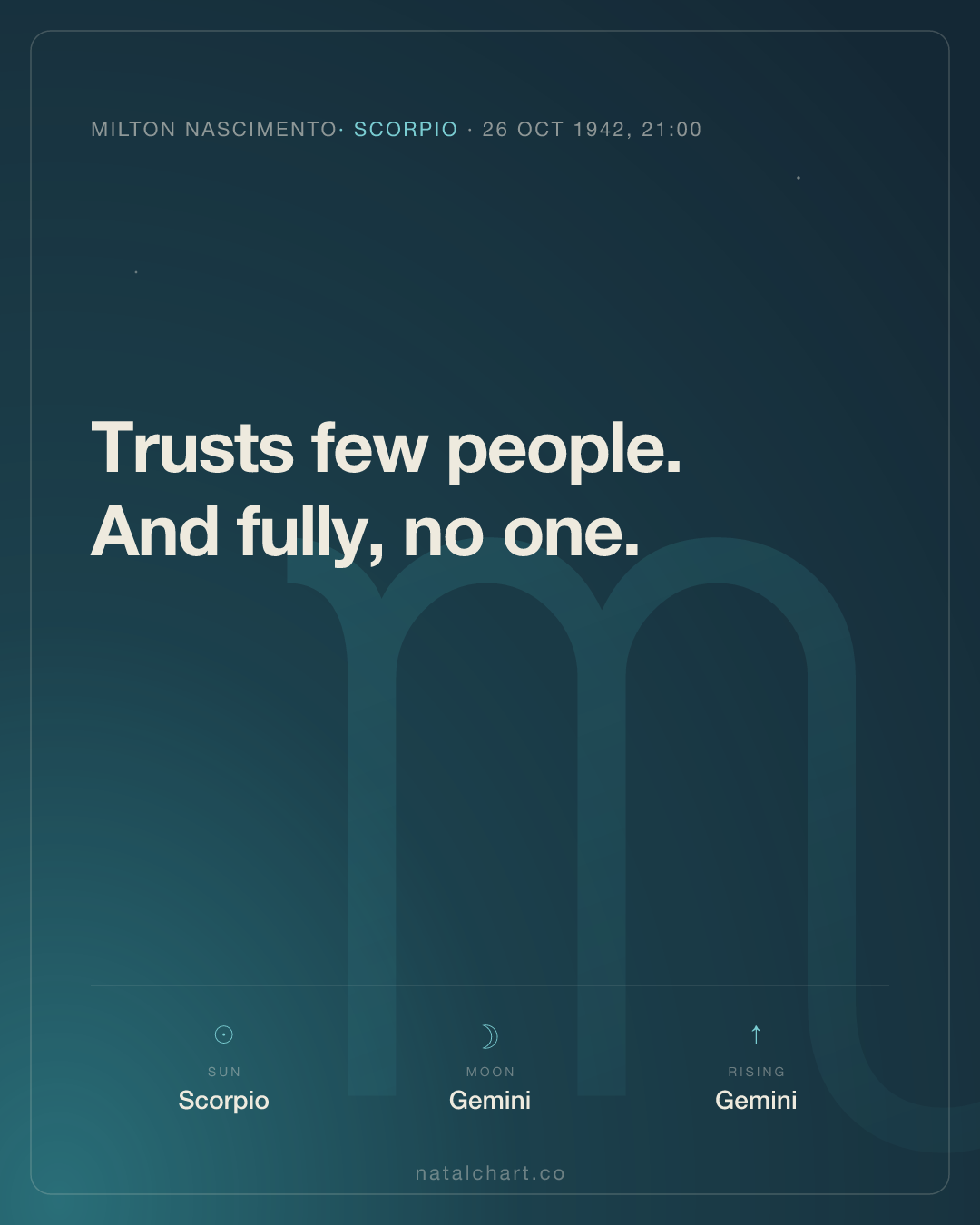
Milton Nascimento's Sun sign is Scorpio — the Sun was in Scorpio at birth (1942).
What is Milton Nascimento's moon sign?
Milton Nascimento has the Moon in Gemini. The Moon sign describes the emotional and instinctive layer of the chart.
What is Milton Nascimento's rising sign?
Milton Nascimento's rising sign (ascendant) is Gemini — the sign on the eastern horizon at the moment of birth.
When and where was Milton Nascimento born?
Milton Nascimento was born in 1942 in Rio de Janeiro.