Carl Sagan — natal chart
What does Carl Sagan’s natal chart reveal?
American astronomer and science communicator. Presenter and co-author of the Cosmos series (1980). Author of Contact (1985) and The Demon-Haunted World (1995). NASA adviser on Mariner, Viking and Voyager missions. Died in 1996 at 62.
 Share
Share
Birth
1934-11-09 · 17:05 · Brooklyn, New York Reliability: A · reliable data
The Pattern That Runs Everything
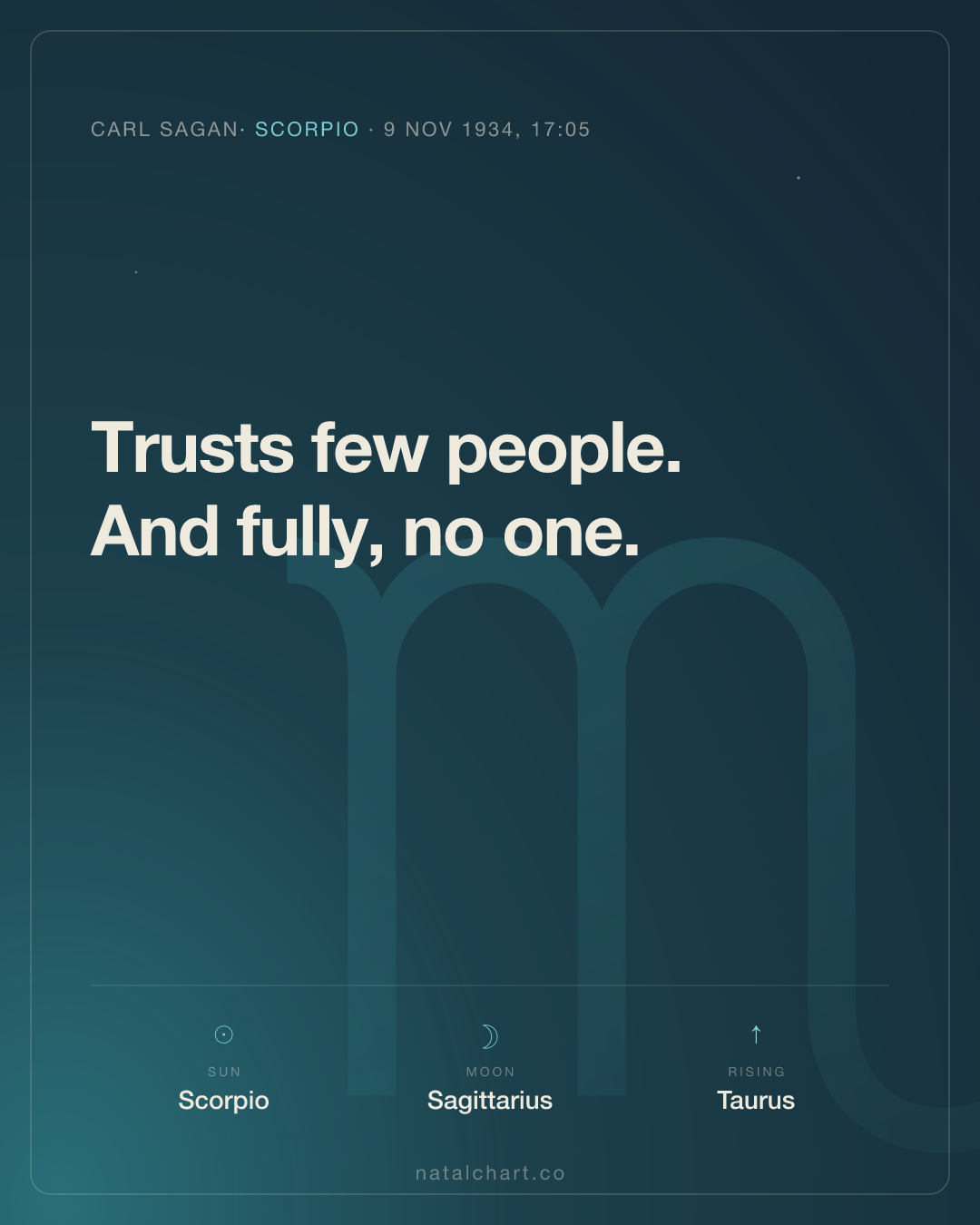
Carl Sagan carries four personal planets — Sun, Mercury, Venus, Jupiter — all gathered in Scorpio in the seventh house, the house of dialogue, of the other, of relationship. In most charts, Scorpio functions as a private, self-contained sign. Here it operates entirely outward: toward the audience, toward the conversation, toward the person on the other side of the question. The effect is a mind that does not just accumulate knowledge but needs to share it, test it, make it live in contact with another person. Every book Sagan wrote, every episode of Cosmos he presented, every congressional hearing where he argued for science funding — these were not performances. They were a Scorpio stellium doing what it was built for: going all the way in, with someone else.
The Way He Came Across
Taurus rises on the Ascendant — the Ascendant is the face someone meets the world with, the impression left before anything is explained. Taurus gives patience, solidity, a quality of presence that does not rush. In Sagan this showed in the famous cadence: the long pauses, the measured delivery, the willingness to let a big idea breathe before moving on. Where other scientists grew impatient with the uninitiated, Sagan sat down and waited for comprehension to arrive. That was the Taurus Ascendant — reliable, unhurried, trustworthy.
The Emotional Life
The Moon sits in Sagittarius in the eighth house — the house that deals with what is hidden, with depth, with the questions that do not resolve easily. A Sagittarius Moon is restless for meaning, uncomfortable with any answer that closes too soon. It needs the horizon to keep receding. Sagan's grief at scientific illiteracy, his almost physical discomfort at pseudoscience and superstition, is right here: the Moon in Sagittarius experiences the failure to ask real questions as a genuine loss, not an abstract problem. The eighth house placement adds weight — this is a Moon that understands mortality, that has thought about what it means to be briefly alive in a vast universe.
Mind and Communication
Mercury joined with Jupiter in Scorpio describes a mind that thinks in large, connected systems. Jupiter amplifies everything it touches; in Scorpio, it amplifies depth, the drive to find what is underneath the visible layer. Mercury alone in Scorpio is precise and probing; Mercury joined with Jupiter becomes something more: a capacity to hold a vast intellectual architecture together and still move between the micro and the macro without losing the thread. Sagan could explain the carbon cycle to a ten-year-old and then pivot to the geopolitical implications of nuclear winter in the same breath. That flexibility is the conjunction.
Love and Values
Venus in Scorpio in the seventh house, in close easy flow with both Neptune and Mars, describes someone whose affection is total and whose aesthetic sense is tuned to depth rather than surface. The connection between Venus and Neptune — Neptune softens and poeticizes whatever it touches — shows up in Sagan's writing: The Demon-Haunted World is rigorous science writing, but it reads like someone who loves the material with the same intensity a poet loves language. The warmth was genuine and it was productive — it drove the writing.
Drive and Precision
Mars in Virgo, joined with Neptune, in the fifth house — the house of creation, of making things — describes a working method built on meticulous preparation. Virgo asks for precision; Neptune dissolves hard edges and opens toward imagination. Together they produce the kind of work Sagan did: the scientific rigour was absolute, but the result was also art. The Voyager Golden Record, which Sagan helped curate, is a perfect expression of this combination — exacting in its science, poetic in its intention.
Vocation: The Public Intellectual
The Midheaven — the public and career point of a chart — is in Aquarius, with Saturn placed there as well. Saturn in Aquarius in the tenth house is one of the most direct signatures of the public intellectual: disciplined, systematic, committed to the long view, oriented toward collective progress rather than personal advancement. Sagan spent decades on NASA advisory boards, not for the salary or the fame — Saturn in Aquarius in the tenth asks for structural, long-term contribution. He was not building a brand; he was building a case.
The North Node: Where Growth Points
The North Node in Aquarius — the North Node is the direction of growth in a life, the quality that develops over time rather than arriving ready-made — reinforces the Midheaven signature. Sagan was, in some ways, becoming more Aquarian as he aged: more committed to the collective, less interested in individual recognition. The Demon-Haunted World, written in his final years, is the most explicitly civic of his books — a sustained argument for why scientific thinking is not just personally enriching but politically necessary.
The Tightest Aspect: Feeling and Structure
The tightest aspect in Sagan's chart is the Moon in easy flow with Saturn — separated by just a fraction of a degree. This combination describes emotional life that is organised rather than raw, grief that is processed rather than displayed, feeling that runs deeper than it shows on the surface. Sagan was not a cold man — anyone who watched Cosmos knows this — but his emotional responses were structured. When he talked about the pale blue dot, the emotion was real and it was contained. That is the Moon-Saturn combination working exactly as it does.
Chiron: The Gift in the Wound
Chiron — the old wound that becomes a source of teaching — sits in Gemini in the second house, the house of resources and worth. Gemini governs communication, language, the act of translating between registers. Sagan grew up in Brooklyn, the child of working-class Ukrainian and Belarusian Jewish immigrants, in a world where the gap between his hunger for knowledge and the tools available to feed it was enormous. That gap — the wound of not having the vocabulary yet, of reaching for something not yet nameable — became the engine of his life's work. He spent fifty years building the bridge between scientific knowledge and the wider public, because he had been on the other side of that bridge himself.
The Warmth Beneath the Science
Sun joined with Venus in Scorpio in the seventh house closes the portrait with something easy to miss: Sagan was, at his core, a person in love with the world and with the people in it. The joining of Sun and Venus is warmth, affection, a genuine delight in beauty and in the other. In Scorpio it runs deep and does not announce itself. It shows up not in charm but in commitment — in the forty-year partnership with Ann Druyan, in the care with which he wrote for audiences who might never have opened a science book, in the extraordinary decision to turn Cosmos into a letter of love to the universe rather than a lecture about it. That warmth was not incidental to the science. It was the reason the science reached anyone at all.
The chart
How to read it →Frequently asked questions
What is Carl Sagan's zodiac sign?
Carl Sagan's Sun sign is Scorpio — the Sun was in Scorpio at birth (1934).
What is Carl Sagan's moon sign?
Carl Sagan has the Moon in Sagittarius. The Moon sign describes the emotional and instinctive layer of the chart.
What is Carl Sagan's rising sign?
Carl Sagan's rising sign (ascendant) is Taurus — the sign on the eastern horizon at the moment of birth.
When and where was Carl Sagan born?
Carl Sagan was born in 1934 in Brooklyn, New York.