Albert Einstein — natal chart
What does Albert Einstein’s natal chart reveal?
Albert Einstein, born on March 14, 1879, in Ulm, Germany, was a theoretical physicist whose contributions fundamentally altered the understanding of nature. His 1905 papers introduced the special theory of relativity and the equivalence of mass and energy expressed in the equation E=mc². His general theory of relativity (1915) redefined the concept of gravity. He was awarded the Nobel Prize in Physics in 1921 for his discovery of the photoelectric effect. Einstein fled Nazi Germany in 1933 and spent his final years at the Institute for Advanced Study in Princeton, where he died on April 18, 1955.
 Share
Share
Birth
1879-03-14 · 11:30 · Ulm, Germany Reliability: AA · vetted record
The Mind That Swam in Deep Water
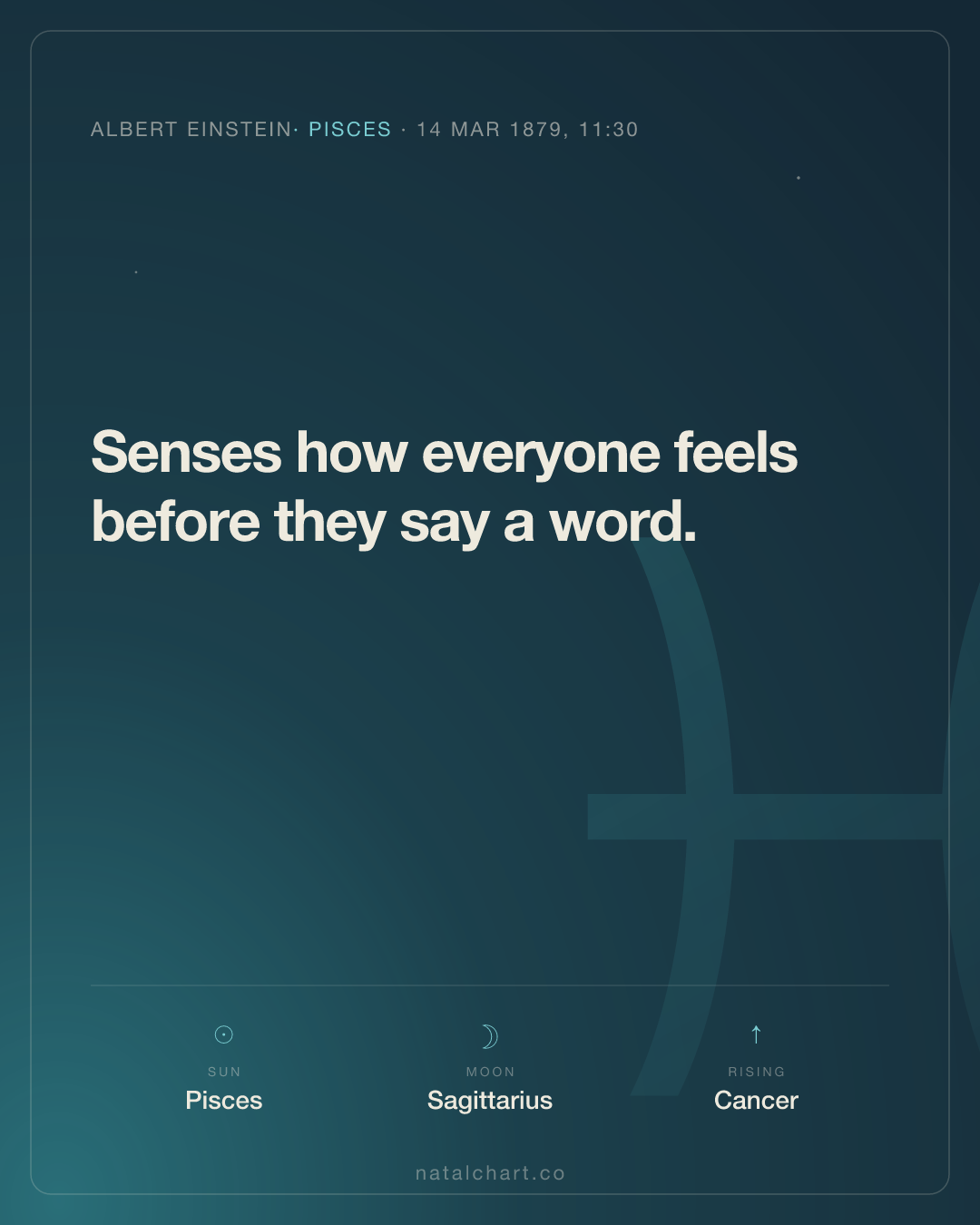
Albert Einstein thought the way a swimmer crosses an ocean — not by forcing the water but by moving with its currents, following the pull of something that couldn't quite be named yet. His Sun in Pisces, placed in the ninth house of philosophy and far horizons, is the single most clarifying fact about him as a thinker: he was not, at root, a calculator. He was an imaginer. The famous thought experiments — riding alongside a beam of light, standing inside a falling elevator — came before the equations, not after. The chart confirms what he himself said: imagination matters more than knowledge.
The Ascendant (the face a person meets the world with) is Cancer: cautious at the edges, guarded with strangers, but capable of deep loyalty once trust is established. Einstein was notoriously private about his emotional life, dismissive of public formalities, genuinely warm with a small circle of colleagues and friends. He once said he had a remarkable ability to detach himself from his surroundings and immerse himself in a problem — which is exactly what a Cancer Ascendant protecting a Pisces Sun does: it keeps the world at arm's length so the inner work can go on undisturbed.
The Emotional Interior
The Moon — the emotional private self — sits in Sagittarius in the sixth house, the house of daily work and health. A Sagittarius Moon moves through feeling the way it moves through ideas: restlessly, always testing the edge of the available territory. Sustained grief or deep emotional stasis was genuinely difficult; what this Moon craves is the feeling of forward motion, of an open horizon. This explains the extraordinary productivity of Einstein's middle years, his relentless correspondence, his tendency to leap from problem to problem. But it also explains why he could seem emotionally unreachable in his intimate relationships — not cold, exactly, but always moving, always somewhere ahead of where he was.
The Moon sits in a gentle flowing connection with Venus (orb 2.6°), which smoothed some of the Sagittarius restlessness into genuine warmth and a real love of music — Einstein's violin playing was well-documented, and he often said that if he hadn't become a physicist he would have been a musician. That Moon-Venus connection is the source of that softer claim.
Mercury, Saturn, and the Burden of Precision
Mercury in Aries in the tenth house, joined to Saturn in Aries (the tightest aspect in the chart, just 1.1° apart), tells the story of Einstein's mind with painful accuracy. Mercury represents how a person thinks and communicates; Saturn represents discipline, difficulty, and the weight of getting things exactly right. Together in the tenth house — the house of public work and reputation — they describe a thinker who was simultaneously audacious and rigorous: bold enough to challenge Newton, methodical enough to spend a decade refining the mathematics of general relativity before publishing.
But Mercury conjunct Saturn in Aries also carried a personal cost. Einstein was a late talker as a child and had difficulty with rote learning and institutional schooling — he famously failed the entrance examination to the Swiss Federal Polytechnic on his first attempt. The Saturn weight on Mercury is not a block; it is a demand for depth that makes quick, surface-level acquisition feel genuinely impossible. What eventually comes out on the other side is not ordinary facility but something much harder-won and more durable.
Venus, Aries, and What He Loved
Venus in Aries in the tenth house places what Einstein valued — clarity, directness, the thrill of the new — squarely in the domain of public work. He was not a man who separated his passions from his science: he loved physics the way one loves a person, with urgency and without reservation. His letters to colleagues pulse with the same excitement as his letters to friends. The Aries quality here is important: he did not love problems that were already half-solved. He needed the frontier, the place where the existing framework broke down.
This Venus in Aries also shows in his willingness to be publicly wrong. He famously resisted quantum mechanics despite having helped launch it, spending his later years at Princeton arguing with the field's leading figures. That stubbornness is also Aries: loving the fight, loving the directness of a challenge, even when the challenge is ultimately not won.
Mars and the Architecture of Patience
Mars in Capricorn in the seventh house — the house of partners, collaborators, and public adversaries — describes how Einstein directed his will and ambition in relation to others. Mars in Capricorn is perhaps the most controlled expression of Mars: it is not reckless; it builds, it plans, it does not spend resources carelessly. In the seventh house, this plays out in the collaborations that defined Einstein's working life: Marcel Grossmann on the mathematics of general relativity; Niels Bohr in the long public argument about quantum mechanics. These were not casual associations — they were serious engagements, carried on over years with full intellectual commitment on both sides.
Mars forms an easy flowing connection with Pluto (orb 2.2°), adding staying power and the ability to work at depth on problems that most people would abandon. The 1905 papers — four of them, published in a single year while Einstein was working as a patent clerk in Bern — are the lived expression of Mars-Pluto: an almost underground accumulation of work that breaks surface all at once with transformative force.
Jupiter, Aquarius, and the Wider Vision
Jupiter in Aquarius in the eighth house, pulling against Uranus (orb 3.8°), marks the part of Einstein that thought beyond the individual and beyond the present. Jupiter in Aquarius moves naturally toward the collective, toward principles that apply not just to one person or one nation but to everyone. This was the Jupiter behind Einstein's lifelong pacifism, his public advocacy against nuclear weapons after Hiroshima, his letter to President Roosevelt that helped initiate the Manhattan Project — and the anguish that followed when he understood what he had helped set in motion.
The tension with Uranus (which sits in Virgo in the third house, the house of communication and immediate environment) kept that Aquarian idealism from becoming impractical abstraction. Uranus in Virgo demanded precision, attention to detail, the factual specificity that distinguished Einstein's political writing from mere idealism. He didn't just sign petitions; he wrote carefully, documented carefully, and remained accountable for his positions in a way that the Jupiter-alone placement might not have demanded.
The Midheaven: A Vocation Written in the Sky
The Midheaven — the public and professional point of the chart — is in Pisces, the same sign as the Sun. When the Midheaven and the Sun share a sign, the private identity and the public vocation are unusually aligned: what a person is at their deepest, they also become in the world's eyes. For Einstein, being a physicist was not a career he had chosen over other options — it was an identity. The Piscean quality of the Midheaven suggests that this public role carried a certain dissolution of boundaries: Einstein didn't just work on physics; he became, in the cultural imagination, almost synonymous with science itself.
The Nobel Prize in 1921, for the photoelectric effect rather than relativity, was an irony that fits the Midheaven perfectly: the public recognition arrived for work that was important but not the work he considered most central to himself. Pisces Midheaven does not always receive recognition for what it believes matters most.
Chiron and the Wound Behind the Method
Chiron — an old wound that can become a gift when it is no longer denied — sits in Aries in the tenth house, alongside Mercury and Saturn. Chiron in Aries carries a wound around assertion, around the right to occupy space and push forward with one's own view. For Einstein, this showed most clearly in the years of professional rejection: the failed polytechnic entrance exam, the difficulty finding an academic post after graduation, the years of the patent office that could easily have been read as exile. He was not recognized quickly or easily, and the wound of that slow start — the sense of being on the outside of the institutions that should have claimed him — never entirely left.
The gift of Chiron in Aries maturing through the tenth house is the capacity to eventually claim that public space with unusual authority, without arrogance, because the path to it was never simple. The care Einstein showed for young physicists later in his career — his accessibility, his willingness to engage with their ideas — is Chiron doing its softer work.
A Warm Closing
Albert Einstein's chart is, at its core, the chart of someone who never quite fit — not in school, not in institutions, not in a single country — and who found in that perpetual outsider position not only the freedom to think differently but the necessity of it. The Sun in Pisces kept the imagination fluid; the Mercury-Saturn discipline gave it form; the Cancer Ascendant protected the inner life long enough for the work to ripen. What the world received, eventually, was not the output of a system that rewarded him early and encouraged him consistently — it was the output of a mind that had to find its own way through, and that in doing so changed the terrain for everyone who came after.
The chart
How to read it →Frequently asked questions
What is Albert Einstein's zodiac sign?
Albert Einstein's Sun sign is Pisces — the Sun was in Pisces at birth (1879).
What is Albert Einstein's moon sign?
Albert Einstein has the Moon in Sagittarius. The Moon sign describes the emotional and instinctive layer of the chart.
What is Albert Einstein's rising sign?
Albert Einstein's rising sign (ascendant) is Cancer — the sign on the eastern horizon at the moment of birth.
When and where was Albert Einstein born?
Albert Einstein was born in 1879 in Ulm, Germany.