Elizabeth Taylor — natal chart
What does Elizabeth Taylor’s natal chart reveal?
British-American actress. Two Oscars: BUtterfield 8 (1960) and Who's Afraid of Virginia Woolf? (1966). Starred in Cleopatra (1963) and Giant (1956). Eight marriages. Pioneer HIV/AIDS activist. Died in 2011 at 79.
 Share
Share
Birth
1932-02-27 · 02:30 · London, United Kingdom Reliability: AA · vetted record
The Core: Water Depth Behind a Fiery Face
Elizabeth Taylor met the world through a Sagittarius Ascendant — the face she turned outward was expansive, bold, and impossible to ignore. But the real architecture of her character sat elsewhere: the Sun, Mercury, and Mars all gathered in Pisces in the fourth house, the most private corner of the chart. She felt everything more intensely than she showed, and what looked like spectacle to the outside world was, at its source, the overflow of a profoundly internal life. The Sagittarius rising gave her the candor and the scale — the violet eyes were the advertisement — but the Pisces stellium was the manuscript.
The fourth house (the house of roots, private life, and what one carries inside) holding three planets in a sign ruled by boundless Neptune creates someone whose home life and inner world are never quite separable from the larger story they inhabit. Taylor's private self — her losses, her loves, her illnesses, the sheer weight of years of public scrutiny — was the raw material her best work drew from. In Who's Afraid of Virginia Woolf? she didn't perform Martha so much as let something real and lived surface on screen. That performance, which earned her second Oscar in 1966, had the specific weight of a woman who had actually inhabited extremity.
Moon in Scorpio: The Interior Nobody Saw
The Moon in Scorpio in the twelfth house describes an emotional life lived largely out of sight. The twelfth house is the part of the chart that stays behind closed doors — what one processes in private, what rarely makes it into public language. Scorpio here means those private feelings run deep, run still, and run with considerable force. Taylor was famous for her passions and her marriages — eight of them — but the chart suggests the version she lived internally was always more intense than anything visible from outside.
Moon in Scorpio in hard tension with Jupiter in Leo (pulling against each other across the chart) describes the battle between containment and excess, between keeping things close and letting them burst outward. This is a push-pull that played through her whole adult life: the capacity for fierce privacy alongside the spectacular public life, the desire for genuine intimacy alongside the almost mythological scale of her romantic history.
Mercury in Pisces: How She Thought and Spoke
Mercury (the planet governing mind, speech, and communication) in Pisces sat joined with the Sun, giving her thinking and her identity an almost indistinguishable quality — she thought in images, in feeling-tones, not in analytical categories. This is the mind of the actress rather than the lawyer: absorptive, impressionistic, gifted at reading a room or a character from the inside out. Pisces Mercury rarely produces precision but frequently produces resonance, and the quality most often cited by directors and co-stars across her career was exactly that — a quality of presence that felt true rather than performed.
Mercury pulling against Neptune across the chart (the planet of dissolution and imagination) sharpens this: her mental world had a slightly porous boundary between what was real and what was felt, between what she knew and what she intuited. In art, that is a gift. In ordinary life, it asks more of the people alongside her.
Venus in Aries: How She Loved
Venus in Aries in the fifth house (the house of pleasure, performance, and bold self-expression) describes a way of loving that is direct, impatient, and immediate — someone who falls fast and fully, who does not easily sustain a slow courtship. This placement would already be striking on its own. But Venus here is joined with Uranus at an almost exact distance, one of the tightest connections in the chart — and Uranus represents rupture, the unexpected, the turn that nobody saw coming.
Venus joined with Uranus this closely describes love that arrives and departs in the same electric register: intense, transformative, and resistant to the ordinary rhythms of settled partnership. Eight marriages across a lifetime is not a statistic to mock — it is the biography of someone who kept believing in love completely and kept showing up for it, even when it hurt. The Taylor-Burton story, in particular — the marriage, the divorce, the remarriage — has the exact quality of Venus-Uranus written large: compulsive, electric, unable to resolve into something quiet.
Venus also pulls against Pluto (the planet of deep transformation and intensity), which adds another layer: her experience of love was rarely comfortable or simple, but it was almost always transformative.
Mars in Pisces: The Drive Behind the Camera
Mars (the planet of will, drive, and action) in Pisces in the fourth house is a quieter Mars than the popular image of Taylor might suggest. Pisces Mars does not charge forward; it moves by absorption, by intuition, by something closer to surrender than force. In acting terms, this is the muscle behind the method — a willingness to dissolve into a character rather than impose oneself on it. The camera found her partly because she let it.
Mars in Pisces also describes someone whose physical courage runs through emotional rather than physical territory — less the warrior, more the person who walks into something difficult because turning away would feel worse.
Jupiter and Saturn: The Scale of Things
Jupiter in Leo in the ninth house (the house of beliefs, travel, and the wider world) speaks to the scale on which Taylor operated. Leo here wants large stages, real grandeur, genuine recognition — and the ninth house places that expansiveness in global contexts. Cleopatra (1963), which was at the time the most expensive film ever made, was not an accident of casting; it was a natural habitat for a Leo Jupiter in the ninth house. Jupiter in easy flow with Uranus (and with Venus) describes the particular combination of luck, boldness, and timing that meant her risks so often paid off in ways that confirmed her instinct to take them.
Saturn in Aquarius in the third house (the house of communication, local connections, and learning) describes a discipline that ran through her public voice and her organizational mind. Taylor's decades-long work founding amfAR and lobbying Congress directly for HIV/AIDS research funding from the early 1980s onward — at a time when few public figures would touch the subject — showed the Saturn in Aquarius quality precisely: structured, principled, institution-building work on behalf of a community that was being left to die. That work was not glamorous by the standards of her film career, but it was arguably the most durable thing she did.
Neptune on the Midheaven: The Public Myth
The Midheaven (the public and career point of the chart) in Libra sits close to Neptune in Virgo in the tenth house. Neptune near the career point almost always produces a public image that outgrows the real person — something mythological accumulates around the professional self. Elizabeth Taylor the icon, the most famous woman in the world for decades, the woman whose face appeared on more magazine covers than any other actress of her generation — that is Neptune at the career point, the image that becomes larger than life and somewhat disconnected from the person underneath it.
The Sun pulling against Neptune (0.7°) across the chart axis reinforces this: there is a structural tension between the Pisces self who simply wanted to work and love and be private, and the global myth that the public and the industry kept projecting onto her. That tension never fully resolved.
Chiron and the North Node: Where the Wound Becomes Work
Chiron (a marker in the chart for an old vulnerability that, over time, becomes a particular kind of knowing) sits in Taurus in the sixth house, the house of health, daily routine, and service. Taylor's documented medical history was long and serious — her health crises were not isolated events but an ongoing relationship with her own body across decades. The sixth house placement suggests that this ongoing negotiation with physical vulnerability was not incidental but central to her story, and that the work she did later in her life — as an activist, as someone who used her platform for service — was grown in part from that soil.
The North Node in Pisces points toward the same Pisces themes that dominate the chart: toward compassion, toward feeling rather than thinking one's way through the world, toward letting the boundaries between self and other become more permeable. For Taylor, the activism of her final decades — the intimacy she cultivated with people dying of AIDS at a moment when they were being treated as untouchable — reads as the most direct expression of that node.
A Life on Its Own Terms
Elizabeth Taylor's chart is not the chart of someone built for half-measures. The tight Venus-Uranus conjunction, the Scorpio Moon in the twelfth house, the Pisces stellium pressing against Neptune — these are not placements that produce a quiet life. They produce someone who lives at full volume in certain registers while remaining genuinely private in others, someone whose capacity for love and transformation kept renewing itself even when it should, by most calculations, have been spent.
What the chart makes clear is that the spectacle was never the point. The spectacle was the side effect of a person who simply refused to feel things at a manageable distance. In the work that will last — Martha in Virginia Woolf, the AIDS activism, the long human record of someone who kept showing up — that refusal reads not as excess but as a specific kind of courage.
The chart
How to read it →Frequently asked questions
What is Elizabeth Taylor's zodiac sign?
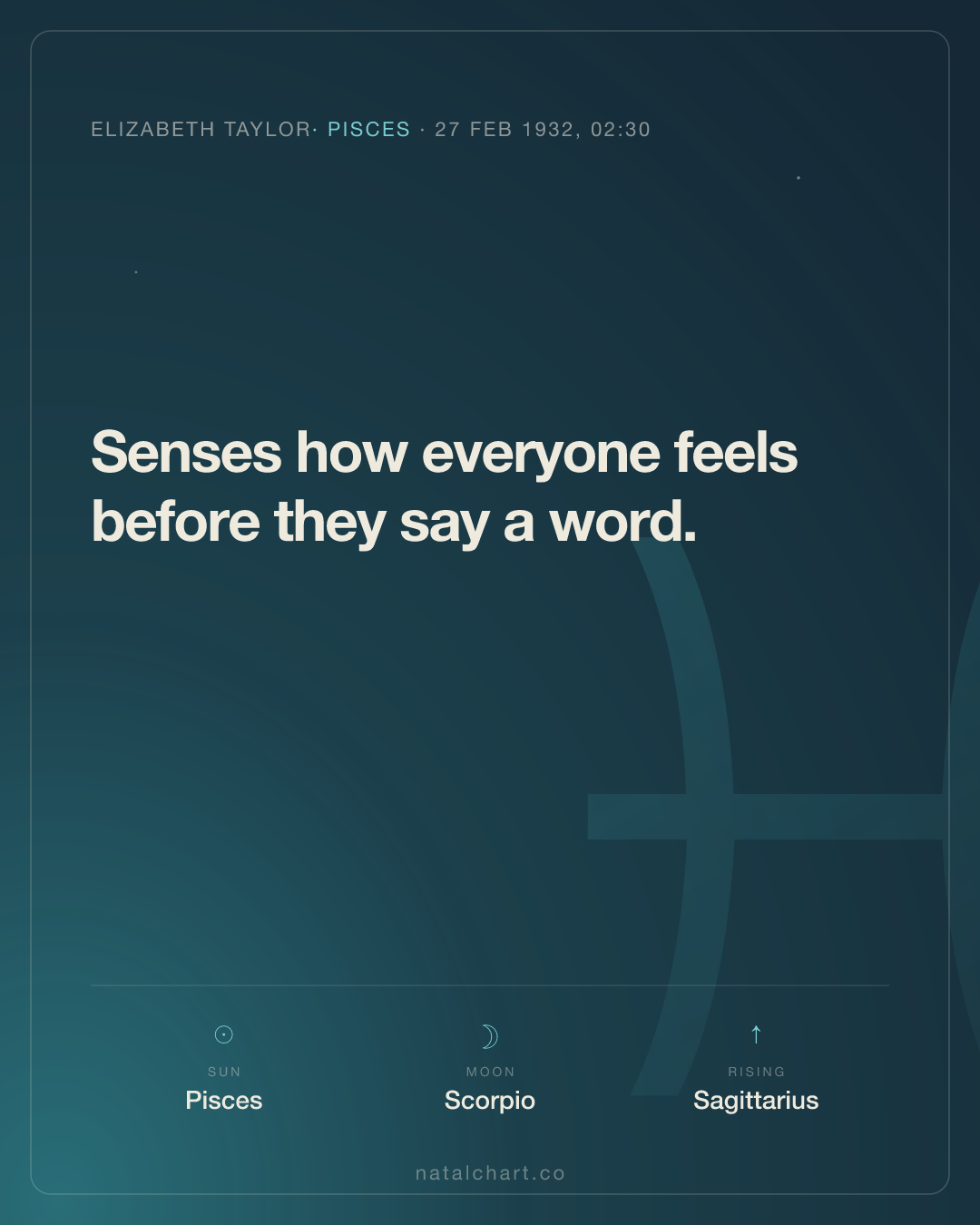
Elizabeth Taylor's Sun sign is Pisces — the Sun was in Pisces at birth (1932).
What is Elizabeth Taylor's moon sign?
Elizabeth Taylor has the Moon in Scorpio. The Moon sign describes the emotional and instinctive layer of the chart.
What is Elizabeth Taylor's rising sign?
Elizabeth Taylor's rising sign (ascendant) is Sagittarius — the sign on the eastern horizon at the moment of birth.
When and where was Elizabeth Taylor born?
Elizabeth Taylor was born in 1932 in London, United Kingdom.