Victor Hugo — natal chart
What does Victor Hugo’s natal chart reveal?
Victor Hugo (1802-1885) was a French poet, novelist, and dramatist of the Romantic movement and a towering figure in French literature. Author of Les Misérables and The Hunchback of Notre-Dame, he was also a political activist who championed social justice and republicanism.
 Share
Share
Birth
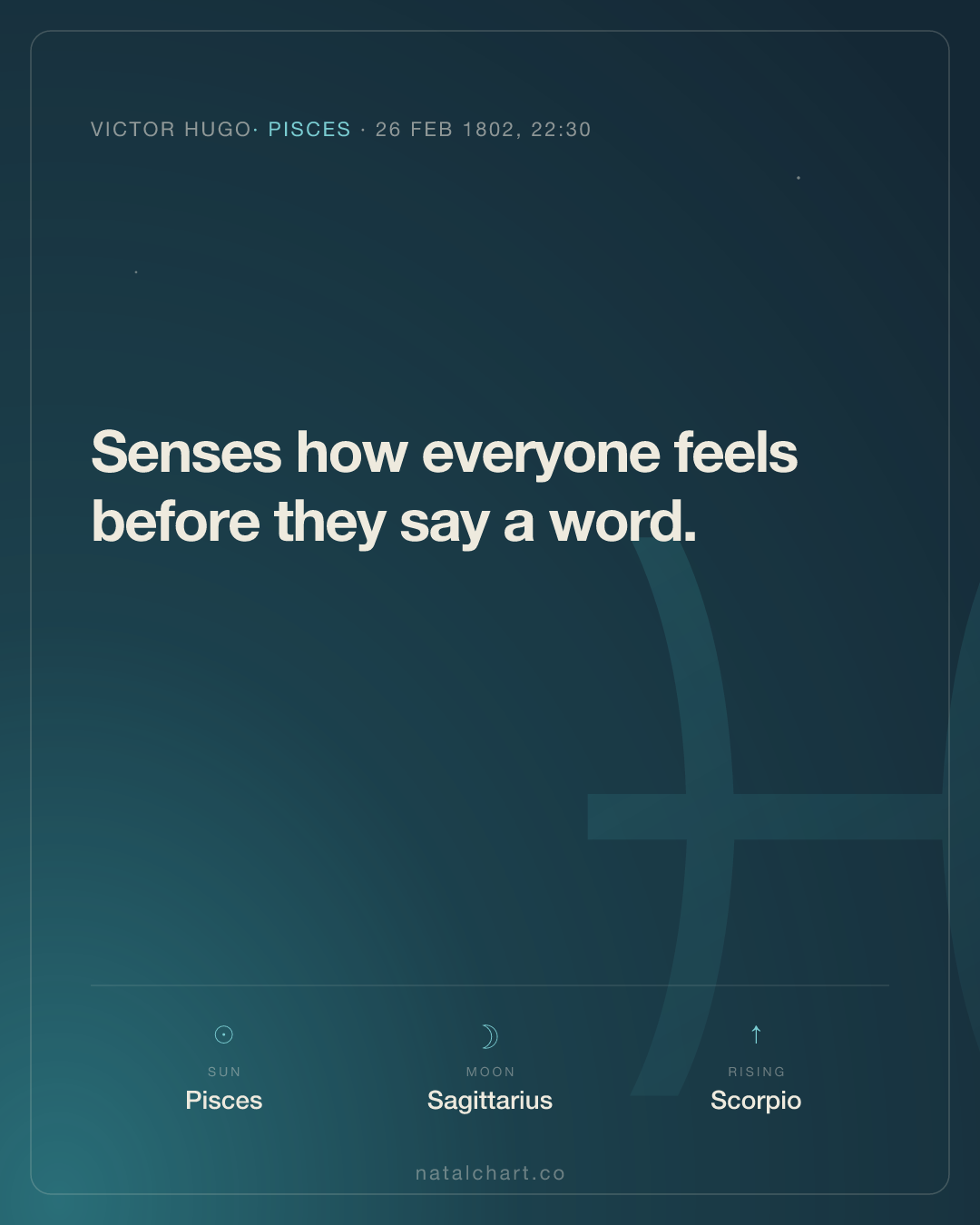
1802-02-26 · 22:30 · Besançon, France Reliability: AA · vetted record
The core: Pisces depth through a Scorpio mask
A Scorpio Ascendant — the face one meets the world with — announces something watchful, unflinching, and hard to dismiss. That was Victor Hugo to the life. Contemporaries described him as intimidating before he was warm, with a gaze that catalogued a room. Yet the chart underneath that exterior is overwhelmingly Pisces: the Sun, Mercury, Venus, and Pluto all gather in Pisces in the fifth house of creative expression, making compassion, boundlessness, and the vast suffering of ordinary people the true engine of his work. He was not an observer of misery from a safe distance. He was constitutionally porous to it — and he turned that porousness into Les Misérables.
Neptune sits right on the Ascendant in Scorpio, blurring the line between the brooding exterior and the oceanic interior. He had the presence of a force of nature and the sensitivity of someone who could not walk past a hungry child without it costing him something.
The Moon: restless belief, house of resources
The Moon in Sagittarius in the second house describes an emotional life driven by ideology. For Hugo, feeling and philosophy were inseparable — he did not simply write about the poor, he built a moral universe in which their suffering was an indictment of society. The Sagittarius Moon needs a cause as much as it needs air, and Hugo's cause — republican government, the abolition of the death penalty, the rights of the dispossessed — was not a political stance adopted late in life. It was his emotional home.
The second house placement gives this a material dimension: his convictions about justice were tied to real, embodied questions of bread, survival, and shelter. Cosette, Fantine, and the barricade boys of Les Misérables are not symbols. They are this Moon made flesh.
Mercury and the mind: visionary language
Mercury in Pisces in the fifth house does not produce crisp logical argument — it produces language that moves in great swells, that accumulates until the reader feels overwhelmed in the best possible sense. Hugo's prose style, which scandalized the classicists of his day, comes directly from here: the cathedral digression in Notre-Dame de Paris, the essay on the Paris sewers in Les Misérables that becomes a meditation on civilization itself.
The tightest aspect in the chart is the Moon pulling against Mercury at barely more than half a degree of separation. Feeling and expression were never quite at peace in Hugo. He was a man who wept at his own speeches — and then rewrote them three times before dawn.
Venus: love as loss, creation as compensation
Venus in Pisces in the fifth house is at its most compassionate and its most prone to idealization. Hugo loved without clear edges — his devotion to Juliette Drouet lasted fifty years, and his writing about women carries the same quality: Esmeralda, Fantine, Cosette are beloved with a grief-tinged tenderness that is always partly elegy.
Venus sitting opposite Saturn — pulling against that planet's demand for duty and restraint — describes a man for whom love and work were perpetually in competition. He was a father who buried two daughters and a son. He was a husband whose political exile separated him from his family for nineteen years on Guernsey. Venus also pulling against Jupiter in Leo suggests this same impulse toward love and beauty was linked to his enormous public ambition: he gave his grief to the page, and the page gave him France's love in return.
Mars: the rebel at home
Mars in Aquarius in the fourth house describes a man whose rebellious instinct was rooted in the private sphere — in family, in the conditions of domestic life, in what it means to have or not have a home. Hugo's republicanism was never abstract. He agitated for the poor because poverty had a face, and that face lived in houses — or didn't. The Aquarian Mars made him a reformer rather than a street-corner revolutionary: he wanted structural change through ideas, through legislation, through literature.
During his exile on Guernsey (1851–1870), forced out of France by Napoleon III's coup, this Mars in the fourth house expressed itself quite literally: he turned his house into a fortress of creative output, writing Les Misérables in the place that was simultaneously his refuge and his prison.
Jupiter and Saturn: fame tempered by severity
Jupiter in Leo sits directly at the Midheaven — the chart's public-reputation point — making the grandeur of Hugo's public life almost geometrically inevitable. He was buried in the Panthéon before 200,000 mourners. His portrait appeared on the fifty-franc note. France named streets, schools, and squares after him while he was still alive. Jupiter in Leo at the apex of the chart describes exactly this: the theatrical, generous, almost monarchical public figure who becomes an institution.
And yet Saturn in Virgo in the eleventh house — the house of communities, movements, and ideals — put constant pressure on that Jupiter. The opposition between them, running through his career axis, meant that every triumph came at a cost measured in sacrifice and in the gap between the ideal France he imagined and the one he had to live in. He spent nearly two decades in exile. He returned to a France that had lost the Franco-Prussian War and was burning its own city in the Commune. Saturn in Virgo did not let the grandeur stand unchallenged.
The outer planets and hidden currents
Uranus in Libra in the twelfth house — the house of hidden things and what lies beneath the surface — gave Hugo a capacity for radical thought that seemed to emerge from some place beyond rational argument. His ideas on the abolition of capital punishment, on the United States of Europe, on universal suffrage were far ahead of his time, and he could rarely explain fully where they came from. Lilith in Leo joins Jupiter at the Midheaven, adding an element of transgression to his public persona: he was the great man of French letters who was simultaneously the great embarrassment of official France — exiled, censored, celebrated against the will of the regime.
The Midheaven: the voice of an era
The Leo Midheaven, with Jupiter and Lilith both occupying it, describes a vocation built on the grandest scale. Hugo did not just write books. He conducted his life as public performance — writing open letters to governments, testifying at trials, using his fame as a political instrument. The question his chart poses at the career level is whether greatness and goodness can be held simultaneously. Jupiter says: make it big. Saturn says: make it true. The tension between them is Les Misérables.
The tightest aspects: the fault lines
Sun joined to Pluto in Pisces describes a personality forged in confrontation with power and death. Both of Hugo's daughters predeceased him; his son Charles died shortly before him. He lived through the Revolution of 1830, the failed uprising of 1848, a coup, and a siege. The Sun-Pluto joining gave him not just the capacity to survive these things but the compulsion to transform them into literature. Saturn pulling against Pluto — nearly as tight — gave that transformation a quality of relentlessness: he did not process grief privately; he built cathedrals from it.
Mercury in easy flow with Neptune gave his language its visionary sweep: he could make the argument and the dream at the same time, which is why readers who have never been to Paris in 1832 can still feel the barricade.
Chiron and the North Node
Chiron — an old wound that slowly becomes a gift — in Capricorn in the third house of communication points to a wound connected to authority and to the voice that is not trusted in its immediate context. Hugo was rejected by the Académie française multiple times before being admitted, and his early plays provoked riots. The pain of being dismissed by the institutions of his own language was real, and the gift that emerged was a refusal to let those institutions define the limits of French literature. He stretched the language until it could hold everything he needed it to hold.
The North Node in Pisces, aligned with the great Pisces gathering, shows the whole life moving toward boundlessness, toward the dissolution of the line between self and the collective suffering of the world. Hugo began as a royalist and ended as a republican. He began writing neat classical verse and ended inventing forms that classicists still dispute. The direction was always outward, always toward more.
A life written in full
What the chart describes, taken altogether, is someone constituted for largeness — a life that was simultaneously a private experience of enormous intensity and a public event of historic proportions. The Scorpio Ascendant gave him the instinct for depth. The Pisces gathering gave him the capacity for boundless feeling. Jupiter at the Midheaven gave him the platform. And Saturn pulling against Pluto made sure none of it came easily or cheaply.
The tension that defines Victor Hugo — between grief and beauty, between political necessity and human tenderness, between the man who loved too many people and the monument France needed him to be — is right there in the chart, in the opposition of Venus and Saturn, in the intensity of the Sun joined to Pluto. He carried it his whole life. And he made it sing.
The chart
How to read it →Frequently asked questions
What is Victor Hugo's zodiac sign?
Victor Hugo's Sun sign is Pisces — the Sun was in Pisces at birth (1802).
What is Victor Hugo's moon sign?
Victor Hugo has the Moon in Sagittarius. The Moon sign describes the emotional and instinctive layer of the chart.
What is Victor Hugo's rising sign?
Victor Hugo's rising sign (ascendant) is Scorpio — the sign on the eastern horizon at the moment of birth.
When and where was Victor Hugo born?
Victor Hugo was born in 1802 in Besançon, France.