Kurt Cobain — natal chart
What does Kurt Cobain’s natal chart reveal?
Kurt Donald Cobain, born on February 20, 1967, in Aberdeen, Washington, was the singer, guitarist, and principal songwriter of the rock band Nirvana. The band's second album, Nevermind (1991), propelled by the single Smells Like Teen Spirit, reached number one in the United States and brought alternative rock into the mainstream. The follow-up, In Utero (1993), was recorded in a more abrasive style. Cobain grew up in a working-class environment in Aberdeen and struggled with chronic health problems and depression throughout his adult life. He died by suicide in Seattle on April 5, 1994, at age twenty-seven. Nirvana's MTV Unplugged in New York (1994) was released posthumously.
 Share
Share
Birth
1967-02-20 · 19:38 · Aberdeen, Washington Reliability: AA · vetted record
Dissolved and Precise
Kurt Cobain carried one of the most watery charts of his generation — Sun, Moon, Mercury, Venus, Saturn, and Chiron all in water signs, with the Pisces cluster so dense that it practically dissolves into itself. Yet what he made was not soft. It was specific, angular, and loud in a way that cut right through the self-protective irony of early nineties culture. That tension — oceanic feeling shaped into something abrasive and exact — is the spine of the whole chart.
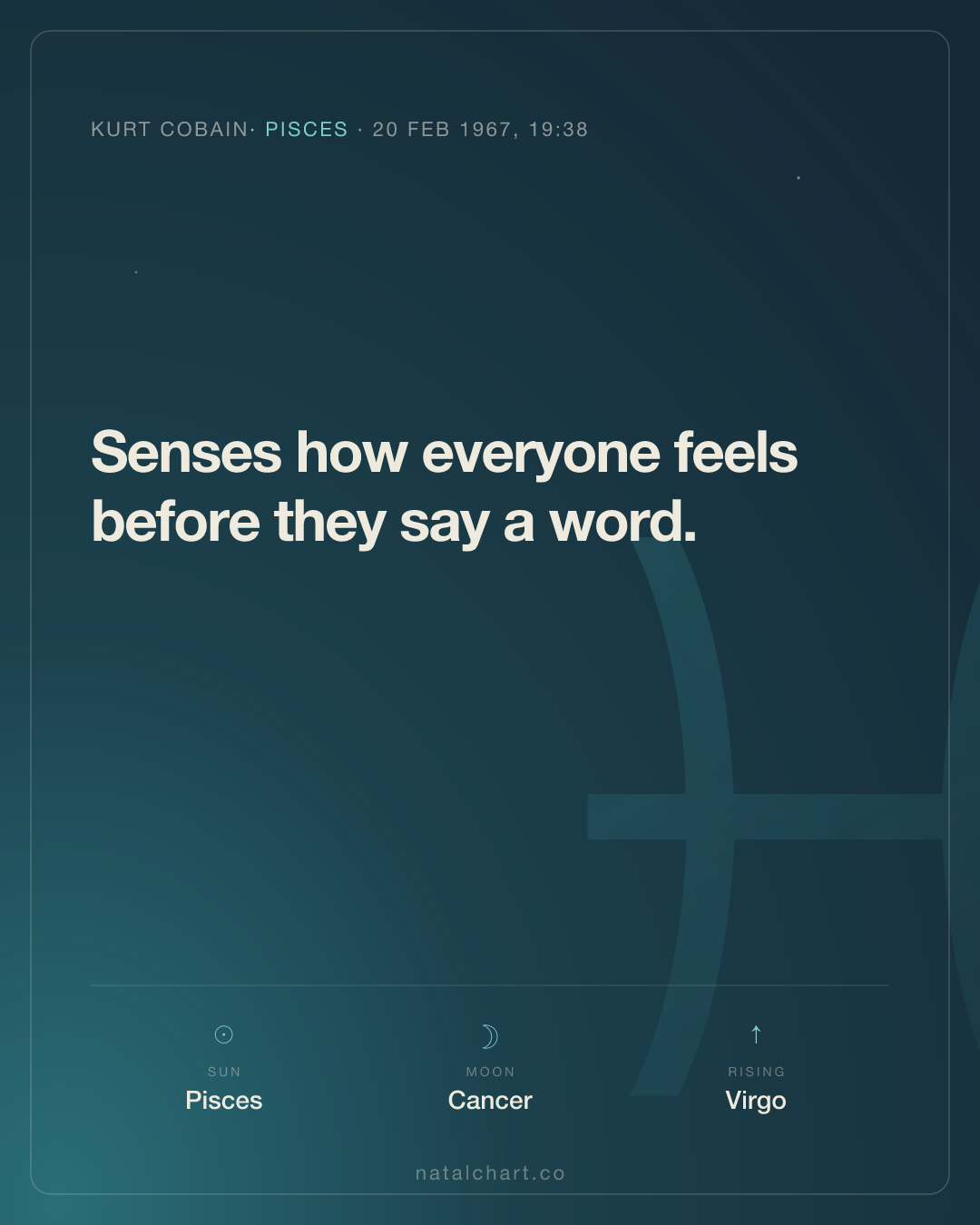
The Ascendant is Virgo, the face he met the world with: precise, self-critical, uncomfortable with pretension. People who knew him describe an obsessive editor, a man who would discard a riff he'd spent weeks on because it felt dishonest. Virgo rising does not grant ease; it grants a permanent internal audit. The ruler of the Ascendant, Mercury, sits in Pisces in the seventh house — the house of others, relationships, the public — and forms a direct tension with Pluto in Virgo. The mind was both razor-sharp and porous; he absorbed other people's pain as if there were no membrane between his nervous system and theirs.
The Moon's Compound Pull
The Moon in Cancer in the eleventh house describes a man whose emotional center of gravity was communal — he needed to belong somewhere, to be part of something that felt like a family, and he found that, unusually, in a mass of strangers. The relationship between Nirvana and its audience was not the usual fan-celebrity transaction; it was something that felt mutual and urgent to both sides. That Moon in the eleventh house, the house of collective belonging and friendship, explains the famous line from his note about not feeling the excitement he used to feel. He had expected the audience to be his anchor, and when the anchor felt unstable, the whole structure wavered.
Jupiter also sits in Cancer in the eleventh house, in easy flow with both Neptune and Uranus. This brings a quality of genuine, expansive warmth toward groups — a care for people in the aggregate that was not manufactured. The compassion Cobain expressed in interviews, in his public statements against homophobia and misogyny at a time when the mainstream music industry barely noticed these things, came from somewhere real.
Love Built from Longing
Venus in Pisces in the seventh house, joined tightly with Saturn and in easy flow with both Jupiter and Neptune — this combination describes love as one of the most charged territories of the chart, both its greatest gift and its most difficult terrain. Venus in Pisces loves without filters; there is no part of the Piscean lover that holds something back as insurance. Saturn alongside it brings the counterweight: a fear of loss, a tendency to create distance just when closeness peaks, a relationship pattern where intensity and withdrawal alternate.
The easy flow with Neptune deepens the imaginative dimension of attachment. Cobain wrote about longing — Something in the Way, Pennyroyal Tea, All Apologies — not in the language of desire fulfilled but in the language of desire as a permanent condition, something lived with rather than resolved. This is Venus-Neptune in Pisces: love as atmosphere rather than event.
A Mind That Absorbed the World Whole
Mercury in Pisces in the seventh house, in direct tension with Pluto in Virgo — this is one of the most telling placements in the chart. Mercury in Pisces does not process information sequentially; it soaks it in, all at once, without clear borders between what belongs to oneself and what has come in from outside. Pluto in the first house in Virgo applies constant pressure: dissect this, name it exactly, strip away the sentimental coating and see what remains.
That push-and-pull between diffuse reception and brutal analysis shows up in Cobain's lyrics more clearly than anywhere else. Lines like "I'm so ugly, that's OK 'cause so are you" or "What else should I be? All apologies" combine the Piscean refusal to declare a fixed self with the Virgoan drive to strip things down to the bone. The tension is the point. It never resolves because the chart never asked it to.
Mars in Scorpio: The Drive Underneath
Mars in Scorpio in the third house — the house of communication, siblings, the immediate environment — sits in exact harmony with the Sun in Pisces, with no degree of separation at all, making this perhaps the most structurally important configuration in the chart. The emotional force of all that Pisces did not evaporate into formlessness; it moved through Scorpio Mars into precise, uncompromising expression. The songs of Nirvana are not vague. They are loud, declarative, and rhythmically relentless — the signature of Mars in Scorpio harnessing Piscean emotional material and forcing it through a narrow, sharp channel.
The third house also governs the voice, and Cobain's voice was the defining instrument of the band — not technically the most accomplished, but immediately identifiable, with a quality of barely-controlled rawness that communicated something beyond the words.
Jupiter, Saturn, and the Long Weight
Jupiter in Cancer in the eleventh house and Saturn in Pisces in the seventh together describe a life where expansion and contraction lived side by side, and usually in the same territory. Jupiter in Cancer offered genuine warmth, loyalty, and a belief that connection was possible at scale — the ability to fill stadiums in a matter of two years and have the audience feel genuinely met. Saturn in Pisces alongside Venus brought the counterweight: a chronic sense of dissolution, of boundaries that wouldn't hold, of the body and its limits pressing constantly against ambition.
The practical history is documented. Cobain struggled with chronic stomach pain from his teens through his career, a condition that shaped his relationship to medication and to the trajectory of his health. Saturn in Pisces does not describe weakness; it describes a specific difficulty with structures that should be fluid — the body's borders, the self's coherence, the line between what one absorbs from others and what one originated. When the struggle is named, it becomes workable. When it stays unnamed, it governs.
Outer Planets at the Ascendant
Uranus and Pluto both in Virgo in the first house — the house of the body and the way one enters every room — made the generational pressure of his birth year (1967) something personal and visible rather than merely atmospheric. Cobain did not experience the cultural disruption of his era from a distance; he was its face. The Virgo precision of both planets meant that the disruption he embodied was never purely wild; it was methodical, self-critical, obsessed with the question of authenticity.
Neptune in the third house in Scorpio, alongside Mars, gives his communication style its characteristic quality of controlled instability. The lyrics were not surrealist or abstract in the manner of, say, early Bowie — they were emotionally focused but grammatically slippery, meaning just slightly out of reach, close enough to feel but not so fixed as to be pinned down.
Midheaven in Gemini: Multiple Voices, One Signal
The Midheaven — the chart's career and public-legacy point — sits in Gemini, sign of the multiple voice, the quick shift, the capacity to speak across registers. Cobain's public legacy was not fixed in the manner of a single definitive statement. He was simultaneously the loud Nevermind record and the quiet MTV Unplugged session, the sardonic interview subject and the openly vulnerable songwriter. The Gemini Midheaven allowed all of these to coexist as facets of one public identity rather than contradictions.
The Unplugged session in particular has taken on a quality of its own since his death — stripped of the amplification, the songs revealed something that the electric versions had also contained but that the acoustic setting made harder to dismiss. That capacity to communicate at multiple volumes, always with the same core signal, is a Gemini Midheaven at work.
Chiron in Pisces and the North Node
Chiron — the old wound that becomes a source of understanding for others — sits in Pisces in the seventh house, in the same sign and house cluster as Sun, Venus, Mercury, and Saturn. The wound here is the Piscean one: the absence of clear borders, the difficulty of knowing where one ends and another begins, the chronic vulnerability of a self that feels things without adequate protection. In Cobain's case this is not metaphor but biography: he described from early life a sense of emotional permeability that his environment — a working-class town, a family under strain, a culture that did not yet have language for what he was experiencing — offered no scaffolding for.
The North Node in Taurus points toward the direction of growth: groundedness, physical anchoring, simplicity, the ordinary pleasures of a life built to last. The chart suggests that the most sustaining move available to him was always toward the concrete and the stable — something that the weight of Pisces and the volatility of Scorpio Mars made genuinely difficult to access. Cobain got close to it in the acoustic sessions, in the small domestic details he wrote about with unexpected tenderness. The distance between where he was and where the North Node pointed was real, and it did not close in the time he had.
What the Chart Holds
A chart this heavily weighted in water, with the Virgo Ascendant as the only consistent dry ground, describes a person permanently negotiating between dissolution and precision. The songs Cobain left are that negotiation made audible: not resolution, but a working tension held long enough to take a shape. That is what endures in the recordings — not the rage, which was real, but the quality of attention underneath the rage. The chart that produced them is, in that sense, exactly visible in the work. The lines he wrote, the decisions he made in the studio, the discomfort he showed when the thing he had made became something larger than he had intended — all of it legible, in retrospect, from here.
The chart
How to read it →Frequently asked questions
What is Kurt Cobain's zodiac sign?
Kurt Cobain's Sun sign is Pisces — the Sun was in Pisces at birth (1967).
What is Kurt Cobain's moon sign?
Kurt Cobain has the Moon in Cancer. The Moon sign describes the emotional and instinctive layer of the chart.
What is Kurt Cobain's rising sign?
Kurt Cobain's rising sign (ascendant) is Virgo — the sign on the eastern horizon at the moment of birth.
When and where was Kurt Cobain born?
Kurt Cobain was born in 1967 in Aberdeen, Washington.