Gabriel García Márquez — natal chart
What does Gabriel García Márquez’s natal chart reveal?
Gabriel García Márquez, born on March 6, 1927, in Aracataca, Colombia, was a novelist and journalist whose work defined Latin American literature for the twentieth century. His novel One Hundred Years of Solitude (1967) sold over fifty million copies and was translated into more than forty languages, establishing magical realism as a recognized literary mode worldwide. His other major works include Love in the Time of Cholera (1985) and The Autumn of the Patriarch (1975). He was awarded the Nobel Prize in Literature in 1982. García Márquez died in Mexico City on April 17, 2014.
 Share
Share
Birth
1927-03-06 · 08:30 · Aracataca, Colombia Reliability: AA · vetted record
The Core: Pisces Sun Rising into Aries
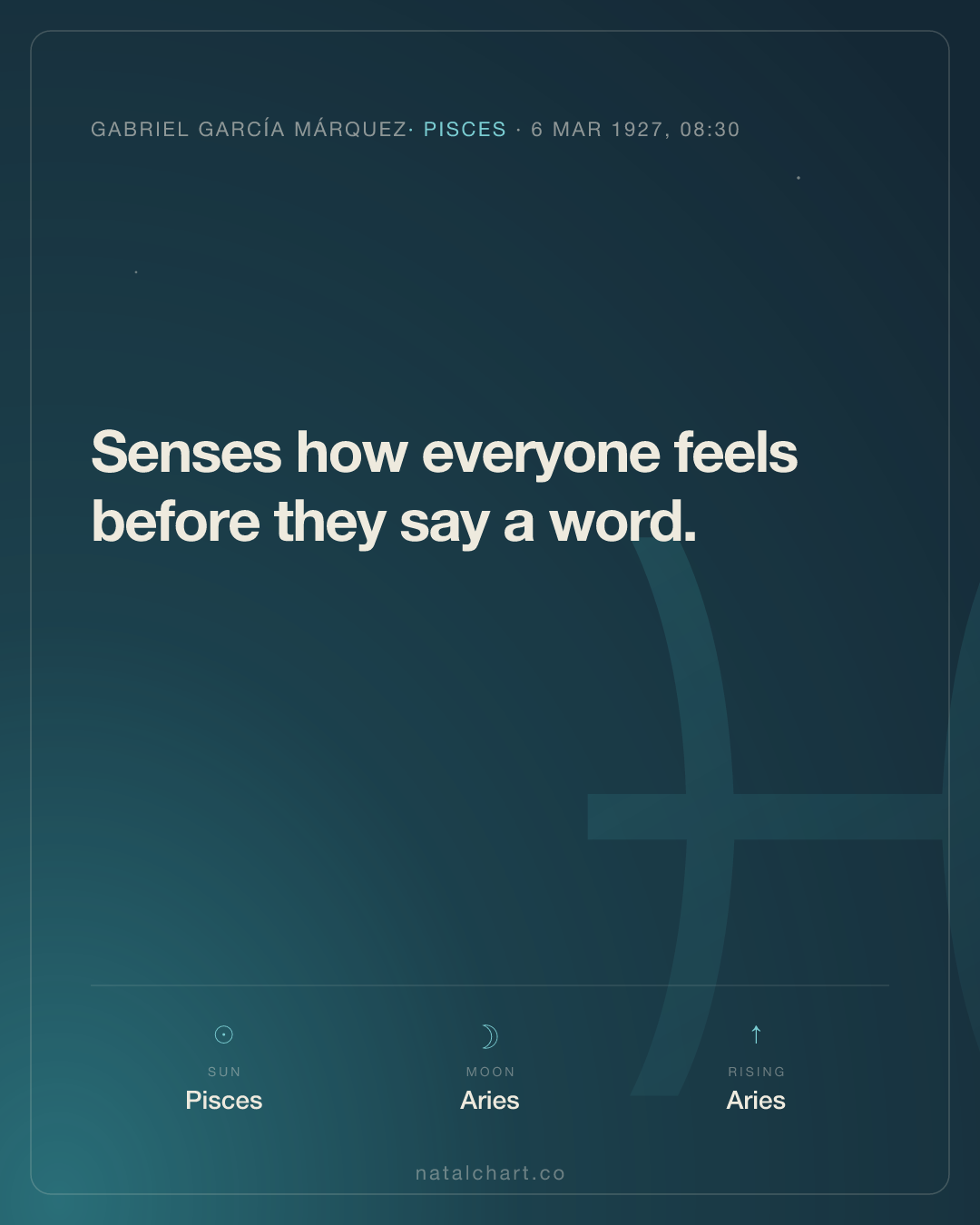
García Márquez operated from a paradox that is written plainly in his chart: a Sun in Pisces in the twelfth house, and an Aries Ascendant (the Ascendant is the face a person shows the world, the mode of first contact). The Pisces Sun in the twelfth house — the house of dreams, the unseen, the permeable boundary between waking and imagination — explains the voice that made him famous: a prose that accepts the miraculous as ordinary, that takes a ghost at the dinner table as seriously as a thunderstorm. That permeability was not a literary choice he made; it was where he lived.
But the Aries Ascendant wrapped that interior world in something much more direct, urgent, and forward-moving. García Márquez the journalist — the man who covered Colombia's political violence in the 1950s, who argued for causes, who had strong public opinions and a physical presence that filled a room — was also real. The Pisces interior and the Aries exterior were not in conflict; they were the engine: vision channeled through will.
The Moon in Aries in the first house reinforces this. The Moon is the emotional life, the gut response, the instinct under pressure. In Aries, it is quick, direct, and easily ignited; in the first house, it is visible, coloring how others experience him. There is an emotional immediacy in everything García Márquez wrote — sentences that land before you have time to think about whether to receive them. That is not only a Pisces gift; it is an Aries Moon in the first house doing its work.
The Inner Life: Moon in Aries
The Moon in Aries in the first house produced someone who felt things first and processed them afterward, if at all. The emotional register was bright, quick, and capable of great warmth — and also capable of impatience, of moving on before the dust settled. The Moon in easy flow with Neptune in Leo in the fifth house (1.0 degree, one of the tightest aspects in the chart) adds something important: Neptune governs imagination, the capacity to dissolve ordinary logic, the place where story and lived experience blur. In the fifth house — the house of creative work, play, and what one makes — this Moon-Neptune connection made the emotional life and the creative life essentially the same thing. He felt by writing and wrote by feeling.
Love in the Time of Cholera, published in 1985, is the clearest biographical trace of this. The novel's exploration of obsession, memory, and a love that outlasts all reason is not a cool intellectual exercise; it is a Moon in Aries story filtered through Neptune — passionate, irrational, lasting far longer than it should.
Mercury: The Mind That Dissolves Borders
Mercury in Pisces in the twelfth house, joined closely to Uranus (1.4 degrees — they travel together through the chart, thinking as one), produced something unusual in a mind: the capacity to reason and the capacity to intuit working simultaneously, without the usual firewall between them. Mercury alone in Pisces would make for a mind that prefers metaphor to argument, feeling to logic, the suggestive over the definitive. Mercury joined to Uranus makes that mind sudden, surprising, capable of the leap that bypasses the expected middle step.
This is the technical explanation for magical realism as a narrative mode: not fantasy (which requires leaving ordinary reality behind) but a prose in which the extraordinary arrives by the same door as the ordinary. The yellow butterflies that surround Mauricio Babilonia in One Hundred Years of Solitude are not symbols to decode — they simply happen, the way things happen in Pisces twelfth-house logic. The Uranus jump is why it feels not just dreamlike but inevitable.
Mercury's sign and house also explain his journalism. The best political writing does not itemize facts — it finds the metaphor that makes the fact undeniable. García Márquez's newspaper work, especially the chronicle of a real kidnapping he reconstructed in News of a Kidnapping (1996), moved between documentary and narration the way his fiction moved between the real and the miraculous.
Venus: Value, Love, and What Endures
Venus in Aries in the first house placed love and what one values in the most direct, unmediated position in the chart. The first house is the self as it meets the world; Venus here produces someone who goes after what they want with little indirection, who makes affective commitments quickly and with full conviction. Combined with the Aries Moon, this is a man who loved loudly, who stayed married to Mercedes Barcha for over fifty years, whose friendships — with Fidel Castro, with Carlos Fuentes, with the Colombian literary world he helped define — were vivid and committed.
Venus in easy flow with Saturn in Sagittarius in the ninth house (2.3 degrees) is the stabilizing factor. This aspect — connecting desire and structure, warmth and patience — explains why those long commitments held. Saturn in the ninth house (the house of long journeys, foreign places, and the mind that seeks larger meaning) is an appropriate marker for someone who left Aracataca, spent years in Europe and Mexico, and built a life that was perpetually in motion between continents and literatures.
Venus also works well with Mars (3.3 degrees, pulling easily in the same direction), combining the impulse to act with the capacity to value what one is acting toward. The result in writing is a style that is both urgent and careful, headlong and precise.
Mars: Discipline Against the Clock
Mars in Gemini in the third house — the house of language, communication, and the immediate exchange of ideas — is exactly where one would expect to find the engine of a professional journalist and novelist. Gemini's facility with words, its ability to hold two ideas at once, its restless need to connect, is amplified by Mars into a drive for linguistic production that does not tire. The third house is also the house of siblings, early education, and the local environment: Aracataca, the Caribbean coast, the stories told by his grandmother that García Márquez called the original source of everything he wrote.
Mars pulling against Saturn (1.0 degree, one of the tightest and most direct tensions in the chart) is the friction that produced the work. Saturn in Sagittarius in the ninth house says: take the long view, be rigorous, don't publish until it's right. Mars in Gemini in the third house says: write now, connect now, produce. That 1.0-degree pull between them is the exact description of how García Márquez worked: reportedly writing One Hundred Years of Solitude over eighteen months in Mexico City, with his family going into debt to feed him while he refused to stop.
Jupiter and Saturn: The Architecture of Meaning
Jupiter in Pisces in the twelfth house, joined to the Sun and Mercury in the same sign and house, amplifies the already-dominant twelfth-house Pisces pattern. Jupiter expands what it touches; in Pisces and the twelfth house, it expands the capacity for myth, for collective memory, for stories that carry more than one culture's worth of meaning. One Hundred Years of Solitude did not become a global novel because García Márquez found a clever formal device; it did so because the Buendía family's story landed as something people from Colombia and Japan and Spain and Nigeria recognized as their own.
Jupiter in easy flow with Pluto in Cancer in the fourth house (2.8 degrees) adds a depth dimension: this expansion of meaning connects to the ancestral, the familial, to what is buried in the ground of a place. The fourth house is the house of home, origin, and what one carries from one's people. García Márquez carried Aracataca with him everywhere he went for ninety years.
Saturn in Sagittarius in the ninth house, pulling against Jupiter (3.5 degrees) and against Mars (1.0 degree), created the structural conscience that kept the mythologizing from collapsing into self-indulgence. Sagittarius seeks philosophical breadth; Saturn demands it be earned. The result was a writer who was also a rigorous craftsman.
The Outer Planets: Where a Generation Meets a Single Life
Neptune in Leo in the fifth house and Pluto in Cancer in the fourth house are generational placements, but their house positions say something specific about García Márquez. Neptune in the fifth house — the house of creative work — means that imagination and the dissolution of ordinary boundaries landed precisely in the place where he made things. Pluto in Cancer in the fourth house (the house of family, home, and origin) connects the deep, irresistible forces of transformation to the familial and the ancestral. The multigenerational sweep of One Hundred Years of Solitude, in which the Buendía family's history accumulates and then destroys itself in a pattern that feels like fate, is the lived expression of Pluto in Cancer in the fourth house.
Uranus in Pisces in the twelfth house, joined to Mercury, has already been discussed — but it is worth noting that Uranus in the twelfth house produces disruptions that come from within: not the shock of external events but the sudden inner leap, the vision that arrives before the argument to support it. This is the experience of writing a first sentence that changes everything.
The Midheaven and Vocation
The Midheaven (the public and career point, the peak of the chart) in Capricorn places his public identity under the sign that builds slowly, demonstrates through accumulated work, and earns authority through longevity. García Márquez published his first short stories in the late 1940s; One Hundred Years of Solitude came twenty years later, in 1967; the Nobel Prize came fifteen years after that, in 1982. The Capricorn Midheaven is not a quick ascent — it is a body of work that becomes undeniable.
Capricorn's traditional ruler is Saturn, which sits in the ninth house in Sagittarius. This links the career to the pursuit of philosophical and cultural breadth — not a local or regional writer but a writer whose frame of reference is explicitly planetary. The journalism, the advocacy, the literary friendships across Latin America, Europe, and beyond were not accessories to the writing; they were the same vocation, expressed in a different register.
Chiron, Lilith, and the North Node
Chiron — an old wound that, with time, becomes a gift — is in Aries in the first house, joined closely to the Moon and Venus in the same sign. This placement suggests a wound that is entirely personal and visible: something in the basic equipment of self-presentation, of acting in the world, of being seen. García Márquez described his early years as marked by poverty, geographic displacement, and the sense of belonging to a culture that the metropolitan literary world did not take seriously. The Chiron in Aries in the first house does not soften that; it records that the starting position required more self-assertion than should have been necessary — and that the assertion eventually became the voice.
Lilith in Libra in the seventh house — the house of partnerships — suggests a complexity in how the shadow side of relationships operated, how the desire for harmony coexisted with something less accommodating. The North Node in Cancer, the house of family and origin, points to the direction of growth: toward rootedness, toward honoring what one came from, toward the stories passed down by grandmothers and preserved in fiction. García Márquez's entire body of work is an answer to the North Node's pull.
A Portrait Without a Frame
The chart of Gabriel García Márquez is, at its center, a cluster of Pisces planets in the twelfth house — Sun, Mercury, Jupiter, Uranus — wrapped by an Aries Ascendant and an Aries Moon that brought that interior world into contact with the real, the immediate, and the political. He was both the man who heard his grandmother tell stories as a child and felt they were as true as any newspaper report, and the man who spent decades working as a journalist, covering Colombia's most violent decades with clear eyes.
Those two things were not in tension in him — they were the same vocation, the same question about what is real and what endures. Macondo, the town in One Hundred Years of Solitude that does not exist on any map and is recognizable from any country, is the permanent record of what happens when a twelfth-house Pisces Sun gives its interior world to an Aries voice and tells it to go.
The chart
How to read it →Frequently asked questions
What is Gabriel García Márquez's zodiac sign?
Gabriel García Márquez's Sun sign is Pisces — the Sun was in Pisces at birth (1927).
What is Gabriel García Márquez's moon sign?
Gabriel García Márquez has the Moon in Aries. The Moon sign describes the emotional and instinctive layer of the chart.
What is Gabriel García Márquez's rising sign?
Gabriel García Márquez's rising sign (ascendant) is Aries — the sign on the eastern horizon at the moment of birth.
When and where was Gabriel García Márquez born?
Gabriel García Márquez was born in 1927 in Aracataca, Colombia.