Maurice Ravel — natal chart
What does Maurice Ravel’s natal chart reveal?
Maurice Ravel (1875-1937) was a French composer and pianist associated with Impressionism. Renowned for his orchestral colour and craftsmanship, his best-known works include Boléro, Daphnis et Chloé, the Piano Concerto in G, and his orchestration of Mussorgsky's Pictures at an Exhibition.
 Share
Share
Birth
1875-03-07 · 22:00 · Ciboure, France Reliability: AA · vetted record
The Core: Three Planets in Pisces, Scorpio Rising
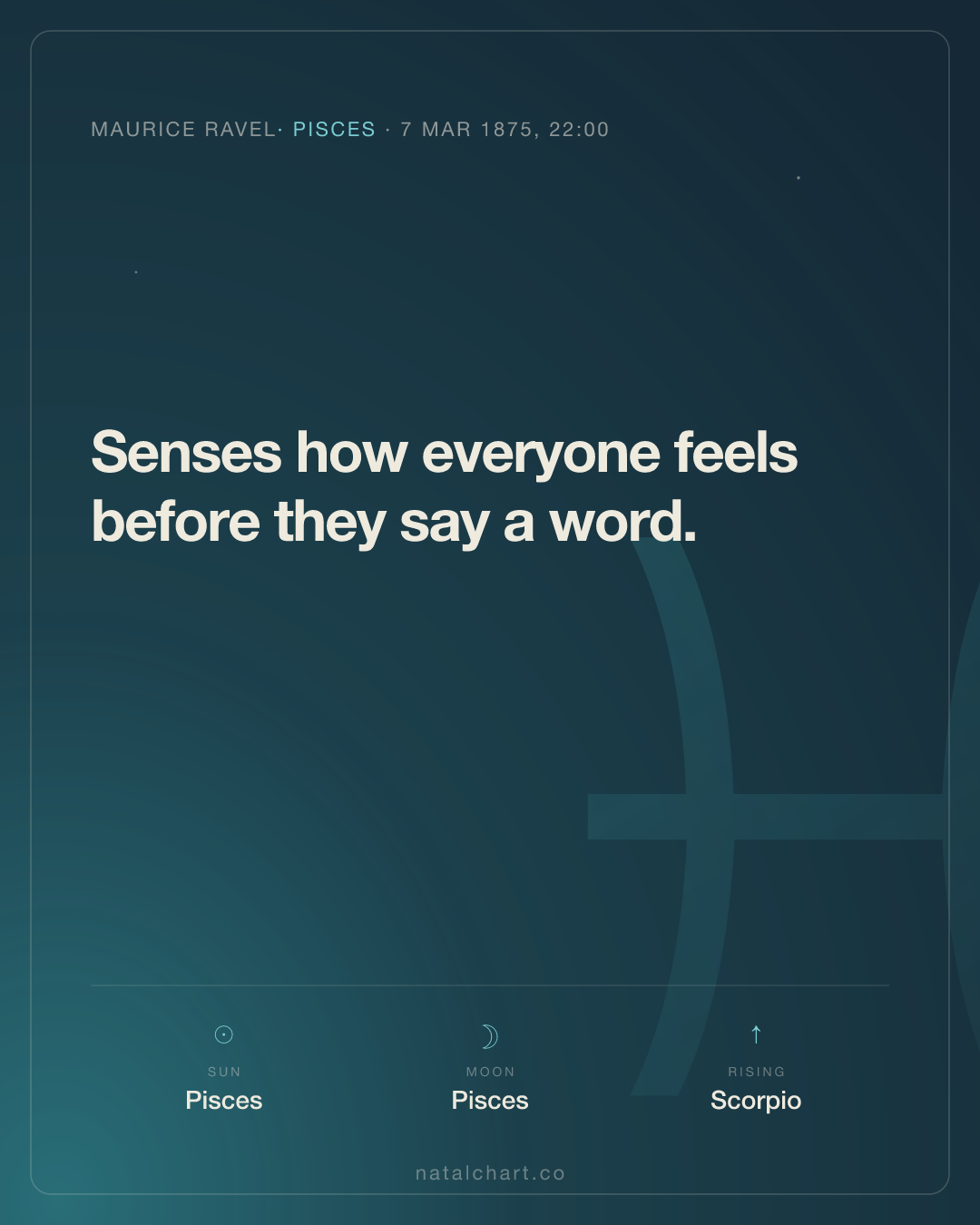
Maurice Ravel came into the world with an extraordinary concentration of planetary energy in a single sign: the Sun, Moon and Mercury all gathered in Pisces, all in the fifth house of creativity, artistic expression and play. Three personal planets in one sign and one house is a rare alignment — and in Pisces, a sign associated with the dissolution of boundaries, sensitivity to the invisible and an almost painful attunement to beauty, it produced exactly what Ravel became: a composer who heard things other people couldn't.
The fifth house governs creative work, the making of things for their own sake, the joy of craft pursued without utilitarian purpose. Ravel was famous for spending years on a single piece — Daphnis et Chloé took six, his String Quartet went through dozens of revisions before he was satisfied. The Pisces quality of perfectionism is different from the Virgo kind: it isn't about eliminating error, it's about getting closer to something ineffable, something that exists just beyond language. He was known to say that Boléro had no musical ideas whatsoever — just one long orchestral crescendo built on repetition. That self-deprecating quip actually describes what Pisces does brilliantly: it holds you inside a feeling so long that the feeling becomes the structure.
The Ascendant — the face a person presents to the world, the sign that shapes first impressions — is Scorpio. Scorpio rising creates a quality of reserve, penetrating attention and controlled intensity. Ravel was famously private, rarely spoke about his emotional life, lived simply in a small house in Montfort-l'Amaury, and deflected almost every biographical question. The Scorpio rising held the Pisces dreamer inside a shell of precision and control — a combination that produced music of extraordinary surface polish covering unfathomable emotional depths.
Inside: A Sun-Moon Conjunction
When the Sun and Moon occupy almost exactly the same position — here, barely 0.8° apart in Pisces — the outer personality and the inner emotional life are fused rather than in tension. There is no gap between who Ravel appeared to be and what he felt inside. This can create a striking consistency: he was the same person in public as in private, the same in a concert hall as in his garden.
But Sun-Moon conjunctions in Pisces carry a particular quality of solitude. Pisces absorbs the emotional weather of its surroundings with unusual sensitivity; when both the Sun and Moon share this placement, everything is felt more deeply. The famous reclusive years at Montfort-l'Amaury — where he worked in near-isolation among his mechanical toys, his garden, and his music — were not eccentricity but necessity. A chart this saturated in Pisces needs quiet to function.
Mercury: Precision Serving Mystery
Mercury — the mind, the way of thinking and communicating — is also in Pisces in the fifth house. Mercury in Pisces is an unusual combination: Mercury prefers clarity and definition; Pisces prefers ambiguity and suggestion. The result is a mind that thinks in images, analogies and sensory impressions rather than in logical chains.
In Ravel's case this paradox resolved into something extraordinary: a musician who was also a precise craftsman. He could explain exactly why a particular chord worked, could discuss orchestration with technical rigour, and yet the music itself moved in ways that resisted explanation. His orchestration of Mussorgsky's Pictures at an Exhibition is technically meticulous — every instrument chosen for a specific timbral reason — but the whole produces an atmosphere that feels like a dream you can't quite shake.
Venus and Saturn: Architecture in the Fourth House
Venus in Aquarius and Saturn in Aquarius share the fourth house — the house of home, private life and the inner foundation. These two planets in the same sign and house form a striking pairing.
Venus in Aquarius finds beauty in structure, abstraction and the unexpected harmonic move — the note that should not work but does. This describes Ravel's compositional signature precisely: his harmonies are technically clean but emotionally surprising, his melodies simple on the surface but harmonically complex underneath. Saturn in the same house and sign brings discipline, patience and the willingness to work in solitude for as long as the work demands. Both planets are under tension — Venus is in a hard pull against Jupiter (Venus square Jupiter, exactly 0.0°) and against Neptune (Venus square Neptune, 2.1°) — suggesting a constant friction between the desire for harmonic freedom and the need for structural rigour. That friction was not a problem to be solved; it was the engine.
Mars: The Risk-Taker
Mars in Sagittarius in the second house — the house of resources, income and what one genuinely owns — brings an expansive, even adventurous quality to Ravel's relationship with practical resources. Mars in Sagittarius acts on instinct and optimism; it seeks the large gesture rather than the careful accumulation.
The most important Mars aspect here is a near-exact flow with Uranus in Leo in the tenth house of career (just 0.5° apart). When two planets are in easy trine like this, they reinforce each other naturally. Uranus in the career house represents radical originality, the impulse to overthrow convention; when Mars in Sagittarius sends energy freely to that Uranus, the result is someone who could take enormous creative risks without self-paralysis. Boléro — a single theme repeated seventeen times at steadily increasing volume with no harmonic development whatsoever — is perhaps the boldest compositional experiment of the twentieth century. It succeeded commercially beyond anything Ravel anticipated, becoming one of the most performed pieces in the orchestral repertoire.
Jupiter in Scorpio: Public Gravity
Jupiter in Scorpio in the first house — sitting close to the Ascendant — brings breadth and authority to the public persona. In Scorpio, Jupiter doesn't shout; it concentrates. It gives Ravel that quality of being someone whose approval meant something, whose silence on a compositional question carried weight. His friendships with Fauré, Debussy and later the younger generation of composers were characterised by this quality: Ravel said little, but when he spoke about music, people listened.
Jupiter also pulls against Neptune across the chart (2.1° apart). Jupiter in Scorpio demands depth, complexity and confrontation with the whole truth; Neptune in Aries seeks simplicity, the direct statement, the immediate feeling. Ravel navigated this tension throughout his career: the surface of his music is often simple to the point of seeming naïve — a child's dance, a bolero rhythm, a waltz — but the inner architecture is dense and carefully constructed.
Uranus and the Midheaven: The Unconventional Path
Uranus in Leo in the tenth house — and the Midheaven, the public and career point, is Leo — announces an unconventional path to public recognition. Leo governs the grand gesture, the commanding display, the work that cannot be ignored. Uranus here says that the recognition will come through originality that breaks with precedent.
Ravel's public reception is a study in this: his early work was repeatedly rejected by the Prix de Rome jury — five times, causing what became known as the Ravel Affair of 1905. Yet those same rejected works are now considered among the most brilliant piano music of the early twentieth century. Uranus sitting directly on the Midheaven in Leo describes a career trajectory defined by initial establishment resistance followed by complete and enduring public vindication.
Chiron and the North Node: Worth Beyond the Jury's Verdict
Chiron — an old wound that, once accepted, becomes a source of skill — is in Taurus in the seventh house, the house of partnership and public dealings. Chiron in Taurus in the seventh suggests a wound related to the recognition of one's concrete worth in the eyes of others: the fear that what you make will not be valued, will be dismissed, will be found insufficient.
Ravel was famously modest about his achievements, deflecting praise to technical considerations, insisting that Boléro was a compositional failure. This was not false modesty — it was the lived expression of Chiron in Taurus in the seventh: the sense that the value of the work was always being determined by someone else's standard.
The North Node in Aries points toward the direction of growth: directness, self-origination, the willingness to act on one's own authority rather than deferring to received institutional judgement. The rejected Prix de Rome entries and the eventual global triumph of Boléro represent exactly that arc.
Saturn Square Pluto: The Structural Demand
Among the tightest aspects in this chart, Saturn in Aquarius in hard tension with Pluto in Taurus (0.7° apart) deserves its own attention. This kind of square creates productive friction, the pressure that forces real work. Saturn demands form, structure, boundaries; Pluto demands transformation, depth and the elimination of what is merely decorative.
This aspect runs like a spine through Ravel's working method. He was known to discard months of work without regret if it didn't meet his own standard. His orchestrations are famously stripped of anything superfluous — every instrument earns its place, every line has a purpose. The Piano Concerto in G, written while his health was already declining, is one of the most economical masterpieces in the repertoire: nothing extraneous, nothing repeated without purpose, nothing wasted.
The Closing Note
Ravel's chart is a study in productive paradoxes: Pisces sensitivity held inside a Scorpio shell; harmonic freedom disciplined by Aquarian structure; radical originality achieving popular success on a scale he found almost embarrassing. What holds it all together is the Pisces stellium's unbroken thread — the capacity to stay inside a feeling until it yields its exact musical form, whether that takes six years (Daphnis) or a lifetime (Boléro). The man who said his most famous work had no musical ideas was describing, with characteristic precision, exactly what was in his chart: the power of pure feeling held long enough to become architecture.
The chart
How to read it →Frequently asked questions
What is Maurice Ravel's zodiac sign?
Maurice Ravel's Sun sign is Pisces — the Sun was in Pisces at birth (1875).
What is Maurice Ravel's moon sign?
Maurice Ravel has the Moon in Pisces. The Moon sign describes the emotional and instinctive layer of the chart.
What is Maurice Ravel's rising sign?
Maurice Ravel's rising sign (ascendant) is Scorpio — the sign on the eastern horizon at the moment of birth.
When and where was Maurice Ravel born?
Maurice Ravel was born in 1875 in Ciboure, France.