Andrés Segovia — natal chart
What does Andrés Segovia’s natal chart reveal?
Spanish classical guitarist born in 1893 in Linares. He brought the guitar to major concert halls and commissioned works from Manuel Ponce, Joaquín Rodrigo and Federico Moreno Torroba. Marquis of Salobreña from 1981.
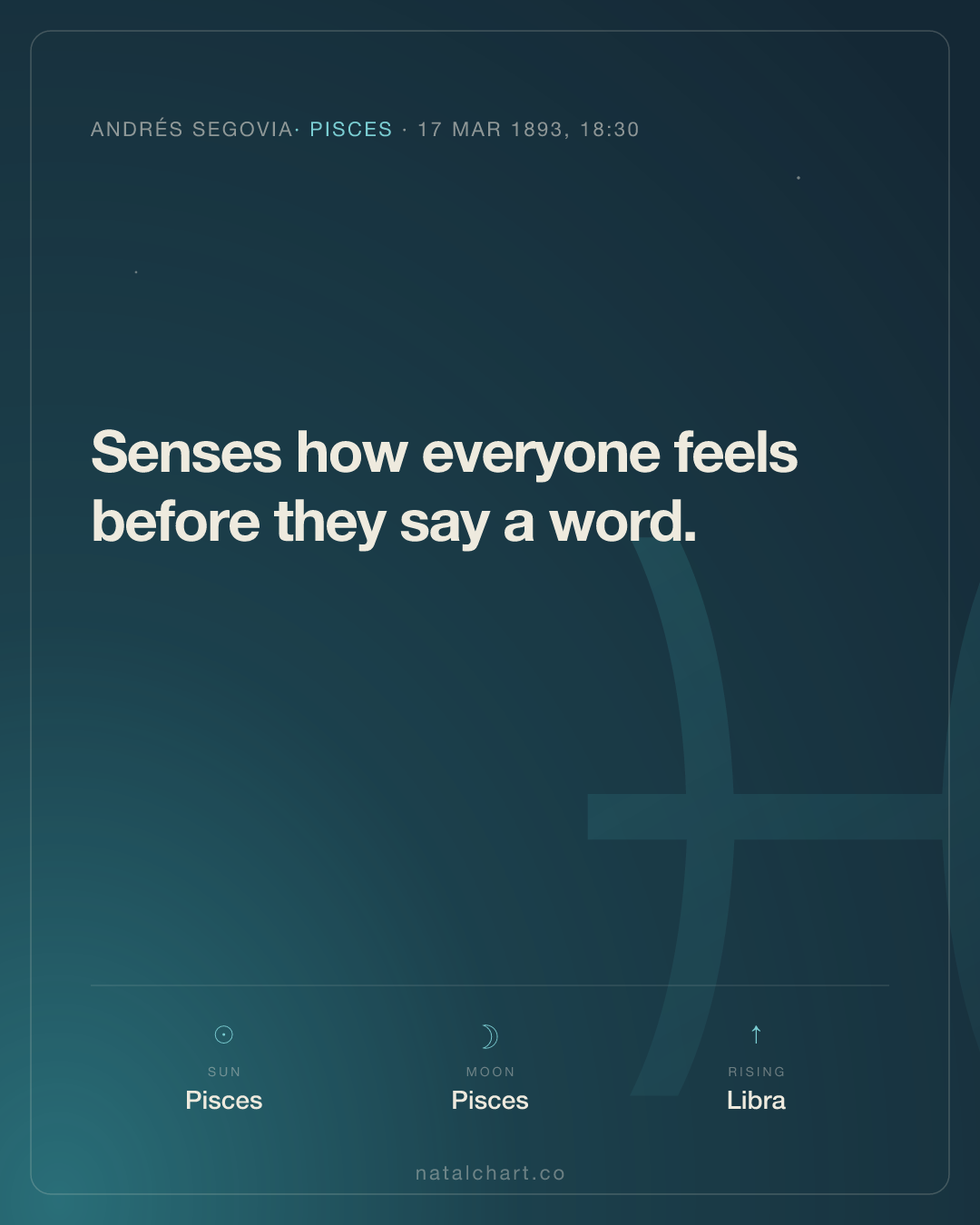 Share
Share
Birth
1893-03-17 · 18:30 · Linares, Spain Reliability: AA · vetted record
The core: Pisces in service, Libra facing the world
Three planets — Sun, Moon, and Venus — all sit in Pisces in the sixth house, the house of daily practice, craft, and dedicated work. This is an unusual concentration of personal planets in the service domain, and for Andrés Segovia it reads with almost uncanny accuracy: a man who spent his life in the daily ritual of six or seven hours of practice, who understood the relationship between himself and the guitar as one of complete devotion, and who experienced music not as performance ambition but as a calling that required total attention.
The Libra Ascendant — the face he met the world with — shaped how he was perceived: refined, balanced, aesthetically impeccable in manner. The classical guitar world he entered in the early twentieth century was one of salons and drawing rooms; Segovia had the Libra bearing to move through that world and the Pisces depth to transform it. The Midheaven in Cancer (the career and public-reputation point) describes a public identity built around emotional depth and the protection of something precious — the guitar's place among the great concert instruments, which he spent his life defending.
The Sun and Moon close together: undivided attention
The Sun and Moon sit within 5.4° of each other in Pisces — a configuration where both luminaries occupy the same sign and the same house, pulling in one direction. The emotional life and the conscious identity are not in conflict here; they are unified. For Segovia, the self that showed the world and the interior life were both Piscean, both oriented toward transcendence through sound, both fed by the same daily practice.
Pisces is not an easy sign for worldly ambition — it dissolves, merges, prefers the invisible to the visible. The genius of Segovia's Pisces was to make the invisible audible. The guitar had been considered a folk instrument, unsuited to serious concert halls, when he began his international career in the 1920s. A Piscean musician doesn't argue for the instrument's dignity through manifesto; he simply plays until the argument becomes unnecessary.
Venus in Pisces: beauty as craft principle
Venus in Pisces, sitting alongside Sun and Moon in the sixth house, describes someone for whom beauty is not an ornament but a craft principle — something to be achieved through daily work, not inspiration alone. Pisces is the sign where Venus works most naturally, where the capacity for empathy and beauty operates without the ego's interference. In the sixth house, that Venusian sensitivity gets channeled into the specific, the technical, the repeated: tone production, fingering, dynamics, the exact quality of sound in the transition between notes.
Segovia commissioned works from Manuel Ponce, Joaquín Rodrigo, and Federico Moreno Torroba — composers who had not previously written seriously for guitar. That commissioning impulse is a sixth-house Venus in Pisces: the understanding that beauty must be produced through relationship and patient cultivation, that the instrument's repertoire was a garden to be tended over decades, not a shelf to be stocked.
Mercury in Aries: the case for the guitar
Mercury in Aries in the seventh house describes a mind that makes arguments directly and doesn't soften what it believes. The seventh house is the domain of direct encounter — and Mercury here is sharpest in face-to-face engagement, in correspondence, in the moment of persuasion. Segovia's letters to composers, his advocacy for the guitar in conservatories and concert halls, his willingness to challenge the institutional dismissal of the instrument — these are Mercury in Aries: direct, forceful, not given to circling.
In tension with Saturn across the chart (Mercury in opposition to Saturn, 4.7°), that directness met resistance. Saturn in Libra in the first house — the institutional and the traditional standing against the direct claim — required the case to be made over and over, for decades, until there was no more reasonable doubt. Segovia was still touring and recording actively into his nineties. The resistance was real; so was the patience.
Mars in Taurus: the patient craftsman
Mars is the planet of action, physical energy, and drive. In Taurus, Mars is not fast — it is steady, cumulative, capable of indefinite effort in pursuit of something tangible. In the eighth house, this Mars has a quality of hidden reserve, of energy that doesn't advertise itself until it is needed and then proves inexhaustible.
The Moon in harmonious relationship with Mars (0.8°, the second-tightest aspect in the chart) is significant: emotional life and physical action work together without friction. Segovia's practice wasn't a struggle against himself — the hours at the instrument fed rather than depleted him. That easy relationship between Moon and Mars describes effort that feels, at the deepest level, like nourishment.
Saturn in Libra: the discipline of beauty
Saturn in Libra in the first house — right alongside the Ascendant — is Saturn in one of its strongest positions (Libra is the sign where Saturn traditionally works best). In the first house, Saturn shapes the entire presentation of self: the seriousness, the impeccable standards, the refusal of the casual or the merely competent.
Saturn in easy flow with Neptune and Pluto (Saturn trine Neptune, 1.7°; Saturn trine Pluto, 2.4°) is one of the most revealing configurations in this chart. A trine is a flowing, natural relationship between planets that might otherwise seem opposed. Saturn's discipline and Piscean transcendence, rather than working against each other, reinforced each other: the more rigorously Segovia practiced, the more deeply he could access the dissolution into music that Pisces makes possible. The discipline was the door to the transcendence, not its barrier.
Neptune and Pluto: a generation's mark
Neptune joined to Pluto in Gemini in the ninth house (0.8°, the tightest aspect in the chart) is a generational configuration shared by everyone born in the 1890s — the signature of a generation at the exact hinge point between the nineteenth-century world and the twentieth. For Segovia specifically, the ninth-house placement matters: the house of long journeys, of philosophy, of crossing cultural borders. He brought the guitar from Spain to South America, from Europe to North America, from the salon to Carnegie Hall.
In Gemini, Neptune-Pluto in the ninth house describes the transformation of cultural communication — how one tradition teaches another, how ideas about what music can be travel across languages and borders. Segovia understood that the guitar had a global voice. He was right.
The Midheaven in Cancer: guardian of something precious
The Midheaven in Cancer describes a public identity built around protection, emotional investment, and the safeguarding of something that could easily be dismissed. Cancer at the career point describes a vocation felt as an obligation of care — not ambition in the conventional sense but a deep commitment to ensure that something fragile survives.
The guitar in 1909, when Segovia gave his first major public recital in Granada, was genuinely fragile: excluded from conservatories, absent from the major concert halls, regarded by the musical establishment as a minor folk instrument. The lifework was to protect and enlarge that fragile thing. A Cancer Midheaven understands that kind of guardianship — it's the work of decades, not a single triumph.
Chiron in Capricorn and the North Node in Taurus
Chiron — an asteroid associated with old wounds that become, through long work, one's deepest gift — sits in Capricorn in the fourth house, the house of roots and private foundation. In Capricorn, Chiron's wound is often connected to what established structures refused to recognize or validate. Segovia was self-taught; no Spanish conservatory of his era took the guitar seriously enough to offer it. That institutional refusal shaped decades of work: the insistence on being taken seriously in the halls that had excluded the instrument, the patient construction of a repertoire that could not be dismissed.
The North Node in Taurus describes the chart's orientation toward the tangible, the enduring, the built thing. For Segovia, this is the repertoire itself: the works he commissioned and premiered, the recordings that fixed his interpretations for later generations, the technical studies that still bear his name. Legacy as transformed resource — taking what was dismissed or undervalued and building something that outlasts the person. That is the North Node in Taurus, lived out over the full length of a century-long career.
A unified portrait
What the chart of Andrés Segovia describes is a person of unusual integration. The Pisces concentration gives an inner life of extraordinary sensitivity. Saturn in Libra gives the discipline and standards to channel that sensitivity into something lasting. Mars in Taurus gives the physical stamina and patience to work for decades without visible impatience. The North Node in Taurus points clearly toward legacy as the real destination.
The guitar does not occupy the place it holds in concert life because of one recital or one recording. It occupies that place because one person spent approximately seventy years of active performing and teaching insisting that it belonged there — and because that person had the Piscean depth to make the argument undeniable, the Saturnian discipline to keep making it, and the Taurean patience to wait as long as necessary for the world to agree. That combination of qualities, written plainly in the chart, is what a century of music sounds like.
The chart
How to read it →Frequently asked questions
What is Andrés Segovia's zodiac sign?
Andrés Segovia's Sun sign is Pisces — the Sun was in Pisces at birth (1893).
What is Andrés Segovia's moon sign?
Andrés Segovia has the Moon in Pisces. The Moon sign describes the emotional and instinctive layer of the chart.
What is Andrés Segovia's rising sign?
Andrés Segovia's rising sign (ascendant) is Libra — the sign on the eastern horizon at the moment of birth.
When and where was Andrés Segovia born?
Andrés Segovia was born in 1893 in Linares, Spain.