Diego Maradona — natal chart
What does Diego Maradona’s natal chart reveal?
Diego Maradona, born on October 30, 1960, in Lanús, Argentina, was a professional footballer widely regarded as one of the two greatest players in the history of the sport. He captained Argentina to victory at the 1986 FIFA World Cup in Mexico, where he scored the infamous 'Hand of God' goal and the 'Goal of the Century' against England in the same quarter-final match. He played for Boca Juniors, Barcelona, and Napoli, where he led the club to two Serie A titles (1987, 1990). Maradona retired from club football in 1997 and later managed Argentina's national team (2008–2010). He died in Buenos Aires on November 25, 2020.
 Share
Share
Birth
1960-10-30 · 07:05 · Lanús, Argentina Reliability: AA · vetted record
The Scorpio Who Became a Myth
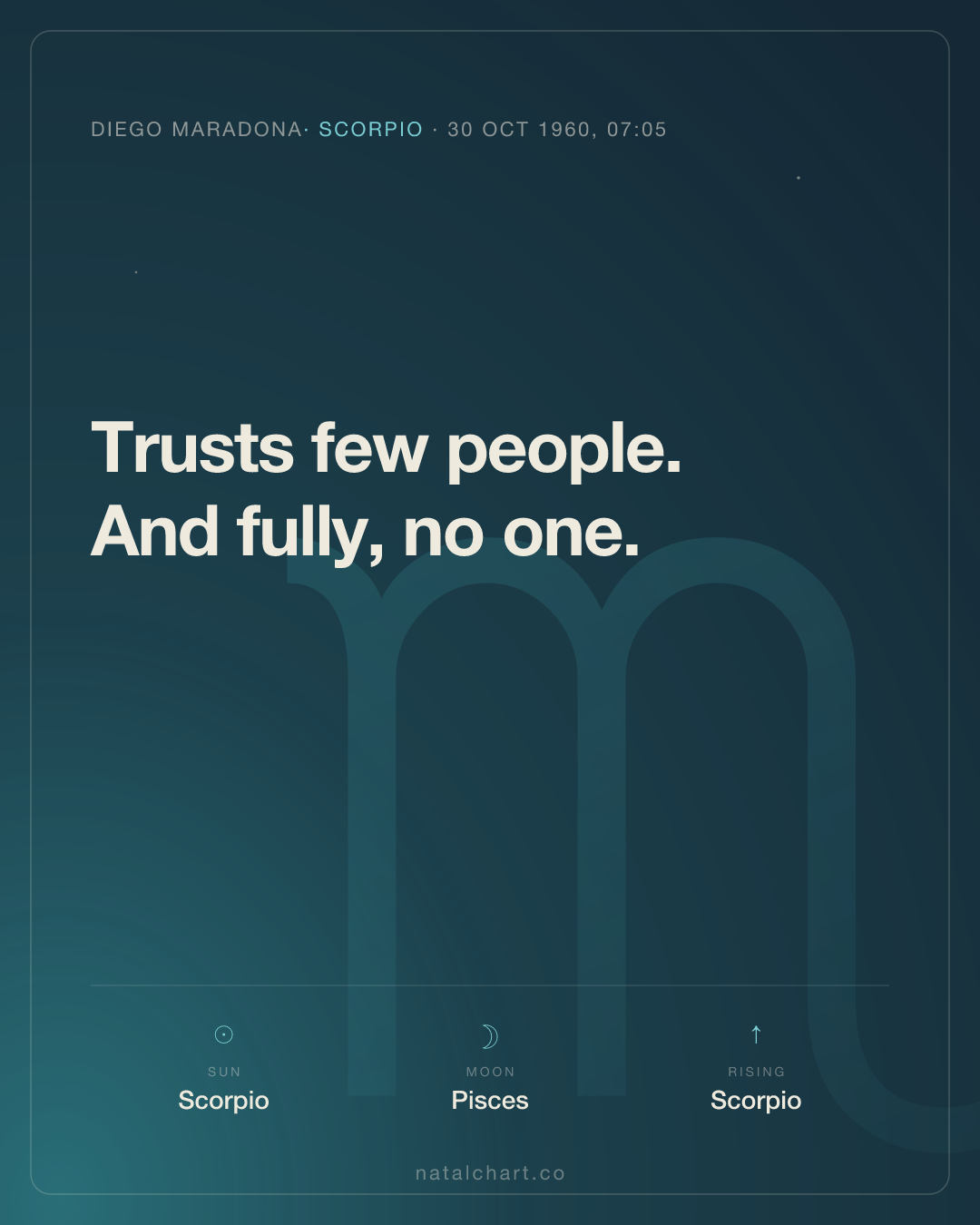
Few charts in the history of sport are as charged as Diego Maradona's. Born on October 30, 1960, at 7:05 in the morning in Lanús, Argentina, he arrived with Scorpio rising — Scorpio as the face he met the world with, the armor and the wound at once. Sun, Mercury, and Neptune all pile into that same Scorpio first house, which is the house of the self, the body, the immediate impression one makes. What that triple conjunction produces is a person whose identity is inseparable from intensity: magnetic, impenetrable, capable of inhabiting a role so completely that the man and the myth fuse into one. The world never quite got to see Diego the private person; it saw El Diego, the character, which may be the same thing.
Sun and Neptune Fused
The tightest conjunction in the chart is Sun joined with Neptune — a 1.8-degree overlap in the first house. Neptune blurs edges. Joined to the Sun, which is the core identity, it produces someone whose self-image floats free of ordinary definitions. There is something theatrical and almost hallucinatory about the way Maradona occupied space on a pitch: the feints, the shifts of weight, the dribbles that looked as though the ball was attached to his foot by an invisible string. Opponents literally could not see what he was about to do next. That is Neptune at work — a quality of evasion and enchantment that no amount of coaching can manufacture.
But Neptune also dissolves. It can make a person vulnerable to substances that blur reality in less beautiful ways. Maradona's cocaine addiction, which shadowed his career and his retirement, reads directly from this Sun-Neptune fusion: the same permeability that made him a genius made him susceptible to the wrong kinds of dissolution.
The Pisces Moon in the Fifth House
The Moon — emotional life, instinctual responses, the body's own intelligence — sits in Pisces in the fifth house, which is the house of play, risk, creativity, and performance. A Pisces Moon is deeply empathic, porous to the feelings of those around it, moved by beauty and by crowd. Maradona's relationship with the stands was legendary: at Napoli, in one of the most partisan football cultures in Europe, he was adored with a fervour that resembled the religious. He felt the crowd; the crowd felt him. It was not a performance — or rather, it was the kind of performance only possible when there is no distance between the performer and what he feels.
The fifth house is also the house of the child, and Maradona played football with a child's unselfconscious joy. The video of him, hours before the 1986 World Cup quarter-final against England, juggling a ball in the tunnel with pure delight, is one of the most telling images in sport. He was not warming up — he was playing. That distinction mattered.
Mercury Square Uranus
Mercury (how one thinks, communicates, processes reality) in Scorpio sits in a tense 90-degree angle — square, a pulling-against — with Uranus in Leo in the tenth house. Uranus is the planet of disruption, sudden reversals, brilliant and unconventional thinking. A Mercury-Uranus square produces a mind that jumps ahead of its own reasoning: intuitions arrive faster than explanations, and the explanations, when they come, are frequently startling. It also produces someone who communicates in a way that shocks — sometimes deliberately, sometimes without quite realising how far the statement has landed.
Maradona's press conferences were events in themselves. The 'Hand of God' declaration — offered with a straight face the day after the goal, as if it were simple fact — was Mercurial Scorpio at its most unapologetic: the statement as provocation, as defiance, as a refusal to apologise for existing. The Uranus dimension added the bolt-from-nowhere quality that made it unforgettable.
Mars in Cancer, Opposition Saturn
Mars, the planet of physical drive and competitive will, sits in Cancer in the ninth house, pulling in sharp opposition — a 180-degree tug-of-war — against Saturn in Capricorn in the third house. Mars in Cancer is not the cleanest placement for a warrior: it is cardinal but emotional, driven by protectiveness rather than aggression, rooted in loyalty to a home or a people. Maradona's greatest performances always had this quality — they were for something. The 1986 World Cup was not abstract competition for him; it was Argentina, still raw from the Falklands War, asserting itself against England. He carried that weight and played through it.
Saturn directly opposing Mars creates structural friction: ambition is real but the effort costs. There are limits, resistances, injuries. Maradona's knees, his body's eventual capitulation to the demands he placed on it, are Saturn's answer to Martian excess.
Venus in Sagittarius
Venus — love, pleasure, what one values and desires — sits in Sagittarius in the second house. Sagittarius Venus is generous, expansive, unconstrained by convention. Maradona's relationship to money, pleasure, and loyalty operated on a grand scale: he gave extravagantly, spent extravagantly, loved with the same total commitment he brought to football. His relationships were complex and often turbulent, but rarely were they small. Venus here pulling against Pluto — in a nearly 3-degree square — introduces an obsessive quality: love that consumes, possesses, transforms, and sometimes destroys. Maradona's personal life had exactly this texture.
Uranus in Leo, the Midheaven
The Midheaven (the public/career point, the highest point of the chart) is in Leo. Leo as the summit of a life suggests a vocation built around brilliance, spectacle, and individual heroism — the single human figure elevated before the crowd. Uranus sitting in Leo in the tenth house makes that public identity volatile, revolutionary, impossible to manage by conventional PR. Maradona's career lurched between coronation and crisis: Serie A champion, FIFA World Player of the Year, then a fifteen-month ban for cocaine use, then a chaotic decade of reinvention. Each phase announced itself abruptly. That is Uranus on the Midheaven: nobody could predict the next act.
Jupiter and Saturn in Capricorn
Jupiter and Saturn share the third house in Capricorn — the house of communication, local environment, siblings, and short journeys. Capricorn disciplines everything it touches; in the third house it produces someone who thinks in strategic, often cautious terms, but whose intelligence is applied rather than theoretical. Jupiter here also speaks to a life shaped by travel and by transmission: Maradona crossed continents, played in front of billions, and transmitted football as a language of expression to an entire generation.
Saturn in this house adds the weight of obligation: the career as a structure to be maintained, the record to be protected. Saturn in Capricorn is its own sign — doubly Saturnian — which means its demands were especially hard. The management of Maradona's body, his health, his public standing, were battles he fought his whole life.
Chiron in Aquarius, House Four
Chiron (an old wound that, worked through, becomes a gift) sits in Aquarius in the fourth house, which is the house of family, roots, belonging, and the private self. The wound here is one of belonging: the boy from Villa Fiorito, one of the poorest villas miserias in Buenos Aires, who could never fully settle into the world his talent opened to him. Maradona was beloved by millions and lonely at a level that wealth and fame could not reach. The Chiron in the fourth house marks the home as the site of both wound and refuge. His loyalty to family — to his parents, to Napoli as an adopted home, to Argentina above all — was the deepest expression of this placement.
The North Node in Virgo
The North Node (the direction in which the chart pulls toward growth) is in Virgo — precision, craft, service, the dedication of skill to something larger than oneself. Maradona was at his finest not in the individual flourish but in the moments of exact service: the precise delivery, the perfect weight of pass, the discipline of the professional who shows up when it matters. The great irony of his career is that the Virgo North Node's call — toward humility, craftsmanship, the body honoured through rigorous care — was exactly what substance abuse was pulling him away from. The two poles of his life map onto this axis precisely.
The Pattern That Held It Together
The Sun sextile Pluto (0.7 degrees — the tightest aspect in the chart after the conjunction) describes someone who does not merely survive pressure but is catalysed by it. A sextile is a flowing angle, an easy passage between two planets. Sun and Pluto in easy flow means that power, intensity, depth, and transformation feel natural to this person — not threatening but generative. Maradona under pressure, in the finals, in the matches that defined careers, was better than Maradona in routine fixtures. He needed the stakes.
And then there is the Moon trine Mars (1.2 degrees, third tightest): emotional intelligence in perfect flow with physical action. When Maradona was at his best, he did not think — he felt his way through the game. The trine is the aspect of gifts that feel effortless. What looked to the world like genius was, for him, simply what football felt like when it was working.
A Life That Still Reverberates
Diego Maradona died in Buenos Aires on November 25, 2020. He was sixty years old. Argentina declared three days of national mourning; in Naples, where the city had given him a saint's devotion, supporters gathered in the streets through the night. The Scorpio rising and the Sun-Neptune conjunction in the first house describe a person whose image, once fixed, never quite fades — they pass from life into something else, something that belongs to those who loved them. Maradona's chart is the chart of a man who was always as much symbol as person. What he gave to football — and to the world — was the proof that a human body, at its furthest reach of coordination and will, could produce something that looks like no effort at all.
The chart
How to read it →Frequently asked questions
What is Diego Maradona's zodiac sign?
Diego Maradona's Sun sign is Scorpio — the Sun was in Scorpio at birth (1960).
What is Diego Maradona's moon sign?
Diego Maradona has the Moon in Pisces. The Moon sign describes the emotional and instinctive layer of the chart.
What is Diego Maradona's rising sign?
Diego Maradona's rising sign (ascendant) is Scorpio — the sign on the eastern horizon at the moment of birth.
When and where was Diego Maradona born?
Diego Maradona was born in 1960 in Lanús, Argentina.