Enrico Fermi — natal chart
What does Enrico Fermi’s natal chart reveal?
Enrico Fermi (1901-1954) was an Italian-American physicist who created the first nuclear reactor and made foundational contributions to quantum theory, nuclear and particle physics. He won the 1938 Nobel Prize in Physics and was a central figure in the Manhattan Project, later honored by the element fermium.
 Share
Share
Birth
1901-09-29 · 19:00 · Rome, Italy Reliability: AA · vetted record
The core: the craftsman of the invisible
Enrico Fermi did not look like a prophet. He was compact, methodical, happiest in a room full of experimental equipment or at a blackboard covered in numbers. Yet what he built in a squash court under the University of Chicago football stadium on December 2, 1942 — the first self-sustaining nuclear chain reaction — changed the material conditions of civilisation. The chart of a man capable of this is worth examining closely, because the combination is unusual: it is not the chart of a grand theorist but of someone who insists on making abstract ideas real, touchable, verifiable.
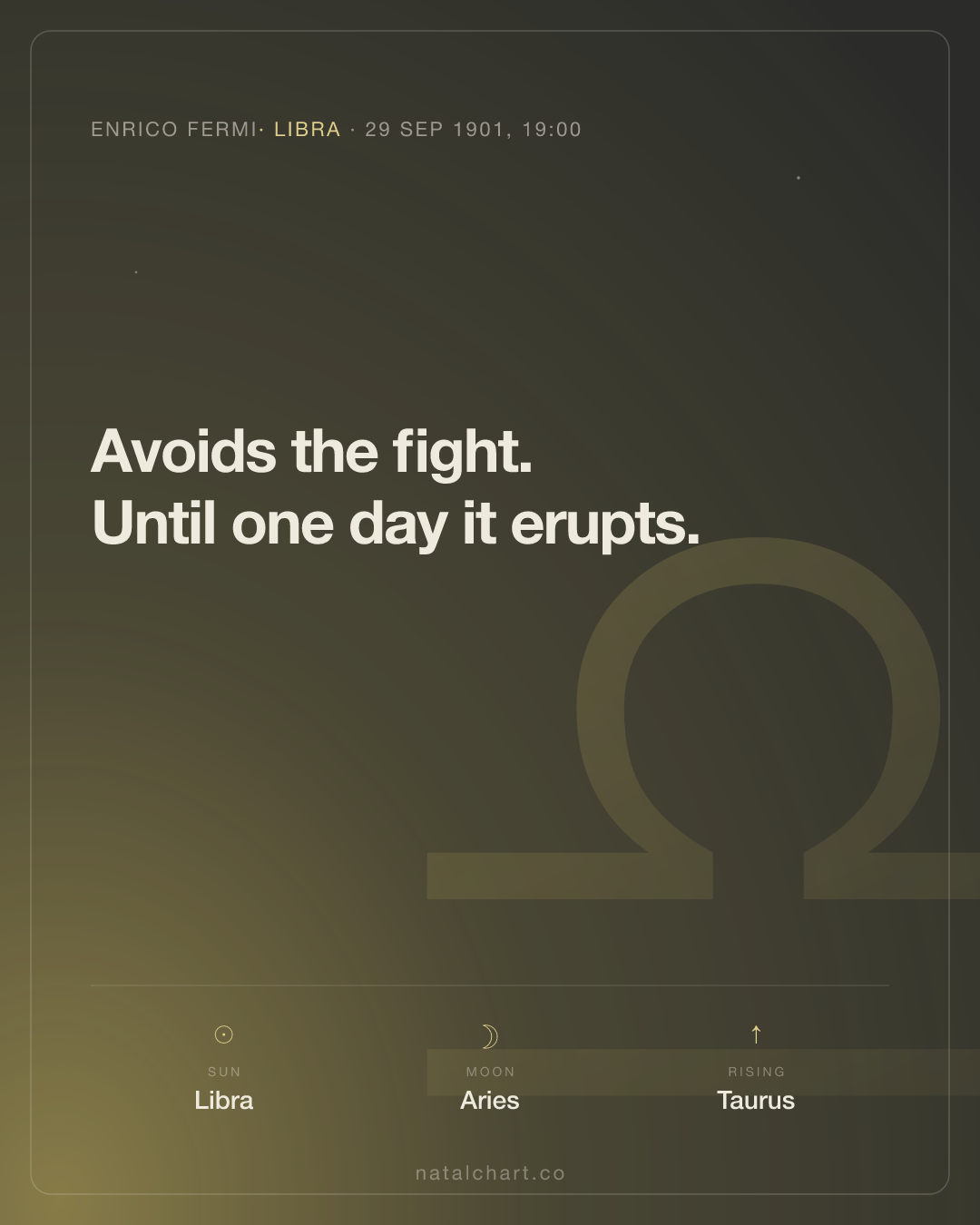
With the Sun in Libra in the sixth house (the house of daily work, craft, and service) and the Ascendant in Taurus, the dominant note is practical mastery in service of something larger. Libra at the Sun weighs, refines, and seeks the elegant solution rather than the dramatic one; the sixth house keeps that search grounded in the daily discipline of measurement, repetition, verification. Taurus rising (the Ascendant is the face one meets the world with) added a physical solidity — Fermi was famous for building things, not just calculating them, and for trusting the evidence of instruments over the beauty of equations. These three signatures point in the same direction: reliability over brilliance, the working scientist over the lone visionary.
The moon: the private engine
The Moon — the interior emotional life, the private self behind the public face — sits in Aries in the twelfth house (the house of solitude, of what happens behind closed doors). This is one of the most private placements in the chart. The Moon in Aries is fast, direct, and competitive; in the twelfth house, that inner intensity is hidden from view.
People who knew Fermi describe a man who was almost aggressively unassuming in public — he preferred to be called "the Professor" and disliked ceremony — but driven by an inner urgency that only revealed itself in the pace at which he worked. He took the Nobel Prize in 1938, used the Stockholm ceremony as cover to emigrate from Mussolini's Italy with his Jewish wife Laura, and was already conducting research in the United States before the official announcement of his prize had been widely reported. That combination — surface calm, inner urgency — reads cleanly as Moon in Aries in the twelfth house.
Mercury: the mind that makes the difficult look easy
Mercury in Libra in the sixth house sat almost exactly opposite the Moon in Aries (1 degree of separation — the tightest aspect in the chart). An opposition means two planets pulling against each other across an axis; here the analytical, balanced Libra mind pulled against the fast, impulsive Aries emotional current. In daily practice, this often produces someone who thinks best in dialogue — who needs a collaborator, an interlocutor, a student to sharpen ideas against.
Fermi was a legendary teacher. His lectures at the University of Rome in the late 1920s essentially created Italian theoretical physics as a discipline; at the University of Chicago his graduate students became some of the most important physicists of the mid-twentieth century. He was known for a particular method: approaching any problem from first principles, stripping away unnecessary complexity, reducing everything to its simplest usable form. That is Mercury in Libra — the mind that prefers the clear, balanced, minimal explanation. Mercury also formed an easy flowing connection with Neptune (3.4 degrees), which added intuitive reach to the otherwise rigorous mental style: the ability to sense where a solution might be before the calculation had confirmed it.
Venus and Mars: focus and the collaborative bond
Venus and Mars both land in Scorpio in the seventh house (the house of partners, collaborators, and significant others), and the two planets are joined (within 5 degrees). The seventh house is about how one relates to others in close or professional partnership; Scorpio here intensifies those partnerships, making them deep commitments rather than casual alliances.
Fermi worked with collaborators of exceptional loyalty: the group of young Italian physicists in Rome known as "i ragazzi di Via Panisperna" (the boys of Via Panisperna) — Segré, Amaldi, Pontecorvo, Rasetti — built some of the most significant experimental findings of the 1930s together, including the discovery of slow neutrons, which later made the nuclear reactor possible. His marriage to Laura Capon was similarly a deep, enduring partnership rather than a biographical footnote; she wrote the most vivid memoir of their life. Venus and Mars in Scorpio in the seventh house carry the quality of bonds that are chosen once and held for life. The North Node also in Scorpio reinforced this theme: Fermi's growth lay precisely in deepening those collaborative commitments, going where the shared work led, rather than operating as a solitary genius.
Jupiter and Saturn: the distant goal
Jupiter and Saturn both in Capricorn in the ninth house (the house of higher learning, foreign travel, and broad philosophical frameworks) shaped the long arc of Fermi's professional ambitions. Capricorn is the sign of sustained effort, institutional building, and the patience to work toward goals that may be a decade away; the ninth house adds the international and theoretical dimension.
That configuration is a precise description of what Fermi actually did: he spent twenty years building the theoretical and experimental foundations of nuclear physics across two countries and three institutions (the University of Rome, Columbia University, the University of Chicago), always working at the intersection of grand physical questions and concrete laboratory technique. Jupiter and Saturn in the ninth house also carry a tension between expansion (Jupiter) and restriction (Saturn): Fermi spent the years 1938-1945 entirely at the mercy of historical constraints — first Italian racial laws that threatened his wife and children, then the secrecy of the Manhattan Project — while pursuing the largest scientific goals of his era. He navigated those constraints with a characteristic pragmatism rather than complaint.
Saturno sat in a pulling tension with the Sun (4.1 degrees apart) and Jupiter pulled against Neptune across the chart (3.1 degrees). Those tensions — between ambition and limitation, between scientific idealism and what is materially possible — defined the shape of his career without stopping it.
The outer planets: a generation's fault lines
Uranus in Sagittarius in the eighth house (the house of deep transformation, of what is shared or inherited, of irreversible change) and Pluto in Gemini in the second house (material resources, what one produces and possesses) trace the historical generation Fermi belonged to. Uranus pulling against Pluto across the chart (5.2 degrees) captures the generational experience of a world being physically and conceptually rebuilt: Fermi was born in 1901, came of age during the First World War, reached his scientific maturity just as quantum mechanics was overturning classical physics, and then spent the crucial years of his life contributing to a project that permanently altered the relationship between scientific knowledge and political power.
Chiron (an asteroid indicating an old wound that, over time, becomes a source of insight to offer others) lands in Sagittarius in the eighth house alongside Uranus. The wound here is one of irreversibility: Fermi was one of the first scientists to grasp what it actually meant that a nuclear chain reaction could be self-sustaining, and the evidence from his biographers suggests he spent the rest of his life in genuine ambivalence about what he had helped to build. He died in 1954, ten years after Chicago, aged fifty-three.
The Midheaven: the public mission
The Midheaven (the point in the natal chart indicating the public role and professional calling) in Capricorn, shared with Jupiter and Saturn in the ninth house, described a vocation of institutional authority in the service of learning and discovery. Capricorn at the Midheaven builds legacies — it does not seek fame for its own sake but rather the satisfaction of having constructed something that outlasts the individual.
Fermi's professional legacy is indeed institutional: he founded or shaped several research groups that became lasting centres of physics, and the element fermium (atomic number 100) was named in his honour in 1955, a year after his death. The Capricorn Midheaven describes a man who wanted the work to matter, who measured success not by public recognition but by whether the physics was right. His legendary practice of the "Fermi estimate" — reasoning from first principles to arrive at an approximate numerical answer without any data — became a standard teaching tool in physics and engineering precisely because it encapsulated his method: trust the structure of the problem, not the prestige of the source.
The tightest aspects: mind and emotion in productive tension
The Moon opposite Mercury (1 degree) was the axis around which the whole chart turned: emotional urgency (Moon in Aries) pulling against analytical precision (Mercury in Libra). For Fermi, that tension was productive rather than paralyzing — it meant he could move fast when intuition demanded it and then step back to verify rigorously. The Sun's tension with Jupiter and Saturn (both within 4-5 degrees) added the texture of ambition checked by reality: every expansive vision had to submit to the discipline of what was actually measurable and buildable.
Mercury's easy flow with Neptune (3.4 degrees) is perhaps the most quietly important aspect: it suggests that the rigorously practical mind was fed by a layer of intuition that didn't always announce itself explicitly. Fermi's colleagues noted that he sometimes arrived at correct answers before he could fully explain how; the Neptune connection is where that comes from.
A warm close: the legacy of the workbench
Fermi is often described as if he were simply a supremely capable machine for producing physics. The chart suggests something more nuanced: a man driven by a private inner urgency (Moon in Aries, hidden in the twelfth house), who chose again and again to channel that urgency into collective work (seventh house partnerships, ninth house institutional building) rather than personal glory. He gave his name to an element he did not discover; the work itself was the monument.
What the chart shows, finally, is the coherence between the person and the achievement: a Taurus Ascendant's trust in the physical and the measurable, a Libra Sun's preference for elegance over drama, a Scorpio Mars and Venus's willingness to commit entirely to the work at hand. These are not separate qualities — they are the same quality expressed at different scales, from the Fermi estimate scratched on a napkin to the pile in Chicago that changed the world.
The chart
How to read it →Frequently asked questions
What is Enrico Fermi's zodiac sign?
Enrico Fermi's Sun sign is Libra — the Sun was in Libra at birth (1901).
What is Enrico Fermi's moon sign?
Enrico Fermi has the Moon in Aries. The Moon sign describes the emotional and instinctive layer of the chart.
What is Enrico Fermi's rising sign?
Enrico Fermi's rising sign (ascendant) is Taurus — the sign on the eastern horizon at the moment of birth.
When and where was Enrico Fermi born?
Enrico Fermi was born in 1901 in Rome, Italy.