Eugenio Montale — natal chart
What does Eugenio Montale’s natal chart reveal?
Eugenio Montale was an Italian poet, critic and translator, born on 12 October 1896 in Genoa. He became one of the most important figures of twentieth-century Italian literature. His first collection, Cuttlefish Bones (Ossi di seppia, 1925), set arid Ligurian coastlines against a stark, questioning view of existence and established his distinctive voice. Later books such as The Occasions (Le occasioni, 1939) and The Storm and Other Things (La bufera e altro, 1956) deepened his compressed, allusive style. He also worked as a journalist and music critic for the Corriere della Sera and was named senator for life in 1967. In 1975 he received the Nobel Prize in Literature. He died in Milan in 1981, his work a cornerstone of modern European poetry.
 Share
Share
Birth
1896-10-12 · 23:00 · Genoa, Italy Reliability: AA · vetted record
The Clarity That Comes From Resistance
Eugenio Montale's first book, Cuttlefish Bones, published in 1925 when he was twenty-eight, opens with lines asking for a diminution: strip away the false illusions, the poet asks, leave only what remains when everything decorative is removed. That impulse — toward the essential, the abrasive, the honestly spare — runs through every book he wrote over the next fifty years. His chart tells the same story from a different angle.
The Sun in Libra sits in the fourth house, the zone of private life, roots, and interiority. Libra seeks equilibrium, precision, the exact word rather than the approximate one; the fourth house turns that inward, away from display. Mercury shares this position, describing a mind that was genuinely happiest when working in private. Montale held a directorial post at the Vieusseux library in Florence for years, was eventually pushed out under Fascism for refusing to join the party, and then spent decades as a journalist and music critic — always at a degree of remove from the centre of Italian cultural power, always producing from a position that was not quite institutional.
The Ascendant and the protective shell
The Ascendant — the outward face, the first impression — is Cancer, the sign most associated with shelter, with the territory one defends, with the domestic and the inward. Montale's poetry is famously territorial: the eroded cliffs and scrubland of the Ligurian coast, the house at Monterosso al Mare where his family spent summers, the specific light and specific smells of a particular geography. These were not decorative backgrounds. They were the material itself. The Cancer Ascendant describes someone who works from the particular rather than the abstract, from the seen rather than the theorised.
The Moon in Capricorn in the seventh house creates a productive tension with this: where the Ascendant is sheltered and specific, the Moon in Capricorn is spare, formally exacting, reluctant to show feeling without first earning the right to do so. The seventh house brings this emotional reticence into the domain of relationships and public exchange. Montale's loves — real and literary — were typically experienced at some distance, transformed by the time they reached the page. The great female figures in his poetry, the Clizia and Volpe of the later books, are presences as much as persons; they are felt through their absence.
Sun flowing into Neptune: the image that dissolves
The tightest aspect in the chart is the Sun in easy flow with Neptune — a connection so exact (0.1 degrees) it amounts to a defining feature of his way of perceiving. Neptune is associated with dissolving boundaries, with images that slip between states, with the moment when a sensory impression carries more than its literal content. In Montale's poetry this shows up as the constant use of objects — a lemon, a cigarette stub, a gust of wind — that hold more weight than they appear to. Nothing is merely itself; everything points toward something that cannot be said directly. This is not mysticism; it is a heightened attentiveness to the way the physical world carries meaning.
Mercury in Libra is in easy flow with Pluto, suggesting a mind drawn to what is hidden, to the underlying structure beneath the surface of language. Montale was a close reader of Dante, of the English metaphysical poets, of Hopkins; he absorbed technical influences quietly and transformed them into something entirely his own.
Venus and Saturn in Scorpio: endurance and exactness
Venus and Saturn are closely joined in Scorpio in the fifth house — the house of creative expression and artistic production. This is not a placement for lyrical ease; it is a placement for work. Scorpio intensifies and concentrates; Saturn demands that nothing be included unless it has earned its right to be there. The combination produces a poetry that is compressed almost to the point of difficulty, where every word carries load and decoration has been stripped away. Montale famously described his poetic method as one of exclusion — removing what was false rather than adding what sounded beautiful.
Uranus joins Venus and Saturn in Scorpio, adding an element of formal disruption: Montale broke with the musical, ornamental Italian poetic tradition of his time, introducing a rougher, more resistant sound. For readers trained on D'Annunzio this was deliberately jarring. He meant it to be.
Mars and Neptune in the twelfth house: the hidden engine
Mars and Neptune both inhabit the twelfth house in Gemini — the house most associated with what operates below the surface, with what is not directly visible. This configuration describes a creative drive (Mars) that works largely in private, through an accumulation of impressions (Neptune), and that reaches the public only once it has been thoroughly processed. Montale was not a prolific poet by volume; each of his major collections was decades in the making. The twelfth house also carries an association with confinement, with periods of enforced withdrawal: the years under Fascism when he was politically marginalised, the long stretches of journalism that sat alongside but separate from the poetry.
Pluto also sits in Gemini in the twelfth house, reinforcing the sense of a creative process that is genuinely subterranean — ideas absorbed, held under pressure, and eventually released in a form that no longer resembles the raw material.
Jupiter in Virgo: the precision of the critic
Jupiter in Virgo in the third house — the house of language, of writing, of everyday communication — describes a generous but precise intelligence. Virgo's Jupiter is not expansive in the grand sense; it expands through detail, through the careful accumulation of specific observations, through the pleasure of getting something exactly right. Montale's prose writing, his essays on music and poetry, his literary criticism for the Corriere della Sera, all reflect this quality: a journalist's discipline, a scholar's precision, and a warmth that never tips into sentimentality.
The Moon and Mercury in tension: the gap between feeling and saying
The Moon in Capricorn is almost exactly in tension with Mercury in Libra — a 0.2-degree pull between the emotional interior and the verbal intelligence. This is perhaps the central tension of Montale's literary career: he felt deeply but expressed with great formal care, and the gap between the two — between the raw experience and the refined utterance — was precisely the space in which his poetry lived. The hermetismo for which his work became known is not obscurity for its own sake; it is the record of someone struggling to close a gap that cannot, in the end, be fully closed.
Chiron and the long recognition
Chiron — the point in the chart associated with the wound that becomes a gift — sits in Leo in the second house. Leo is the sign of creative self-expression and visibility; the second house is associated with resources, value, and what one materially holds. Montale spent most of his working life outside the Italian literary mainstream, living modestly, without the state recognition that lesser poets received. The Nobel Prize in Literature, which came in 1975 when he was seventy-nine, was in some ways a belated confirmation of a body of work that had been important for decades without receiving its full institutional due. The wound was the long wait; the gift was arriving at it with an integrity entirely intact.
What the chart says last
Montale's chart is the portrait of a writer who turned difficulty into method, who took the natural reticence of the Cancer Ascendant and the formal exactness of the Virgo/Scorpio placements and made them into an aesthetic. The Sun in easy flow with Neptune gave him the sensitivity to perceive; the Moon in tension with Mercury gave him the difficulty of saying; and the long patience of Saturn in the fifth house gave him the discipline to keep returning to the work until it was right. His poetry endures because it is honest about what cannot be said while still, somehow, saying it.
The chart
How to read it →Frequently asked questions
What is Eugenio Montale's zodiac sign?
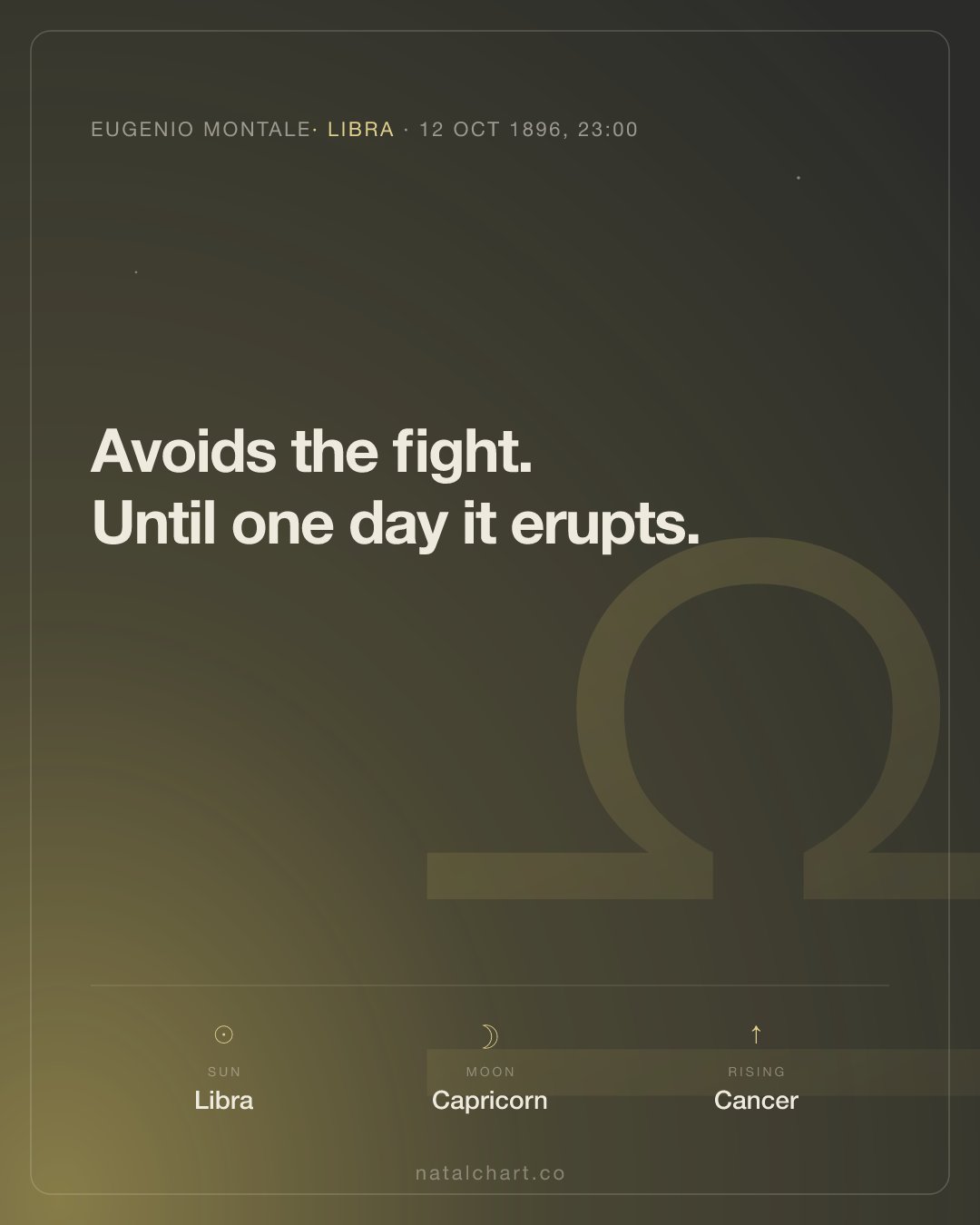
Eugenio Montale's Sun sign is Libra — the Sun was in Libra at birth (1896).
What is Eugenio Montale's moon sign?
Eugenio Montale has the Moon in Capricorn. The Moon sign describes the emotional and instinctive layer of the chart.
What is Eugenio Montale's rising sign?
Eugenio Montale's rising sign (ascendant) is Cancer — the sign on the eastern horizon at the moment of birth.
When and where was Eugenio Montale born?
Eugenio Montale was born in 1896 in Genoa, Italy.