Luciano Pavarotti — natal chart
What does Luciano Pavarotti’s natal chart reveal?
Luciano Pavarotti (1935-2007) was an Italian operatic tenor regarded as among the greatest of his era. Famous for his ringing high notes and charismatic stage presence, he brought opera to mass audiences, notably as one of the Three Tenors, and his signature aria 'Nessun dorma' became globally recognized.
 Share
Share
Birth
1935-10-12 · 01:40 · Modena, Italy Reliability: AA · vetted record
The core: a voice built for the public stage
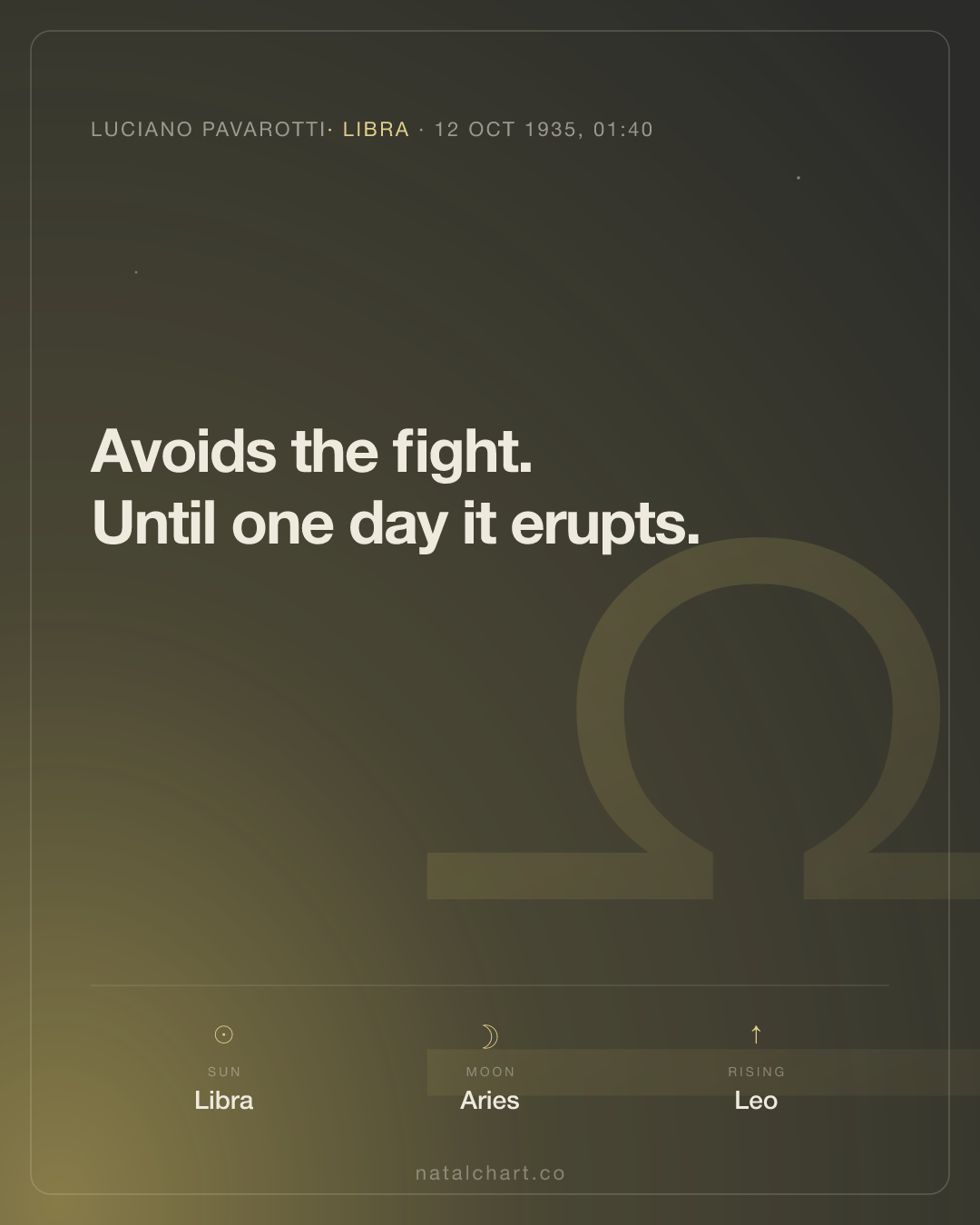
Luciano Pavarotti had the kind of chart that is almost impossible to conceal from the world. The Leo Ascendant — the face he presented to everyone who encountered him — announced itself immediately and completely. Leo rising is magnanimous, warm, built for presence; people in the room feel drawn toward it before a word is spoken. On a concert stage before 250,000 people in Central Park, or in any rehearsal room in Modena, Pavarotti filled the available space. This was not performance — it was nature.
The Sun in Libra in the third house sits at the center of this. Libra is the sign of balance, relationship, and the precise calibration of beauty; the third house is the domain of voice, language, and communication. His entire identity was expressed through his voice and his capacity to create relationship through sound. "Nessun Dorma," the aria from Puccini's Turandot that became his signature, is a piece about holding a note until the world gives way — and Pavarotti held the final high B-flat with an ease that made audiences feel the aria had always existed to be sung by him.
The opposition: passion and performance in productive tension
The Sun in Libra pulls in exactly the opposite direction from the Moon in Aries in the ninth house — a separation of about 2.4°, tight and constant. Sun opposite Moon is not a contradiction to be resolved; it is a motor. The Sun's Libra wants harmony, refinement, the relationship between voices; the Moon's Aries wants fire, immediacy, the moment of impact. In opera, these two impulses are not enemies. The form requires discipline, exact intonation, measured breath control; the performance demands that it feel completely spontaneous and alive. Pavarotti managed both at the same time.
The Moon in the ninth house — the house of foreign lands, expansion, and the wide view — describes someone whose emotional home was never one place. He was born in Modena, became internationally famous, and sang in every major opera house in the world. The Three Tenors concerts (beginning 1990) were a direct expression of this: opera meeting football stadiums, meeting television, meeting the person who had never set foot in a concert hall.
Mercury and Jupiter in Scorpio: depth at the root
Mercury in Scorpio in the fourth house — Mercury governs the mind and communication; the fourth house is the home and the private self — describes a way of thinking that does not stay on the surface. Scorpio wants to know what is actually happening underneath the pleasing exterior. This is not inconsistent with Pavarotti's warm public image; it simply means the charm was backed by a serious intelligence about his craft. He was known to be meticulous about musical preparation even as he projected the ease of someone who found the high C effortless.
Jupiter in Scorpio in the fourth house, joined closely to Mercury, amplifies everything: a large emotional interior, a home life that mattered deeply, a relationship to private experience that was rich and sometimes complicated. These two planets work together easily (Mercury trine Saturn, orbe 3.5°), meaning the depth of mind connected naturally to the discipline required to sustain a career of this scope.
Venus and Neptune in Virgo: precision as devotion
Venus in Virgo in the second house speaks of a relationship to beauty that is also a form of craftsmanship — the pleasure is in the detail being exactly right. The second house governs values and what one holds most dear, and Pavarotti's relationship to his voice was nothing less than devotional: he protected it, studied its mechanics, and understood its limits with the granular attention that Virgo demands. Neptune in Virgo, right beside Venus, adds a layer of idealism — the craft reaching toward something beyond itself, always slightly unattainable.
This is also a chart where the voice was the livelihood in the most literal sense. For Pavarotti, what he valued and what he relied on were the same thing.
Mars in Sagittarius: the joy of the stage
Mars in Sagittarius in the fifth house — the fifth house is creativity, performance, and what one does purely for the love of it — describes a performer whose pleasure was genuine and visible. Sagittarius is expansive, optimistic, drawn toward the grand gesture; Mars is the planet of action and drive. Mars and the Sun work together in easy flow (orbe 0°, the tightest aspect in the entire chart), meaning the drive to act and the central identity were in perfect alignment. He did not perform despite who he was; performing was exactly who he was.
The Moon in Aries also flows easily with Mars (orbe 2.4°). Fire feeding fire: the emotional immediacy of Aries connected directly to the Sagittarian expansiveness of the stage. This is why a Pavarotti performance never felt careful or cautious — even when it was technically impeccable, it felt like risk and joy.
Mars pulling against Neptune: the dream with friction
Mars in Sagittarius pulls against Neptune in Virgo (orbe 2.2°) — the drive toward grand expression pulling against the planet of dissolution, confusion, and the ideal that can never quite be reached. This is not a comfortable pairing. It describes the friction between what one wants to do and what the reality of the body, or the moment, or the dream makes difficult. For a singer, the body is the instrument, and the body is mortal. Pavarotti's career included periods of controversy over questions of what the voice could and could not do across decades — that tension between aspiration and limit is precisely this pairing made biographical.
Uranus in Taurus and the Midheaven: a revolutionary in a formal art
The Midheaven — the point in the natal chart associated with vocation and public legacy — is in Taurus, a sign that prizes beauty, the physical, and what endures. Uranus sits in Taurus in the tenth house. Uranus is the planet of disruption and sudden reorganization; Taurus is the sign that resists change. Pavarotti's greatest contribution was arguably not his singing within the opera world — exceptional as it was — but his decision to take opera outside it. The Three Tenors concerts, the televised Nessun Dorma at the 1990 FIFA World Cup, the collaborations with popular artists: these were all disruptive moves in a tradition-bound medium. He used the weight of the classical form to break its own walls.
Saturn and Uranus work together in easy flow (orbe 0°, equally as tight as the Sun-Mars aspect), meaning discipline and reinvention were never in conflict for him. He could change without losing structure.
Chiron, Saturn, and the North Node: the long arc
Saturn in Pisces in the eighth house — Saturn governs form, time, and earned achievement; Pisces is fluid, resistant to hard edges — describes a tension between the discipline a major singing career requires and the part of the self that wants to dissolve into the music rather than control it. The resolution was not to eliminate the tension but to let both be true: the formal perfection and the surrender.
Chiron — an old wound that, when carried consciously, becomes a source of understanding for others — is in Gemini in the eleventh house, the house of the collective and the audience. The wound here may be about voice itself: the fear of the gap between what one wants to say and what actually comes out. A tenor who spent his life singing for millions left many accounts of genuine stage fright. That anxiety was not despite the gift; it was part of the same root.
The North Node in Capricorn — the point in the natal chart that indicates what one is here to develop — points toward rigor, legacy, and the work that endures beyond the individual moment. Pavarotti's final years included the Pavarotti & Friends charity concerts in Modena, which raised millions for humanitarian causes in Bosnia and Kosovo. The man who sang for pleasure in the fifth house built something that outlasted the individual performances.
A warmth that stayed
Luciano Pavarotti died in 2007 in his hometown of Modena. He had asked that his funeral be held at the Modena Cathedral, where the choir sang Panis Angelicus — the same piece he had sung as a boy in that same choir. Sun in Libra wanted beauty; Leo rising wanted warmth; the Moon in Aries wanted it to be felt. All three got what they came for.
People who heard him live describe something that recordings never quite captured — a physical fullness in the hall that microphones don't transmit. That is appropriate for a chart like his: the part of it that mattered most was always slightly beyond what could be held.
The chart
How to read it →Frequently asked questions
What is Luciano Pavarotti's zodiac sign?
Luciano Pavarotti's Sun sign is Libra — the Sun was in Libra at birth (1935).
What is Luciano Pavarotti's moon sign?
Luciano Pavarotti has the Moon in Aries. The Moon sign describes the emotional and instinctive layer of the chart.
What is Luciano Pavarotti's rising sign?
Luciano Pavarotti's rising sign (ascendant) is Leo — the sign on the eastern horizon at the moment of birth.
When and where was Luciano Pavarotti born?
Luciano Pavarotti was born in 1935 in Modena, Italy.