Michel Foucault — natal chart
What does Michel Foucault’s natal chart reveal?
Michel Foucault (1926-1984) was a French philosopher and historian of ideas born in Poitiers. His studies of power, knowledge and social institutions in works such as 'Discipline and Punish' and 'The History of Sexuality' made him one of the most influential thinkers of the 20th century.
 Share
Share
Birth
1926-10-15 · 07:30 · Poitiers, France Reliability: AA · vetted record
The Man Who Asked What We Take for Granted
Michel Foucault spent his life asking the question nobody else thought to ask: not "is this institution good or bad?" but "how did we come to think this is normal at all?" Prisons, hospitals, schools, the very categories of madness and sexuality — he looked at each one and found not neutral social arrangements but mechanisms through which power defines what counts as a person, as knowledge, as truth. His chart maps a mind built for exactly that kind of work: probing beneath the surface of things, comfortable in the margins, restless with received ideas.
The Face He Presented, the Depths He Concealed
Scorpio was rising at Foucault's birth — this is the Ascendant, the face a person meets the world with, the first impression they give. Scorpio rising means an intense, watchful, not easily readable exterior. People who met Foucault in lecture halls at the Collège de France often described a quality of controlled power: the shaved head, the piercing directness, the sense that he was reading the room while showing nothing of himself. Both Mercury and Saturn sat close to this Ascendant, in the first house: Mercury put an incisive, probing intelligence at the very front of his personality, and Saturn added a quality of seriousness, even severity, that people felt immediately. His intellectual manner was not light or playful in the conventional sense — it was precise, controlled, and deliberate.
His Sun, however, sat in Libra in the twelfth house — the most hidden sector of the chart, the place of solitude, of things worked out in private. For all his public presence and eventual celebrity in French intellectual life, there was a core of his identity that operated well away from the crowd. His most productive years — the long archival research that produced "Madness and Civilization" (1961) and "The Birth of the Clinic" (1963) — were years of quiet, sustained solitary labour in libraries and archives.
The Emotional Life Underneath
The Moon in Aquarius in the fourth house — the fourth house being the most private, domestic, interior zone — describes an emotional interior that was cool, observational, and somewhat detached even from itself. Jupiter shared this house, also in Aquarius: intellectual expansion was a home feeling for Foucault, something that felt safe rather than threatening. He was more at ease exploring an abstract system than sitting with raw feeling, and his writings, for all their moral weight, are notably cerebral in register. This does not mean he was unfeeling — the Moon-Uranus sextile (a flowing, easy connection) brought a genuine excitement for the unconventional and the marginal that was personal, not merely theoretical. His attraction to outsider figures — the mad, the criminal, the sexual dissident — was rooted in this placement.
The Core Tension: Structure Against the Boundless
The tightest aspect in this chart — the one that matters most — is Mars in Taurus in the seventh house at almost exact tension with Jupiter in Aquarius. Mars here is stubborn, thorough, relentless in material terms: once Foucault took hold of a problem, he would not let go. He spent years in Swedish and Polish archives before "Madness and Civilization" was complete. Jupiter in Aquarius pulled in the opposite direction: toward breadth, abstraction, the grand theoretical gesture, the sweeping claim. This tension is productive and visible in the work itself — the meticulous historical detail pulling against the monumental theoretical argument. The books are both fully documented and grandiose. Neither part won; they stayed in friction throughout his career.
Saturn in Scorpio — sharing the first house with Mercury — was in tension with Neptune in Leo in the tenth house (the tenth house is the public and professional zone, the career point of the chart). Neptune here gave his public intellectual persona a quality of almost mythic elusiveness: he resisted being pinned to a single school or label, repeatedly denied being a structuralist or a poststructuralist, and wrote from behind conceptual frameworks that were hard to locate ideologically. Foucault the public figure was, paradoxically, partly a construction he kept deliberately unstable. The Saturn-Neptune tension — disciplined rigour versus deliberate conceptual dissolution — was the engine of that quality.
Venus and the Hidden Self
Venus in Libra in the twelfth house placed the relational self, the aesthetic sense, and the capacity for connection in the most concealed part of the chart. This was not a person who easily made his private attachments part of his public identity. His relationship with Daniel Defert lasted from 1963 until his death in 1984, and while Defert was present throughout — including founding ACT UP France after Foucault's death — Foucault himself remained largely private about this dimension of his life. The twelfth-house Venus-Pluto tension (Venus in an uncomfortable angle with Pluto in Cancer in the ninth) added intensity and difficulty to the relational sphere: connections mattered deeply but were complicated, occasionally destabilising.
The Work and Why It Landed the Way It Did
Neptune in Leo in the tenth house (the public and career point) explains something specific about the reception of Foucault's work. Neptune in this position gives a professional profile that is large, somewhat mythologised, and difficult to pin down — and Leo adds the quality of cultural centrality, of becoming a kind of intellectual figure-in-itself. "Discipline and Punish" (1975) and the first volume of "The History of Sexuality" (1976) were not just academic books; they became cultural events, read in sociology departments and prisons and theatre companies and activist collectives simultaneously. This is Neptune-in-the-tenth territory: the work exceeds its original container.
The Sun-Jupiter trine (a flowing connection) supported this: Libra's concern with frameworks of justice and fairness amplified by Aquarius's reach toward the systemic and the collective produced work that felt simultaneously precise and universal. He was asking about power — which is everyone's lived experience — using tools sharp enough to feel personally relevant.
Chiron and the North Node
Chiron (the old wound that, over time, becomes a distinctive gift) sat in Taurus in the seventh house, the house of the other, of encounters, of how one is met by the world. There was something in the relational dimension of Foucault's experience — his sexuality, his early psychiatric confinement as a young man, his position as an outsider in the French academic establishment before he eventually dominated it — that carried real difficulty. His work on the ways institutions categorise and manage marginal figures was not purely intellectual; it carried the weight of someone who had been on the receiving end of that categorisation.
The North Node in Cancer in the ninth house (the ninth being the house of knowledge systems, of higher learning, of the broad theoretical frame) pointed toward a future orientation: bringing something nourishing, rooted, and humane into the domain of ideas — not just critique but a kind of care for those who had been excluded from official knowledge. His later lectures and interviews, particularly those toward the end of his life, moved in exactly this direction: from genealogy of power to the ethics of the self, from critique to something more like cultivation.
The Closing Note
Foucault died in 1984 at fifty-seven, before much of what he set in motion had fully landed. The ideas in "The History of Sexuality" are still being argued over; "Discipline and Punish" is still taught in criminology, education, and philosophy departments worldwide. What his chart shows is not a man who was trying to be influential — the twelfth-house Sun and hidden Venus suggest someone who thought deeply in private and put the results into the world — but rather one whose particular configuration of driving tension, probing intelligence, and disciplined scrutiny of the taken-for-granted produced work that outlasted him cleanly. The wound and the gift were the same thing: the experience of being categorised made him the sharpest analyst of how categorisation works.
The chart
How to read it →Frequently asked questions
What is Michel Foucault's zodiac sign?
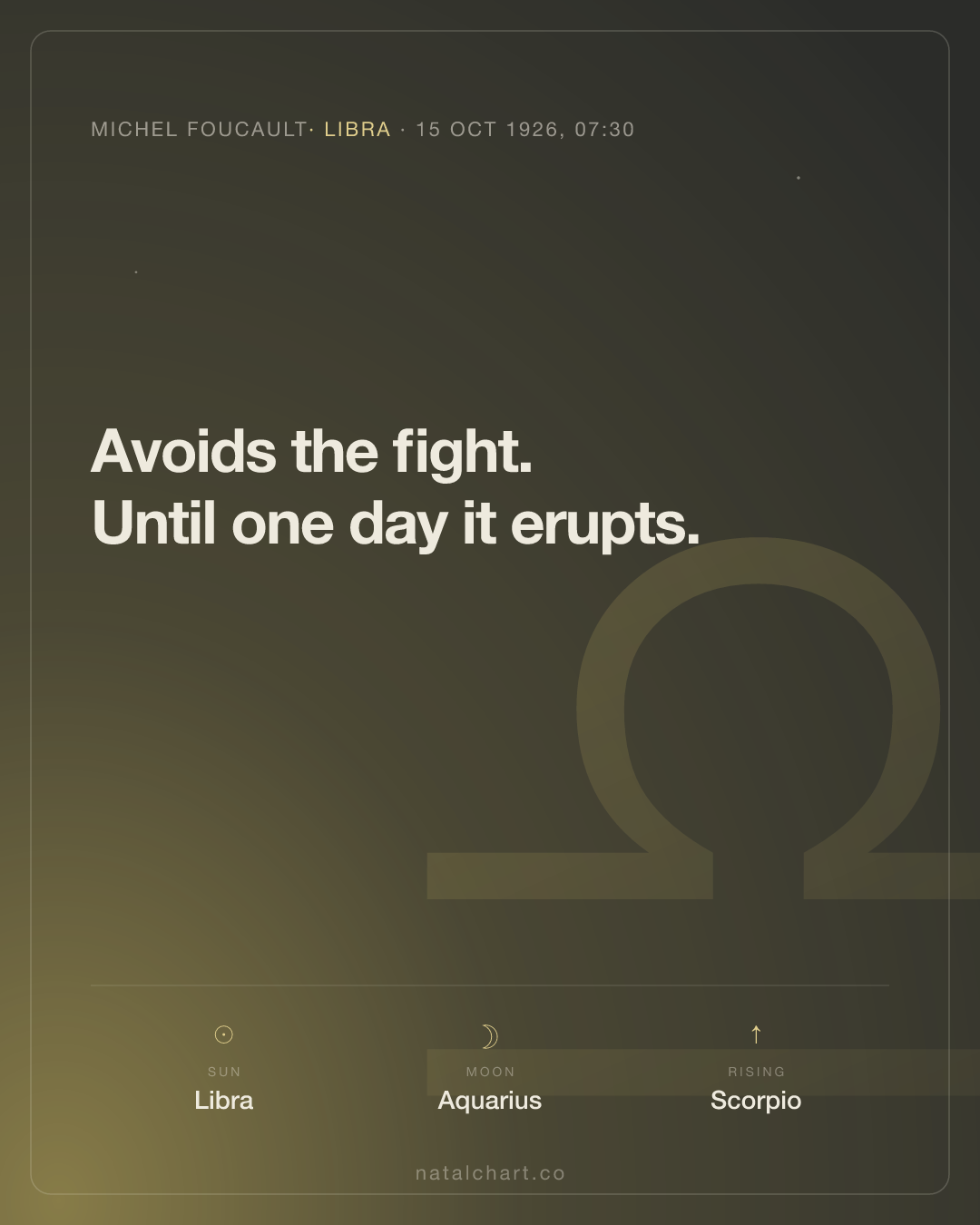
Michel Foucault's Sun sign is Libra — the Sun was in Libra at birth (1926).
What is Michel Foucault's moon sign?
Michel Foucault has the Moon in Aquarius. The Moon sign describes the emotional and instinctive layer of the chart.
What is Michel Foucault's rising sign?
Michel Foucault's rising sign (ascendant) is Scorpio — the sign on the eastern horizon at the moment of birth.
When and where was Michel Foucault born?
Michel Foucault was born in 1926 in Poitiers, France.