Oscar Wilde — natal chart
What does Oscar Wilde’s natal chart reveal?
Irish writer and playwright. Author of The Picture of Dorian Gray (1890), The Importance of Being Earnest (1895) and Salomé (1893). Convicted in 1895 for homosexuality. Died in Paris in 1900 at 46.
 Share
Share
Birth
1854-10-16 · 03:25 · Dublin, Ireland Reliability: AA · vetted record
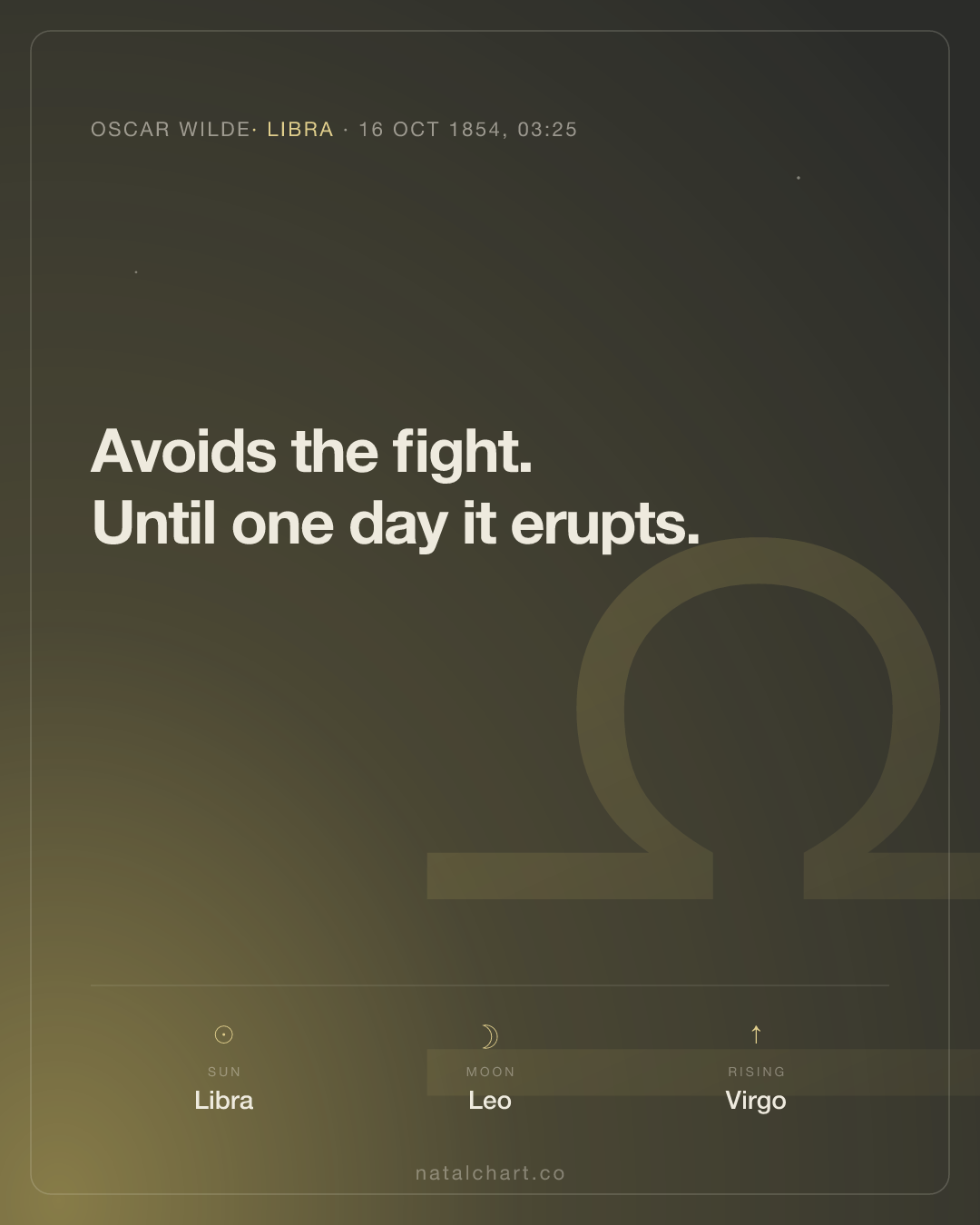
Libra Sun and Virgo Ascendant: Style as Substance
Oscar Wilde arrived in the world on 16 October 1854 with a Virgo Ascendant — the face he showed the world, the first impression — and a Libra Sun in the second house at his core. Virgo rising shapes a person of sharp critical faculties, someone who notices the poorly chosen word, the clumsy construction, the aesthetic misstep. Wilde notoriously corrected his proofs with the care of a craftsman: a famous story has him spending a morning inserting a comma, then an afternoon removing it. This was not affectation — it was Virgo Ascendant expressing itself. The Libra Sun in the second house adds another layer: Libra lives for beauty, for balance, for the elegant formulation; the second house ties identity to values and material worth. For Wilde, the beautiful phrase, the well-cut coat, the perfectly appointed drawing room were not frivolities. They were the things one was here to pursue.
Mercury Trine Neptune: The Imagination of Language
The tightest aspect in Wilde's chart — Mercury in Scorpio trine Neptune in Pisces, with an extraordinary margin of only 0.2 degrees — is the astrological fact that explains his literary genius most directly. A trine is an easy flow between two planets; Mercury governs words, thought, and communication; Neptune governs imagination, myth, and the dissolving of literal boundaries. When these two planets flow together this closely, language becomes a vehicle for something beyond the merely literal. The Picture of Dorian Gray (1890) is the obvious expression: a novel about a portrait that ages while its subject stays young is not a story about painting. It is a meditation on vanity, corruption, and the hidden cost of the beautiful life. The wit in the plays — The Importance of Being Earnest (1895) above all — operates on the same principle: every epigram says one thing on its surface and something else entirely underneath. The phrase sounds like a joke; the thought cuts like a knife.
Moon in Leo, Twelfth House: The Performer in the Dark
Wilde's Moon in Leo in the twelfth house is one of the most poignant placements in his chart. The Moon describes the emotional interior, the instinctual self. Leo wants recognition, wants to be seen, wants the warmth of an appreciative audience. The twelfth house is the domain of what is hidden — kept from public view, worked out in private, sometimes suppressed. This Moon wanted desperately to perform its identity openly, but the twelfth house kept that inner life in the shadows. In Wilde's era, and under the laws that convicted him in 1895 for "gross indecency," who he truly was could never be fully shown in public. The most private self — the one the Moon in Leo most urgently wanted to express — was the very self the law forbade. The twelfth house Moon also connects to institutions and confinement: he was imprisoned in Reading Gaol from 1895 to 1897, and the work that emerged from that darkness, The Ballad of Reading Gaol (1898), is one of the most direct expressions of emotion in his entire output.
Venus in Libra: Beauty as a Moral Position
Venus in Libra in the second house is a classical placement for an aesthete. Venus rules both Libra and the second house by association; when placed in its own sign in the house of values, the planet amplifies its core meaning to the point where it defines the person's entire relationship to the world. For Wilde, beauty was not a preference — it was a moral system. His 1882 lecture tour of America, where he proclaimed the doctrine of Aestheticism — that art exists for its own sake and needs no utilitarian justification — was a statement of this Venus in Libra at its most declarative. It was also, incidentally, a great commercial success: he lectured 140 times to packed houses, which the second house would have appreciated.
Saturn in Gemini at the Midheaven: The Career Built on Words
The Midheaven (the highest point in the chart, the zone of public vocation and reputation) is in Gemini, with Saturn positioned there. Gemini rules language, duality, and communication in all its forms. Saturn brings structure, discipline, and long-term consequence. A career built entirely on writing, speaking, and the manipulation of language — plays, novels, poems, criticism, letters, lectures — is exactly what Saturn in Gemini at the Midheaven describes. Saturn also brings its heavier signature: reputation won slowly and lost suddenly. Wilde's public standing collapsed with near-total speed in 1895. Saturn at the Midheaven in square to Neptune — a tension of 2 degrees — suggests an inherent friction between the public image and something elusive or undisclosed underneath. The man who wrote social comedies about nothing more threatening than cucumber sandwiches was living a private life that Victorian law defined as criminal.
Mercury in Scorpio, Third House: The Weapon of Wit
Mercury in Scorpio in the third house gives Wilde's thinking its characteristic quality: depth of penetration, psychological exactness, the ability to say the unsayable with the lightest touch. Scorpio does not skim the surface. Its Mercury goes for the hidden truth, the thing no one is saying out loud. The third house governs communication, writing, and the exchange of ideas. When Mercury sits here in Scorpio, conversation becomes an act of surgical precision. "The truth is rarely pure and never simple" — the kind of line that sounds offhand but lands with the weight of a diagnosis — is Mercury in Scorpio doing exactly what it does. The opposition between this Mercury and Uranus (2.2 degrees) adds a further charge: ideas arrive suddenly, at odd angles, in defiance of expectation. Wilde's best lines come from nowhere and explain everything.
Jupiter in Capricorn, Fifth House: The Creative Investment
Jupiter in Capricorn in the fifth house describes creative work approached with serious intent and methodical ambition. The fifth house covers artistic creation, play, and performance. Jupiter expands whatever it touches; Capricorn keeps it purposeful and oriented toward results. Wilde wrote for the stage with a craftsman's discipline: The Importance of Being Earnest was completed in a fortnight, but the precision of its construction suggests years of accumulated skill. Jupiter in square to the Libra Sun (3.2 degrees) — a tension between expansion and the need for aesthetic balance — suggests that Wilde's creative ambition sometimes pulled against his desire for perfect form. The plays that worked best were the ones where these two impulses found their accommodation.
Chiron in Pisces, Seventh House: The Wound in the Other
Chiron (the astrological marker of an old wound that becomes, over time, a source of wisdom) falls in Pisces in the seventh house, the house of significant relationships and public encounters. Chiron in Pisces in the seventh carries the wound of idealized love — love that dissolves boundaries, that merges identities, that cannot survive the test of ordinary reality. The relationship with Lord Alfred Douglas, which led directly to the catastrophic 1895 trials, was this placement made visible. Wilde knew, or should have known, that Douglas's nature would bring ruin; he stayed because Chiron in the seventh house sometimes needs to live through the wound in order to understand it. The great compassion that informs De Profundis (written in prison, 1897) — a long letter to Douglas that became a meditation on suffering and forgiveness — was the gift that emerged from the wound.
Moon Square Uranus and Sextile Saturn: The Emotional Architecture
Two aspects cluster around the Leo Moon with remarkable precision: a square (tension) with Uranus of only 0.3 degrees, and a sextile (an easy flow) with Saturn of the same closeness. The square with Uranus in Taurus charges the emotional life with a need for radical independence — a refusal to be confined, an instinct to shock, an impatience with conventional feeling. Wilde's public persona operated exactly this way: the outrageous statement, the deliberate provocation, the refusal of bourgeois respectability. The sextile with Saturn at the same time gave that same emotional life a structural backbone: the discipline to shape impulse into form, to convert feeling into art. Without the Uranian charge, there would have been no provocation; without the Saturnian structure, there would have been no form.
North Node in Taurus: What Was Left Behind
The North Node (the point in a chart that marks the direction of growth) is in Taurus — the sign of earthly pleasure, material stability, and the patient accumulation of the good things in life. Taurus asks for groundedness, for roots, for the long-term tending of what one has. Wilde's biography reads as a cautionary counterpoint: the man who understood material beauty better than almost anyone of his era died penniless in a Paris hotel room in November 1900, having spent his final years in exile and near-destitution. The North Node is not a guarantee of arrival — it is a compass bearing. His literary reputation took decades after his death to be fully restored. That restoration, slow and permanent, is the North Node finally claiming its ground.
A Portrait That Will Not Age
Oscar Wilde died on 30 November 1900 at forty-six, in Paris. The trajectory of his life is almost unbearably dramatic — the rise, the fall, the exile, the early death. But the chart suggests something the biography sometimes obscures: the literary work was not an accident of circumstance. Mercury trine Neptune at 0.2 degrees, Saturn at the Midheaven in Gemini, Venus in Libra in the second house — these are the marks of a writer whose relationship to language was constitutive, not decorative. He did not write well in spite of his life; the writing and the life were the same thing, looked at from different angles. The epigrams still circulate, still sting, still make their point. Dorian Gray's portrait hangs on a wall that does not age.
The chart
How to read it →Frequently asked questions
What is Oscar Wilde's zodiac sign?
Oscar Wilde's Sun sign is Libra — the Sun was in Libra at birth (1854).
What is Oscar Wilde's moon sign?
Oscar Wilde has the Moon in Leo. The Moon sign describes the emotional and instinctive layer of the chart.
What is Oscar Wilde's rising sign?
Oscar Wilde's rising sign (ascendant) is Virgo — the sign on the eastern horizon at the moment of birth.
When and where was Oscar Wilde born?
Oscar Wilde was born in 1854 in Dublin, Ireland.