Serena Williams — natal chart
What does Serena Williams’s natal chart reveal?
American tennis player, 23 individual Grand Slams in the Open Era, the all-time record. Four Olympic golds. World number one for 319 weeks. Younger sister of Venus Williams. Retired from the tour in 2022 at 40.
 Share
Share
Birth
1981-09-26 · 20:28 · Saginaw, Michigan Reliability: AA · vetted record
The core: the labour of excellence
Serena Williams didn't arrive at the top of world tennis by luck or natural ease — she got there through a combination of relentless application and an almost unusual emotional investment in every match, every drill, every point. Her birth chart shows exactly this. The Taurus Ascendant — the sign of sustained physical effort, of building something that lasts, of earning through the body — is the face she met the world with from the start. Taurus on the horizon means the first impression is one of quiet, grounded solidity: she didn't announce herself with flash, she announced herself by showing up and delivering.
But that Taurus surface holds something far more complicated underneath. The Sun, Mercury, Jupiter, Saturn, and Pluto are all gathered in Libra in the 6th house — the house of daily work, discipline, craft, and the service rendered through expertise. Five planets in the same sign and house is an extraordinary concentration, all pointing in one direction: the pursuit of excellence as a daily practice, not as a destination reached once and remembered. Libra brings the sense of balance, fairness, and competition as a form of artistry; the 6th house brings the idea that greatness is earned in the training session before dawn, not at the victory ceremony. This is a person for whom the work is never finished, the standard is never fully met, the preparation is never quite complete.
The Moon: emotional precision behind the power
The Moon in Virgo in the 5th house describes an emotional interior that functions through fine-grained analysis and a very high internal bar. Williams has spoken openly about the pressure she placed on herself — the psychological demands she made that had nothing to do with what anyone else expected. In Virgo, the Moon carries a constant internal monitoring: a background process that checks whether things are being done correctly, that identifies errors even in apparent victories.
In the 5th house — the sector of performance, of the arena, of play — this Moon found its most natural expression. Williams was not just physically dominant on court; she was emotionally precise. The way she read an opponent's patterns, the way she adjusted mid-match, the way she recovered from a service break — these were not purely athletic qualities, they were the products of a Virgo Moon that processed emotional information with the same rigor it applied to everything else. The Moon in tension with Neptune adds a layer of heightened sensitivity, an imagination that could amplify pressure into something larger than itself. The mental battles Williams described throughout her career — the moments when doubt crept in — came from this Moon.
Venus and Mars: the defining tension
The tightest aspect in the whole chart — less than a degree of separation — is Venus in Scorpio in the 7th house in tension with Mars in Leo in the 4th house. This is the central knot of the chart, and it explains a great deal about how Williams competed.
Venus in Scorpio in the 7th house, which concerns one-on-one relationships and direct opponents, brings an intense, all-or-nothing approach to competition. For Scorpio, the match is never just a match — it carries an undertow of stakes, of identity, of something that must be won completely or it is lost completely. This is the placement of someone who makes every point personal, who cannot entirely separate the score from the self. And Mars in Leo in the 4th house is fiercely proud, rooted in a deep sense of what is owed, of what must be defended in the name of home, family, and self-respect. When these two planets are in tension, the competitive drive is enormous — but it is also emotionally demanding, because winning feels necessary rather than simply satisfying.
The moments when Williams clashed with officials, when she expressed her outrage publicly on court, came from this configuration. It was not theatrics: it was the collision between a Scorpio Venus that reads situations as deeply meaningful and a Leo Mars that cannot stand what it perceives as disrespect. Recognising this dynamic — the genuine depth of feeling behind each eruption — helps explain why her competitors found her so relentlessly difficult to play against. The match was always about more than tennis.
Mercury and the mind: the argument that wins
Mercury in Libra in the 6th house, though relatively far from Pluto in terms of degree, still describes a mind that weighs, compares, and looks for structural patterns. Libra Mercury reasons by comparison: who is stronger here, what am I doing that is working, where is the imbalance I can exploit? In the 6th house, this thinking is applied moment by moment, in real time, as a craft skill rather than a theoretical exercise.
Williams was never just a baseline slugger — she thought tactically, adjusted game plans, and found angles on opponents that had nothing to do with brute power. Off the court, Mercury in Libra describes someone who weighs arguments carefully, who speaks about fairness and equity in measured terms. Her public statements on race, pay equality, and the treatment of women in sport were never careless — they were thought through, placed carefully, designed to be heard.
Jupiter and Saturn: building the empire
Jupiter and Saturn are both in Libra in the 6th house, in close company with the Sun, Mercury, and Pluto. This is a rare and powerful stellium — five planets occupying the same house and sign — and in the 6th house, it speaks to a life organised around professional excellence and the discipline of sustained effort.
Jupiter in Libra expands through balance and through the experience of direct competition — each new opponent was also an opportunity, a stimulus for growth. Saturn in Libra, which functions particularly well in this sign, brings the capacity to compete with long-term patience: to lose a set and trust the system, to come back from injury and rebuild. Saturn is also the planet of the career arc, and Williams's arc is extraordinary in its length and consistency — world number one at 23, at 35, and again at 36. Saturn in easy flow with Mars in Leo adds a further layer: the discipline and the competitive fire worked together rather than against each other.
Outer planets and the generation she transcended
Uranus and Neptune in Scorpio in the 7th house describe a generation shaped by intensity and hidden complexity in relationships and direct confrontations. But for Williams, these planets in the 7th house also spoke to the opponents she faced across the net: Scorpio brings encounters that transform both parties, that cannot be walked away from lightly.
Neptune in Sagittarius in the 8th house adds something less immediately visible but deeply present: an intuition about what lies beneath the surface of a match, a felt sense of when to press and when to wait. The 8th house is the sector of what is not said, of psychological territory, and Williams navigated that territory with an instinct that went beyond training.
The Midheaven: building a legacy
The Midheaven — the career and public reputation point at the top of the chart — is in Capricorn. Capricorn at the Midheaven describes someone whose reputation is built slowly, through demonstrated ability over time, and whose achievements become more impressive the longer the career runs. This is not the placement of a shooting star; it is the placement of a monument.
Williams's 23 Grand Slam titles in the Open Era were not accumulated in one spectacular run — they arrived over more than two decades, the last of them in 2017 while she was eight weeks pregnant, a detail that itself captures the Capricorn Midheaven perfectly. The Midheaven in Capricorn also speaks to the way she built outside tennis: the fashion lines, the ownership stakes in the Miami Dolphins, the venture capital work through Serena Ventures. The career arc was always pointing toward institution-building, not just athletic achievement.
Chiron: the body as the site of the gift
Chiron — a point in the chart that marks an old vulnerability that gradually becomes a person's most distinctive gift — is in Taurus in the 1st house, conjunct the Taurus Ascendant. In Taurus, Chiron's wound is physical, embodied: it lives in the body, in questions of physical sufficiency, in the experience of the body as both the source of power and the site of vulnerability.
Williams's relationship with her physical body has been both her greatest asset and a recurring source of difficulty — the knee surgeries, the Achilles injury that forced her retirement announcement, and most alarmingly, the pulmonary embolism and blood clots following the birth of her daughter in 2017, which she has spoken about with striking directness. The body was the arena in which the wound and the gift were always the same thing. Chiron in Taurus in the 1st house says: the path through the vulnerability is exactly the same as the path toward the gift. You cannot separate the strength from the fragility.
The North Node in Cancer points toward the direction of greatest growth: toward nurture, emotional roots, family as foundation rather than distraction. The retirement announcement Williams made in the summer of 2022 — framed explicitly as a choice to invest in her family and the possibility of a second child — was one of the most direct expressions of this North Node possible.
The portrait that emerges
Serena Williams carried, throughout her career, the weight of expectations that were never just about tennis. She competed at the intersection of race, gender, and sporting history in ways that most athletes are never required to. Her chart reflects that weight: the Scorpio Venus that made everything personal, the Virgo Moon that could never quite switch off the internal monitor, the Capricorn Midheaven that asked her to keep building even when the body said otherwise.
But the chart also shows the capacity that made it possible: the Taurus Ascendant that could take a hit and come back to the baseline, the Libra stellium that turned daily discipline into art, the Mars in Leo that refused to concede that any situation was beyond recovery. What she built — 23 Grand Slams, four Olympic golds, 319 weeks at number one — is a structure that will not be dismantled. The Capricorn Midheaven asked for a monument, and she delivered one.
The chart
How to read it →Frequently asked questions
What is Serena Williams's zodiac sign?
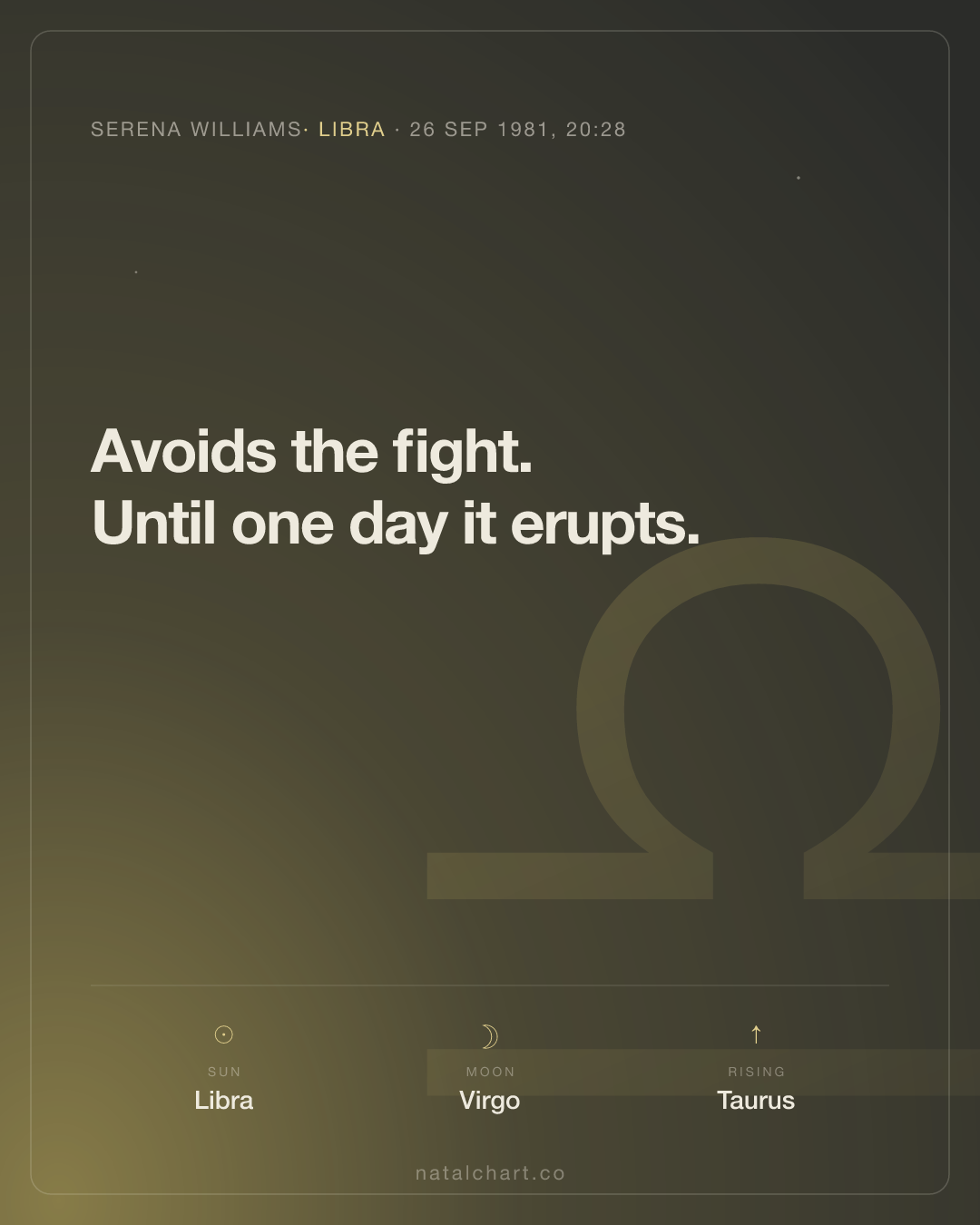
Serena Williams's Sun sign is Libra — the Sun was in Libra at birth (1981).
What is Serena Williams's moon sign?
Serena Williams has the Moon in Virgo. The Moon sign describes the emotional and instinctive layer of the chart.
What is Serena Williams's rising sign?
Serena Williams's rising sign (ascendant) is Taurus — the sign on the eastern horizon at the moment of birth.
When and where was Serena Williams born?
Serena Williams was born in 1981 in Saginaw, Michigan.