Vinicius de Moraes — natal chart
What does Vinicius de Moraes’s natal chart reveal?
Vinicius de Moraes (1913-1980), born Marcus Vinicius da Cruz de Mello Moraes in Rio de Janeiro, was a Brazilian poet, lyricist, playwright and career diplomat. He graduated in law in 1933 and joined the Brazilian foreign service, serving in cities including Los Angeles, Paris and Montevideo. His early poetry collections, such as 'O Caminho para a Distância' (1933) and 'Cinco Elegias' (1943), gave way to more sensual, accessible verse. His 1956 play 'Orfeu da Conceição' inspired the 1959 film 'Orpheus' (Black Orpheus), which won the Academy Award for Best Foreign Language Film. A central figure of bossa nova, he collaborated with Antônio Carlos Jobim on 'Garota de Ipanema' (The Girl from Ipanema, 1962) and many other standards, and later partnered with Toquinho. His songbook and poems remain widely performed and studied.
 Share
Share
Birth
1913-10-19 · 05:10 · Rio de Janeiro, Brazil Reliability: A · reliable data
The core: beauty as a way of thinking
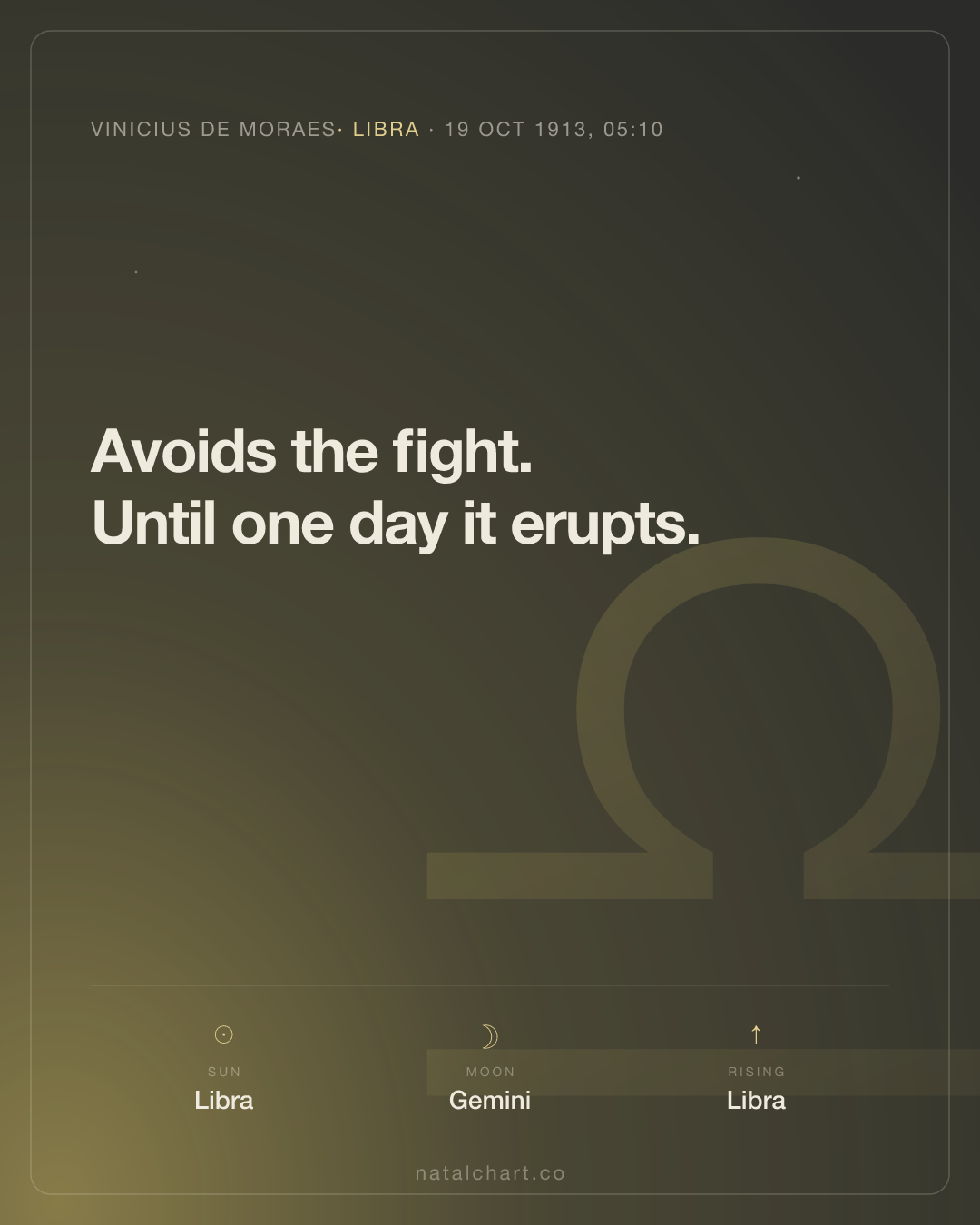
Vinicius de Moraes had a Libra Sun and a Libra Ascendant — the same sign on the surface and at the center, which means that what the world saw (the charm, the ease, the instinct for harmony) was not a performance but the thing itself. Libra is the sign of balance, of relationship, of the conviction that beauty and truth can coexist in the same phrase. For a man who wrote love sonnets in the morning and legal briefs in the afternoon, and who then spent his evenings composing bossa nova with Antônio Carlos Jobim, this was less a contradiction than a single coherent project. Everything he touched had the quality of an attempt to reconcile: the erotic and the lyrical, the popular and the elevated, the diplomatic and the bohemian.
The Moon: a mind that needed movement
The Moon in Gemini in the ninth house (the house of travel, foreign places, and the expansion of the mind through encounter with what is different) describes an emotional life that ran on variety, conversation, and discovery. Vinicius worked as a diplomat in Los Angeles, Paris, and Montevideo before the bossa nova years. Those postings were not interruptions of his literary life; they fed it. The Moon in Gemini needs to move and to talk — it gathers experience from everywhere and reassembles it into something new. Saturn is also in Gemini, alongside the Moon, which adds discipline and structure to that restlessness: the ease of conversation backed by real study, the lyric line polished until it holds. The combination produced a writer who was fluent in French literature (he translated and absorbed it), conversant in cinema (the screenplay for Black Orpheus came from his 1956 play Orfeu da Conceição), and still able to write a bossa nova lyric light enough to float.
Mercury: the word as instrument
Mercury in Scorpio in the second house is a placement that takes language seriously as a material possession — something you build, accumulate, and deploy with precision. Scorpio brings depth and an instinct for what lies beneath the obvious; the second house brings craft and the sense that words are things of value that must earn their place. The near-exact trine between Mercury and Mars (an easy, productive link) amplifies this: the thinking and the doing run together without friction, which is what allows a poet-diplomat to move between a formal demarche in the morning and a samba lyric in the afternoon without losing the thread of either. Vinicius was never a dilettante playing at both roles; he was someone whose mind genuinely operated at that intersection.
Venus: love and art through the hidden door
Venus in Virgo in the twelfth house is the subtlest placement in the chart. The twelfth house is the space of what remains unseen, of the private interior that never quite makes it into the public version of oneself. Venus here does not love loudly or display its affections for effect; it refines them, worries over them, seeks the detail that makes the feeling true. Virgo is the sign of precision and of service, of getting the small things right because the small things are what hold larger ones together. "Garota de Ipanema" — one of the most performed songs in the history of recorded music — is not a declaration of conquest; it is an observation, patient and precise, of something beautiful passing by. That is Venus in Virgo in the twelfth house: the feeling fully present, the declaration withheld.
The sextile between Venus and Neptune (the planet of imagination and art) is almost exact — barely half a degree of separation — and it marks one of the most gifted artistic configurations in the chart. Neptune in the tenth house (the public, professional zone) means the imagination was not private but productive, not a retreat from the world but an engagement with it. The combination with Venus produced a sensibility that could make the aesthetic and the emotional inseparable — which is exactly what bossa nova required.
Venus in tension with Pluto (a pull between the graceful surface and the transformative force underneath) explains the darkness that runs through his love poetry even when the melody is light. The sonnets he wrote in the 1940s and 1950s are love poems, yes, but they are also poems about loss, about the way beauty passes, about the cost of feeling things at full intensity.
Mars: public vocation and the drive to make things happen
Mars in Cancer in the tenth house (the house of public life and professional standing) sits alongside Neptune and Pluto — a convergence of drive, imagination, and transformative force in the most visible part of the chart. Mars here acts through feeling and through care; Cancer makes the ambition personal and relational rather than cold. The tenth house wants a public role, and Vinicius had several at once: diplomat, playwright, poet, lyricist. The Mars-Neptune pairing in this public zone describes an artist who built institutions as much as works — bossa nova was not just a collection of songs but a cultural movement, and he was one of its architects.
The tension between Mars and Jupiter (an opposition, meaning the two planets pull against each other from opposite ends of the chart) sets a recurring pattern of expansion checked by caution, or ambition meeting the limits of institutional life. The Brazilian Foreign Service was both his support and his constraint; the tension between the two eventually resolved when he left the diplomatic career to devote himself entirely to music and performance.
The Midheaven and vocation: a Cancer career
The Midheaven — the public and career point of the natal chart — falls in Cancer, the sign of care, of the maternal, of the home and the feeling of belonging. For Vinicius, this translated into a body of work that consistently returned to the themes of love, the city of Rio de Janeiro, the body, and the ordinary pleasures of human life. His most enduring work — "Garota de Ipanema," "A Felicidade," the Orfeu material — is not about power or ambition but about tenderness. Cancer at the Midheaven suggests that the lasting professional legacy is one of emotional warmth, and that is precisely what his reputation rests on. The convergence of Mars, Neptune, and Pluto all in Cancer in the tenth house amplifies this many times over.
Jupiter and Saturn: the architecture of a life
Jupiter in Capricorn in the fourth house (the house of roots, home, and private life) is a placement that builds quietly and over time rather than in rapid bursts. Capricorn is the sign of patience and of the long project; the fourth house is the private foundation beneath the public career. Vinicius spent decades building his body of work — the early symbolist poems, the transition to a more accessible style, the bossa nova collaboration with Jobim, the later partnership with Toquinho — and each phase was a consolidation of what came before rather than a break from it.
Saturn in Gemini in the ninth house, alongside the Moon, brings structure to the restless travel and the gathering of foreign influences. The years in Los Angeles and Paris were not wandering; they were study, and the discipline of the foreign service gave formal shape to what might otherwise have remained scattered.
Chiron and the North Node: the thread that runs through
Chiron (the old wound that becomes, over time, a gift one can offer others) falls in Pisces in the sixth house, alongside Lilith. The sixth house concerns daily work and health; Pisces is the sign most associated with dissolution, with the blurring of boundaries. The wound here is something like the difficulty of sustaining routine in the face of a sensibility that is fundamentally porous to the world — and the gift is exactly that porousness, turned into a craft. The daily discipline of writing, of diplomatic service, of musical collaboration with the most exacting composer of his generation (Jobim was famous for his precision) was the structure that held the openness in place.
The North Node in Pisces — the direction in which a life grows over time — points toward compassion, surrender, and the willingness to dissolve the boundary between self and other in service of something larger. His most famous works ask the listener to do exactly that: to feel the beauty, to be moved, to let the distinction between the song and the person hearing it briefly disappear.
The close: the girl keeps walking
The girl from Ipanema walks to the sea and does not look back. The observer watches, is moved, and turns the observation into something that sixty years later is still being sung in every language. That is the precise signature of this chart: a Libra Sun that cannot not notice beauty, a Venus in the twelfth house that turns private feeling into art rather than declaration, a Mercury-Mars trine that makes the craft effortless, and a Cancer Midheaven that ensures the whole project is about tenderness rather than self-promotion. Vinicius de Moraes built, over a long life, a body of work so grounded in the pleasure of being alive and the pain of loving that it has become almost impossible to separate from the culture that produced it. That is a rare kind of permanence.
The chart
How to read it →Frequently asked questions
What is Vinicius de Moraes's zodiac sign?
Vinicius de Moraes's Sun sign is Libra — the Sun was in Libra at birth (1913).
What is Vinicius de Moraes's moon sign?
Vinicius de Moraes has the Moon in Gemini. The Moon sign describes the emotional and instinctive layer of the chart.
What is Vinicius de Moraes's rising sign?
Vinicius de Moraes's rising sign (ascendant) is Libra — the sign on the eastern horizon at the moment of birth.
When and where was Vinicius de Moraes born?
Vinicius de Moraes was born in 1913 in Rio de Janeiro, Brazil.