Whitney Houston — natal chart
What does Whitney Houston’s natal chart reveal?
American pop, R&B and soul singer. Her self-titled debut (1985) and Whitney (1987) broke records. Voice behind I Will Always Love You in The Bodyguard (1992). Niece of Dionne Warwick. Died in 2012 at 48.
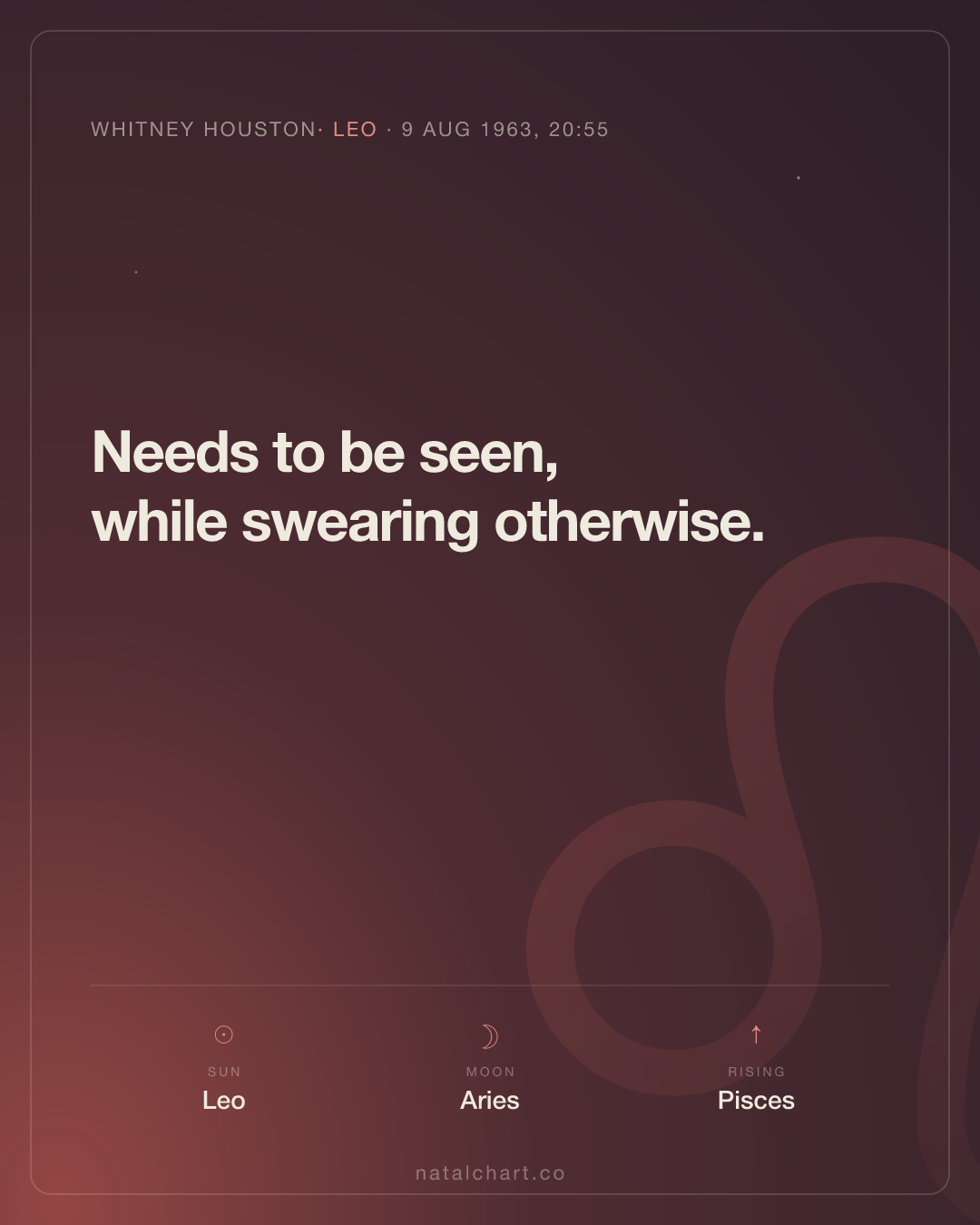 Share
Share
Birth
1963-08-09 · 20:55 · Newark, New Jersey Reliability: AA · vetted record
The Voice That Lived Where Most People Only Dream
Some singers have a voice. Whitney Houston had a voice that made other singers stop and listen, a phenomenon so outsized it reshaped what pop music thought was possible. But the chart behind that voice tells a quieter and more complicated story — a person built for excellence and love, carrying a private weight that the lights never fully dissolved.
Pisces Rising: the world met a dream, not a person
The Ascendant describes the face a person meets the world with, the first impression they make and the armor they wear. Whitney's was Pisces — the most porous, empathic, and boundary-dissolving of all rising signs. To the public she seemed almost celestial: fluid, luminous, open. This was real. But Pisces rising also means the person inside is easily swamped by others' needs, easily absorbed into whatever environment surrounds them. There was always a gap between how large Whitney appeared and how exposed she felt. Chiron — a point that marks an old wound that can become a gift when it's worked through — was in Pisces in the first house, right on that Ascendant. The gift was unmistakable (that voice, that presence). The wound ran underneath it: a lifelong question of whether the real person was seen, loved, or simply consumed by a world that needed her to keep performing.
Sun in Leo, house 6: devotion to the work
Her Sun — the core of identity, the life-force — was in Leo. Leo wants to shine, to give, to be the warmth in the room. Paired with Venus, also in Leo and in the sixth house (the house of craft, discipline, and daily effort), this is less about ego and more about an almost devotional relationship to excellence. The sixth house is where you show up, put in the hours, and do it again. Whitney's vocal technique was extraordinary — not raw talent left untrained but something she practiced and refined from childhood through her years at the New Hope Baptist Church in Newark. The Leo Sun gave her the radiance; the sixth-house placement gave her the work ethic. She didn't just have the voice; she prepared the voice.
Moon in Aries, house 2: the hunger to matter
The Moon shows the emotional interior — what a person needs to feel safe and whole. Whitney's Moon was in Aries in the second house. Aries Moons move fast emotionally: they feel things fully, right now, and they need to act on that feeling. In the second house — the house of self-worth, possessions, and the question "do I have enough?" — that drive takes on a specific color: a deep need to establish her own value on her own terms. The Moon in Aries was also conjunct Jupiter (these two were very close together in the chart), which amplifies everything: emotions bigger, needs louder, confidence higher, and the lows correspondingly harder. The Sun and Moon in easy flow with each other (Sun in Leo trine Moon in Aries, the tightest aspect in the chart) gave her an unusual internal coherence — most people feel a gap between who they project and who they feel themselves to be. For Whitney, those two things mostly aligned. When she was performing, she was whole.
Mercury conjunct Pluto: a mind that went deep
Mercury (the way a person thinks, communicates, and processes information) was in Virgo in the seventh house. Virgo Mercury is precise, analytical, and critical — it hears the flat note before anyone else, it notices the small mistake, it holds itself to a standard that can feel impossibly high. Closely joined with Pluto, the planet of depth and transformation, this Mercury didn't just observe — it went underneath things, felt their weight, understood their shadow. She was known among musicians and producers as deeply involved in her own work: not simply a vessel for a song but someone who understood arrangement, who understood what a lyric needed. That Mercury-Pluto conjunction in Virgo also sextiled Neptune (an easy-flowing connection that opened a channel to something more intuitive and transcendent) — which is why her technical precision never came out sounding clinical. She could hit the mathematically exact note and make it feel like a prayer.
Venus in Leo: love as a grand performance of loyalty
Venus describes what a person values and how they love. In Leo, love is generous, devoted, and theatrical — it wants to be the great love story, the grand gesture, the unforgettable declaration. "I Will Always Love You" — a song already perfect in Dolly Parton's original — became something entirely different in Whitney's hands, not because she changed the words but because Leo Venus meant every syllable. The sustained note at the climax isn't a display of technical power; it's a declaration. Venus in Leo also wants love to be reciprocated with equal heat and loyalty, which can make relationships complicated: the standard is simply very high.
Venus was in tension with Neptune (a 1.7-degree square, one of the tighter hard aspects in the chart). Neptune softens edges, dissolves boundaries, makes the ordinary feel like enchantment. In tension with Venus, it means love can be idealized past the point of reality — the person in front of you becomes a projection of everything you need love to be. This aspect is about the gap between the love that's dreamed and the love that's livable.
Saturn in Aquarius, house 12: the weight kept hidden
Saturn — the planet of discipline, structure, and where a person carries their heaviest lessons — was in Aquarius in the twelfth house. The twelfth house is private. It's what a person carries alone. Saturn here means the hardest work happens out of sight: the discipline, the inner critic, the weight of expectation. For someone as publicly omnipresent as Whitney was in the 1980s and 90s, this placement describes something that never fully showed up on stage — the private cost of carrying so much. Jupiter sextile Saturn (one of the tightest aspects in her chart, at half a degree) gave her the resilience to hold it together in public, to build something lasting out of rigorous effort. But the twelfth house keeps its own counsel.
Jupiter and Saturn: the architecture of a career built to last
Jupiter in Aries in the second house, close to the Moon, gave Whitney a sense of her own worth that was expansive and real. She knew what she was worth — and she negotiated accordingly, at a time when Black women in the industry rarely did. Her contract with Arista and her relationship with Clive Davis were negotiated seriously; she was not simply a product to be managed. Jupiter in easy flow with Saturn means the big ambition was held inside a real structure: the career was built to last, and for twenty-five years it did.
Midheaven in Sagittarius: a vocation without borders
The Midheaven marks the career, the public reputation, and what a person leaves in the world. Whitney's was in Sagittarius — the sign of the archer, of reaching far, of crossing distances that others find too great. Sagittarius Midheavens often find their greatest impact beyond the community they were born into. Whitney was born in Newark, New Jersey; she became one of the best-selling musicians of all time globally, in dozens of languages, across generations. The Bodyguard soundtrack became the best-selling movie soundtrack in history. The North Node (a point marking the direction of growth, the path that unfolds forward) was in Cancer — pointing toward nurturing, toward home, toward the kind of love that sustains rather than dazzles. In retrospect, her most beloved music was always the love song: not the spectacle but the devotion.
The hardest tension: Venus square Neptune
Of all the aspects in this chart, Venus square Neptune is the one that most clearly names the central difficulty. The dream of perfect love and the reality of actual relationships in an imperfect world — this is the tension that runs through a life. Neptune in Scorpio in the ninth house adds intensity: the idealized love isn't soft and gauzy, it's consuming and transformative, it has to be total. When reality falls short of the dream — and it always does eventually — Neptune square Venus can struggle to recalibrate, to accept the good that's actually there. This isn't a flaw. It's the other side of what made her sing that climax with the conviction that stopped stadiums.
The gift inside the wound
Chiron in Pisces in the first house returns at the end, because it matters. The wound at the center of her public presence — the question of whether she was loved for what she really was — is also the source of the gift. A singer who didn't carry that question couldn't have sung "I Will Always Love You" the way she did. The longing in her voice wasn't performance; it was true. What the chart describes is a person whose inner and outer lives were more integrated than it might have seemed — a Leo Sun and Aries Moon that faced the same direction, a voice that carried the real weight of its owner's experience. That's why it hit. That's why it still does.
The chart
How to read it →Frequently asked questions
What is Whitney Houston's zodiac sign?
Whitney Houston's Sun sign is Leo — the Sun was in Leo at birth (1963).
What is Whitney Houston's moon sign?
Whitney Houston has the Moon in Aries. The Moon sign describes the emotional and instinctive layer of the chart.
What is Whitney Houston's rising sign?
Whitney Houston's rising sign (ascendant) is Pisces — the sign on the eastern horizon at the moment of birth.
When and where was Whitney Houston born?
Whitney Houston was born in 1963 in Newark, New Jersey.