Antonio Machado — natal chart
What does Antonio Machado’s natal chart reveal?
Spanish poet born in 1875 in Seville. A key figure of the Generation of '98, he published 'Soledades' (1903) and 'Campos de Castilla' (1912). He died in exile in Collioure, France, in 1939.
 Share
Share
Birth
1875-07-26 · 04:30 · Seville, Spain Reliability: AA · vetted record
The core: a Leo who heard the silence
Antonio Machado published poetry that felt less like self-expression and more like listening — listening to the landscape of Castile, to the grief of a country failing to modernise, to the quiet of a room where something had been lost. That quality of attention, so unexpected from a Sun in Leo, becomes perfectly legible in his chart: the Sun is almost exactly in tension with Neptune, a pull less than a third of a degree apart, the tightest aspect in the whole map. Leo wants to shine, to author, to place the self at the centre; Neptune dissolves the self back into the surrounding field. The result was not a man who erased his identity but one who made his identity porous — the poems feel personal and universal at the same time.
The Ascendant in Cancer reinforces that receptivity. The face Machado met the world with was protective and inward-turned, more comfortable absorbing impressions than projecting them. Mercury and Venus both sit here in Cancer too, forming a cluster in the first house: the mind (Mercury) and the values (Venus) are shaped by the same shelter-seeking, memory-saturated quality as the Ascendant itself. Machado thought and loved through feeling first, through what had already been lived.
Moon: the ground underfoot
The Moon in Taurus in the eleventh house sits joined to Neptune, which is also in Taurus. The Moon-Neptune connection — about four degrees apart — gives the emotional life a quality of diffusion: feelings don't stay neatly contained, they seep into the atmosphere, into the poem, into the idea of the land itself. Taurus grounds that diffusion in something physical and enduring: earth, bread, walking, the particular smell of thyme in a dry field. Machado's most celebrated collection, Campos de Castilla (1912), is built almost entirely on this axis — the emotional and the geographical fused, the Castilian plateau felt from the inside rather than described from above.
The eleventh house places this Moon-Neptune conjunction in the domain of the collective, of what is shared beyond the personal. Machado was not simply writing about his own grief; he was writing about a generation's grief, about Spain's grief. That capacity to absorb the public mood and speak it back in intimate terms is one of the clearest signatures in this chart.
Mercury and Venus: thought spoken before it is reasoned
Mercury and Venus in Cancer in the first house are joined to each other — about three and a half degrees apart. Venus is closer to the Ascendant; Mercury follows just behind. This places the intellectual life and the affective life right at the surface, in the zone of how Machado came across. He was not a poet who argued or displayed erudition; he was a poet who disclosed feeling, and the feeling arrived as thought. The celebrated line from Soledades — the collection that opened his mature work in 1903 — about the mirror and the water captures exactly this Mercury-Venus fusion: sensation and reflection, joined.
The Cancer quality makes both planets tender and retrospective. Machado wrote obsessively about the dead — his wife Leonor, who died at twenty-one in 1912 after three years of marriage, appears again and again in poems that refuse to let her fully disappear. Cancer holds on. It does not release.
Mars and the Midheaven: the working life
Mars in Sagittarius in the sixth house describes the working life directly: this is the house of daily labour, health, and the disciplines one imposes on oneself, and Sagittarius in this position gives the work an ideological charge. Machado spent most of his adult life as a teacher of French in provincial Spanish towns — Soria, Baeza, Segovia — and that rhythm of daily instruction, of contact with students and the texture of provincial life, fed everything he wrote. Mars in Sagittarius teaches because the teaching is itself a form of journeying; Machado's classrooms were, for him, points on the map of an interior Spain he was always trying to understand.
The Midheaven in Aries — the public point of the chart, where the professional reputation concentrates — places a Bélier-like directness at the top of the vocational profile. Machado's voice was plain-spoken, anti-rhetorical, resistant to the ornamental flourishes that the Modernismo movement was then making fashionable. That directness was a choice and a provocation. The Generation of '98, the literary and intellectual circle to which he belonged alongside writers like Unamuno and Azorín, defined itself precisely by rejecting the hollow grandeur of an empire that had just lost its last colonies.
Jupiter and Saturn: philosophy with ballast
Jupiter in Libra in the fourth house, in easy flow with Saturn in Aquarius, gives the philosophical dimension of Machado's work its distinctive balance. Jupiter in the fourth house is the thinker rooted in the home, in the private, in what the family and the landscape have deposited in the body over time. Libra asks for fairness and for weighing of perspectives; Machado's essays and his imaginary dialogues between invented philosophers (Juan de Mairena, Abel Martín) are exercises in exactly this — thinking by putting positions in conversation rather than by arriving at a single truth.
Saturn in Aquarius in the eighth house flows easily with Jupiter, providing the structural discipline that keeps the philosophical imagination from becoming formless. Chiron sits here too, in Aquarius in the eighth house — this is the old wound that becomes a teacher's gift. Chiron marks the place where something was broken that couldn't simply be repaired, but whose fracture became the source of insight. Machado's life contained breaks that shaped everything: exile from Seville to Madrid as a child, the death of Leonor, the Spanish Civil War, the final exile to France where he died in February 1939, three weeks after crossing the border on foot in the winter cold.
The tightest aspects: the tensions that drove the work
Sun in tension with Neptune (less than a third of a degree) is the defining aspect: the authorial self perpetually in friction with the tendency to dissolve into what surrounds it. This is not a comfortable aspect to live but it produces extraordinary receptive writing — poetry that sounds like the landscape speaking rather than a man describing it.
Saturn in tension with Pluto (under a degree) adds a generational weight that Machado carried consciously. The Generation of '98 were children of an empire in collapse; Pluto is transformation through destruction, and Machado's whole literary project can be read as an attempt to find what was worth keeping in the ruins.
Jupiter in easy flow with Saturn (half a degree) is the aspect that kept him sane through all of it: the philosopher's ability to hold opposites in productive tension, to believe in something without requiring it to be absolute. Mars in easy flow with both Jupiter and Saturn gives the daily work — the classroom, the desk, the walk — a genuinely philosophical weight.
The North Node and the direction of growth
The North Node in Aries points toward the individual voice, toward the courage to speak in the first person without shelter. For a Cancer Ascendant with a Neptune-soaked Sun, that is the real challenge: to allow the self to stand rather than dissolve. Machado spent a career negotiating this. He invented alter egos (Mairena, Martín) to speak through, which is one way of moving toward Aries without fully arriving. But in the poems written after Leonor's death — the Nuevas Canciones and the Poesías completas — the voice becomes starker, more exposed, more willing to say I lost something and it did not come back. That is the Aries North Node working.
The close: what the map gives back
Machado died in February 1939 in Collioure, a small French coastal town just over the border from Spain, having crossed into exile on foot with his mother and brother as Franco's forces closed in. He died three days after his mother. He left the last manuscript pages in the pocket of his coat.
The Saturn in Aquarius trine Jupiter in Libra — the aspect that gave him the philosophical balance to hold contradictions without collapsing — held right to the end. The man who wrote that the road is made by walking did not stop walking until he could not. What the chart shows, and what the life confirms, is a poet whose greatest quality was the capacity to absorb the real — the land, the grief, the political catastrophe — without flinching and without falsifying, and to give it back in words that still feel true.
The chart
How to read it →Frequently asked questions
What is Antonio Machado's zodiac sign?
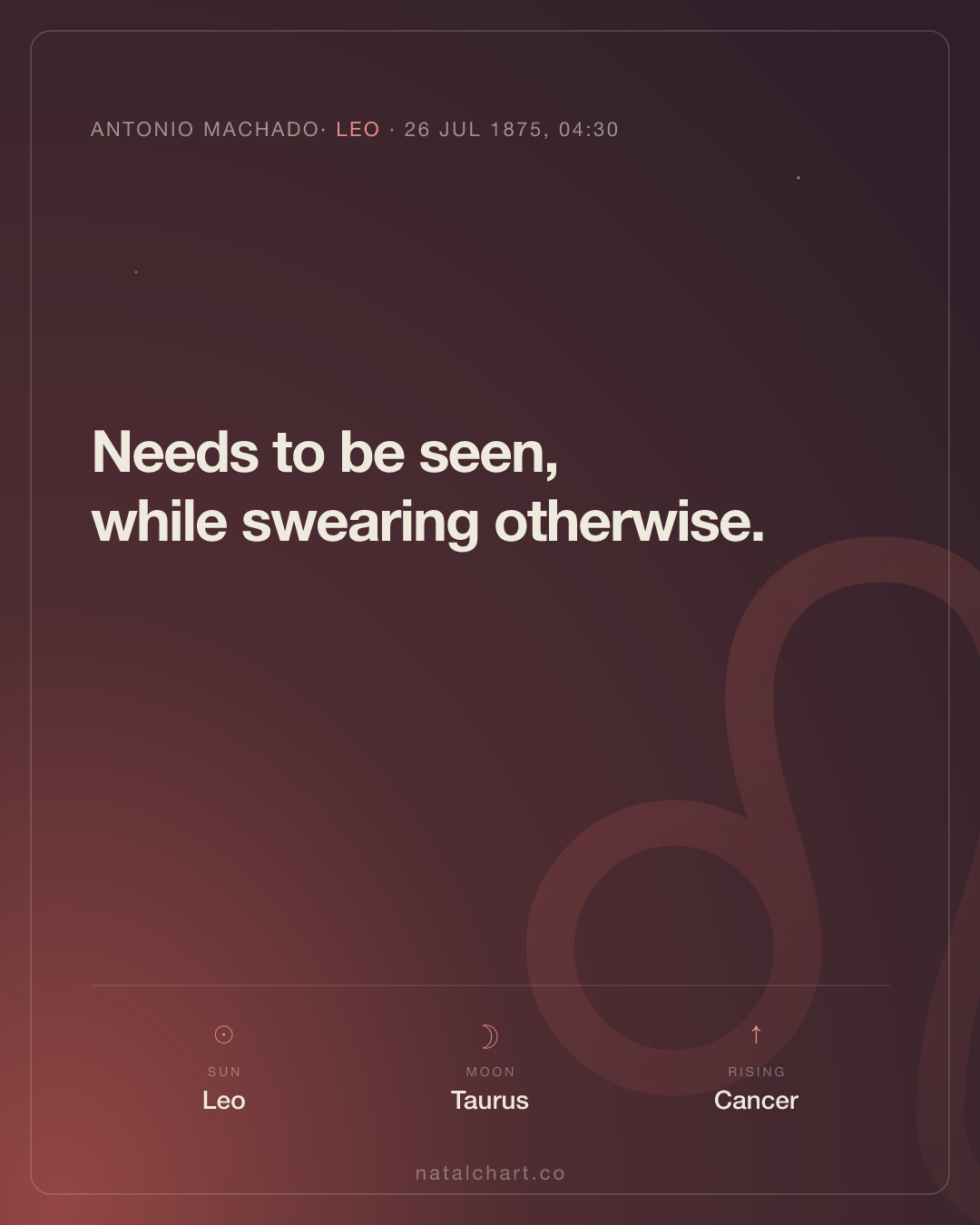
Antonio Machado's Sun sign is Leo — the Sun was in Leo at birth (1875).
What is Antonio Machado's moon sign?
Antonio Machado has the Moon in Taurus. The Moon sign describes the emotional and instinctive layer of the chart.
What is Antonio Machado's rising sign?
Antonio Machado's rising sign (ascendant) is Cancer — the sign on the eastern horizon at the moment of birth.
When and where was Antonio Machado born?
Antonio Machado was born in 1875 in Seville, Spain.