Ayrton Senna — natal chart
What does Ayrton Senna’s natal chart reveal?
Brazilian Formula 1 driver born in 1960. Three-time world champion in 1988, 1990 and 1991 with McLaren. Took 41 wins and 65 pole positions in 161 races. Died after a crash at the San Marino GP in Imola on 1 May 1994.
 Share
Share
Birth
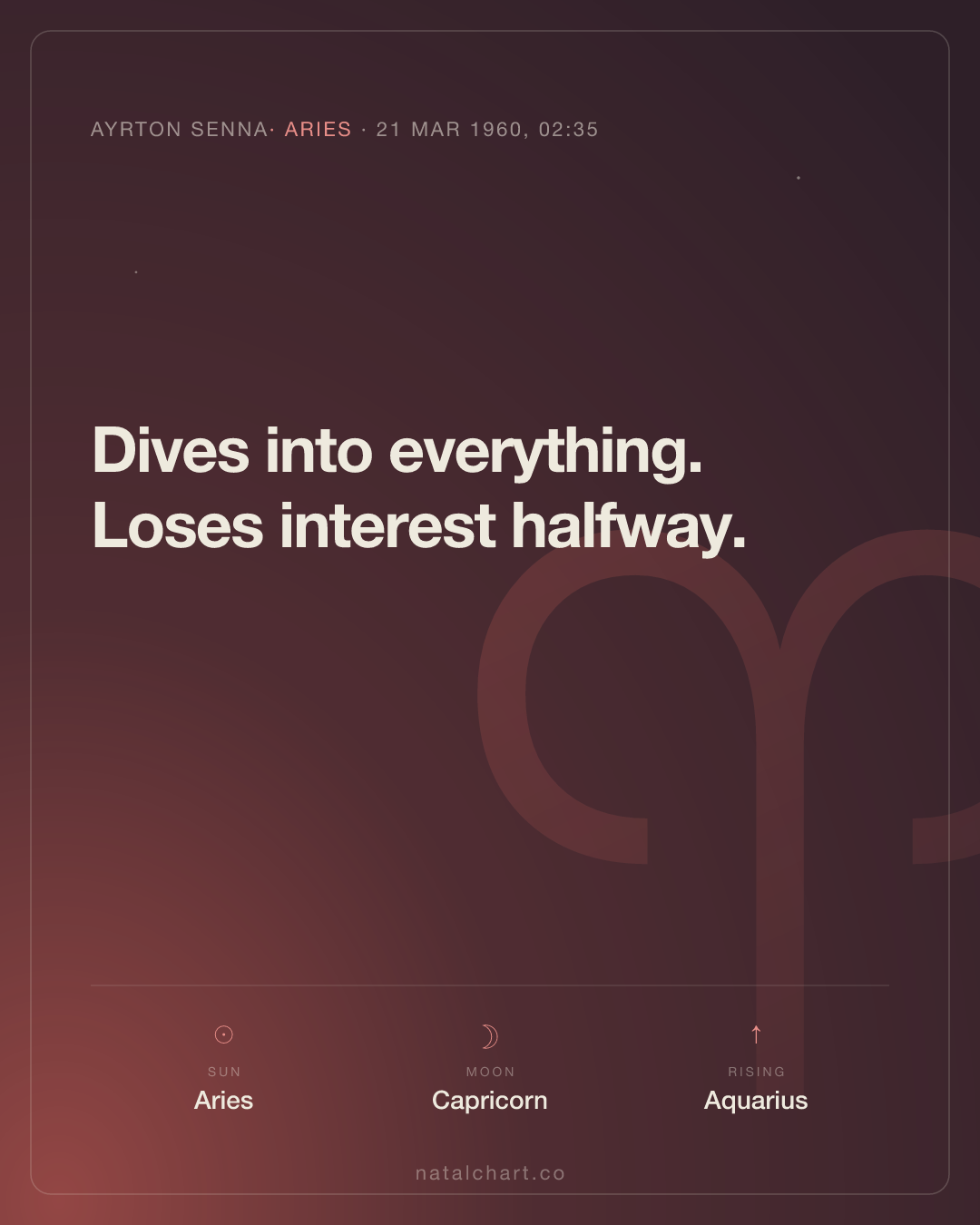
1960-03-21 · 02:35 · São Paulo Reliability: AA · vetted record
The man who drove at the edge of what was possible
Ayrton Senna did not race to finish. He raced to find out where the limit was, and then to place himself exactly one millimetre before it. That peculiar combination of recklessness and precision — the willingness to be first at any cost, married to a technical intelligence that could feel air resistance through the steering wheel — is written plainly in his natal chart. The Sun in Aries in the third house captures it cleanly: Aries is the pioneer, the one who acts before thinking is finished, and in the third house, the domain of quick reactions and immediate perception, it describes someone who read situations in real time and responded faster than anyone around him. His 65 pole positions — a record that stood for nearly two decades — were not accidents of machinery. They were Aries Sun in the third house: the instinct to go first, every time, in the domain of pure reflexive speed.
The Ascendant and the way he met the world
The Ascendant (the point in the natal chart that describes how a person meets the world and how others first experience them) is in Aquarius, with Chiron — an asteroid associated with an old wound that gradually becomes a gift — sitting right beside it in the first house. Aquarius brings an air of detachment and individuality, a sense that the person before you operates by a different set of rules than everyone else does. People who met Senna often described something precise and slightly separate about him, an intelligence that was warm but unmistakably apart. The Chiron in Aquarius in the first house adds a thread of hurt to the picture: the wound of not quite fitting in, of being genuinely different in a way that others struggle to understand. Over time, that wound became his most legible gift — the quality of complete singularity that made watching him drive feel like watching something that had never happened before.
The hidden emotional life
The Moon in Capricorn in the twelfth house, joined there by both Jupiter and Saturn, tells a different story from the public image of volcanic speed and self-belief. The twelfth house is the house of what is kept private, what operates below the surface; Capricorn adds a quality of emotional restraint and a tendency to carry weight alone rather than share it. Senna was privately religious — he spoke about his faith with a directness that surprised journalists more familiar with the stoicism of athletes. He was also genuinely troubled by the deaths he had witnessed in the sport and by his own proximity to danger. The Moon-Saturn conjunction (4°) in this house describes someone who bore that inner weight with discipline, who did not easily let the difficulty show. Jupiter alongside them enlarged the scope of his inner life, giving it a philosophical dimension — the famous late-career interviews where he spoke with calm certainty about the meaning of what he did belong to this configuration.
Mercury, Venus, and the interior register
Mercury and Venus are both in Pisces in the second house, and both form aspects to Neptune in Scorpio in the tenth. This is the most quietly surprising part of the chart. Mercury in Pisces describes a mind that thinks in images and feelings rather than strict logic — an intuitive, pattern-reading intelligence that could assess a corner through sensation rather than calculation. Venus in Pisces in the second house suggests deep attachment to what one has built and a sensitivity to material insecurity that may have had roots in early life (his family was wealthy, but the drive to accumulate resources independently was persistent). The Mercury trine to Neptune (3.9°) and the Venus trine to Neptune (2.4°) give both planets an otherworldly quality, a permeability — the sense that Senna could read a circuit not just with his intellect but with something closer to instinct, as though the track communicated directly with him. His accounts of exceptional laps — Monaco 1984, qualifying at Donington 1993 — describe states of consciousness that went beyond normal competitive focus, and this Neptune configuration in the tenth house (the house of vocation and public life) is the astrological signature of that phenomenon.
Mars in Aquarius: the rebel engineer
Mars in Aquarius in the first house is the chart's clearest statement of how Senna competed. Aquarius brings a quality of systematic experimentation — the desire to find the unconventional solution, to approach a problem from an angle that has not been tried. Mars here is not impulsive in the crude sense; it drives toward disruption of the expected pattern. In practical terms: Senna would brake later than anyone thought possible, change lines through corners in ways that baffled competitors who had studied his data, demand technical configurations from engineers that seemed counterintuitive until they worked. Mars in the first house places this drive front and centre of the personality — it was not separate from who he was, it was how he was. The opposition to Uranus in Leo in the seventh house (3.3°) adds tension: Uranus in the seventh describes partnerships and opponents who were themselves unpredictable forces. His rivalries — most famously with Alain Prost — had this exact quality, a collision of two completely different and irreconcilable competitive logics.
Jupiter, Saturn, and the nature of ambition
Jupiter and Saturn in Capricorn in the twelfth house describe the architecture beneath the ambition. Capricorn's version of ambition is structural — it builds slowly, systematically, with an eye on what will last rather than what will impress in the moment. Saturn here is austere and concentrated; Jupiter amplifies the scope. Three world championships (1988, 1990, 1991) arrived methodically, after years of accumulating technical understanding, political capital within his teams, and the ability to manage a season as a whole rather than chase individual victories. The Sun square Jupiter (1.6°) — the Sun in Aries pulling against Jupiter in Capricorn — describes a real tension between the instinct to charge ahead and the discipline to preserve position; Senna was not always able to resolve this, and several title-deciding incidents had this quality of immediate impulse overriding longer strategy. His collision with Prost at Suzuka in 1990, which he later admitted was deliberate, is the most striking instance.
The Midheaven and a vocation without compromise
The Midheaven (the career and public reputation point in the natal chart) in Scorpio, with Neptune sitting right on it in the tenth house, describes a vocational life of unusual intensity. Scorpio brings all-or-nothing quality to everything it governs; in the domain of career and public identity, it creates someone for whom professional life is never merely professional — it carries existential weight. Neptune in the tenth house gives the public persona a quality of myth. Senna became, during his life and especially after his death at Imola on 1 May 1994, something more than a racing driver in the public imagination — a figure of absolute commitment, of the insistence on excellence at any cost. That mythologisation was not manufactured; it was written into the chart from the beginning. The Venus opposition to Pluto (2.1°), with Pluto in Virgo in the eighth house, adds the final register: Pluto in the eighth house rules irreversible transformation and what is permanently changed. The intensity Senna brought to relationships — professional and personal — had this transformative quality; nothing and no one he touched stayed the same.
The North Node and the path of refinement
The North Node (the point in the natal chart that indicates the direction of deepest personal development) in Virgo points toward precision, craft, and the refinement of technique over instinct. The Sun in Aries represents the natural starting point — the raw, instinctive first move; the North Node in Virgo asks that this be refined, made precise, stripped of excess. Senna's development as a driver followed this arc: the aggressive, sometimes reckless junior who won Formula Ford and Formula Three championships evolved into a meticulous, data-obsessed technician who spent hours with engineers after practice sessions, feeding back sensations with a precision that the technical staff found extraordinary. The Jupiter trine Pluto (2.0°) gave him access to reserves of power — both mechanical and psychological — that others could not reach. The combination made him, across those three championship years at McLaren, close to unbeatable.
Chiron and what the wound became
Chiron in Aquarius in the first house, the closest point to the Ascendant, returned as a theme in everything Senna became publicly. The Aquarian wound — of difference, of not quite belonging, of being legible to the crowd but genuinely known by almost no one — resolved into the very thing he was celebrated for: the quality of absolute individuality, of the driver who did not race like anyone else because he did not think like anyone else. He was Brazilian at the height of the sport's European dominance, a Catholic mystic in a world of engineers, a man who wept in public and spoke about his interior life with a directness that was unusual in his profession. The wound did not disappear. It became the most recognisable thing about him.
A portrait in full
The chart of Ayrton Senna, read together, describes someone whose interior life was far richer and more complex than the image of pure competitive fire that the sport produced. The Aries Sun drove toward the front; the Capricorn Moon bore its private weight without complaint; the Pisces Venus and Mercury felt the circuit more than they calculated it; the Aquarius Mars disrupted every conventional expectation. What made Senna extraordinary was not that any one of these qualities was exceptional — it was that they were all present at once, working together in the confined space of a cockpit at 300 kilometres per hour, producing something that could not be reduced to talent alone. His 41 victories across 161 races, his three world titles, and the silence that fell at Imola on a Sunday afternoon in May 1994 are all part of the same story — the story of someone who had found, in the most extreme circumstances available to him, something that felt completely true.
The chart
How to read it →Frequently asked questions
What is Ayrton Senna's zodiac sign?
Ayrton Senna's Sun sign is Aries — the Sun was in Aries at birth (1960).
What is Ayrton Senna's moon sign?
Ayrton Senna has the Moon in Capricorn. The Moon sign describes the emotional and instinctive layer of the chart.
What is Ayrton Senna's rising sign?
Ayrton Senna's rising sign (ascendant) is Aquarius — the sign on the eastern horizon at the moment of birth.
When and where was Ayrton Senna born?
Ayrton Senna was born in 1960 in São Paulo.