Octavio Paz — natal chart
What does Octavio Paz’s natal chart reveal?
Octavio Paz, born on March 31, 1914, in Mexico City, Mexico, was a poet, essayist, and diplomat whose work examined the cultural and historical identity of Mexico alongside broader questions of modernity and time. His landmark essay The Labyrinth of Solitude (1950) analyzed the psychology and mythology of Mexican identity. His long poem Sunstone (Piedra de sol, 1957) is based on the Aztec calendar and is considered a masterpiece of twentieth-century Spanish-language poetry. Paz served as Mexico's ambassador to India from 1962 to 1968. He received the Cervantes Prize in 1981 and the Nobel Prize in Literature in 1990. He died in Mexico City on April 19, 1998.
 Share
Share
Birth
1914-03-31 · 23:40 · Mexico City, Mexico Reliability: AA · vetted record
The core pattern
Octavio Paz was born with a Sagittarius Ascendant — the face he turned toward the world was restless, exploratory, driven by a need to see beyond what was immediately given. The Ascendant is the outward manner, the first impression, the skin of the self. In Sagittarius, it signals someone who approaches life as an ongoing inquiry: every border is an invitation, every fixed answer a provocation. Paz spent decades moving between countries, languages, and disciplines — from Mexico to the United States, to Paris, to India, where he served as ambassador for six years — and this restlessness was not incidental to his work. It was the method.
The Sun, which describes the central identity, falls in Aries in the fifth house — the house of creative expression, of what one makes and offers to the world. Aries is direct, assertive, first: it does not wait for permission. In the fifth house, this Aries energy is channeled into art, into the act of making something new. Paz's first great poems arrived early; his 1957 long poem Sunstone (Piedra de sol), built on the Aztec calendar cycle of 584 days, is one of the most formally daring works in twentieth-century Spanish-language poetry. Venus joins the Sun in Aries in the fifth house, and Lilith does too: the creative drive is also aesthetic and, in some sense, unruly. These three placements together say that expression was not a choice — it was the organizing principle of a life.
Moon: the emotional interior
The Moon in Gemini in the seventh house — the seventh house governs partnerships, the encounter with the Other — tells a great deal about how Paz experienced connection. Gemini is the sign of duality, dialogue, the meeting of two minds. Paz was drawn to conversation in its deepest sense: not just talk, but the space where one perspective brushes against another and something new emerges. His relationship with ideas was intimate and bilateral; his essays were dialogues with history, with literature, with Mexico itself.
But Saturn also sits in Gemini in the seventh house, joined with the Moon within a couple of degrees. Saturn alongside the Moon in the house of relationship brings weight, restraint, and a certain seriousness to emotional life. Partnerships were not easy or light for Paz — they carried real gravity, real consequence. Saturn and the Moon together in the seventh house also point toward a kind of emotional loneliness that can coexist with intellectual brilliance: the difficulty of being fully met, of finding a partner who can hold the same depth. His long marriage to Marie-José Tramini, whom he met in India in 1964 and married a year later, endured until his death — perhaps precisely because she met that need for real companionship, for someone who could stand in the seventh house alongside him.
Saturn and the Moon are also part of a cluster with Pluto in Gemini in the seventh house: three planets in the sign of dialogue and in the house of the Other. This is a heavy, transforming weight placed on relationship, on the question of who the other person is and how one understands them.
Mercury: thought and its constraints
Mercury, the planet of the mind and language, falls in Pisces in the fourth house — the house of origins, of inner life, of what lies beneath. Mercury in Pisces does not think in straight lines. It thinks in images, in resonances, in connections that dissolve ordinary categories. This is the mind that wrote The Labyrinth of Solitude (1950): a meditation on Mexican identity that does not argue so much as it evokes, that does not define Mexico as much as it circles it with extraordinary patience.
But Mercury in Pisces forms a tight square — a pulling-against tension — with Saturn in Gemini in the seventh house, the tightest personal tension in the chart at just over half a degree. Pisces dissolves; Gemini articulates. The intuitive, image-driven mind of Mercury in Pisces is constantly in friction with the demand of Saturn in Gemini for clarity, for form, for something communicable. This is not a comfortable tension, but it is a productive one. Paz spent his entire career at exactly this intersection: turning the intuited, the felt, the mythological, into language that others could follow. The square did not stop him — it was the engine.
Mercury in Pisces also flows easily with Mars in Cancer in the eighth house — a harmonious relationship between language and depth, between the way he thought and the emotional intensity he was willing to carry. Mars in Cancer in the eighth house is not a combative placement; it is a driven one, but the drive is inward, investigative, transforming. It suits perfectly the long, patient, interior work of the essayist and poet.
Venus and creative love
Venus in Aries in the fifth house, alongside the Sun and Lilith, places the aesthetic and the erotic at the center of creative life. Paz wrote about love with unusual directness — Sunstone opens as a love poem and expands outward into history and myth; his later La llama doble (1993) is a sustained meditation on love and eroticism as forms of knowledge. This is Venus in Aries in the fifth house speaking: love is not a quiet, domesticated feeling but an experience that arrives with force, that reshapes what one knows.
Aries does not wait. In the fifth house, it means the creative act is also an act of assertion, of claiming the right to make something new without apology. Paz did not write with timidity. Even in his diplomatic role, he resigned his ambassadorship to India in 1968 in protest over the Tlatelolco massacre — an act of Aries-fifth-house assertion, a refusal to stand behind something he could not endorse.
Jupiter, Saturn, and the long arc
Jupiter in Aquarius in the third house — the third house is the house of writing, ideas, communication — and Uranus also in Aquarius in the third house: two planets of expansion and originality in the same sign and house, in the domain of language and thought. This double placement signals a mind that genuinely enjoys the broad sweep, that is drawn to universals, to ideas that cross cultures and periods. Paz was not a regional writer who happened to receive international attention; he was a thinker who considered the whole of Western and Eastern tradition his material.
Saturn in Gemini in the seventh house is in a harmonious relationship with both Jupiter and Uranus: the flow between them says that the structure (Saturn) and the originality (Uranus) and the expansion (Jupiter) were not in conflict — they worked together. The discipline of form, the daring of vision, and the range of reach all reinforced each other over a long career. The Nobel Prize in Literature came in 1990, when Paz was seventy-six — Saturn's long game, rewarding work that had been building since the 1930s.
The outer planets and deeper currents
Neptune in Cancer in the eighth house, alongside Mars: the eighth house governs depth, transformation, what lies beneath the surface of ordinary life. Neptune here gives a particular sensitivity to what is hidden, to the mythological layers beneath history, beneath national identity. Paz was drawn throughout his career to pre-Columbian civilization, to the Aztec calendar that structures Sunstone, to the question of what Mexico was before the Conquest and what survived that rupture. Mars and Neptune together in Cancer in the eighth house — Cancer being the sign of origins, of what came before — placed this investigation at the heart of his creative drive.
Pluto in Gemini in the seventh house adds a quality of depth and transformation to the encounter with the Other. The ideas Paz met, the conversations he entered, the partnerships he formed — none of them left him unchanged. Dialogue, for him, was genuinely transformative, not merely pleasurable.
The Midheaven and public vocation
The Midheaven — the public and career point of the chart, the point that describes what one is recognized for in the world — falls in Libra. Libra is the sign of balance, aesthetics, dialogue, and justice. This is the sign in which Paz's public vocation is written: a man recognized for the beauty and balance of his work, for his commitment to dialogue across cultures and traditions, for his role as a voice that could hold complexity without resolving it too quickly.
The Libra Midheaven also resonates with the diplomatic career: from 1962 to 1968, Paz represented Mexico in India, one of the most intellectually formative periods of his life. The dialogue between Eastern and Western traditions that marks his later essays, including El mono gramático (1974), written in India, carries the Libra Midheaven's desire to hold two things at once, to find the place where they meet.
Chiron, the North Node, and the wound beneath
Chiron — an asteroid associated with an old wound that, once acknowledged, becomes a source of understanding for others — falls in Pisces in the fourth house, alongside Mercury. The fourth house is the house of origins, of the inner life, of what one carries from childhood and family. Chiron in Pisces here points toward a wound connected to dissolution, to boundaries that were not clear, to something in the earliest ground of life that was hard to hold or name.
Paz grew up in a household shaped by absence and difficulty — his father, a lawyer and Zapatista activist, was often away or struggling; the family moved between Mixcoac and Los Angeles during his early years. Chiron in Pisces in the fourth house does not name a specific trauma, but it does mark a sensitivity in the place of origins that became, over time, the source from which he drew his most lasting insights — into Mexico, into identity, into what it means to belong somewhere and to lose that belonging.
The North Node in Pisces — the North Node is a point describing the direction of growth, the quality toward which a life tends to develop — deepens this. The growth edge for Paz was not assertion (he had Aries Sun and Venus for that) but a movement toward the intuitive, the compassionate, the capacity to hold what cannot be entirely named. Sunstone itself, with its circular structure that ends where it begins, is a Piscean form — it refuses linear resolution, it opens rather than closes.
A closing portrait
Octavio Paz's chart is the portrait of a mind that lived at the intersection of fire and water, of assertion and dissolution, of the need to speak and the knowledge that language never fully arrives. The Aries Sun driving forward to express, the Mercury in Pisces knowing that the truest things resist exact statement, the Moon in Gemini in need of genuine dialogue — these are not contradictions but a single creative engine.
The Nobel Prize citation in 1990 described his writing as marked by "widened horizons" and "sensuousness of imagery." Both phrases are legible in the chart: the Sagittarius Ascendant opening every horizon, the Venus and Sun in Aries in the fifth house pressing toward the vivid and the immediate. But the lasting quality of the work — its capacity to feel true even now, decades after it was written — comes from the deeper root: Mercury in Pisces in the fourth house, touching something older and less nameable than any single poem.
Paz died in Mexico City in 1998, at eighty-four. The last years of his life were spent at the foundation he had created and the journal Vuelta he had directed. The man who had always been in motion came, finally, to tend the things he had built. That too is in the chart: the Capricorn-leaning Saturn doing its long, patient work.
The chart
How to read it →Frequently asked questions
What is Octavio Paz's zodiac sign?
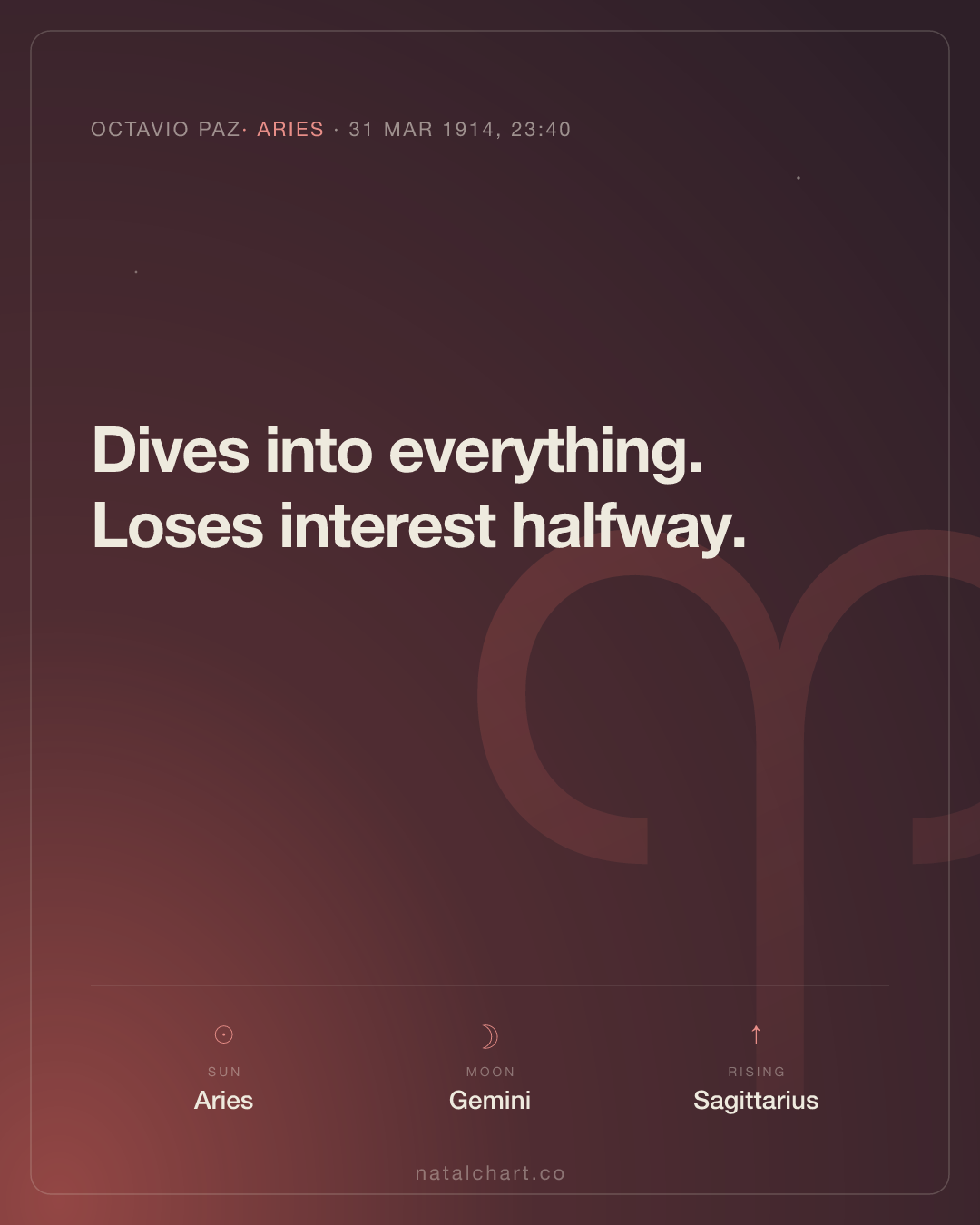
Octavio Paz's Sun sign is Aries — the Sun was in Aries at birth (1914).
What is Octavio Paz's moon sign?
Octavio Paz has the Moon in Gemini. The Moon sign describes the emotional and instinctive layer of the chart.
What is Octavio Paz's rising sign?
Octavio Paz's rising sign (ascendant) is Sagittarius — the sign on the eastern horizon at the moment of birth.
When and where was Octavio Paz born?
Octavio Paz was born in 1914 in Mexico City, Mexico.