Brigitte Bardot — natal chart
What does Brigitte Bardot’s natal chart reveal?
Brigitte Bardot (born 1934) is a French former actress, model, and singer who became an international sex symbol of the 1950s and 1960s. A star of films such as And God Created Woman, she retired from entertainment in 1973 to devote herself to animal-rights activism.
 Share
Share
Birth
1934-09-28 · 13:15 · Paris, France Reliability: AA · vetted record
The core: a Libra who refused to be decorative
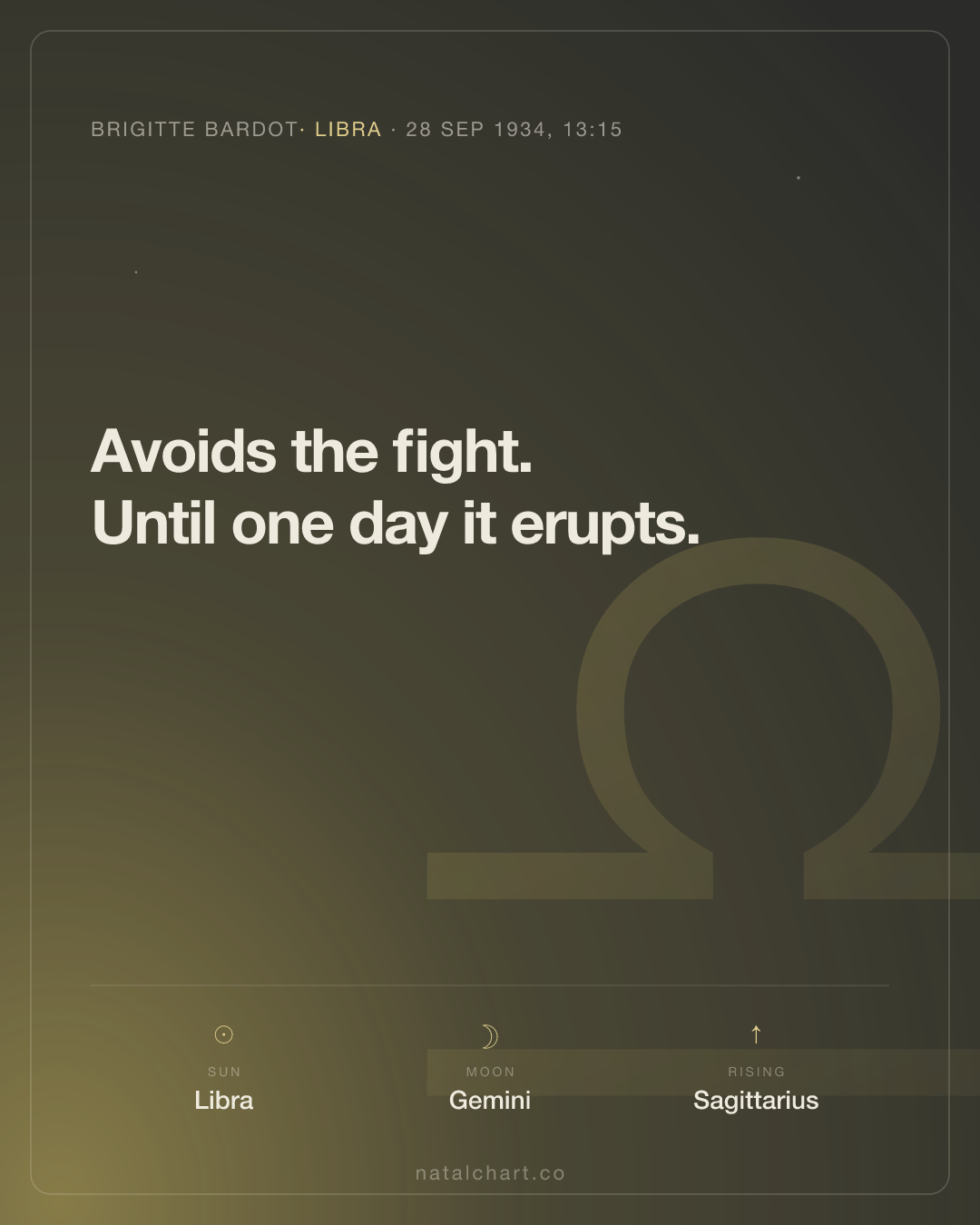
Brigitte Bardot's chart opens with one of the most concentrated signatures in the zodiac: Sun, Mercury, and Jupiter all gathered in Libra, in the eleventh house, the domain of public life, collective causes, and the wider world. Three planets this tightly clustered in the same sign and house create what astrologers call a stellium — a single, overwhelming note that colors almost everything else. Libra seeks balance, beauty, and relationship; but it also carries a quiet, persistent drive to influence the terms of how things look and feel in the world. Bardot did not simply embody an aesthetic ideal — she disrupted it, dismantled the old codes of femininity, and in doing so changed what an international star was allowed to be.
The Ascendant in Sagittarius — the sign rising at the horizon at the moment of birth, the face one presents to the world — adds an arrow to all that Libra elegance. Sagittarius is frank, restless, physically adventurous, and constitutionally opposed to performing what it doesn't feel. In Bardot, this translated into the bluntness that shocked journalists, the refusal to pretend to be more demure than she was, and the physical confidence that the camera caught so readily. The Sagittarius rising is not the image-making sign — it is the sign that moves too fast and too freely to worry about the image.
The Moon: the difficulty of being truly known
The Moon in Gemini, in the seventh house — the house of one-to-one relationships, partnership, and the experience of being met by another person — describes an emotional life that moves quickly, shifts registers, and is genuinely hard to pin down. Gemini gives the Moon a dual quality: on the surface, lightness, adaptability, curiosity; underneath, a more difficult question about which face is the real one. In relationships specifically — and the seventh house makes this most visible in partnerships — Bardot's emotional fluctuations were well documented, a series of intense connections that burned brightly and ended sharply.
The Moon forms a tense angle with Neptune — the two planets pulling against each other — and this is one of the chart's most psychologically telling aspects. Neptune dissolves boundaries; under tension with the Moon, it can make it difficult to see relationships clearly, to know where genuine feeling ends and projected ideal begins. The film and the fantasy around Bardot — the icon as opposed to the person — were partly a Neptune creation; and the difficulty of being truly seen beneath that image was real and personal.
Mercury: a mind that runs ahead of itself
Mercury joined so closely to Jupiter — within a tenth of a degree, the two practically fused — creates an intelligence that thinks at scale, reaches for the big picture, and can be impatient with the small print. In Libra, this mind works through comparison, through weighing, through an eye for proportion and contradiction. In the eleventh house, these ideas are directed outward, toward the public sphere. Bardot's later career as an animal-rights activist — a cause she pursued with full public intensity, sometimes outraging the same audiences who had once adored her glamour — reflects this placement precisely: someone who marshals their full intellectual and expressive resources in service of a collective cause they believe in absolutely.
But Mercury also forms a tense angle with Pluto and a pulling-apart angle with Uranus, which means the mind, for all its force, was not always at peace. There was something insistent and relentless about her convictions — a quality that made her both compelling and, at times, combative.
Venus: the professional and the exacting
Venus in Virgo, in the tenth house — the house of public reputation and vocation — is a particularly striking placement for someone whose entire career was built on a particular image of feminine beauty. Virgo brings precision, selectivity, and a demanding perfectionism; it does not find beauty in extravagance but in refinement, in the detail that is exactly right. Venus here describes someone for whom the craft of beauty — the precise angle of a photograph, the exact movement in a dance sequence — was never incidental. And alongside it, Neptune in Virgo in the same house amplifies this quality, adding a capacity for almost mythological projection that the public willingly participated in.
In Bardot's private life, Venus in Virgo in the tenth also speaks to someone who kept her deepest personal values somewhat separate from her public persona — a person behind the image, with specific and sometimes hard-to-meet requirements for intimacy.
Mars: the adventurer who never settled
Mars in Leo, in the ninth house — the house of travel, of philosophical freedom, of the wide-ranging life — describes a will that expresses itself most fully in motion, in the physical experience of open spaces, in the refusal of confinement. Bardot's decision to withdraw entirely from the entertainment industry in 1973, moving permanently to Saint-Tropez to live among animals, has the unmistakable signature of Mars in Leo in the ninth: dramatic in its execution, uncompromising in its direction, and completely authentic. The Leo quality gives Mars here a theatrical decisiveness — when the line was drawn, it was drawn with full commitment.
Mars forms a tense, pulling-apart angle with Saturn — the two planets working against each other — and this describes a recurring friction between the drive toward freedom and expansion on one side, and constraint, duty, or the expectations of others on the other. Bardot's entire public narrative can be read as this tension played out on the largest possible stage.
Jupiter and Saturn: the public voice and its costs
Jupiter in Libra, joined so closely to Mercury, expands everything connected to communication, public standing, and the ability to reach a wide audience. The Jupiter-Mercury conjunction in Libra in the eleventh house is the placement of someone who, when they speak, is heard. It also brings the expectation — sometimes felt as a pressure — of representing something beyond the personal. Bardot became, almost involuntarily, a symbol of an era, a country, a particular idea of freedom. Jupiter in the eleventh has that quality of making the individual into a collective emblem.
Saturn in Aquarius, in the third house — the house of communication, of the local environment, of the people one grows up among — carries a certain quality of early seriousness about ideas and expression. Saturn here does not block communication but structures it, gives it weight. It also forms a tense angle with Mars, reinforcing that underlying tension between disciplined structure and expansive freedom that runs through the whole chart.
The outer planets: disruption and the times
Uranus in Taurus, in the sixth house — the house of daily life, of the body, of practical routines — describes someone whose relationship with the ordinary fabric of daily existence was consistently interrupted or restructured. The sixth house is also the house of health, and Bardot's physical life — both its extraordinary vitality in her youth and the difficult episodes that followed — reflects a Uranian quality of unpredictability in this domain.
Pluto in Cancer, in the eighth house — the house of deep transformation, of what cannot be controlled, of the experience of loss — describes a generation that lived through upheaval at the most fundamental level. In Bardot's chart, Pluto in the eighth forms a tense angle with the Libra stellium, which means that the themes of power, irreversible change, and the dynamics of control and release were always running beneath her public story.
The Midheaven: beauty as a cultural argument
The Midheaven — the highest point in the chart, indicating how one is known in the world and what the vocation aims toward — falls in Libra. For Bardot, this confirms that her public identity was always fundamentally aesthetic and relational: not simply the vehicle of beauty, but beauty as a position, as a statement about what the world owes its inhabitants. The Midheaven in Libra with Venus ruling it from the tenth house creates a career that is, at its core, an argument about how life should look.
Chiron and the North Node: the wound in the partnership
Chiron — an old wound that with time can become a capacity to understand others' pain — falls in Gemini, in the seventh house of relationships. A wound precisely in the domain of being met and known by another person is one of the most isolating placements in a chart — and for someone who became an international icon while simultaneously describing herself as profoundly lonely, it has clear resonance. The seventh house Chiron does not prevent deep connection; it means the path to it carries specific difficulties that take time and honesty to navigate.
The North Node in Aquarius — the point indicating the direction of deepest growth — points toward the universal, toward causes that transcend the personal, toward a relationship with the collective rather than with individuals alone. Bardot's second life as an animal-rights campaigner, in which she channeled the full force of her public standing toward a cause larger than herself, is exactly this trajectory fulfilled.
A life lived at full volume
What emerges from Brigitte Bardot's chart is the portrait of someone who was never going to be quietly at ease in a conventional story. The concentration of Libra planets in the eleventh house gives her an outsized relationship with the public sphere; the Sagittarius Ascendant ensures that the performance is always undercut by bluntness; the Moon-Neptune tension makes genuine intimacy genuinely difficult. The Mars-Saturn opposition keeps freedom and structure perpetually in argument. And through all of it, Chiron in the seventh quietly marks the cost: to be seen by millions and felt truly known by very few. The second chapter of her life — the animal sanctuary, the campaigns, the refusal to continue — was not a retreat. It was the North Node destination: a relationship with a cause large enough to feel worthy of the fullness she had always carried.
The chart
How to read it →Frequently asked questions
What is Brigitte Bardot's zodiac sign?
Brigitte Bardot's Sun sign is Libra — the Sun was in Libra at birth (1934).
What is Brigitte Bardot's moon sign?
Brigitte Bardot has the Moon in Gemini. The Moon sign describes the emotional and instinctive layer of the chart.
What is Brigitte Bardot's rising sign?
Brigitte Bardot's rising sign (ascendant) is Sagittarius — the sign on the eastern horizon at the moment of birth.
When and where was Brigitte Bardot born?
Brigitte Bardot was born in 1934 in Paris, France.