Claude Debussy — natal chart
What does Claude Debussy’s natal chart reveal?
Claude Debussy, born 22 August 1862 in Saint-Germain-en-Laye, was a French composer whose work transformed the language of Western music at the turn of the twentieth century. Trained at the Paris Conservatoire, he developed a distinctive style built on novel harmonies, modal scales and shimmering orchestral colour, often linked to Impressionism. His landmark works include the orchestral Prelude a l'apres-midi d'un faune (1894) and La Mer (1905), the opera Pelleas et Melisande (1902), and the piano collections that contain Clair de lune. His innovations in tonality and form deeply influenced later composers across Europe. He died on 25 March 1918 in Paris.
 Share
Share
Birth
1862-08-22 · 04:30 · Saint-Germain-en-Laye, Yvelines, France Reliability: AA · vetted record
The composer who listened to what music could become
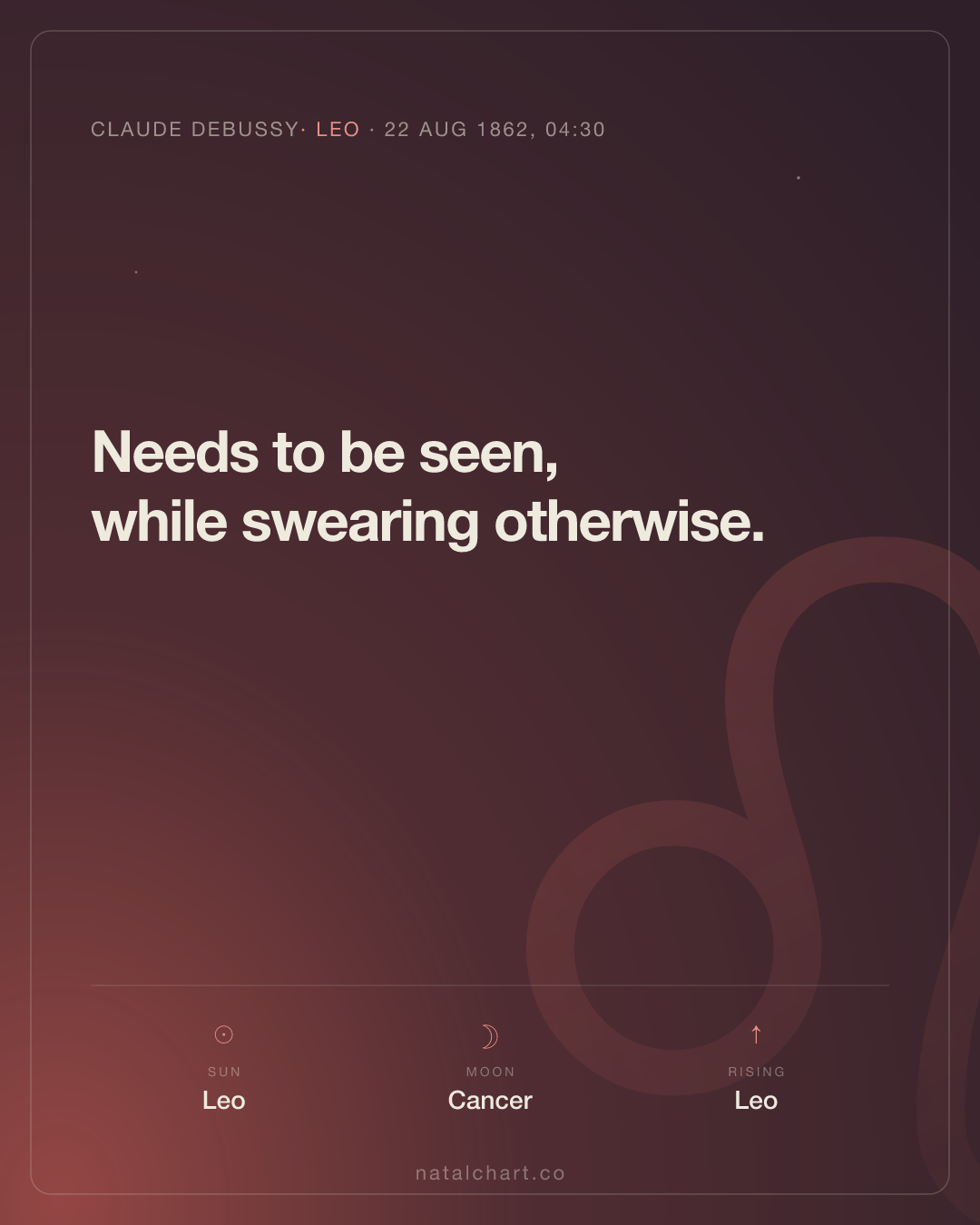
Claude Debussy was born under a Leo Sun conjunct a Leo Ascendant — the same sign rising as the Sun sign — which creates an unusual intensity of self-presentation, a quality of being wholly and visibly oneself at all times. The Sun also sits alongside Venus in Leo in the first house, and Chiron occupies the same first-house Leo territory. What this cluster describes is not vanity but a profound stake in the act of creation as an expression of identity: making music was not something Debussy did, it was what he was. The Sun and Mercury are joined closely together — within three degrees — so that the analytical and the creative ran as a single current; he thought through composition and composed through thought.
His landmark works — the Prélude à l'après-midi d'un faune (1894), La Mer (1905), Pelléas et Mélisande (1902), the piano pieces that contain Clair de lune — are not experiments in technique for their own sake. They are the sound of a particular inner world externalised with great precision. That is the Leo-first-house signature: the inner life made fully visible, without apology.
Moon in Cancer: listening from the inside
The Moon in Cancer occupies the twelfth house — the house traditionally associated with what operates quietly below the surface, with the interior life that isn't on full display. The Moon in Cancer is already a deeply receptive placement, sensitive to atmosphere, to the emotional weather of a room or a landscape; in the twelfth house, this sensitivity becomes almost submarine, operating mostly beneath the level of conscious articulation. Debussy's music is saturated with this quality: the shimmer and suggestion, the half-formed atmosphere that hovers on the edge of definition, the way Nuages from the Nocturnes creates the feeling of something just out of reach. The Moon forms a supporting aspect with Saturn — the planet of structure and form — which kept this receptivity from dissolving into pure impression. It also sits in tension with Mars, which means the tenderness coexisted with a sharp-edged creative will.
Venus and the standard of beauty
Venus in Leo in the first house is a placement with a very specific quality: it holds beauty to a high standard, demands that what it loves be worthy, and pours considerable creative energy into its aesthetic. Venus forms a supporting aspect with Jupiter in Virgo (the planet that amplifies, in a sign of precision and craft) and an easy, flowing aspect with Neptune — the planet most associated with dissolving the boundaries between heard sound and felt atmosphere. The Venus-Neptune connection is everywhere in Debussy's music: the way harmony stops needing to resolve to a satisfying conclusion, the way chords are used for colour rather than function, the way the music seems to float rather than march. This is Venus in Leo taking Neptune in Aries's dissolution and giving it a gorgeous form.
The Venus-Jupiter connection in Virgo adds the other half: the exquisite attention to craft, the precise notation, the obsessive revision. Debussy was a meticulous craftsman who burned his sketches. The generosity of Leo and the perfectionism of Virgo, working through Venus and Jupiter, describe a composer who could not accept sloppiness in himself even as he rejected conventional rules.
Mercury in Virgo: the analyst in the workshop
Mercury moves into Virgo in the second house — a shift from the first-house Leo creative identity into the house of craft, skill, and what one builds. Mercury in Virgo is exacting in analysis, attentive to the smallest unit of construction, interested in how things work at the level of the particular note, the precise interval. Debussy's theoretical writings and his letters to fellow composers show a mind that could account for exactly what he was doing harmonically, even as the music itself refuses easy categorisation. The Sun-Mercury conjunction — both in Leo at the boundary with Virgo — brings together the Leo creative drive with the Virgo analytical precision: a composer who felt his way toward new harmonic territory and then could explain it clearly.
Mars and Neptune: a new music from collision
Mars in Aries in the ninth house — the house of larger frameworks, philosophy, and what lies beyond the familiar — sits in an easy, energising aspect with Uranus in Gemini in the eleventh house (the house of collective movements and future-oriented causes). Mars in Aries is direct, uncompromising, unwilling to work within inherited constraints; in the ninth house, this quality becomes an intellectual refusal to accept received frameworks. Debussy famously rejected the Germanic musical tradition that dominated the Paris Conservatoire, turned toward Russian music, toward Javanese gamelan (which he heard at the 1889 World Exhibition in Paris and never forgot), toward medieval modes and whole-tone scales. That is Mars-Uranus in the ninth: the force that breaks conventional frameworks in the pursuit of a more authentic one.
Neptune also sits in Aries in the ninth house, close to Mars. The Mars-Neptune proximity in a fire sign describes the creative impulse as something both aggressive and dissolving — a drive to push boundaries combined with a sensitivity to what lies beyond them. Jupiter in Virgo stands in tension with Neptune, a polarity the chart holds throughout: the exacting craftsman and the boundary-dissolving visionary, pulling in opposite directions, producing music that is simultaneously rigorous and atmosphere-soaked.
Saturn and Uranus: structure refusing stasis
Saturn in Virgo in the second house — the house of craft and accumulated skill — sits in tension with Uranus in Gemini in the eleventh house. This is a quieter version of the tension between the practised, disciplined craftsman and the restlessly innovative force that keeps the craft from calcifying. In Debussy's career, the tension is visible between his years of careful Conservatoire training and his subsequent systematic rejection of everything he had been taught. He could only break the rules with such precision because he had learned them at such depth. Saturn in the second makes the foundation solid; Uranus in the eleventh keeps looking for what hasn't been done yet.
The Midheaven in Taurus and the body of sound
The Midheaven — the public and career point in a chart, the signature by which one's work is known — sits in Taurus, the sign most associated with the physical and sensory world, with beauty as something that can be heard and felt as a physical fact. Pluto in Taurus in the tenth house (the career house) sits near this Midheaven, adding the quality of a transformative impact on the cultural landscape. Debussy's public contribution was precisely this: he made music more sensory, more physical, more concerned with the immediate impression of sound rather than with abstract structural argument. The Midheaven in Taurus anchored this in the body rather than in the intellect.
Chiron and the wound of originality
Chiron in Leo in the first house — alongside the Sun, Venus, and Ascendant — places the old wound right at the centre of identity. The wound in Leo is often about the legitimacy of one's creative expression, the fear of being told that what one makes is not good enough, not serious, not properly musical. Debussy's early career was marked by exactly this: the academic establishment found his music unclear, lacking in proper development, impressionistic in the pejorative sense. His opera Pelléas et Mélisande was attacked on those grounds at its premiere. Chiron in the first house eventually transforms the wound into the most visible gift: the same qualities that were initially rejected — the harmonic ambiguity, the refusal of formal resolution, the atmospheric shimmer — became the defining mark of a new musical era.
The North Node and a legacy that keeps expanding
The North Node in Sagittarius (an astronomical point indicating a direction of development) sits in the sixth house — the house of daily practice, craft, and the continuous refinement of skill. Sagittarius's orientation toward the large frame, the philosophical statement, the work that reaches beyond the workshop into the culture at large, combined with the sixth house's emphasis on consistent, daily discipline, describes the particular kind of legacy Debussy built: not a single work of genius but a complete transformation of musical language through sustained and rigorous practice over a lifetime. He died in Paris in March 1918, in the middle of World War I, working on sonatas he did not live to finish. The music he left behind went on changing what was possible in Western composition for decades after he was gone.
The chart
How to read it →Frequently asked questions
What is Claude Debussy's zodiac sign?
Claude Debussy's Sun sign is Leo — the Sun was in Leo at birth (1862).
What is Claude Debussy's moon sign?
Claude Debussy has the Moon in Cancer. The Moon sign describes the emotional and instinctive layer of the chart.
What is Claude Debussy's rising sign?
Claude Debussy's rising sign (ascendant) is Leo — the sign on the eastern horizon at the moment of birth.
When and where was Claude Debussy born?
Claude Debussy was born in 1862 in Saint-Germain-en-Laye, Yvelines, France.