Dolores del Río — natal chart
What does Dolores del Río’s natal chart reveal?
Mexican actress born in 1904 in Durango. A star of silent and sound Hollywood cinema, she starred in 'Bird of Paradise' (1932). She returned to Mexico for 'María Candelaria' (1944) and 'Doña Perfecta' (1951).
 Share
Share
Birth
1904-08-03 · 06:45 · Durango, Mexico Reliability: AA · vetted record
A star who was born to be seen — and knew exactly how to be seen
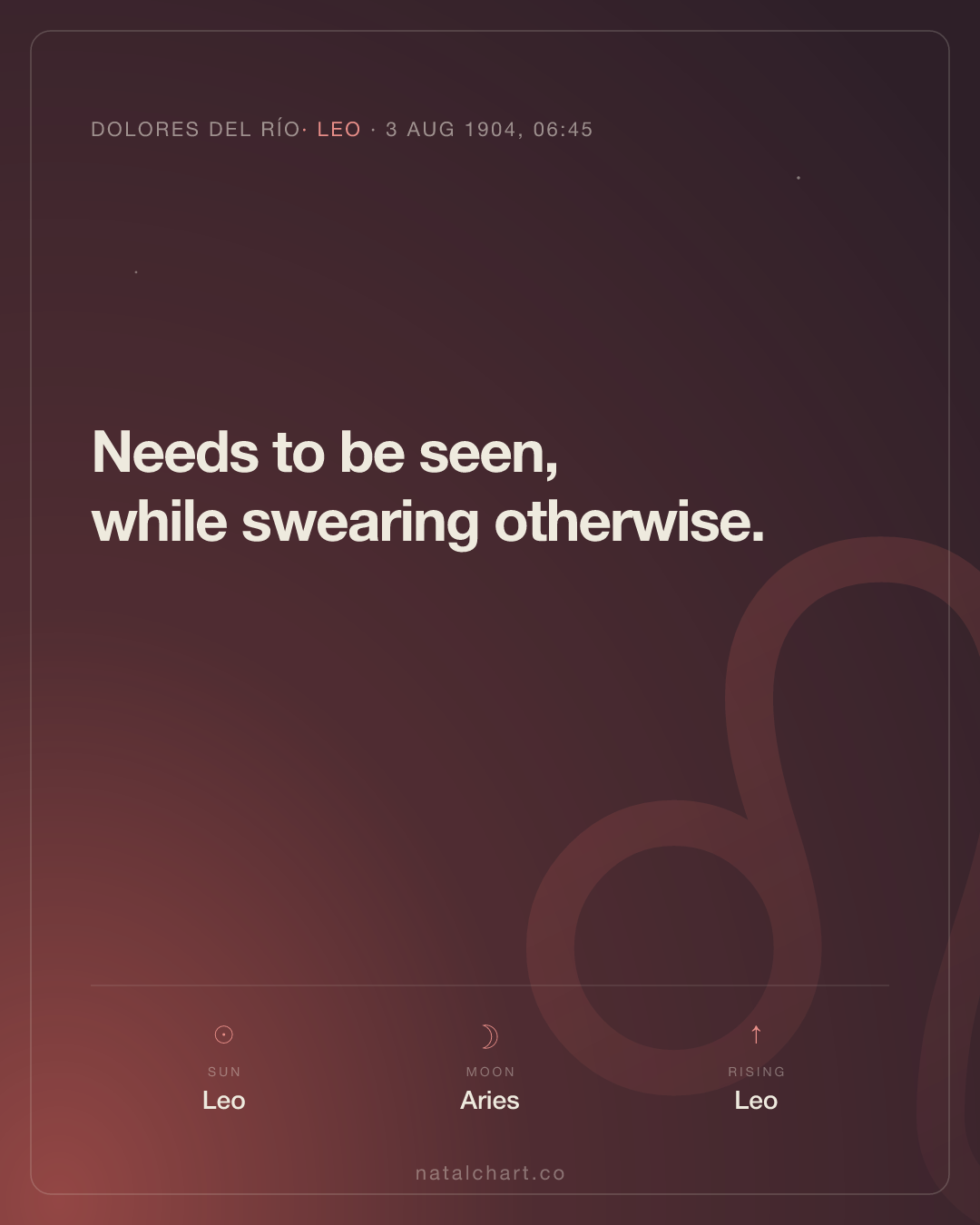
Dolores del Río walked into a room and the room changed. That quality — a presence so complete it shifted the atmosphere — is written directly into her chart. The Sun in Leo sits right on the Ascendant, also in Leo: the same sign, the same degree area, doubling down on a single quality. The face she showed the world was not a mask over something more complicated; it was her. A Sun-on-the-Ascendant person does not hide the self behind a persona — the self is the persona, fully and on purpose. In an era when Hollywood manufactured stars, Dolores del Río was one who had arrived already made.
Venus rising alongside the Sun: beauty as identity
Venus in Leo shares the first house with the Sun, and the two are within the same sign. The combination of Leo's Sun, Leo's Venus, and Leo's Ascendant in the same house is not subtle: this is someone for whom physical beauty and personal identity were genuinely fused — not vanity, but a recognition that the self finds expression through form. Dolores del Río was widely considered one of the most beautiful women in Hollywood during the late silent and early sound era, and what made that beauty distinctive was that it felt intentional, even authored. She chose how she looked, managed her image with precision, and translated it into a sustained international career spanning decades.
The Moon in Aries, Jupiter alongside it: the fires that moved her
Beneath the composed Leo exterior, the Moon in Aries in the ninth house tells a very different story. The Moon describes the emotional interior — how someone actually feels, away from the stage. In Aries, that interior is quick, direct, sometimes combustible: she needed to move, to decide, to act. The ninth house is the territory of travel, foreign lands, beliefs, and the life lived far from the place of origin. A Mexican woman who became a genuine star in 1920s Hollywood, then returned to Mexico to reshape its national cinema — this Moon traces that arc perfectly. Jupiter sits exactly alongside the Moon, amplifying everything: the range of her movements, the scale of her ambitions, the breadth of countries and cultures she moved through. When Dolores del Río left Hollywood in the early 1940s to return to Mexico and make María Candelaria (1944), that was an Aries Moon decision — fast, certain, and driven by something she knew about herself that she did not need to explain to anyone.
Mercury in Virgo: the precision inside the glamour
Mercury in Virgo in the second house describes how her mind worked and what she did with information. Virgo's Mercury is analytical, discriminating, careful — it notices what others miss. The second house connects this to resources, practical value, and what she built materially. Dolores del Río was not simply a creature of instinct and beauty; she was reported to be technically meticulous about her work, attentive to the craft of acting in ways that survived the transition from silent film to sound. Mercury in easy flow with both Jupiter and Neptune speaks to an intelligence that could move between the specific (the details of a role, the technical requirements of a scene) and the large-scale imaginative (the overall shape of a career, the arc of what a film was trying to say).
Saturn opposite Venus: the cost of the image
The tightest aspect in the entire chart — Venus in Leo directly opposed to Saturn in Aquarius, only a fifth of a degree apart — is the most revealing. This opposition is between the seventh house (Saturn) and the first (Venus), meaning it plays out in the space between self and other, between identity and relationship. Saturn in opposition always describes something that must be negotiated rather than simply enjoyed: the beauty and personal magnetism of Leo's Venus on the Ascendant came with a structural counterweight. Saturn in Aquarius in the seventh house can describe relationships that are constrained by circumstance, by public role, by duty — love that must operate within limits that feel external and not fully chosen. Dolores del Río married twice, lived through the enormous social regulation of Hollywood's studio era, and navigated her public image as a Mexican woman in a system designed for white American stars. The Venus-Saturn opposition was not tragedy; it was the discipline that gave the beauty its edge, the structure that made the grace mean something.
Mars in Cancer: the protector who worked in private
Mars in Cancer in the twelfth house describes how she acted, and where. The twelfth house is behind-the-scenes, hidden, the place of private effort. Mars in Cancer does not attack directly; it moves sideways, protects, builds a perimeter. Combined with Neptune also in the twelfth house in Cancer, this gives a picture of someone whose real drive operated in ways that were not fully visible — the work she did to maintain her position, to craft each role, to manage what a long career in a volatile industry required. Her decision to leave Hollywood at the height of her fame and return to Mexico, where she became a central figure of the Golden Age of Mexican cinema, was not a retreat. It was a Mars-in-Cancer move: protective, strategic, building something durable away from the exposure that had defined the first phase of her career.
Jupiter and the trine to Uranus: the pioneer who crossed borders
Jupiter in Aries alongside the Moon, in the ninth house, with a trine to Uranus in Sagittarius in the fifth house, describes an appetite for territory that others had not yet mapped. Uranus in the fifth house is where creative risks live — the unexpected, the unconventional choice, the role that no one else would take. Jupiter in easy flow with Uranus amplifies that risk-taking into something visionary: not just willing to cross borders, but able to build something lasting on the other side. For Dolores del Río, that border was literal. She was the first major Latin American star of Hollywood, and when she returned to Mexico, she was instrumental in giving Mexican cinema a visual language of its own. Doña Perfecta (1951) was not just a film role; it was a statement about what Latin American cinema could look and sound like.
The Midheaven in Taurus: a lasting name
The Midheaven — the public and career point — in Taurus describes what she built professionally and how she wanted to be remembered. Taurus builds for permanence: it is not interested in flash that fades, but in quality that holds. A career that spanned the 1920s to the 1950s across two national cinemas, that survived the transition from silent to sound, that was recognized in both Hollywood and Mexico City — this is a Taurus Midheaven career. The North Node in Virgo, which points toward the direction of growth across a life, reinforces this: the path was always through craft, precision, the unglamorous work of getting the details right so the larger thing could stand.
Chiron in Capricorn: the wound of belonging
Chiron — an old wound that over time becomes a source of particular skill — sits in Capricorn in the sixth house, the house of daily work and the body. In Capricorn, Chiron often describes a wound around legitimacy: the sense of needing to prove oneself in systems that were not built to recognize you. For a Mexican actress in 1920s Hollywood — one of the most racially stratified industries in the world at the time — that wound was structural. The roles she was offered, the way her ethnicity was both exoticized and constrained, the limits placed on how she could be seen: these were Capricorn Chiron territory. What she did with it was exactly what Chiron at its best describes: she did not simply endure the limitation, she developed a mastery inside it that eventually allowed her to move beyond it entirely.
Saturn trine Pluto: the architecture of power
Saturn in Aquarius in easy flow with Pluto in Gemini in the eleventh house speaks to an ability to navigate — and ultimately transform — the structural conditions of a life lived in public. Pluto in the eleventh house concerns collective power, the way individuals interact with groups and institutions. Saturn in flow with Pluto does not mean those institutions were easy; it means she had an instinct for how they actually worked, and that instinct was a resource. She did not fight the system frontally; she understood it well enough to use it, and at the right moment, to step away from it into something more fully on her own terms.
A face that history did not forget
What Dolores del Río's chart describes, finally, is someone who was not simply beautiful but who understood beauty as a form of intelligence: something to be shaped, deployed, and outlasted. The Leo Sun and Ascendant gave her the presence; the Virgo Mercury and Saturn opposition to Venus gave her the discipline; the Aries Moon with Jupiter gave her the courage to move when others would have stayed. She crossed the border between two national cinemas at a time when no one had done it in either direction with her stature. The chart of someone who not only shone but built something that shone long after she left the room.
The chart
How to read it →Frequently asked questions
What is Dolores del Río's zodiac sign?
Dolores del Río's Sun sign is Leo — the Sun was in Leo at birth (1904).
What is Dolores del Río's moon sign?
Dolores del Río has the Moon in Aries. The Moon sign describes the emotional and instinctive layer of the chart.
What is Dolores del Río's rising sign?
Dolores del Río's rising sign (ascendant) is Leo — the sign on the eastern horizon at the moment of birth.
When and where was Dolores del Río born?
Dolores del Río was born in 1904 in Durango, Mexico.