Gustavo Cerati — natal chart
What does Gustavo Cerati’s natal chart reveal?
Argentine musician born in 1959 in Buenos Aires. Leader and guitarist of Soda Stereo, he recorded 'Canción animal' (1990). His solo work includes 'Bocanada' (1999) and 'Ahí vamos' (2006). He died in 2014.
 Share
Share
Birth
1959-08-11 · 06:30 · Buenos Aires, Argentina Reliability: A · reliable data
The Voice That Carried Lightning
Gustavo Cerati was born with his Sun joined to Uranus — the planet of sudden flashes and deliberate rule-breaking — both placed in Leo, the sign most associated with creative self-expression and the need to be heard. That combination, sitting in the house of personal resources and earned value, meant that for Cerati, his voice was both his instrument and his identity: the thing he owned most completely, and the thing most capable of disrupting the room.
Leo energy is often described as performance, but what distinguished Cerati was the depth behind the spectacle. His Sun in the second house speaks of someone who took the development of his craft as a long-term investment — not overnight brilliance but a consistent, cumulative refinement of his particular sound. Soda Stereo did not arrive fully formed; they built album by album, each one a more deliberate statement than the last, and Canción animal in 1990 remains a landmark precisely because it sounds like a band that had spent years learning what it was before declaring it.
The Cancer Ascendant: A Protective Shell Over Deep Water
His Ascendant — the sign rising on the horizon at the moment of birth, which shapes the face a person presents to the world — was Cancer. Cancer rising creates a first impression that is warm, careful, emotionally perceptive. Cerati had that quality in interviews and on stage: an attentiveness, a sensitivity in the way he received questions and audiences, that was genuine rather than performed.
Cancer's traditional ruler is the Moon, and Cerati's Moon was in Scorpio, in the fifth house — the zone of creative output, risk, and the kind of pleasure that costs something. A Scorpio Moon runs deep. Emotions are not surface events but full immersions; what is felt is felt completely, and what is avoided is avoided with equal intensity. This Moon was exactly in flowing alignment with his Mars — barely a tenth of a degree of separation — which meant his emotional impulses fed directly into action. He did not sit with a feeling; he made something out of it. That is precisely how songs like those on Bocanada work: they are not about emotional experiences, they are the emotional experiences, rendered in sound.
Mercury and the Precision of Expression
Mercury — the planet governing how a person thinks and communicates — was also in Leo, in the second house alongside his Sun. Leo Mercury communicates with authority and color; it wants its ideas to land and to be remembered. But Cerati's Mercury was not operating alone: Venus and Mars were both in Virgo, in the third house, the zone of language, local movement, and the immediate exchange of ideas.
Virgo in communication is precise. It does not like waste or looseness; it edits. The Venus-Mars conjunction here, with barely two degrees between them, tells of a creative drive — Mars — that was always in conversation with aesthetic judgment — Venus. Cerati was known for his meticulous production work, for caring about where exactly a guitar line sat in a mix, for treating a song as something that could always be made more exactly what it meant to be. That is a Virgo third house speaking.
The pairing of Leo Mercury (bold, declarative) with Virgo Venus-Mars (precise, exacting) explains the combination his work achieved: grand emotional statements delivered with surgical attention to detail.
The Scorpio Cluster: Depth as the Creative Engine
The Moon was not alone in Scorpio's fifth house. Jupiter and Neptune were there too — three significant planets sharing the same territory. Jupiter expands whatever it touches; Neptune dissolves boundaries between the self and something larger. Together in the fifth house of creative expression, and in Scorpio, this cluster produced an artist for whom creative work was the primary site of transformation.
Scorpio does not make art about surfaces. The fifth house can be playful and hedonistic, but Scorpio here insists on stakes — the song must matter, must reach below the comfortable level. Cerati's solo record Bocanada (1999), made after Soda Stereo's first breakup, is perhaps the clearest expression of this: lush, sensory, deeply interior, structured around longing and dissolution. It is the record of a man who needed to make something rather than simply wanting to.
Jupiter in Scorpio also carries an appetite for going further than is strictly necessary — more depth, more risk, more willingness to follow an idea into uncomfortable places. His restlessness as an artist, the way each record sounded genuinely different from the last, came from this.
Saturn in Capricorn: The Builder
Saturn was in Capricorn — the sign it rules and where its qualities of discipline, structure, and long-term thinking are most clearly expressed — placed in the seventh house, the zone of significant partnerships and collaborations. Saturn trine Pluto (in easy flow, about two and a half degrees) gave this a quality of patient, sustainable power-building.
In the seventh house, Saturn speaks of someone who takes creative partnerships seriously, who does not enter them lightly and who expects them to be enduring and productive. His collaborative relationship with bassist Zeta Bosio and drummer Charly Alberti in Soda Stereo lasted fifteen years. That kind of longevity in rock is rare; it requires the capacity to treat a band as a structure worth maintaining, not just a convenient arrangement. Saturn in Capricorn in the seventh house did exactly that.
The Taurus Midheaven — the career and public identity point of the chart — reinforced this: Taurus builds slowly and durably. The public face was not volatile or unstable but accumulative, solid, something that grew in stature over time. His reputation in Latin rock did not peak and collapse; it compounded.
Chiron and the Aquarius Wound
Chiron — an asteroid-planet often associated with an old wound that, when worked with consciously, becomes a source of hard-won skill — was in Aquarius, in the eighth house. The eighth house governs deep change, shared resources, and what happens at the limits of the self.
Aquarius carries the wound of not quite belonging to the group — of being the one who sees differently, whose instincts run against the current. For Cerati, who pushed Soda Stereo toward sounds that were genuinely unusual for early-1980s Buenos Aires (mixing post-punk textures, synthesizers, and South American sensibility in ways no one had quite done), this placement reads clearly. The thing that set him apart was also the thing that could make the work feel lonely.
That eighth house location suggests the wound was also connected to profound personal loss — transitions that could not be undone. The North Node in Libra speaks of a lifelong pull toward partnership, artistic balance, and the beauty that comes from genuine dialogue rather than solo declaration.
Moon Square Uranus: The Restless Interior
The Moon's tension with Uranus — three degrees apart, a pull in different directions — created an interior life that was difficult to settle. Scorpio Moon wants depth and continuity; Uranus disrupts, fractures, demands novelty. The result was an artist who was emotionally committed to what he made but could not stay in one place too long. Soda Stereo dissolved in 1997 at the height of their powers, not because they had failed but because Cerati needed the break — needed to go somewhere the band format could not take him. Bocanada was what he found there.
This tension also fed the creative output directly. The best moments in his discography have an emotional weight that feels accumulated and considered — the Scorpio Moon — but arrive in forms that are unexpected, laterally shifted from where you thought the song was going — the Uranus pull.
A Portrait in Full
Gustavo Cerati's chart is the portrait of an artist who treated music as a serious, even austere commitment — not a career move but a form of self-investigation — and who had the technical capacity and emotional depth to make that commitment yield extraordinary work. The Leo Sun-Uranus conjunction gave the voice and the willingness to break form. The Scorpio cluster gave the emotional stakes that made the breaking matter. The Virgo Venus-Mars gave the craftsman's eye that kept it honest. The Cancer Ascendant softened the entry into all of it, made it approachable.
What his chart carries, and what his body of work confirms, is that he was genuinely trying to find something — not to deliver a product, but to reach something true. That search, and the discipline he brought to it, is what made Canción animal and Bocanada hold up across decades. It is also, finally, what makes them feel so much like someone who meant every word.
The chart
How to read it →Frequently asked questions
What is Gustavo Cerati's zodiac sign?
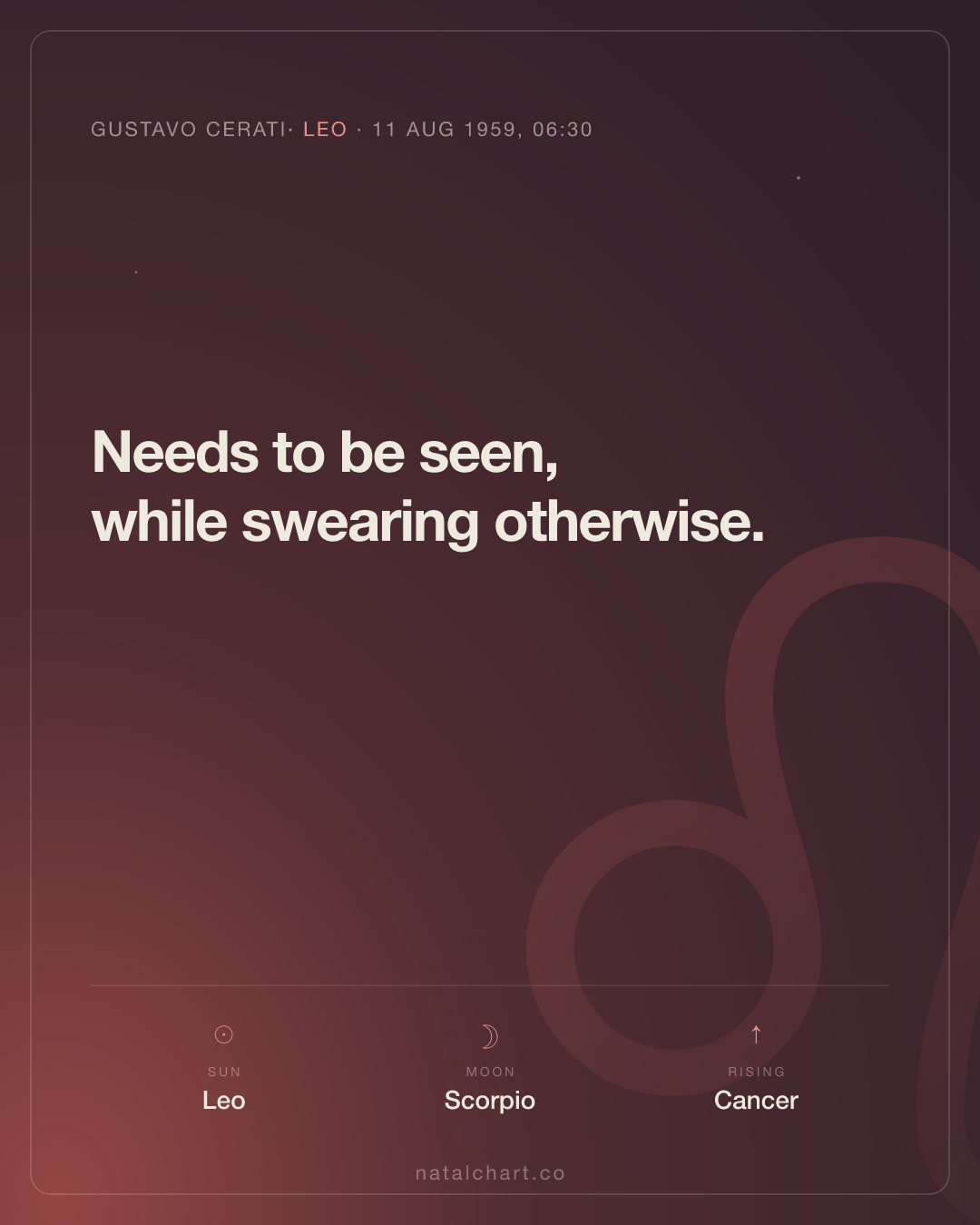
Gustavo Cerati's Sun sign is Leo — the Sun was in Leo at birth (1959).
What is Gustavo Cerati's moon sign?
Gustavo Cerati has the Moon in Scorpio. The Moon sign describes the emotional and instinctive layer of the chart.
What is Gustavo Cerati's rising sign?
Gustavo Cerati's rising sign (ascendant) is Cancer — the sign on the eastern horizon at the moment of birth.
When and where was Gustavo Cerati born?
Gustavo Cerati was born in 1959 in Buenos Aires, Argentina.