Gustavo Kuerten — natal chart
What does Gustavo Kuerten’s natal chart reveal?
Brazilian tennis player born in 1976. Won Roland Garros in 1997, 2000 and 2001 on clay. He was world number one in December 2000, the first South American to top the rankings. Hip injuries forced his retirement from the tour in 2008.
 Share
Share
Birth
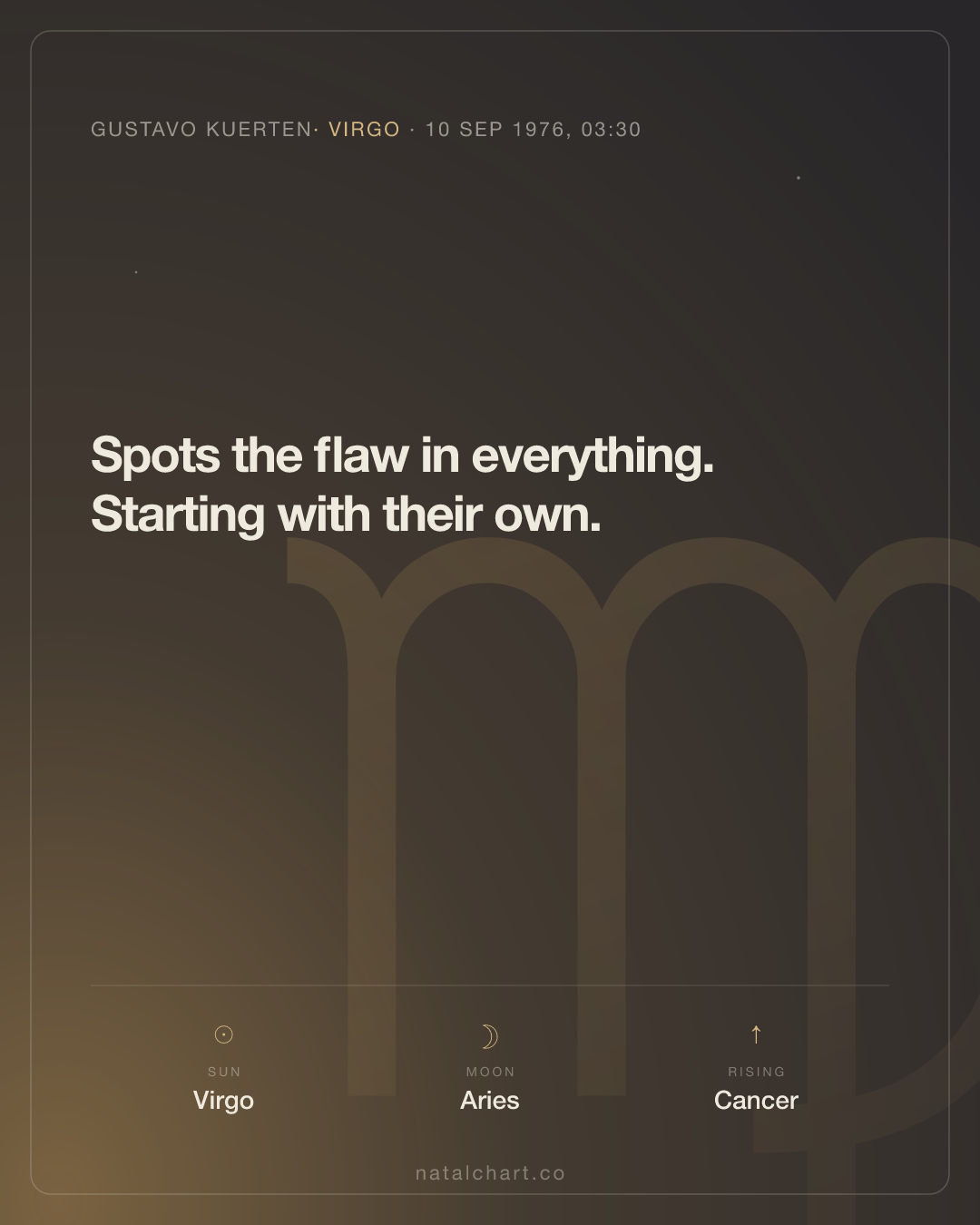
1976-09-10 · 03:30 · Florianópolis, Santa Catarina Reliability: AA · vetted record
Ascendant Cancer: the quiet warmth that disarms
There was always something about Gustavo Kuerten that felt different from the usual tennis champion — a warmth that did not fit the sport's often cold, competitive surface. His Cancer Ascendant (the sign rising at the moment of his birth, meaning the face he naturally turned toward the world) explains a great deal of that quality. Cancer Ascendant creates an instinctively protective exterior, one that reads as approachable and genuine — which Kuerten consistently was. He drew the crowd in, signed autographs with patience, refused to perform the requisite emotional coldness. This was not an act. The Ascendant shapes the body language and the first impression; his said: I am safe, you can trust this.
Sun in Virgo: craftsmanship as identity
The Sun in Virgo, placed in the third house (the area of the chart linked to communication, local environment and the work of the hands), describes someone whose identity is built on attention to detail and the refinement of technique. Kuerten was not blessed with the most naturally explosive physical gifts in men's tennis. He was not the tallest, the most powerful. What he had was a relentless commitment to improving what he could control: the precise architecture of a backhand, the placement of a serve, the tactical management of a clay point. Virgo takes something that works and works on it further, searching for the cleaner version. The third house adds a communicative quality — his body language on court was articulate, precise, readable. The way he moved and gestured during a match was part of how he played.
Moon in Aries in the tenth house: emotion that drives rather than retreats
The Moon describes emotional life — what one feels, how one reacts instinctively, what provides a sense of security. Kuerten's Moon sits in Aries, in the tenth house (the public and career area of the chart). Aries Moon responds immediately, does not dwell, converts feeling into action. In the tenth house, this emotional drive is directly visible to the public — the famous heart drawn in the clay at Roland Garros after his 1997 victory was not a calculated media gesture. It was an Aries Moon moment: pure, immediate, joyful. Winning felt like fire, and the body expressed it before the mind could edit it. The Moon in Aries in a public house also means emotional setbacks are visible — the defeats, the painful hip years, the long absence from the tour between 2002 and 2008 — processed in public, as openly as the victories had been celebrated.
Venus, Mars and Pluto in Libra: the court as an aesthetic arena
Venus, Mars and Pluto are all clustered in Libra, in the fourth house (the private foundation of the chart). Venus and Mars barely 0.5 degrees apart, and both joined with Pluto just 0.2 and 0.3 degrees away respectively — this is an exceptionally tight cluster. Libra gives Mars a quality that looks paradoxical: the drive to compete is bound up with a need for elegance, for the clean line, for something that is satisfying to look at even mid-battle. Kuerten's game had that quality. The two-handed backhand that anchored his clay-court dominance was beautiful — not just effective. He was not trying to hit through his opponent; he was trying to find the perfect geometry. Pluto fused into this cluster adds intensity and the capacity to transform under pressure. The three Roland Garros titles — 1997, 2000, 2001 — were not won by the most physically dominant player in the draw. They were won by the most compelling one.
Moon opposite Mercury: the tension between instinct and thought
The Moon and Mercury sit almost exactly opposite each other in Kuerten's chart, just 0.6 degrees from exact. This is a tension (the two poles pull against each other rather than working smoothly together) between instinct and analysis, between emotional response and deliberate thought. In practice, this can look like an internal argument: the Aries Moon wants to react immediately, to play the daring shot, to move forward; the Mercury in Libra — in the fourth house, very private — wants to consider, to weigh, to find the measured approach. On the best days, this tension produces brilliant improvisation grounded in sound tactics. On harder days, it creates hesitation at precisely the moment when the game needs decisiveness. Managing that internal debate is something Kuerten navigated over his career with visible intelligence.
Saturn in Leo: the discipline that built the brand
Saturn in Leo, in the second house (the area of personal resources and material security), describes the way hard work and discipline are connected to reputation and reward. Leo wants visibility, recognition, the sense of having made a mark. Saturn says: earn it, and earn it through sustained effort over a long period, not through a single stroke of luck. Kuerten's career had exactly that shape — his 1997 Roland Garros victory was a shock, but his return wins in 2000 and 2001 demonstrated that the first title was not a fluke. He went away and built something more solid. Saturn in easy flow with Neptune (0.5 degrees) softens this a little: the discipline was never grinding or joyless. There was a quality of inspired hard work — structure and imagination in the same motion.
Outer planets: Uranus in Scorpio and the depth of transformation
Uranus in Scorpio in the fifth house (the house of performance, personal expression and risk-taking) describes a deeply unusual capacity to transform under pressure in competitive contexts. Scorpio and Uranus together bring radical, sudden shifts at the most intense moments. The 1997 Roland Garros final — Kuerten arriving as a 66th-ranked qualifier to beat the world number one — had that quality of rupture, of something that should not have happened according to any conventional reading of the odds. The fifth house locates this gift in the arena of creative self-expression. Kuerten was not a tactical grinder; he was a performer. The crowd at Roland Garros sensed this. Neptune in Sagittarius in the sixth house (the area of daily work, training and health) adds an idealistic quality to the training process — a sense that the work had a larger meaning beyond the results, and also, more literally, that the physical body was vulnerable in ways that demanded careful management. The hip injuries that ended his career in 2008 are written into this placement.
Midheaven in Taurus: a reputation built to last
The Midheaven (the career and public-reputation point) in Taurus describes a vocational drive toward something enduring, solid and genuinely worth having. Taurus does not want flash; it wants permanence. Kuerten became the first South American to reach the top of the ATP rankings — world number one in December 2000. That landmark was not temporary noise. He was beloved in Brazil in a way that outlasted his playing years, invited to carry the Olympic torch at the 2016 Rio Games. The Midheaven in Taurus, with Chiron and Lilith both close by in the eleventh house (the area of community, collective belonging and the legacy one leaves behind), suggests that the most lasting part of his public story would be what he gave to a broader group — which is precisely what happened. Guga Kuerten became something larger than a tennis result.
Chiron in Taurus: the gift inside the physical wound
Chiron (a small planet that represents an old wound which, over time, transforms into a genuine strength) sits in Taurus in the eleventh house. In Taurus, physical endurance and the relationship with the body are central. The hip injuries that forced Kuerten from the tour at thirty-one — years of surgery, rehabilitation, the difficult acceptance of a body that would not cooperate — are written into this placement. Chiron in the eleventh house suggests that the wound ultimately became a doorway into something communal. After retiring, Kuerten became a tireless advocate for the social inclusion of people with disabilities through the Instituto Guga Kuerten, founded in Florianópolis. The body that had limited him became the starting point for work that supported others whose bodies limited them. That is exactly what Chiron in the eleventh house describes: a personal wound turned outward, into service.
The warm close: what clay gave back
There is a particular coherence to Gustavo Kuerten's life in the chart. The Cancer Ascendant, the Virgo Sun committed to craft, the Aries Moon burning openly in public, the tightly clustered Libra planets hunting for the beautiful move — they all describe someone whose greatest performances came from the convergence of genuine feeling and meticulous preparation. He drew a heart in the clay at Roland Garros because Roland Garros genuinely moved him. The three titles were not won despite the sensitivity; they were won because of it. The hip that broke the playing career became the foundation for work that matters more. The chart, read from end to end, describes a person who brought real feeling to everything he touched — and let other people feel it too.
The chart
How to read it →Frequently asked questions
What is Gustavo Kuerten's zodiac sign?
Gustavo Kuerten's Sun sign is Virgo — the Sun was in Virgo at birth (1976).
What is Gustavo Kuerten's moon sign?
Gustavo Kuerten has the Moon in Aries. The Moon sign describes the emotional and instinctive layer of the chart.
What is Gustavo Kuerten's rising sign?
Gustavo Kuerten's rising sign (ascendant) is Cancer — the sign on the eastern horizon at the moment of birth.
When and where was Gustavo Kuerten born?
Gustavo Kuerten was born in 1976 in Florianópolis, Santa Catarina.