Jorge Luis Borges — natal chart
What does Jorge Luis Borges’s natal chart reveal?
Jorge Luis Borges, born on August 24, 1899, in Buenos Aires, Argentina, was a writer whose short fiction and essays transformed the possibilities of literature in the twentieth century. His collections Ficciones (1944) and The Aleph (1949) introduced a form of philosophical fantasy in which labyrinths, infinite libraries, and mirrors became tools for exploring problems of knowledge and identity. He served as director of the National Public Library of Argentina from 1955 to 1973 and held a professorship at the University of Buenos Aires. Borges gradually lost his sight and composed much of his later work by dictation. He died in Geneva on June 14, 1986.
 Share
Share
Birth
1899-08-24 · 21:00 · Buenos Aires, Argentina Reliability: A · reliable data
The core: a mind that could not help but go deeper
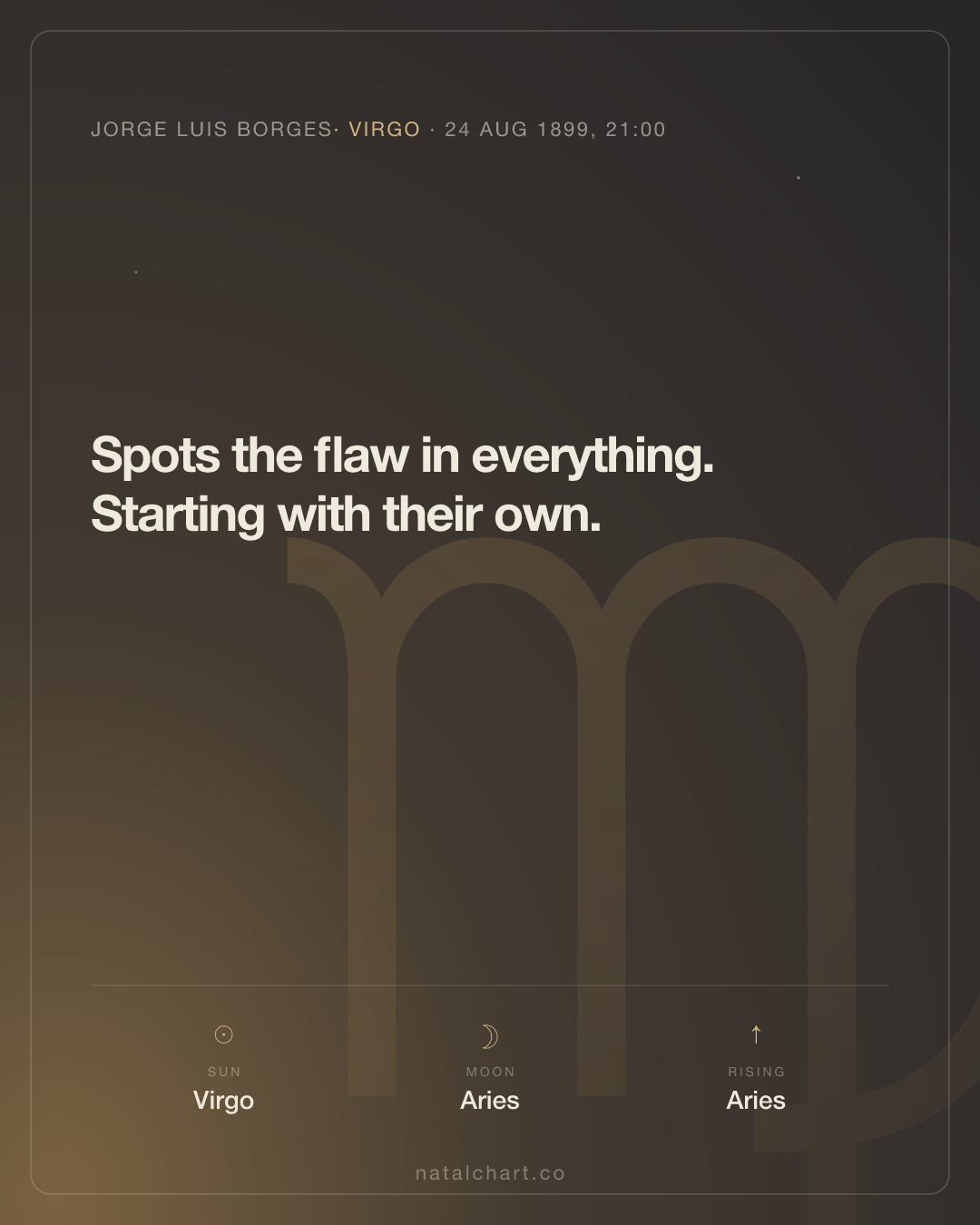
Borges moved through the world as if every surface concealed a door. That relentless intellectual restlessness is written clearly in the natal chart: the Sun in Virgo placed in the sixth house, the Ascendant in Aries, and a stellium of Mercury, Venus, and Lilith all gathered in Leo in the fifth house. The drive, the precision, the theatrical ambition — each one feeds the others. Virgo sharpens and dissects; Aries charges forward without apology; Leo performs with authority. In Borges the result was a writer who submitted everything to rigorous analysis, then presented the conclusions with the self-assurance of someone who had never doubted the stage was rightfully his.
The Ascendant — the face a person meets the world with — is Aries. It projects directness, confidence, an almost confrontational alertness. Biographers consistently describe the young Borges as precocious and certain: the child who read the Quixote in English before Spanish, who published a poem at nine, who never performed the usual hesitancies of literary apprenticeship. The Aries rising gives the exterior a quality of readiness, of arriving already decided. That this Aries outer face belongs to someone whose Sun is Virgo — meticulous, self-questioning, drawn to serve — is one of the central tensions in his chart and, arguably, in his work.
The emotional interior: fire at the door
The Moon — the emotional register, the private interior — lands in Aries as well, right in the first house, sitting close to the Ascendant. When the Moon and Ascendant share a sign, the inside leaks into the outside; the emotional life is not hidden but immediate, easily readable on the face and in the voice. Borges was famously mercurial in his enthusiasms: he fell hard for languages, for philosophical puzzles, for writers he adored, pivoting with the sudden certainty characteristic of Aries fire.
The Moon is in easy flow with Venus (the tightest aspect in the whole chart, less than half a degree apart). Emotional warmth and aesthetic pleasure reinforce each other naturally in this chart. Borges's deep affections — for Icelandic sagas, for Kipling, for detective fiction, for Silvina Ocampo — were never casual appreciations. They were complete commitments, returned to again and again with the loyalty of someone for whom feeling and taste are inseparable. The Moon is also in easy flow with Mercury and with Neptune in the third house: the emotional life and the literary imagination are fused. A feeling, for Borges, nearly always became a text.
Mind and creative voice: Leo on the fifth house
Mercury in Leo in the fifth house describes the way Borges thought in public: with flair, with a performer's instinct for the telling example, with a quality of deliberate pleasure in the right sentence. Mercury and Venus are joined in the same degree (within four degrees), with Lilith also in this same fifth house zone. The fifth house governs creative expression, play, the delight of making something. For Borges it is saturated: thought, language, beauty, and a certain charged independence all converge there.
Venus in Leo in easy flow with Neptune (in the third house of language and communication) is the aspect that gives the prose its quality of controlled enchantment — precise at the surface, dreamy at the depth. The Aleph, the infinite library of Babel, the circular ruins: these are images that work simultaneously as logical constructions and as hallucinations. Venus-Neptune does not blot out form; in Borges it dissolves form just enough to let the uncanny through. That he carried out this effect in short forms — the essay, the story of three to eight pages — reflects the Virgo-sixth-house Sun working its constraint on the fifth-house Leo extravagance. He wanted the labyrinth but also wanted it to fit in a coat pocket.
Mars and the question of the other
Mars, the planet that describes how a person acts and contends, is in Libra in the seventh house — the house of partnerships and counterparts, and the sign famous for its difficulty in acting unilaterally. This is Mars at something of a disadvantage: Libra prefers to deliberate, to consider both sides, to negotiate rather than strike. In Borges the result was a writer who frequently needed an interlocutor. His collaborations with Adolfo Bioy Casares were not mere professional arrangements; they were, by all accounts, essential thinking-partnerships. Seis problemas para don Isidro Parodi, the Antología de la literatura fantástica, the invented H. Bustos Domecq — these came out of genuine dialogue, of Mars in Libra doing its best work when there is another mind across the table.
Mars in the seventh also shapes the dynamic of opposition: Borges's literary stances were often defined against something — against realism, against local-color nationalism in Argentine letters, against what he saw as the provincial and the sentimental. The fight was real, but it was conducted through argument and irony rather than direct combat. Libra civilizes the warrior.
Jupiter, Saturn, and the architecture of thought
Jupiter in Scorpio in the eighth house and Saturn in Sagittarius in the ninth house form a striking pair. Jupiter in Scorpio does not expand toward comfort; it expands toward what is hidden, what is paradoxical, what cannot be said plainly without losing something. The eighth house is the house of what lies below the surface: inheritance, death, transformation, the other side of the mirror. Borges spent his entire career there. The themes of his fiction — the double, the labyrinth, the encyclopaedia as trap, death and its postponements — are eighth-house concerns mediated by Scorpio's appetite for the concealed truth.
Saturn in the ninth house is the serious scholar, the one who takes philosophical and metaphysical questions not as entertainment but as vocation. The ninth house governs higher learning, belief, far distances — and Saturn there structures it, demands rigor, refuses easy consolation. Borges read Berkeley and Schopenhauer and Hume not as a dilettante but as someone for whom the problems of time, consciousness, and identity were urgently personal. Uranus sits alongside Saturn in Sagittarius in the ninth house, and the Sun is in tension with Uranus (a pull between precision and rupture). The result: a thinker who needed formal structure but whose deepest impulse was always to overturn the framework he had just built.
The vocational point: Capricorn at the Midheaven
The Midheaven — the point in a chart that describes the public role, what a person is known for in the world — is in Capricorn. This is the sign of patient, long-term mastery, of authority earned through sustained work rather than sudden arrival. Borges did not receive major international recognition until he was in his sixties, sharing the International Publishers' Prize with Samuel Beckett in 1961. The years before were not empty — they produced Ficciones and The Aleph — but recognition moved at Capricorn's pace, arriving after decades of quiet, disciplined writing that bypassed the literary fashions of its moment. He served as director of the National Public Library of Argentina from 1955 to 1973, a Capricorn office if ever there was one: institutional, authoritative, solitary in its demands.
Capricorn at the Midheaven also describes a public persona that grows more authoritative with age. Late in life, blind and dictating his texts, Borges became something close to a literary monument while still alive — which is, again, the Capricorn trajectory: the long climb, the consolidation, the statue erected before the man departs.
The tightest pull: Saturn against Pluto
The second-tightest aspect in the chart is Saturn in Sagittarius pulling against Pluto in Gemini across the ninth and third houses — less than one degree of separation. This is one of the most demanding tensions a chart can hold. Saturn wants structure, continuity, and established truth; Pluto dissolves and destroys those very structures. In the third-to-ninth axis — the axis of communication, language, belief, and meaning — this tension runs all the way through. It produces the writer who cannot let a philosophical framework stand without also writing the story that exposes its limits. Tlön, Uqbar, Orbis Tertius is an almost perfect illustration: a false encyclopaedia that colonizes reality, Saturn (the encyclopaedia, the codified system) consumed by Pluto (the dissolution of the real). The creative output of this tension is extraordinary; the personal cost is a certain melancholy, a sense that no structure finally holds.
Saturn, Chiron, and the North Node in Sagittarius
Saturn, Chiron, and the North Node all gather in Sagittarius in the ninth house. Chiron — often described as an old wound that over time becomes a particular gift — in Sagittarius is a wound around meaning, belief, and the possibility of a stable philosophy. Borges found no stable philosophy. He borrowed from every tradition — Kabbalah, Gnosticism, Idealism, Buddhism, Argentine gaucho mythology — and committed to none. In his late essays and interviews he treated this as a mild embarrassment; in fact it was the engine. The North Node in Sagittarius points toward the work of integration — toward synthesizing the scattered fragments of knowledge into something that holds. The infinite library is Borges reaching toward that integration, and knowing, simultaneously, that it cannot be reached. That is not failure; it is the most honest thing a ninth-house Sagittarius chart can do.
The progressive loss of sight, which closed in steadily from his mid-thirties and became total around 1955 — the same year he was appointed director of the Library — is its own Chiron story: the man who loved books above everything received the library and lost the ability to read it. He responded by dictating, by deepening his reliance on memory and oral tradition, by writing shorter and more concentrated pieces. The wound did not end the work; it transformed it.
Neptune and Pluto in the third house: language as labyrinth
Neptune and Pluto both sit in Gemini in the third house — the house of language, siblings, the immediate environment, the first exchanges of ideas. These are generational planets, shared with everyone born in the same era, but they take on biographical weight in a chart like this. Neptune dissolves categories; in Gemini it dissolves the categories of language itself. Pluto transforms at the root; in Gemini it transforms how things are named and how names create reality. The Borges who argued that translations are sometimes improvements on originals, who invented false citations and treated bibliography as fiction, who wrote the story of a man who rewrites Don Quixote word for word two centuries later and produces a different book — that Borges was doing what Neptune-Pluto in Gemini demands: testing language to the point where it confesses its own instability.
A warm close: the gift inside the restlessness
The chart of Jorge Luis Borges describes a person who could not finally rest anywhere — not in a system, not in a body that worked as he wished, not in simple certainty. The Moon in Aries wants motion and immediate feeling; the Sun in Virgo wants exactness and service; Leo wants the stage; Capricorn wants the long authority of time. These are not easy companions. What they produced, held together by the extraordinary trine between Moon and Venus and the fifth house concentration of creative desire, was a body of work that has remained genuinely alive for more than a century — still quoted, still generating new readings, still felt by people who have never thought of themselves as literary.
The wound around belief, the perpetual questioning, the Saturn-Pluto tension that would not let any structure stand unchallenged — all of this was not despite the writing but because of it. Borges made the uncertainty into the material. That is not a small thing to do with a difficult chart. It is, arguably, the best thing anyone can do with one.
The chart
How to read it →Frequently asked questions
What is Jorge Luis Borges's zodiac sign?
Jorge Luis Borges's Sun sign is Virgo — the Sun was in Virgo at birth (1899).
What is Jorge Luis Borges's moon sign?
Jorge Luis Borges has the Moon in Aries. The Moon sign describes the emotional and instinctive layer of the chart.
What is Jorge Luis Borges's rising sign?
Jorge Luis Borges's rising sign (ascendant) is Aries — the sign on the eastern horizon at the moment of birth.
When and where was Jorge Luis Borges born?
Jorge Luis Borges was born in 1899 in Buenos Aires, Argentina.