Italo Calvino — natal chart
What does Italo Calvino’s natal chart reveal?
Italo Calvino (1923-1985) was an Italian writer, born in Cuba, known for imaginative and allegorical fiction. His works include Our Ancestors, Invisible Cities and If on a winter's night a traveler, blending fantasy, fable and structural experiment that made him one of the major postwar literary figures.
 Share
Share
Birth
1923-10-15 · 08:50 · Santiago de las Vegas, Cuba Reliability: A · reliable data
The core: a mind that lived in the invisible
Italo Calvino is one of those writers whose work looks effortless from the outside — playful, geometrically precise, endlessly inventive — but whose inner architecture is far more complicated. The chart tells the story of someone who built an entire literary world partly as a way of processing what he could not say directly, and who was, for all his wit, a deeply private person.
The Sun in Libra, placed in the twelfth house — the house of what stays hidden, of what works below the threshold of public visibility — is one of the most telling positions in this chart. Libra seeks balance and form; the twelfth house means that much of that seeking happened internally, away from the world's gaze. Calvino was a celebrated figure, but he was famously guarded in interviews, resistant to autobiographical confession, almost allergic to the direct first-person mode. He wrote fictional labyrinths rather than memoirs. That is the twelfth house doing its work.
Saturn in Libra sits directly alongside the Sun in the twelfth house — joined tightly, within less than two degrees. Saturn here is not a weight that crushed him; it was the structural principle that made his particular kind of creativity possible. He worked with discipline, rigorously, over long periods. Invisible Cities was not dashed off; nor was the encyclopedic precision of Cosmicomics. Saturn in the twelfth with the Sun produced a writer who needed solitude and long concentration to do his best work, and who was quietly severe about his own output.
The Ascendant — the face shown to the world — is Scorpio. Where the twelfth-house Sun was retiring and interior, the Scorpio mask was penetrating, watchful, intensely curious about hidden mechanisms. People who met Calvino in person often noted the gap between the lightness of the prose and the seriousness of the man.
The emotional interior: steadiness under the surface
The Moon in Capricorn in the third house gives the emotional life its particular character: steady, careful, not inclined to display feeling, but perpetually active in analysis. The third house is the house of thought, communication, and the immediate environment. For Calvino, the emotional register and the intellectual register were probably never fully separable — processing the world meant writing about it, thinking about it, making structures that could hold it.
The Moon in Capricorn in the third house also speaks to someone who found emotional stability in disciplined intellectual work. He was a reader before he was a writer; the act of engaging with texts, ideas, and formal systems was, for him, a form of emotional equilibrium as much as a professional practice.
The Moon and Mercury pull against each other — not a violent pull, but a persistent one, a friction between the emotional need for clear structural form (Capricorn Moon) and a Mercury in Libra that was drawn to ambiguity, balance, and the refusal of easy conclusions. That tension is arguably the engine of his best work: If on a winter's night a traveler is a book that formally refuses to be finished, that holds its form against the reader's desire for resolution. That is Moon-Mercury tension made into art.
The mind: balance, depth, and the love of structure
Mercury in Libra in the twelfth house describes a thinker drawn to symmetry, to multiple perspectives held simultaneously, and to the beauty of formal arrangement. Libra's Mercury does not rush to conclusions; it considers, weighs, and often produces something that looks deliberately inconclusive because incompletion was part of the design. Calvino's essay Six Memos for the Next Millennium — his unfinished final work — proposed lightness, quickness, exactitude, visibility, multiplicity, and consistency as the literary values worth preserving. That is Mercury in Libra making a formal argument for balance.
Mercury also sits very close to Mars in this chart — joined within five degrees. Mars is in Virgo, in the eleventh house. That combination gives the intellectual work its precision and its edge: the analytical acuity of Virgo, the drive to actually complete and structure the thought, pulling the Libran Mercury toward something more exacting than pure balance for its own sake. Our Ancestors — the trilogy comprising The Viscount, The Baron in the Trees, and The Nonexistent Knight — is structurally meticulous, allegorically exact. That is Mars in Virgo giving form to Mercury's ideas.
Venus and Jupiter: the Scorpio depth
Venus in Scorpio in the first house is the most emotionally charged personal planet in this chart. The first house is the house of self-presentation, and Venus there means that the aesthetic sensibility, the values, and the capacity for attachment were fundamental to how Calvino moved through the world. Venus in Scorpio does not attach lightly: the things it loves, it loves with sustained intensity, and it tends to be drawn to what is hidden, layered, and difficult.
Jupiter in Scorpio in the first house joins Venus very closely. That combination amplifies the quality: a deep, penetrating curiosity about what lies beneath surfaces, a genuine appetite for mystery and transformation. Calvino's fiction repeatedly performs the operation of making visible what ordinarily stays hidden — the invisible cities beneath Marco Polo's words, the knight who is nothing but armor, the baron who escapes to the trees rather than participate in a world that has not yet earned his presence. Jupiter and Venus in Scorpio in the first house are why those themes feel organic rather than contrived.
Neptune at the top: the public image as dream
Neptune in Leo in the tenth house — the tenth house is the career and public point of the chart — describes a public reputation built partly on something that resists clear categorization. Neptune blurs and expands; in the tenth house it produces figures whose work is hard to pin down, who seem to embody something larger than their individual output. Calvino was claimed by realists, fabulists, structuralists, postmodernists, and magical realists almost simultaneously. His public image had that Neptunian quality of reflecting back whatever the reader needed to see.
The Sun and Saturn both flow easily toward Neptune across the chart. The Sun in easy flow with Neptune — within little more than a degree, the tightest aspect in the chart — means that the hidden, interior Sun found its natural outlet through a Neptunian mode: fiction, dream, fable, the not-quite-real. He did not write romans-à-clef or confessional poetry; he wrote cosmological fairy tales. That is the twelfth-house Sun finding its path through Neptune in the tenth — the private made public, but wrapped in image and structure so that the personal is never directly exposed.
Mars, Uranus, and the structural experiments
Uranus in Pisces in the fifth house — the fifth house is the house of creative work and play — gives the formal experiments in his fiction their characteristic quality: not arbitrary disruption but something genuinely visionary, rooted in a creative imagination attracted to dissolving the conventional boundaries between genres and modes. The fifth-house Uranus in Pisces wanted to imagine what storytelling could become if it broke its own rules.
Pluto in Cancer in the ninth house speaks to a generation marked by historical rupture — the generation that came of age during fascism and the Second World War and had to rebuild not just countries but entire systems of thought. Calvino's early work was shaped directly by that history: his first novel The Path to the Nest of Spiders was rooted in the Italian Resistance. The ninth house is the house of worldview and philosophy; Pluto there describes a worldview forged in confrontation with historical catastrophe.
The Midheaven: craft as the public standard
The Midheaven — the career and public legacy point of the chart — is in Virgo. Virgo as a Midheaven describes a public legacy built on craft, precision, and the quality of the work itself rather than on personality or celebrity. Calvino's reputation rests on the exactitude of his sentences, the rigor of his formal architectures, the absence of any evident sloppiness. The North Node — the direction the life was pulling toward — is also in Virgo, reinforcing that the path forward ran through precision and the commitment to making the thing well, not just making the thing.
Chiron: the wound of the unfinished
Chiron — the old wound that slowly becomes a point of strength — is in Aries in the sixth house, the house of work, craft, and the body. Aries Chiron speaks to something urgent and incomplete in the daily practice itself: a drive that was never fully satisfied, a work ethic that pressed against its own limits. Calvino died in September 1985 of a cerebral hemorrhage, two days before he was due to travel to Harvard to deliver the Norton Lectures — the six memos. Only five were complete. The sixth — on consistency — was never written. That unfinished manuscript is the Chiron in Aries made literal: the wound is the incompletion, and the gift is everything that was finished before it.
The legacy
What the chart describes, ultimately, is a sensibility constituted by productive tensions: the Scorpio depths working through Libran forms, the twelfth-house privacy finding public expression through Neptune's dreamwork, the Moon's emotional steadiness holding Mercury's playful ambiguity in check, Saturn's discipline at the service of a radically inventive imagination. Invisible Cities is perhaps the purest expression of all of it: a book of pure form and pure feeling, geometrically exact and emotionally resonant, publicly celebrated and privately mysterious. That is Italo Calvino.
The chart
How to read it →Frequently asked questions
What is Italo Calvino's zodiac sign?
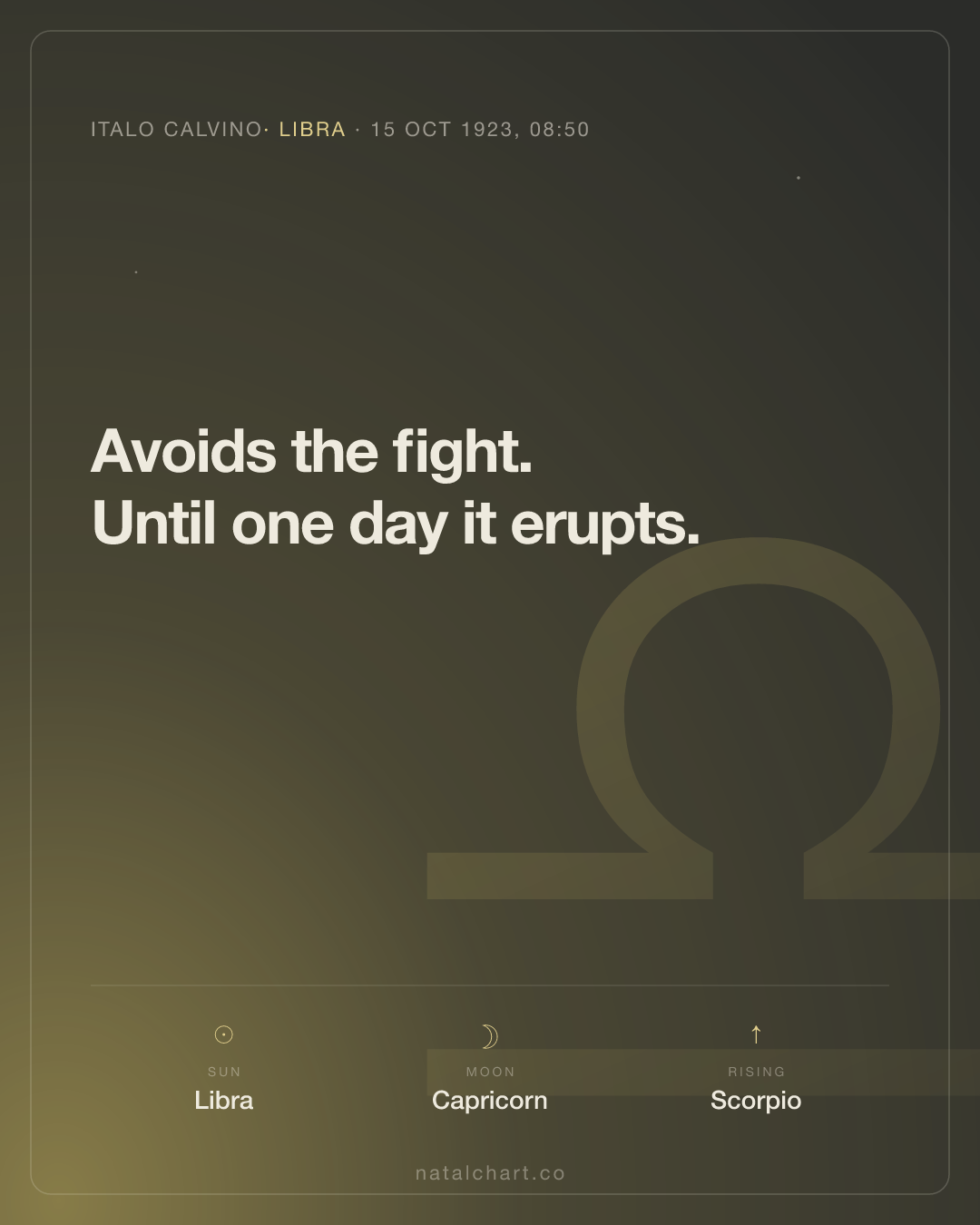
Italo Calvino's Sun sign is Libra — the Sun was in Libra at birth (1923).
What is Italo Calvino's moon sign?
Italo Calvino has the Moon in Capricorn. The Moon sign describes the emotional and instinctive layer of the chart.
What is Italo Calvino's rising sign?
Italo Calvino's rising sign (ascendant) is Scorpio — the sign on the eastern horizon at the moment of birth.
When and where was Italo Calvino born?
Italo Calvino was born in 1923 in Santiago de las Vegas, Cuba.