Jimi Hendrix — natal chart
What does Jimi Hendrix’s natal chart reveal?
American guitarist, technical landmark of electric rock. Led The Jimi Hendrix Experience on Are You Experienced (1967) and Electric Ladyland (1968). Performed at Woodstock in 1969. Died in London in 1970 at 27.
 Share
Share
Birth
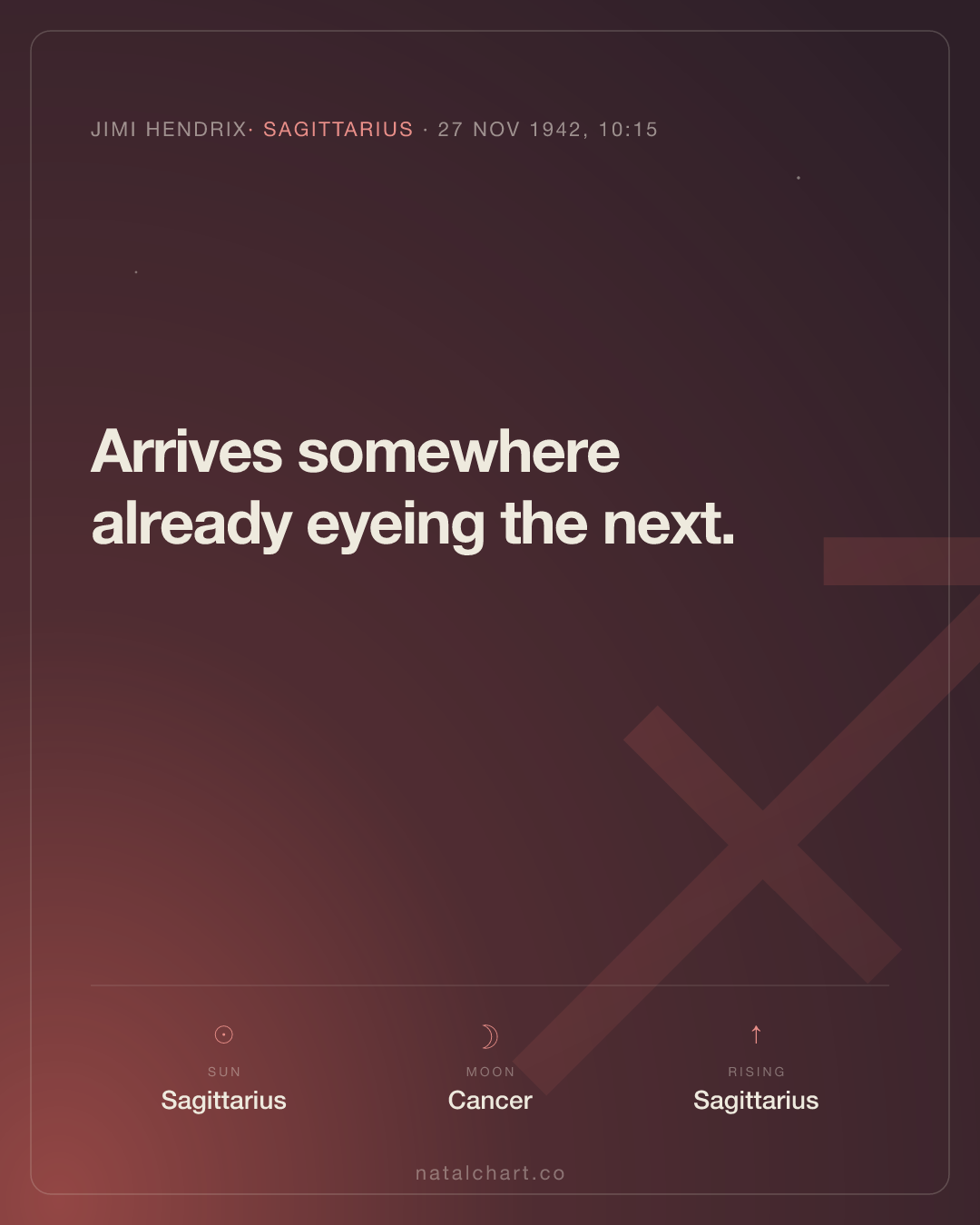
1942-11-27 · 10:15 · Seattle, Washington Reliability: AA · vetted record
The shape of him
Jimi Hendrix arrived already fully formed, which was precisely the problem for everyone who had to hear him and then figure out what to do next. A Sagittarius Ascendant, Sagittarius Sun, and Sagittarius Mercury in the first house — all three stacked at the rising angle — made him someone for whom identity and expression were one indivisible thing. He didn't perform; he happened. The Sagittarius quality is expansive and restless, always looking for what's on the other side of the border, and Hendrix applied that quality to the electric guitar: there was always one more sound in it, one more territory, one more dimension the instrument had not yet yielded. Are You Experienced (1967) did not ask whether you were ready; it assumed you weren't and took you there anyway.
The interior life
His Moon in Cancer in the eighth house describes an emotional interior that was deep, private, and invested in what lies beneath surfaces. The eighth house covers transformation, the hidden, everything that changes under pressure; Cancer brings loyalty, sensitivity, and a longing for shelter that is rarely fully met. He was publicly exuberant and privately tender — people who knew him well described a man who was gentle, easily hurt, and much quieter than the stage persona suggested. Jupiter also fell in Cancer in the eighth house, expanding everything: the sensitivity, the depth, the capacity to absorb and be absorbed. That eighth-house Jupiter is part of why his music felt inexhaustible — there was always more depth available, more to draw from.
Lilith also occupied Cancer in the eighth house. In this position, Lilith marks a suppressed emotional intensity that operated underground. The tenderness that the Sagittarius first house projected outward had a shadowy, unexpressed counterpart in the eighth — something that didn't get out cleanly.
How he thought and communicated
Mercury in Sagittarius in the first house was joined to the Sun and Ascendant, operating as one voice. Mercury in Sagittarius thinks in leaps — connections between ideas that seem distant, philosophical overarching structures, the meaning behind the particular. For Hendrix, the guitar was his Mercury: it was how he organised and communicated ideas. He didn't read music; he heard patterns and reproduced and transformed them by ear. That is Mercury in Sagittarius — not the careful notational approach, but the fast, intuitive, leap-oriented one.
Mercury and Uranus were in tight opposition — pulling in opposite directions at a separation of barely half a degree. Uranus (the planet of electricity, disruption, and radical innovation) sat in Gemini in the seventh house, directly across the chart from Mercury. The opposition describes a mind that is constantly in dialogue with its own disruptor: every musical idea had an Uranian counter-argument, an electric challenge that pushed it somewhere unexpected. This is the technical engine behind the sound — the fretboard tapping, the whammy-bar dive bombs, the feedback weaponised as melody. Mercury wanted to say something; Uranus kept asking whether it could be said differently, louder, upside down.
What moved him
Venus in Sagittarius in the first house sat in flowing harmony with Pluto — the tightest aspect in the entire chart, under half a degree. Venus (beauty, aesthetics, love) in easy flow with Pluto (intensity, transformation, depth) produces an aesthetic instinct that is not decorative but transformative. He did not make pretty music; he made music that changed the listener. The 1969 Woodstock performance of the American national anthem — guitar alone, feedback and whammy bar turning a patriotic standard into an account of war — is this aspect made audible. Venus wanted beauty; Pluto ensured it was beauty that cost something.
Venus also sat in tension with Saturn (in Gemini, in the seventh house), at under two degrees separation. Saturn here is the weight of expectation, the constraint of the established form. The tension produced the specific Hendrix quality of brilliance under pressure — the songs have structure, have form, even when they seem to be exploding.
Mars and what drove him at depth
Mars in Scorpio in the twelfth house is hidden and powerful. The twelfth house is the house of what operates below the threshold of visibility — the private interior, the unconscious drives, the things that move a person without their full awareness. Mars in Scorpio here was the furnace: the relentless, obsessive, sometimes self-destructive drive that kept him working through the night, chasing sounds no one had heard, reconfiguring the instrument, building Electric Lady Studios in New York so he could work whenever the impulse hit. The drive was real and it ran deep and it was not easily governed. That Mars in the twelfth is also part of what made the story tragic — the thing that powered him was also the thing least visible from the outside, least managed.
His public vocation
The Midheaven (the public and career point at the top of the chart) falls in Libra — the sign of beauty, balance, and aesthetic partnership. His public identity was constructed around sound as an art form, around making music that was beautiful in the fullest sense. Libra also rules the seventh house directly, where Saturn and Uranus both sit — meaning the structures and disruptions of his career, the partnerships (managers, bands, record labels) that shaped his trajectory, were all connected to the same Libra Midheaven axis. The tension between aesthetic vision and commercial structure is built into this chart.
Neptune in Libra in the eleventh house added the collective and the idealistic dimension: the audience was not just a crowd to him, it was a community to be transformed. The Woodstock crowd. The Isle of Wight. He wanted the music to land on everyone at once.
The tightest patterns in the chart
Venus in flow with Pluto at under half a degree is the signature aspect of this chart, already discussed. But the triple pattern that runs through Sagittarius Sun, Mercury, and Venus — all joined in the first house — means that his public face, his thought process, and his aesthetic were locked together as one expression. There was no separation between what Jimi Hendrix thought, what Jimi Hendrix loved, and what Jimi Hendrix looked like to the world. What you saw was what there was.
Uranus and Neptune were also in tight flow (under one degree) — a generational pattern, but one that connected to his personal planets through the Mercury opposition to Uranus. The thread from his individual mind to the broader cultural disruption of his era was unusually short.
Saturn and Pluto in easy flow at just over two degrees reinforced the discipline-under-intensity pattern: he could hold enormous creative pressure in structural form — a three-minute single that felt infinite, or a fifteen-minute live improvisation that never lost its shape.
Saturn, Jupiter, and the longer arcs
Saturn and Uranus both fell in Gemini in the seventh house — the house of partners, audiences, and one-on-one encounters. Saturn here brought the weight of structural expectations in relationships: the Experience band (Mitch Mitchell and Noel Redding) was a tight, accountable unit. The management relationship with Michael Jeffrey was Saturn in Gemini in the seventh in its difficult register — contractual constraint, duplicity, finally dissolution. Uranus in the same house brought the radical ruptures: the Experience broke up, Band of Gypsys formed, another reconfiguration was underway when he died.
Jupiter in Cancer in the eighth gave the expansive depth already described — the sense that the emotional and transformative well was essentially bottomless.
The outer planets and what they opened
Pluto in Leo in the ninth house describes an approach to philosophy, long journeys, and cultural transmission that was transformative and radically personal. The ninth house covers what we believe, the culture we absorb and transmit; Leo performs it. He absorbed the entire lineage of American blues — Robert Johnson, Muddy Waters, B.B. King — and performed it at a scale that became a global transmission. The music went everywhere because the ninth house pushed outward and Pluto ensured the transmission was not diluted.
Chiron (the old wound that becomes a gift over time) and the North Node (the compass bearing, the larger direction a life is pulled toward) both fell in Leo in the ninth house, alongside Pluto. For someone with a Sagittarius first house — expansive, outward, projecting — the wound and the direction both pointed toward the ninth house's territory: philosophy, meaning, legacy, transmission to others. He was pulled toward leaving something that would outlast him, and that pull was inseparable from the wound of never quite feeling that what he had already left was enough. He died while Electric Lady Studios was still being completed.
The lasting shape
Jimi Hendrix's chart holds together as one coherent argument: a man for whom thinking, loving, and being were the same act, whose private depth (Cancer eighth house Moon and Jupiter) ran underground beneath the Sagittarian public explosion, whose tightest aspect — Venus to Pluto — ensured that beauty was never decorative but always costly and transformative, and whose Mercury opposing Uranus meant that every musical idea was immediately challenged by its own disruption. The creative restlessness was not a side effect of the talent; it was the mechanism. Electric Ladyland came out in 1968. He died in 1970. The music has been reshaping everyone who touches it ever since.
The chart
How to read it →Frequently asked questions
What is Jimi Hendrix's zodiac sign?
Jimi Hendrix's Sun sign is Sagittarius — the Sun was in Sagittarius at birth (1942).
What is Jimi Hendrix's moon sign?
Jimi Hendrix has the Moon in Cancer. The Moon sign describes the emotional and instinctive layer of the chart.
What is Jimi Hendrix's rising sign?
Jimi Hendrix's rising sign (ascendant) is Sagittarius — the sign on the eastern horizon at the moment of birth.
When and where was Jimi Hendrix born?
Jimi Hendrix was born in 1942 in Seattle, Washington.