Winston Churchill — natal chart
What does Winston Churchill’s natal chart reveal?
British politician and writer. Prime Minister during World War II (1940-45) and again (1951-55). Led resistance against Nazi Germany. Nobel Prize in Literature 1953 for his historical works. Died in 1965.
 Share
Share
Birth
1874-11-30 · 01:30 · Woodstock, United Kingdom Reliability: A · reliable data
The Lion Who Reads the Storm
Winston Churchill saved a democracy, wrote its history, and won the Nobel Prize for doing both. To understand how a single person could carry that weight — and repeatedly collapse under it before returning — his birth chart draws a portrait that is less a paradox than a deeply coherent tension held in place for ninety years.
The Ascendant and the face he met the world with
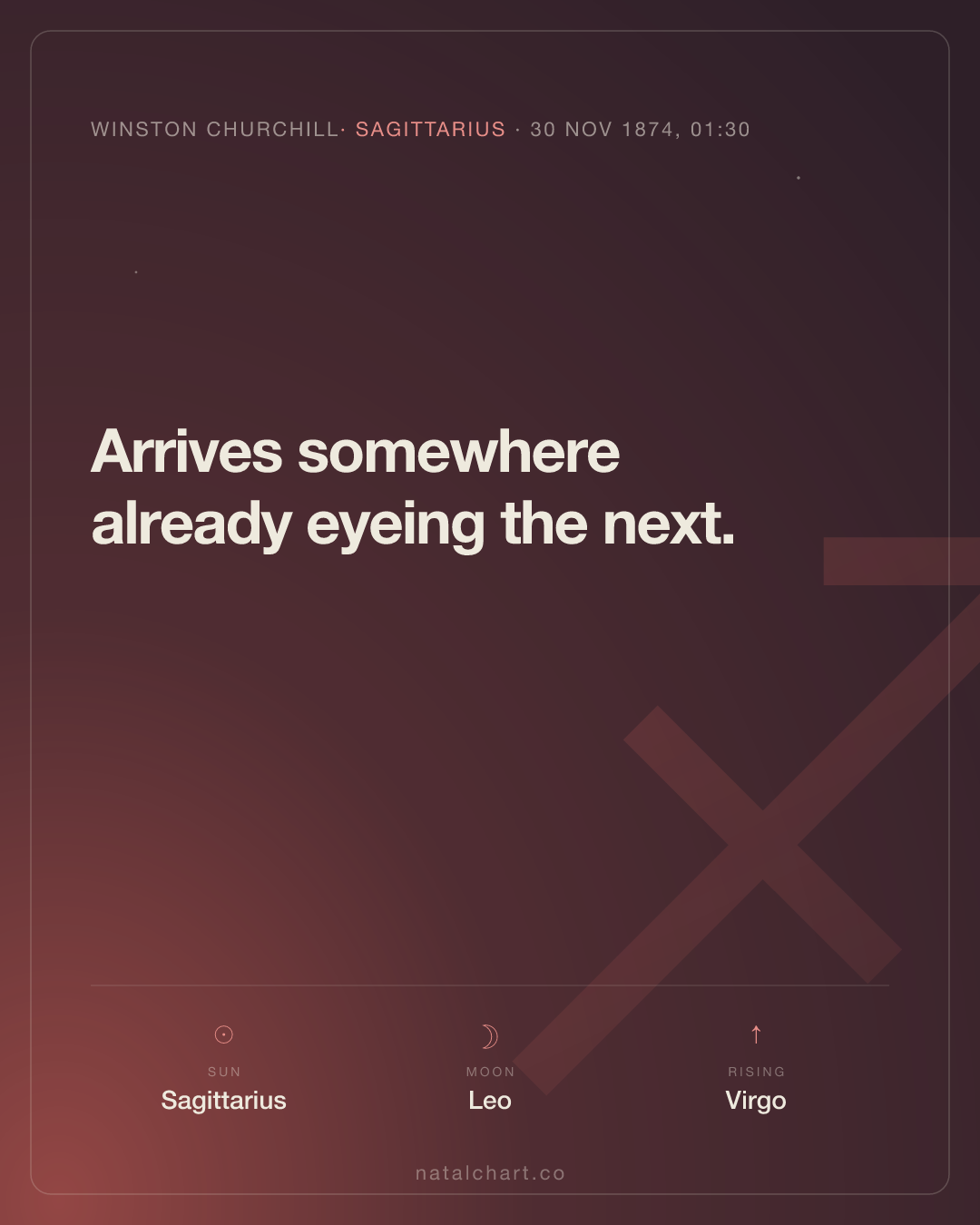
Virgo was rising at the moment of Churchill's birth — and the famous meticulousness is right there. The Ascendant (the face one meets the world with, the instinctive presentation) in Virgo brings an appetite for precision, a restlessness with vagueness, and a public exterior that is more careful and guarded than the inner fire would suggest. Saturn, the planet of structure and discipline, sits in the Sixth House — the house of daily work and craft — in Aquarius. This placement describes someone whose iron self-discipline is not naturally easy but deliberately constructed and then applied methodically to an unconventional vocation. Churchill famously worked in bed until noon dictating to secretaries, painted obsessively in his downtime, and built brick walls at Chartwell with his own hands. Virgo rising + Saturn in the Sixth is not a metaphor for that pattern: it is the pattern.
The Sun and the core
The Sun is in Sagittarius, in the Fourth House — the house of home, private life, and the roots from which one draws. Sagittarius is the sign of breadth, of the long view, of conviction carried at full volume. In the private Fourth House, this fire burns not in public display but in the home territory: the library at Chartwell, the personal histories that became Churchill's literary life's work, the almost territorial conviction that Britain was worth fighting for and that he understood its soul better than anyone. Alongside the Sun, Venus sits in Sagittarius in the same house — values, pleasure, and affection are all Sagittarian in character: generous, enthusiastic, occasionally excessive. The famous quantities of champagne, cigars, and brandy are in the chart.
The Sun forms a harmonious working relationship with Saturn — these two planets cooperate rather than fight. Personal identity and self-discipline reinforce each other; the man who shut himself in his study to write five-volume histories of the Second World War while still serving as Prime Minister was not forcing himself to do something unnatural. He was doing what the chart describes as home territory.
The Moon and the private self
The Moon is in Leo, in the Twelfth House — and this placement deserves particular attention. The Moon describes the emotional interior, the instinctive self, how one feels privately. Leo craves recognition, needs to matter, needs to be seen and heard and loved. In the Twelfth House — the house of what is hidden, of inner life, of what operates below the surface — this need for recognition is largely invisible to the outside world. Churchill's famous Black Dog, the depression that stalked him for much of his life, lives partly here: a grandiose emotional nature that is almost entirely hidden, that cannot easily receive the recognition it needs, that turns inward when the outer stage goes dark.
The Moon also forms its tightest harmonious relationship with Neptune: imagination and emotional life flow together easily. Neptune in Aries in the Eighth House — the house of crisis, transformation, death, and collective upheaval — connects the Moon's hidden emotionality to the sense of historical crisis. Churchill described watching Britain's darkest hours not as a burden but as a calling — as if the crisis was the moment his imagination had been waiting for. This is the Moon-Neptune trine speaking: a quality of poetic visionary perception that turns catastrophe into narrative.
Mercury and the weapon of words
Mercury — the planet of communication, writing, and the mind — is in Scorpio, in the Third House, the house of speech and written expression. Scorpio's Mercury does not communicate gently: it investigates, it cuts to bone, it speaks to the hidden structure of things. The Third House amplifies this into a genuine vocation for the written and spoken word. Then consider that Mercury is in tension with Uranus (sudden, brilliant, unconventional) and in opposition to Pluto (the planet of power, depth, and transformation, in the Ninth House of philosophy and publication): the mind is penetrating, occasionally dangerous, fascinated by the dark truth beneath the surface and capable of broadcasting it with transformative force.
The Nobel Prize citation praised Churchill's «mastery of historical and biographical description and for brilliant oratory in defending exalted human values.» That is Mercury in Scorpio, in the Third House, in a charged opposition to Pluto in the Ninth, to the letter. The speeches — «We shall fight on the beaches», «Their finest hour», «Blood, toil, tears and sweat» — are Scorpionic precision wrapped in Sagittarian fire and delivered through the lungs of a Virgo Ascendant who measured every syllable.
The Midheaven and the public vocation
The Midheaven (the highest point of the birth chart, describing the direction of professional and public life) is in Gemini — the sign of the communicator, the one who moves between worlds, the one who can speak to multiple audiences simultaneously. Combined with the Mercury in Scorpio that rules this point, the public vocation is defined by words: the politician who persuades, the writer who interprets, the orator who transforms. Churchill mastered all three within the same lifetime and the same career. The duality of Gemini is also there: Churchill the writer and Churchill the warrior occupied the same body with equal conviction, and neither fully made sense without the other.
Mars, Jupiter, and the engine of action
Mars and Jupiter both occupy Libra, in the Second House — the house of resources, material security, and values. Mars in Libra does not act impulsively: it calculates, weighs, seeks the strategically correct moment. Jupiter in the same sign and house expands this quality into something philosophically principled — the conviction that the right cause, pursued with sufficient resource, will prevail. The combination in the Second House suggests that the engine driving Churchill's action was always partly material: the question of whether Britain had the men, the money, the ships, the alliances to sustain the fight was not merely strategic but almost existential to him.
Mars forms a harmonious working relationship with Uranus: tactical brilliance and unconventional maneuver come naturally. The Gallipoli campaign was a failure, but its conception — attack from an unexpected direction to break the impasse of the Western Front — was pure Mars-Uranus thinking. So was the dramatic crossing of the Rhine, the early enthusiasm for tanks, the support for radar development. Even his wrong calls had an inventive logic.
The outer planets and the historical moment
Pluto in Taurus, in the Ninth House, describes the slow transformation of philosophical and institutional structures — the end of empire, the rewriting of the international order, the cultural upheaval of the Victorian world being dismantled and replaced across a lifetime. Churchill was born into one world and died in another, and he was both an agent of that transformation (in decolonization, in the forging of the Atlantic alliance) and a fierce resister of it (his opposition to Indian independence). Pluto in the Ninth holds both: the person who transforms belief systems often does so by fighting hardest against the very tide they are part of.
Neptune in Aries, in the Eighth House, connects idealism (Neptune) to crisis and collective transformation (Eighth House) and to the pioneering, impulsive energy of Aries. The First World War, the Second World War, the Cold War — three civilizational crises across a single lifetime. Neptune in Aries in the Eighth is not merely a personal placement: it describes the historical moment into which Churchill was born and in which he operated.
Chiron, the North Node, and the wound that became a gift
Chiron — an asteroid that in a birth chart describes an old wound that gradually becomes a source of hard-won wisdom — is in Aries, in the Eighth House. A wound around personal courage and survival, in the domain of crisis and collective power. Churchill was an undistinguished student, a second-tier soldier, a man dismissed as a dangerous eccentric for most of his political career. The wilderness years of the 1930s, when he warned about Hitler and was laughed at, were the years of Chiron's deepest exposure: the brave, correct, ignored voice. The Eighth House wound — that no one believes you until the catastrophe arrives — eventually became the gift: the man who had been consistently underestimated was the only one who had been right all along.
The North Node (the point that describes the direction of growth and contribution in a life) is in Aries — the sign of individual courage, direct action, and the pioneer who goes first. Churchill's North Node pulled him not toward the careful diplomacy of the Libran Mars but toward the blunter, bolder act: the speech that refused to promise anything except «blood, toil, tears and sweat»; the telegram to Roosevelt; the broadcast to occupied Europe. Not accommodation — action.
The tightest threads
A chart's tightest aspects are its clearest statements. Moon trine Neptune (1.2°): private emotional life and poetic imagination work in seamless harmony — the man who cried while watching documentaries about the Blitz, who wrote prose of genuine literary beauty, who described history as a sequence of dramatic human choices. Mars sextile Uranus (1.3°): tactical inventiveness flows easily into action, the unconventional move is the instinctive one. Venus sextile Jupiter (1.5°): warmth and generosity come naturally, the famous hospitality at Chartwell, the loyalty to old friends, the genuine enjoyment of abundance. Sun sextile Saturn (1.9°): personal identity and disciplined effort cooperate rather than fight.
The more challenging threads are there too: Mercury's tension with Uranus produces a mind so fast and so unconventional that it is frequently ahead of everyone else — and therefore frequently misread, ignored, or dismissed as reckless. Mercury's opposition to Pluto gives the words an almost compulsive depth and power that can feel overwhelming to listeners and readers alike.
A portrait in full
Winston Churchill was a man who contained, without resolving, the tension between the careful Virgo analyst and the Sagittarian fire-carrier; between the hidden Leo Moon that needed desperately to matter and the Twelfth House that kept it largely from view; between the Libran strategist who calculated every move and the Aries North Node that eventually demanded the bold, unguarded act. He was formed by failure — the Gallipoli disgrace, the political wilderness, the Black Dog years — and the Chiron in the Eighth House suggests that those wounds were not incidental but necessary: the wisdom he brought to Britain's darkest hour was inseparable from the years of being disbelieved.
The Nobel Prize was for literature, not for politics, and that is quietly correct. The Midheaven in Gemini, Mercury in Scorpio against Pluto, the Moon that dreamed in Leo while hidden in the Twelfth — Churchill's most durable gift was not the strategy, which was sometimes brilliant and sometimes catastrophically wrong. It was the words: the reading of history as a story of human choice, told with a precision and gravity that made the choice feel both possible and urgent. «We shall fight on the beaches» was not a military assessment. It was a sentence that changed what people believed was possible. That is the chart.
The chart
How to read it →Frequently asked questions
What is Winston Churchill's zodiac sign?
Winston Churchill's Sun sign is Sagittarius — the Sun was in Sagittarius at birth (1874).
What is Winston Churchill's moon sign?
Winston Churchill has the Moon in Leo. The Moon sign describes the emotional and instinctive layer of the chart.
What is Winston Churchill's rising sign?
Winston Churchill's rising sign (ascendant) is Virgo — the sign on the eastern horizon at the moment of birth.
When and where was Winston Churchill born?
Winston Churchill was born in 1874 in Woodstock, United Kingdom.