Louis de Funès — natal chart
What does Louis de Funès’s natal chart reveal?
Louis de Funes, born 31 July 1914 in Courbevoie, was a French actor and one of the most popular comedians in the country's history. After years in supporting roles, he had his breakthrough with La Traversee de Paris (1956) and became a box-office phenomenon in the 1960s with the Gendarme series beginning with Le Gendarme de Saint-Tropez (1964). He starred in enduring comedies including La Grande Vadrouille (1966), Le Grand Restaurant (1966), Les Aventures de Rabbi Jacob (1973) and the Fantomas trilogy. Known for his frenetic facial expressions, explosive temper and physical timing, he drew tens of millions of spectators across the 1960s and 1970s and received a Cesar of Honor in 1980. He died on 27 January 1983.
 Share
Share
Birth
1914-07-31 · 01:00 · Courbevoie, Hauts-de-Seine, France Reliability: C · uncertain Birth time (1:00 AM) comes from an astrological source of limited reliability.
The Precision Behind the Explosion
Louis de Funès spent decades in supporting roles before the world noticed what was happening. The man the public would eventually love — the whirlwind of grimaces, the comic rages, the body that seemed powered by some internal electrical fault — was already there in his work in the 1950s, fully formed, waiting for the material to catch up to him. The chart explains both the waiting and the explosion.
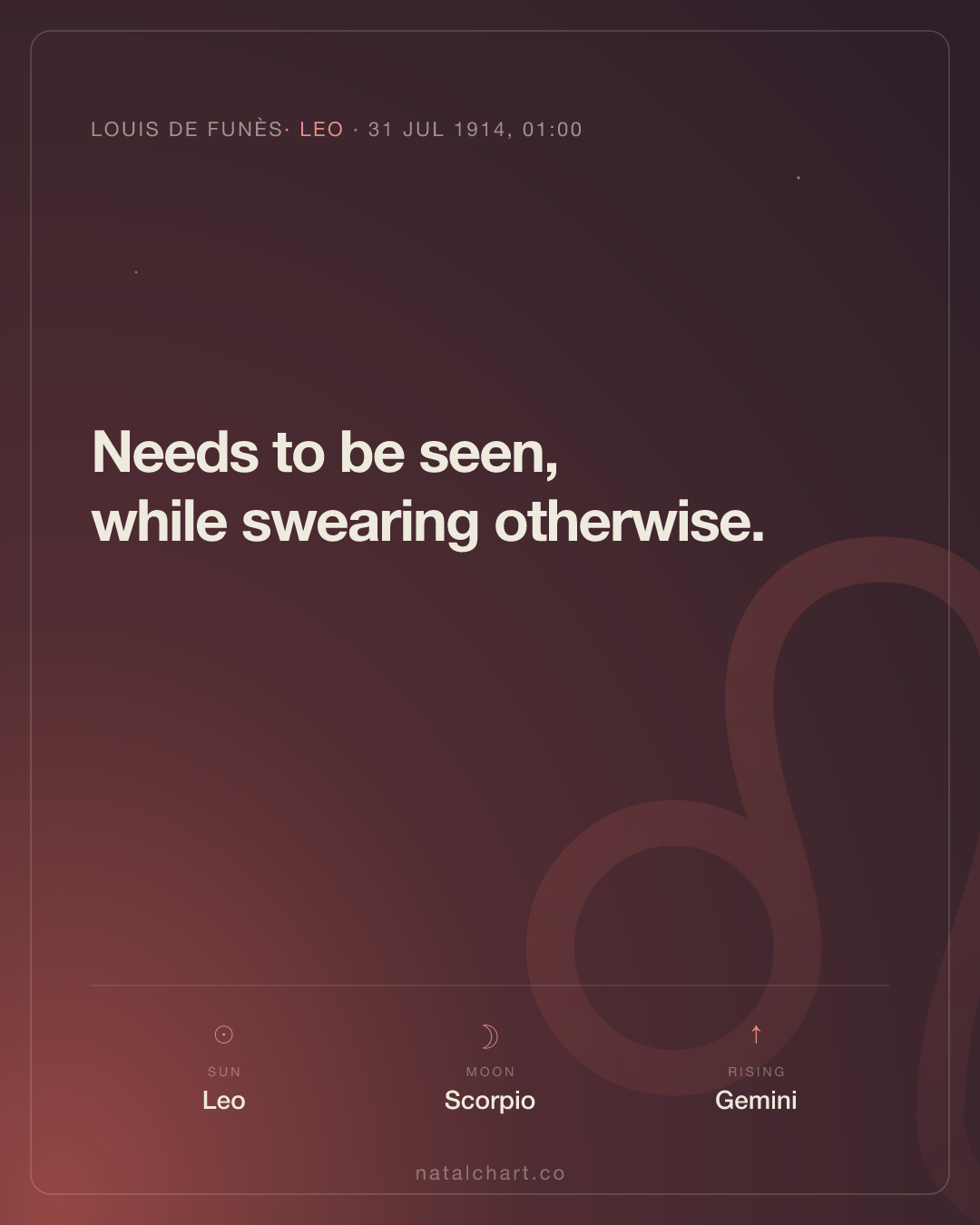
His Ascendant is in Gemini — the face he met the world with was quick, adaptable, verbal, dual. Where others chose a register, Gemini holds several at once. Saturn, however, is also in Gemini in the first house, the house of the self and its outward presentation. Saturn here is the planet of discipline and delay sitting precisely at the threshold of how a person is first encountered. It compressed the Gemini quicksilver into something precise rather than scattered, and it made him wait: the breakthrough only arrived when he was forty-two.
Sun in Leo: The Stage as Natural Habitat
The Sun in Leo in the third house settles the central identity. Leo does not merely perform — Leo performs for an audience that it instinctively senses across the room, and adjusts until the response is what it wanted. The third house is the house of expression, of language, of the immediate exchange between person and room. Sun here means the identity is expressed — not merely held internally — through speech, through gesture, through the communicative act.
De Funès was famous for a physicality so controlled it operated like a musical instrument. Every eyebrow, every shoulder, every intake of breath was functional. Leo in the third house, mediated by Gemini at the Ascendant, produces someone for whom expression is not a secondary capacity but the primary mode of being in the world.
Moon in Scorpio: The Intensity That Powered the Comedy
The Moon — the emotional interior — is in Scorpio in the sixth house, the house of work, method and daily practice. The Moon in Scorpio describes an interior that feels things at depth, that does not take the surface at face value, that notices what is not being said. That intensity is not at all opposite to great comedy — it is the fuel of it. The best screen comedians are people who feel the absurdity of social conventions more acutely than others, who find the gap between what is claimed and what is real genuinely insufferable.
The Moon in Scorpio forms a near-exact angle of natural collaboration with Mars in Virgo — an orb of barely a tenth of a degree. That is the tightest aspect in the entire chart. The emotional charge (Moon in Scorpio) and the drive to act (Mars in Virgo) operate in almost complete unison. In the work, this shows up as the remarkable physical-emotional integration of his performances: the face and the body were not illustrating something the emotion decided — they were the emotion itself, executing.
Mercury, Venus and Mars in Virgo: The Craft Underneath
Venus and Mars are both in Virgo in the fourth house, the house of foundations, of what is worked on in private. Virgo is the sign of discernment, of method, of the precise calibration that distinguishes between what works and what almost works. Venus here values the exact gesture over the approximate one; Mars here drives toward a standard rather than toward the finish line.
Mercury in Cancer — the mind and its style of communication — joins easily with this Virgo cluster, adding emotional attunement to the analytical precision. De Funès prepared meticulously. He was known for arriving on set having worked the scene down to the smallest detail, not because he was anxious but because the craft demanded it. The Virgo emphasis in the fourth house means the real laboratory was private, invisible — the audience only saw the result.
Sun Opposing Uranus: The Tension That Made History
The Sun in Leo stands in opposition to Uranus in Aquarius in the ninth house — the two planets pulling against each other with fewer than three degrees separating them. Uranus is the planet of rupture, of surprise, of the break that doesn't look like a break until it has already happened. In opposition to the Sun (the core identity), it produces people whose self-expression carries an element of disruption — something about the way they present themselves is slightly, productively, wrong.
This is a useful aspect for comedy. The gap between what the character believes about himself and what the audience sees is the engine of the Gendarme films, of Les Aventures de Rabbi Jacob, of La Grande Vadrouille. Uranus in the ninth house (the house of broad ideas, social belief) adds the dimension of social satire: the figures de Funès played were always, in some way, about a certain kind of French self-importance meeting something it couldn't process.
Jupiter and Uranus in Aquarius: The Vocation
Jupiter and Uranus share Aquarius in the ninth house — the house of the wide view, of what one transmits to others. The Midheaven, the public point of the chart, is also in Aquarius. Aquarius at the Midheaven produces people whose public identity becomes collective in some way — less about individual achievement than about a relationship with the many. De Funès drew more than seventy million spectators across a single decade. That is not a career; that is a social phenomenon.
Jupiter in easy collaboration with Pluto deepens this: the capacity to touch people at a level that bypassed critical evaluation. Audiences who had watched him for twenty minutes in a supporting role in 1956 would be back in 1966, and again in 1973, because what he did reached something pre-verbal, something in the body that responds before the mind has a chance to judge.
Chiron in Pisces and the Long Approach
Chiron — the old wound that turns slowly into a gift — is in Pisces in the tenth house, the house of public standing and reputation. The tenth house governs what the world makes of a person over time. Chiron here suggests a long, sometimes painful apprenticeship before recognition arrives — the wound is precisely the gap between what one is capable of and what the world has yet to see.
The North Node in Pisces points in the same direction: the path was through dissolution of the ego into something that serves others, into comedy that opens rather than closes. The forty years of small parts were not a waste; they were the construction of a precision instrument that would eventually be used by an entire country for its laughter.
A Portrait in Full
What the chart captures is an extraordinary integration of opposites. The Gemini Ascendant under Saturn's compression kept the expressiveness disciplined. The Scorpio Moon powering the Virgo Mars kept the intensity purposeful. The Sun in Leo opposing Uranus kept the performance subversive. Each tension had a use.
He died in 1983 with a Cesar of Honor and a filmography that had made him, across the 1960s and 1970s, one of the most-watched performers in the world. The chart is the chart of someone who arrived exactly when the world was ready for him — and who had spent the preceding decades making certain that when the moment came, nothing was left to chance.
The chart
How to read it →Frequently asked questions
What is Louis de Funès's zodiac sign?
Louis de Funès's Sun sign is Leo — the Sun was in Leo at birth (1914).
What is Louis de Funès's moon sign?
Louis de Funès has the Moon in Scorpio. The Moon sign describes the emotional and instinctive layer of the chart.
What is Louis de Funès's rising sign?
Louis de Funès's rising sign (ascendant) is Gemini — the sign on the eastern horizon at the moment of birth.
When and where was Louis de Funès born?
Louis de Funès was born in 1914 in Courbevoie, Hauts-de-Seine, France.