Mata Hari — natal chart
What does Mata Hari’s natal chart reveal?
Mata Hari (1876-1917) was a Dutch exotic dancer and courtesan who became famous across Belle Époque Europe. Born Margaretha Zelle, she was convicted of spying for Germany during World War I and executed by firing squad in France, becoming an enduring symbol of the femme fatale.
 Share
Share
Birth
1876-08-07 · 13:00 · Leeuwarden, Netherlands Reliability: AA · vetted record
The Core: A Life Built for the Stage
There are charts where the public persona is a side note — a professional layer atop a private self. Mata Hari's chart is not that. Her Sun, Mercury, Mars, and Uranus all fall in Leo and all crowd into the tenth house, which astrologers call the public/career point — the part of the chart most visible to the world. For Margaretha Zelle, the stage was not where she performed: it was where she existed. The private woman and the radiant spectacle were not separable. What most people spend a lifetime hiding — ambition, desire, the hunger to be seen — she turned into the architecture of an entire identity.
The Ascendant is the face someone meets the world with, the first impression they project before they say a word. Hers is Scorpio: a gaze that feels like it already knows something about you. Even when she was dazzling an audience with colour and movement, the underlying frequency was Scorpionic — controlled, probing, never fully disclosed. Jupiter, the planet of abundance and expansion, sits directly on that Scorpio Ascendant, amplifying its magnetism into something almost theatrical by itself. Rooms changed when she entered them. That was not performance; that was a quality of presence she carried at all times.
The Inner Life: Dreaming Under Discipline
Beneath the spectacle was a Moon in Pisces in the fifth house — the emotional interior of someone whose inner world ran on feeling, image, and longing rather than logic. Pisces Moon people feel the edges of things dissolve; moods and atmospheres pass through them like weather. In the fifth house — the zone of pleasure, creativity, and self-expression — that sensitivity fed directly into her art. The dances she invented were not technically authentic (historians are clear on that), but they had the conviction of dreams: they felt true, which was precisely the point.
Saturn sits beside that Moon in Pisces, and Saturn is the planet of limitation, form, and hard-earned skill. That pairing tells a particular story: a rich emotional life held inside a container of iron discipline. Margaretha Zelle did not stumble onto a stage and improvise her way to European fame. She trained herself, constructed a persona, maintained it under pressure, and repeated the performance night after night for years. The Pisces Moon gave her the material — the fantasy, the oceanic longing, the ability to disappear into a character. Saturn kept it from floating away.
Venus: Loving at a Distance
Venus, the planet governing how someone loves and what they value, is in Cancer and placed in the ninth house — the house of long journeys, foreign cultures, and philosophical yearning. A Venus in Cancer loves with a tenderness that runs very deep, but the ninth-house placement pulls that love away from the domestic and toward the exotic, the distant, the philosophically charged. Her relationships stretched across borders, languages, and social strata. She moved toward men (and sometimes women) the way a Cancer Venus does — with genuine warmth, with a need to nurture and be held — but always in the context of a world larger than any single hearth.
Chiron, sometimes called the wound that becomes a gift, also sits in Cancer in the ninth house, right beside that Venus. The two placements together suggest that her deepest tenderness was also her point of greatest vulnerability — that the warmth she offered from a distance was partly a protection. She had left the Netherlands at twenty-one after a failed marriage and a grief so heavy it included the death of her young son. The longing to belong somewhere, to be held by something, runs as a quiet note beneath all the public glamour.
Mercury and Mars: Words That Burn, Movement That Provokes
Mercury and Mars are joined at almost exactly the same degree in Leo in the tenth house — less than one degree apart, which makes it one of the tightest pairings in her entire chart. Mercury governs how a person thinks and communicates; Mars governs how they act and fight. When those two sit this close, thought and action become almost the same motion. She did not deliberate slowly and then perform; the performance was the thinking, the argument, the provocation, all at once.
Uranus — the planet of rupture, originality, and deliberate shock — joins that Mercury-Mars pair in Leo. All three together in the public tenth house: it is the signature of someone who communicated through disruption. Her performances were designed to unsettle European audiences who thought they knew what a woman's body was for. They were arguing with the audience, and the audience, largely, was entranced. That three-planet cluster (Mercury, Mars, Uranus in Leo, tenth house) is among the most striking configurations in any chart from that era — a blueprint for a life lived as ongoing provocation.
Jupiter and Pluto: Power, Depth, and the Risk of Excess
Jupiter in Scorpio on the Ascendant pulls against Pluto in Taurus in the seventh house (the house of partnerships and open adversaries). Jupiter and Pluto pulling against each other is a tension between the drive for absolute expansion and the need for control; between the wish to know everything and the refusal to be fully known. She moved through aristocratic and military circles not as a spectator but as a full player — she understood power, its textures and its prices, in ways that few publicly visible women of her era did.
The seventh house, where Pluto sits alongside Neptune, also governs open enemies. Neptune there — dreamy, dissolving, obscuring — has been noted by chart readers for generations: the quality of ambiguity that surrounded her public relationships was not incidental. People could not quite pin down who she really was to them, what she actually wanted, whether what she showed them was real. For Mata Hari, that was partly a survival strategy and partly just who she was.
The Midheaven: Craft in the Service of Theatre
The Midheaven (the public/career point at the very top of the chart) falls in Virgo — precise, analytical, technically exacting — in what seems an odd placement for someone associated with volcanic self-expression. But Virgo at the Midheaven tells the story of a professional who mastered her craft through painstaking attention to detail. The Leo planets below it supplied the fire; the Virgo Midheaven shaped that fire into a repeatable, refined performance. She studied Indian and Javanese dance traditions, even at a remove; she constructed her costumes with care; she managed her public image with a precision that her contemporaries did not always recognise as the strategic labour it was.
There is also something in the Virgo-Midheaven-with-Leo-stellium combination that speaks to service through spectacle: a performer who works, rigorously, in order to give an audience something worth their time.
The Outer Planets and the World She Moved Through
With Uranus joined to her personal planets in Leo, Mata Hari was genuinely of her generation's revolutionary edge — but it was a personal revolution, not an ideological one. She was not making a feminist argument in any explicit sense; she was simply refusing to behave as the era demanded, and the refusal was magnetic precisely because it was unselfconscious.
Neptune and Pluto in Taurus in the seventh house place a generational signature on her partnerships and public antagonists. The dreamy instability (Neptune) and the transformative power dynamics (Pluto) of the late-Victorian/Edwardian era ran directly through her most intimate arrangements. Her relationships with military officers and aristocrats during wartime were neither entirely innocent nor — as the French court decided — entirely treasonous. They were genuinely ambiguous, which is exactly the quality Neptune in the house of partnerships tends to generate.
Chiron and the North Node: The Wound, the Direction
The North Node (the point astrologers associate with the direction of growth) falls in Pisces, the same sign as her Moon and Saturn. Her growth was always back toward feeling, toward dissolution of the hard boundary between self and world, toward the kind of trust that Pisces demands and that the Scorpio Ascendant finds difficult to grant. The disciplined performer and the woman who simply needed to belong to something real were in permanent negotiation.
Lilith in Capricorn in the third house adds one further note: a stubbornness in communication, a refusal to soften her voice for anyone's comfort. Her letters and interviews, even when her situation was desperate, carry that quality — a dry, composed directness that the French military found unsettling in a woman awaiting execution.
A Portrait Across the Veil
What the chart describes is not a spy, not a seductress, not a victim — all the labels the century tried to press on her. It describes a woman with an extraordinary capacity for self-invention (Leo stellium, tenth house), genuine emotional depth beneath an impenetrable exterior (Scorpio Ascendant, Moon in Pisces), a love of what lay beyond borders (Venus in Cancer, ninth house), and a mode of communication so charged with personal force that it read as dangerous to the men who held her fate.
The four Leo planets in the tenth house — Sun, Mercury, Mars, Uranus — are among the most concentrated assertions of public self this chart could carry. She wanted to be seen, and she was. The world found her unforgettable and could not quite forgive her for it. That, more than anything else in her chart, feels like the through-line of her life: the price of being fully, brilliantly, uncompromisingly visible.
The chart
How to read it →Frequently asked questions
What is Mata Hari's zodiac sign?
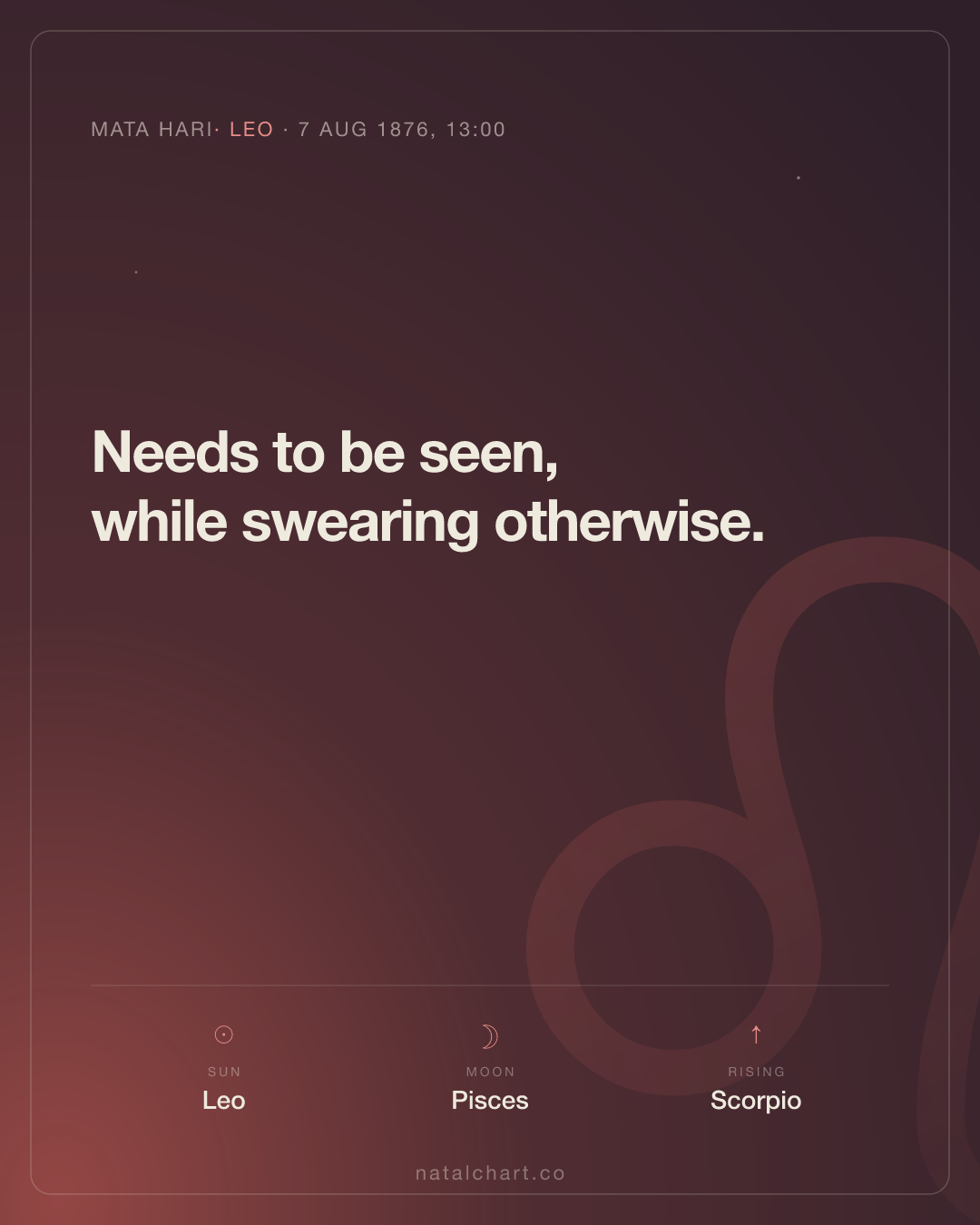
Mata Hari's Sun sign is Leo — the Sun was in Leo at birth (1876).
What is Mata Hari's moon sign?
Mata Hari has the Moon in Pisces. The Moon sign describes the emotional and instinctive layer of the chart.
What is Mata Hari's rising sign?
Mata Hari's rising sign (ascendant) is Scorpio — the sign on the eastern horizon at the moment of birth.
When and where was Mata Hari born?
Mata Hari was born in 1876 in Leeuwarden, Netherlands.