Michelangelo Antonioni — natal chart
What does Michelangelo Antonioni’s natal chart reveal?
Michelangelo Antonioni, born in Ferrara on 29 September 1912, was one of the most innovative film directors and screenwriters of the 20th century. After beginning in documentary, he revolutionised cinematic language with the so-called "trilogy of incommunicability": "L'Avventura" (1960), "La Notte" (1961) and "L'Eclisse" (1962). He went on to direct "Red Desert" (1964), "Blow-Up" (1966) and "The Passenger" (1975). A master of dilated time and visual composition, he won prizes at Cannes and Venice and in 1995 received an honorary Oscar. He died in Rome in 2007.
 Share
Share
Birth
1912-09-29 · Ferrara, Emilia-Romagna, Italy Reliability: X · no time No verified birth time: ascendant and houses are omitted.
The Shape of Absence
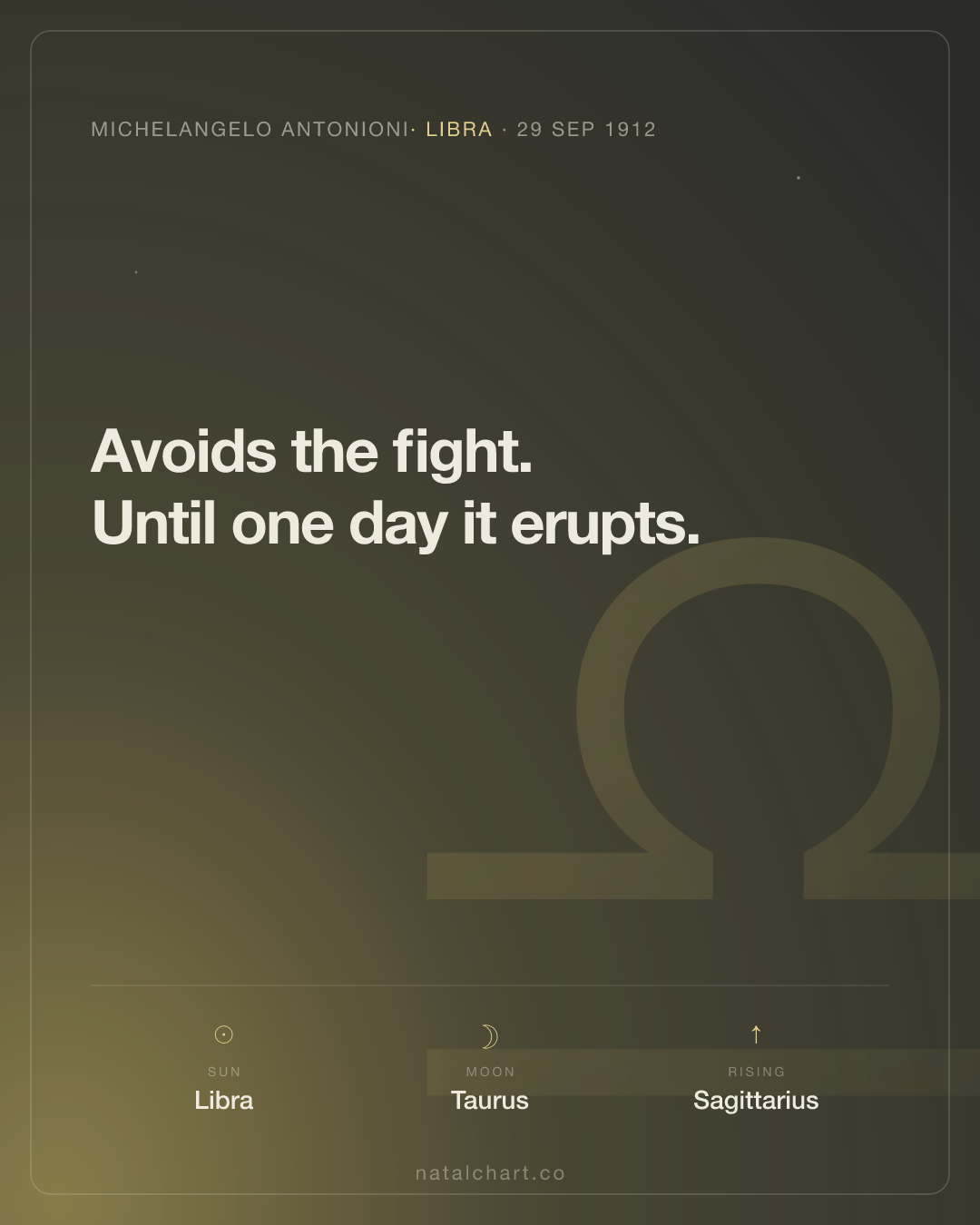
Four planets in Libra — the Sun, Mercury, Venus, and Mars — make Antonioni's chart one of the most concentrated expressions of a single sign in the records of Italian cinema. Libra is preoccupied with form, with the space between things, with what is withheld rather than declared. It searches for balance and finds instead the gap: the moment when two people reach toward each other and the distance between them becomes the subject. This is, in one sentence, the thematic core of almost everything Antonioni made. It was not a style he chose. It was the way he saw.
The Sun and Mercury in Libra worked in easy coordination with Saturn in Gemini — a relationship of mutual reinforcement between the mind's need for precision and its capacity to hold multiple things simultaneously without forcing a resolution. His films do not conclude in the conventional sense. L'Eclisse ends with an empty street corner where the lovers agreed to meet and did not. The camera stays on the intersection for several minutes. This is Saturn and Mercury in dialogue: the patience to look at what is not there, the discipline to resist filling the silence.
The Emotional Ground
The Moon in Taurus tells a different story — or rather, it completes the portrait. Taurus is the sign most associated with material reality, with what can be seen and touched and trusted because it persists. The Moon governs the emotional interior, and in Taurus it tends toward stability, toward the concrete, toward a mistrust of what cannot be substantiated. Set against the Libra cluster — abstract, relational, perpetually unresolved — the Taurus Moon acted as ballast. Antonioni could sustain the ambiguity in his films because something in him needed solid ground underneath it.
He was a meticulous craftsman of visual space. The landscapes in Red Desert (1964) — the petrochemical plant at Ravenna, the grey fog, the colors he had painted onto actual walls and trees to achieve the hues he wanted — reflect a Moon that experienced the world through what the eye could verify. The abstraction was always anchored in a specific, material image.
Venus and the Irresolvable
Venus in Libra occupied a peculiar position in the chart: pulled in two directions at once by its tightest aspects. On one side, it stood in tension with Uranus — a sharp, less-than-a-degree angle that introduces rupture into the experience of beauty and connection. On the other, it flowed easily with Pluto — a deep, transformative current underneath the surface of every relationship. These two pressures together produce someone for whom closeness is never simple: it arrives with an undertow of change, of something that cannot be sustained exactly as it is.
The relationships in Antonioni's films operate precisely this way. Claudia and Sandro in L'Avventura (1960) begin to fall for each other while searching for the woman who has disappeared between them. The desire is real; the guilt is real; the film refuses to arbitrate. Venus in tension with Uranus introduces the unexpected break; Venus in easy flow with Pluto suggests that whatever the break reveals is more true than what preceded it.
Mercury and the Form of Thought
Mercury in Libra squared Pluto — a tension between the way one thinks and the pressure to go beneath the surface of things, to find what is concealed. Antonioni began as a documentary filmmaker, trained on observed reality. The square from Pluto pushed that observation toward psychology: not what people do, but what they cannot say. The trilogy of incommunicability — L'Avventura, La Notte (1961), L'Eclisse (1962) — is the most sustained cinematic treatment of this theme in the twentieth century. The title of the trilogy came from critics; Antonioni himself resisted labels. But the Mercury-Pluto tension describes it exactly: a mind that looks at communication and finds, underneath it, everything that cannot be communicated.
Mercury also worked in easy coordination with Uranus. The documentary training, the documentary eye, the capacity to find in observed reality something that theory cannot predict — this is the Mercury-Uranus flow. Blow-Up (1966) turns that quality into subject matter: a photographer who photographs reality and discovers he has documented something he cannot explain.
Mars and the Patience of Form
Mars in Libra is often described as difficult — the planet of action and decision placed in the sign most associated with weighing and deferring. In a filmmaker's chart, this configuration tends to produce someone for whom the work takes a long time, who revises extensively, who will not release something until the form is exactly right. Antonioni's production was not large. He made seventeen features over fifty years. Each one was specific and considered. The Passenger (1975), shot on location across four continents with Jack Nicholson, took years to develop and remains one of the most formally precise films about identity and its erasure ever made. Mars in Libra: the drive channelled entirely into the quality of the decision, not its speed.
Jupiter and Saturn: Breadth and Constraint
Jupiter in Sagittarius expanded the frame — a genuine openness to the world's variety, a willingness to move, to shoot in London and Morocco and the Sahara. The ninth house placement, associated with travel and broad inquiry, fits the career of a man who made films that could not have been made by someone rooted in one place. Sagittarius at its best is curious without agenda, interested in what it does not yet know.
Saturn in Gemini held the opposite pressure: the discipline of precision in language, the refusal to simplify. Antonioni was also a writer — he wrote the screenplays for all his major films — and the Saturn-Mercury-Sun trine (Mercury and Sun both in easy flow with Saturn) suggests that his literary precision and his visual precision came from the same source. The syntax of an Antonioni film and the syntax of his scripts are recognizably the same mind.
Chiron and the North Node
Chiron — an old wound that gradually becomes a place of skill — was in Pisces. Pisces dissolves boundaries: between self and world, between image and reality, between what is documented and what is imagined. The wound associated with this placement is often a difficulty with the line between empathy and absorption — the risk of losing oneself in what one observes. In Antonioni's work, this risk was precisely managed: he observed his characters with tremendous empathy and kept the camera at a distance that preserved their privacy. The wound became the instrument.
The North Node — the point that suggests the direction in which a life finds its fullest expression — was in Aries. Aries values initiative, the willingness to begin, the courage to assert a point of view without waiting for consensus. For someone with four planets in the diplomatic, indecisive Libra, the North Node in Aries was a corrective: toward commitment, toward the signature, toward work that takes a stand even when it refuses to judge. The honorary Oscar he received in 1995 — at eighty-two, long after he had suffered a stroke that left him unable to speak — was recognition of exactly that: a body of work that had taken a stand, patiently, over fifty years.
A Single Portrait
Antonioni made films about the difficulty of being in relation to another person in a world that offers no reliable framework for understanding what that relation is. His chart describes, with unusual precision, the inner conditions that made those films possible: the Libra cluster that could see both sides simultaneously and refused to choose; the Taurus Moon that kept the abstraction grounded in the visible; the Venus pulled between rupture and depth; the Mercury in tension with Pluto that kept drilling beneath what was said. The form was not a preference. It was the only honest shape his perception could take.
The chart
How to read it →Frequently asked questions
What is Michelangelo Antonioni's zodiac sign?
Michelangelo Antonioni's Sun sign is Libra — the Sun was in Libra at birth (1912).
What is Michelangelo Antonioni's moon sign?
Michelangelo Antonioni has the Moon in Taurus. The Moon sign describes the emotional and instinctive layer of the chart.
When and where was Michelangelo Antonioni born?
Michelangelo Antonioni was born in 1912 in Ferrara, Emilia-Romagna, Italy.