Alejandro Sanz — natal chart
What does Alejandro Sanz’s natal chart reveal?
Spanish singer and songwriter born in 1968 in Madrid. He has sold more than 25 million records with albums such as 'Más' (1997) and 'El alma al aire' (2000). He has won four Grammys and 26 Latin Grammys.
 Share
Share
Birth
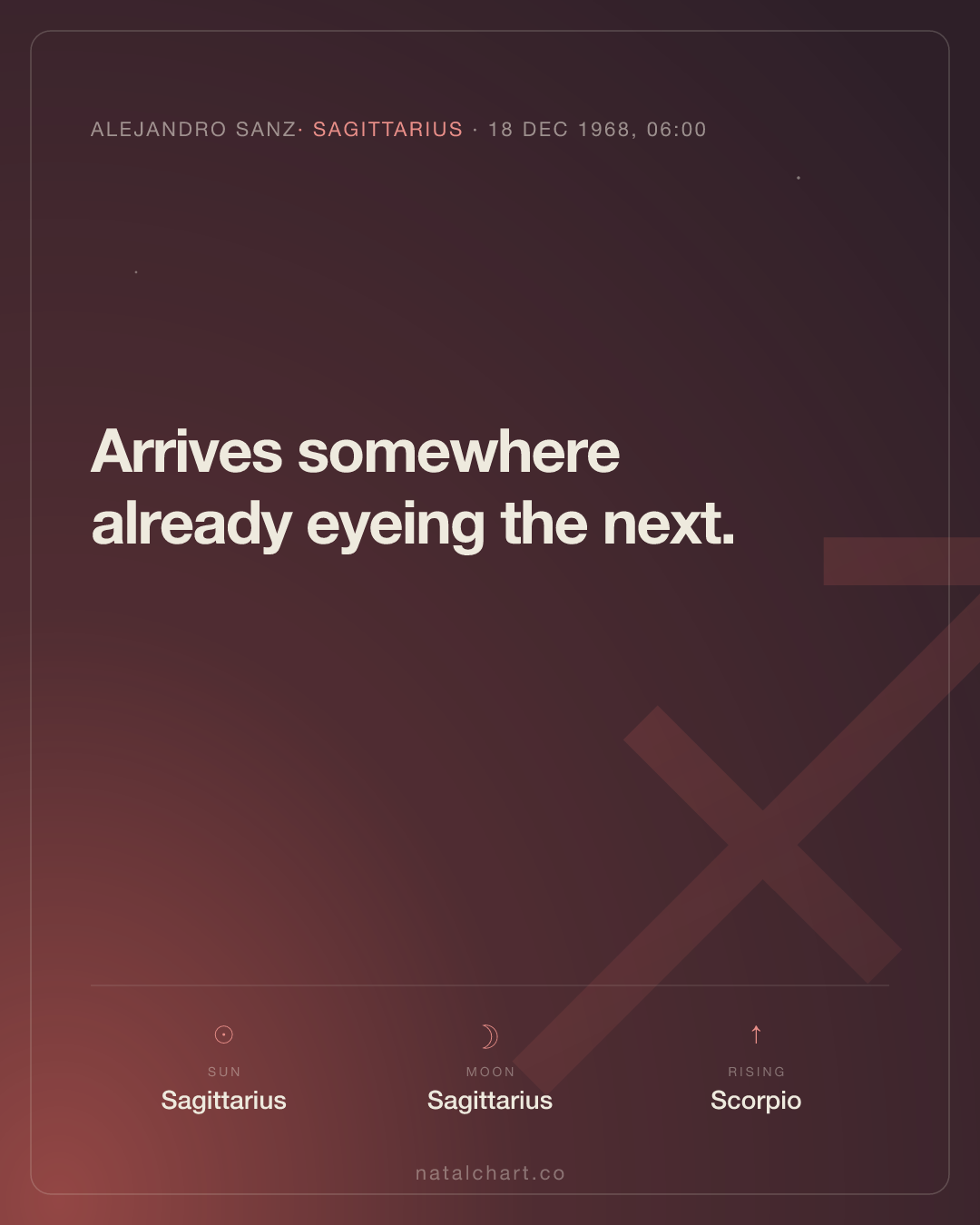
1968-12-18 · 06:00 · Madrid, Spain Reliability: A · reliable data
The Core: A Voice Built on Fire and Weight
Alejandro Sanz has always written from inside the fire — not watching it from a safe distance. The reason is right there in the centre of his chart: both Sun and Moon land in Sagittarius, in the second house (the house of what one values, what one builds from, what gives security). When the two great personal planets share the same sign and the same house, they pull in one direction. They make for a person of strikingly unified purpose — and in Sanz's case, that purpose has always been the song itself. The voice is not the vehicle for life; the song is the life.
But there is a counterweight. The Ascendant — the face someone meets the world with — falls in Scorpio, with Neptune sitting directly on top of it. Neptune here blurs the boundary between self and atmosphere; it gives an artist an uncanny capacity to dissolve into an audience. That brooding, intimate quality audiences felt from Más onward, the sense that he was singing about something private he'd decided to share — that comes from this placement. He is warmer, more expansive inside than the Scorpio surface suggests.
The Emotional Interior
A Sagittarius Moon in the second house does not brood in silence. Emotion here moves quickly and expresses honestly — there is generosity in how feeling is given out, and a real restlessness when life contracts into the narrow and routine. The breakthrough album Más (1997) arrived when Sanz stopped trying to sound like anything else and let that Sagittarian breadth take over: direct feeling, big choruses, no ironic distance.
The Moon sits in very close flowing relationship with both Jupiter and Uranus — the three form a tight cluster of easy movement. Jupiter amplifies; Uranus introduces the unexpected swerve. This is why his discography keeps changing shape rather than repeating a formula. El alma al aire (2000) went somewhere Más had not; collaborations with artists from Shakira to Alicia Keys were natural rather than calculated. The restless Uranian need to break the expected pattern is built directly into how he feels.
The Mind and How It Communicates
Mercury in Capricorn in the third house gives the working intelligence a different temperature to the expansive Sun and Moon. The mind here is patient, structural, interested in craft at the sentence level. Sanz has spoken often about rewriting lyrics ten or twenty times — this is Capricorn Mercury at work, refusing to leave until the line is precise. But Mercury pulls against Jupiter and Uranus (a tense, productive friction), which means the disciplined craftsman and the spontaneous risk-taker are always in negotiation. The friction is part of the method.
Love, Values and the Unconventional
Venus in Aquarius in the fourth house places the affective life in an unusual position. The fourth house is home, private life, the ground beneath everything; Aquarius in it seeks connection that defies convention and refuses to be owned. Love for Sanz has rarely been simple — the songs make that plain. Corazón Partío, Te Lo Agradezco, Pero No — these are not songs written by someone who finds intimacy uncomplicated. Venus in Aquarius prizes authenticity above comfort, and will push away what feels constricting even when the cost is high.
Drive, Depth and the Invisible Work
Mars, Jupiter and Uranus all land in Libra in the twelfth house — the house of what runs beneath the surface, what powers action from a hidden place. Mars in Libra is driven by a need for beauty, balance, and the right collaboration. In the twelfth, that drive is largely inward: the work happens before the audience ever arrives. The twenty-six Latin Grammys Sanz has accumulated came out of an enormous body of recorded work, most of which required sustained solitary effort no one saw. Mars in Libra also produces one of his most documented qualities: the instinct to bring other artists in, to find the song that the collaboration reveals rather than the one he would write alone.
The Growth Tension: Sun Square Pluto
The tightest personal tension in the chart is the Sun in Sagittarius working against Pluto in Virgo — these two pull against each other. Sagittarius wants to expand, roam, speak freely; Pluto in Virgo demands exact reckoning, relentless improvement, willingness to dismantle and rebuild. This is the tension that made four Grammy wins feel insufficient when the craft itself could still be better. It is also the tension behind the public mental-health honesty Sanz has shown in recent years — that Plutonian compulsion to name the thing honestly, whatever the cost to the comfortable public image.
Sun square Pluto does not get easier with success. It asks instead for a specific kind of integrity: not polishing the surface, but reworking the foundation.
The Career Point and the Midheaven
The Midheaven — the public and career point of the chart — falls in Virgo. Virgo at the top of the chart shapes a public identity built on precision, service, and the evidence of craft rather than spectacle. Sanz was never a pure showman; the Spanish music press has returned again and again to the musicianship, the arranging, the way the albums hold together as wholes. Pluto sits in the eleventh house close to this Virgo axis, so the career has run through collective structures — record industries, Latin music's global expansion, the political and cultural weight of Spanish as a language — in ways that required navigation at depth, not just personal talent.
Chiron and the North Node
Chiron — an asteroid-like body in the chart associated with an old sensitivity that gradually becomes a source of strength for others — falls in Pisces in the fifth house. The fifth house is creative expression, play, the places where one takes pleasure for its own sake. Pisces here suggests that the very vulnerability in artistic expression, the risk of not being understood, is exactly the place where Sanz's work has connected most widely. The songs that felt most exposed — Y, ¿Si Fuera Ella?, La Tortura — were also the ones that ran deepest for listeners.
The North Node in Aries points toward the direction that brings the most productive growth: direct action, personal courage, the willingness to move first without waiting for consensus. For someone with so much Libra (Mars, Jupiter, Uranus — all in the house of unseen work), the challenge has been bringing what is privately known into clear, unambiguous declaration.
The Full Picture
What makes Alejandro Sanz's chart coherent as a portrait is the way the expansion and the discipline keep checking each other. The Sagittarius fire wants everything to be felt and shared immediately; the Capricorn Mercury says: not yet, not until the line is right. The Scorpio Ascendant with Neptune keeps private what the Sagittarius Sun and Moon most want to give away freely. Twenty-five million records is the result of that sustained friction — not the easy parts, but the productive difficulty of a person built to want more than any single outcome can hold.
The chart
How to read it →Frequently asked questions
What is Alejandro Sanz's zodiac sign?
Alejandro Sanz's Sun sign is Sagittarius — the Sun was in Sagittarius at birth (1968).
What is Alejandro Sanz's moon sign?
Alejandro Sanz has the Moon in Sagittarius. The Moon sign describes the emotional and instinctive layer of the chart.
What is Alejandro Sanz's rising sign?
Alejandro Sanz's rising sign (ascendant) is Scorpio — the sign on the eastern horizon at the moment of birth.
When and where was Alejandro Sanz born?
Alejandro Sanz was born in 1968 in Madrid, Spain.