Camarón de la Isla — natal chart
What does Camarón de la Isla’s natal chart reveal?
Spanish flamenco singer born in 1950 as José Monge Cruz. He renewed flamenco singing with albums such as 'La leyenda del tiempo' (1979), recorded with Tomatito and Paco de Lucía. He died of cancer in 1992.
 Share
Share
Birth
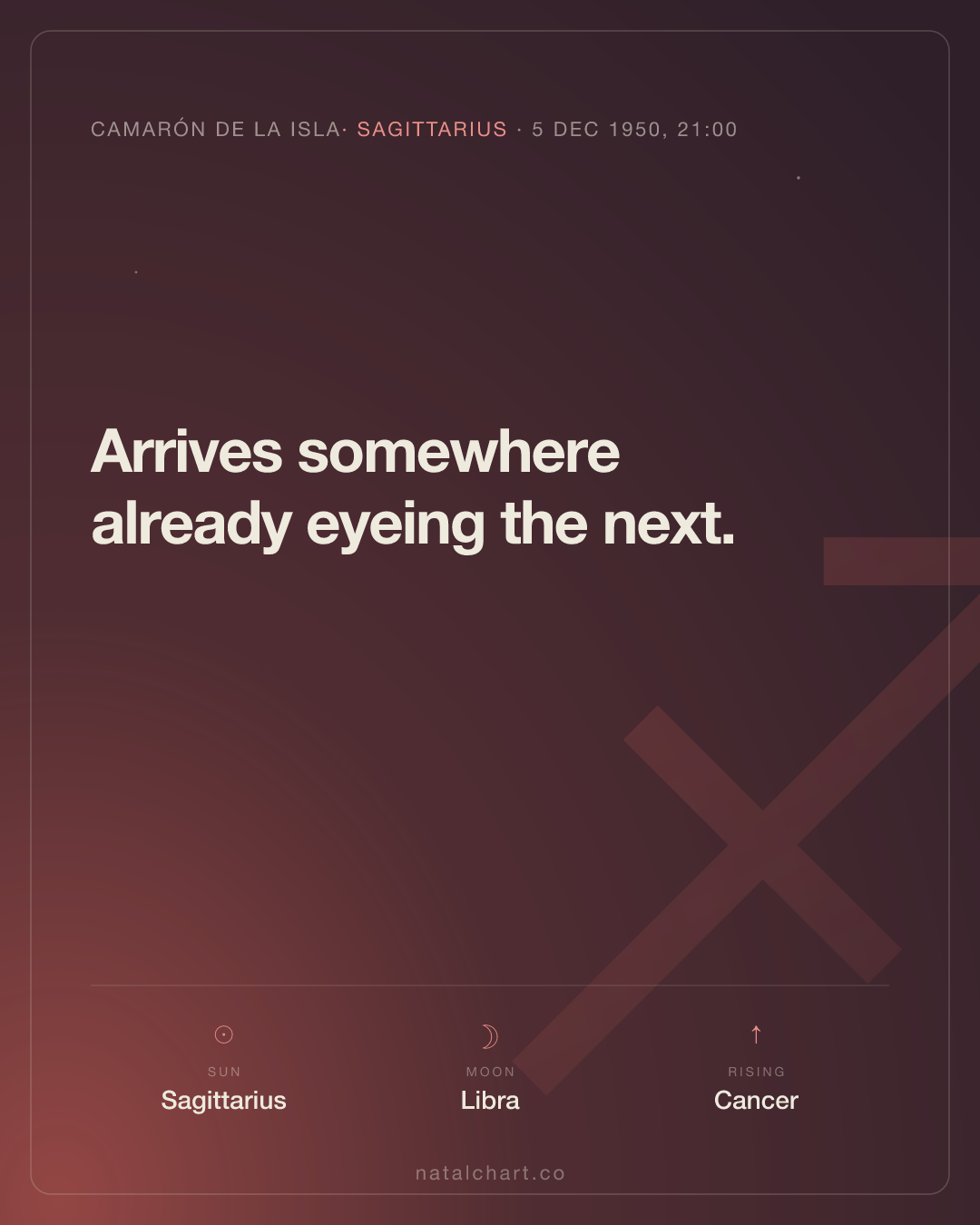
1950-12-05 · 21:00 · San Fernando, Spain Reliability: AA · vetted record
The Voice That Broke Flamenco Open
José Monge Cruz was born on 5 December 1950 in San Fernando, Cádiz — a coastal town the locals call La Isla — and grew up to become Camarón de la Isla, the singer who changed flamenco forever. His birth chart is built for exactly that: an Ascendant in Cancer (the sign of instinct, roots, and emotional memory) rising in the first house, paired with a Midheaven in Aries (the public/career point — the face of one's vocation) that drives toward conquest and breaks with tradition. The combination of a protective, deeply feeling shell with a career angle that charges forward is the astrological portrait of a man who lived rooted in old Gypsy song and yet never stopped pushing flamenco somewhere it had never been.
Moon, Saturn and Neptune: The Stillness Inside the Storm
The Moon in Libra in the fourth house sits alongside Saturn and Neptune in Libra — a triple presence in the house of home, roots, and private identity. For Camarón, the fourth house was not just family background; it was the gitano community of San Fernando, the forges and ironworkers' culture, the deep wells of cante jondo tradition. Moon in Libra searches for balance and beauty; in the fourth, that search turns inward, toward ancestral memory. Saturn alongside the Moon in the fourth house is a weight, a formal inheritance: the rules and forms of flamenco as they were handed down. Neptune here dissolves those forms from within — it is the same Neptune that allowed Camarón to absorb the old styles and then transmute them into something almost entirely his own. The Moon in a tense square with Mars (orb 0.6°) gives the emotional interior a restless edge; the stillness of the fourth house is always charged with pressure, never inert.
Mercury and Mars in Capricorn: The Craft of Discipline
Mercury and Mars both occupy Capricorn in the seventh house — the house of one-on-one relationships and artistic partnerships. Mercury in Capricorn thinks in structures, in the grammar of things: Camarón's command of the palos (the formal categories of flamenco) was legendary. He absorbed the styles of earlier masters — Mairena, Caracol, Valderrama — with an almost architectural precision before dismantling and rebuilding them. Mars in Capricorn pursues its objectives with methodical persistence; it does not burn out in a sprint but sustains effort across time. The seventh house placement of both planets is revealing: the key relationships of Camarón's creative life were partnerships — above all his collaboration with guitarist Paco de Lucía and later with Tomatito. The creative fire ran between people, not in isolation.
The near-exact square between Mercury and Saturn (orb 0.1°) — the tightest aspect in the entire chart — tells a story of friction between intuition and structure. Camarón was not a conservatory-trained musician; he lived in a tradition that was oral, felt, inhabited rather than read. Saturn kept pulling toward the established forms; Mercury in Capricorn kept testing them. That tension produced La leyenda del tiempo (1979), the album that scandalized flamenco purists by incorporating electric bass, rock rhythms, and the poetry of Federico García Lorca — and that history now recognizes as one of the most important records in Spanish music.
Venus and Neptune: Beauty Without Compromise
Venus in Sagittarius in the sixth house (the house of craft, daily work, and devotion to one's practice) forms an exact sextile with Neptune in Libra (orb 0.5°), and a trine with Pluto in Leo (orb 1.3°). This is one of the most beautiful clusters in the chart. Venus in Sagittarius is expansive and idealistic in its aesthetic; it seeks beauty that transcends borders, beauty that crosses cultural lines. The sixth house grounds this vision in craft: it demands that the ideal be worked for, every day, in the room with the guitar and the rhythm and the voice. The sextile with Neptune lends a capacity to channel something beyond the personal — flamenco singers speak of a state called duende, a quality of uncontrollable presence that some nights descends like weather. Camarón's duende was documented and witnessed throughout his life; this Venus-Neptune thread in the chart is its celestial signature.
Sun and Chiron in Sagittarius: The Artist Who Could Not Be Contained
The Sun in Sagittarius in the sixth house — alongside both Venus and Chiron — describes a person whose sense of identity is built through devotion to a practice, through the daily act of singing as a form of living. Sagittarius does not follow maps; it makes them. Chiron (an old wound that becomes a gift) in Sagittarius in the sixth house points to a wound around freedom and belonging: the tension between the Gypsy tradition that formed him and the wider world that claimed him. Camarón spent his whole life navigating this — never fully leaving his roots in San Fernando, but never being contained by them either.
The Sun in tense aspect with its surroundings, particularly through the square between its sign ruler Jupiter and Mercury (orb 0.6°), creates a personality that is simultaneously expansive and rigorous — the dreamer who insists on precision.
Jupiter in Pisces: The Spiritual Dimension
Jupiter in Pisces in the ninth house is the most overtly expansive placement in the chart. The ninth house governs long journeys — physical, philosophical, spiritual — and Jupiter is at home in Pisces, the sign it traditionally rules. For Camarón, this placement speaks to the way flamenco functioned not merely as a musical genre but as a form of spiritual navigation, a container for suffering, longing, and transcendence. The Mercury-Jupiter sextile (orb 0.6°) connects the structured intelligence of Capricorn to this Piscean openness — a bridge between craft and mystery that runs through the whole of his recorded output. La leyenda del tiempo was named after a poem by Lorca about the non-linear nature of time; it is a Pisces-Jupiter album in spirit.
Uranus in Cancer: Roots That Revolt
Uranus in Cancer in the first house sits right on the Ascendant — this is the planet of radical disruption placed in the very room of personal identity and physical presence. In Cancer, Uranus disrupts domestically: it overturns the household, the inherited culture, the family pattern. For Camarón, this is the astrological mechanism of his greatest ruptures — not rejecting his Gypsy heritage, but electrifying it from within. The Ascendant in Cancer already speaks of protection, instinct, sensitivity; Uranus here means that the protection is also a revolution. He looked like a traditionalist; he was a transformer.
Pluto in Leo: The Depth Beneath the Performance
Pluto in Leo in the second house governs the relationship with one's own resources, voice, and self-worth. Leo rules performance and self-expression; Pluto in the second house suggests that the deepest transformation happens through the act of putting oneself — one's full self, including the frightening parts — on public display. Camarón's voice was famously raw, cracked, extreme: it did not polish or conceal, it exposed. The trine between Venus and Pluto (orb 1.3°) wires the beauty-seeking artistic drive (Venus in Sagittarius) to Pluto's uncompromising depth. Art that is both beautiful and unflinching is the product of this aspect.
Midheaven in Aries: The Pioneer's Vocation
The Midheaven in Aries — the public/career angle — is the vocation of the pioneer, the first-mover, the one who opens the road for others. Aries does not collaborate by nature; it breaks ground and forces the question. Camarón's career is precisely this: he did not merely improve flamenco, he redefined what it could be, forcing every serious singer who came after him to reckon with the possibility he had demonstrated. The North Node in Pisces (the evolutionary direction indicated by the lunar nodes) reinforces the Jupiter-Pisces current: the life's work points toward boundless artistic expression, toward dissolving the borders between what is sacred and what is new.
A Voice That Still Carries
Camarón de la Isla died of lung cancer in 1992, aged 41, in Badalona. The grief across Spain was described as equivalent to a national mourning; flamenco musicians and fans filled the streets of San Fernando. More than three decades later, La leyenda del tiempo is still studied as a turning point, and his recordings of the traditional palos — soleares, bulerías, siguiriyas — remain the standard against which new singers measure themselves. A chart loaded with Sagittarius fire and Capricorn discipline, rooted in a Cancer Ascendant and aimed at an Aries Midheaven, describes the arc of his life with uncanny precision: born from deep roots, built through rigorous daily work, and driven by an irreversible impulse to go further than anyone before.
The chart
How to read it →Frequently asked questions
What is Camarón de la Isla's zodiac sign?
Camarón de la Isla's Sun sign is Sagittarius — the Sun was in Sagittarius at birth (1950).
What is Camarón de la Isla's moon sign?
Camarón de la Isla has the Moon in Libra. The Moon sign describes the emotional and instinctive layer of the chart.
What is Camarón de la Isla's rising sign?
Camarón de la Isla's rising sign (ascendant) is Cancer — the sign on the eastern horizon at the moment of birth.
When and where was Camarón de la Isla born?
Camarón de la Isla was born in 1950 in San Fernando, Spain.