Cazuza — natal chart
What does Cazuza’s natal chart reveal?
Cazuza, born Agenor de Miranda Araújo Neto on April 4, 1958, in Rio de Janeiro, Brazil, was a singer, songwriter, and poet who became one of the most influential figures in Brazilian rock. He rose to prominence as the frontman of Barão Vermelho, recording the albums Barão Vermelho (1982) and Maior Abandonado (1984), which included enduring songs such as Bete Balanço and Pro Dia Nascer Feliz. After leaving the band in 1985, he launched a solo career with Exagerado (1985) and the acclaimed double album Ideologia (1988). His lyrics combined romantic intensity, social critique, and direct language. Diagnosed with AIDS, he continued writing and recording until his death on July 7, 1990, at age thirty-one. His final works, including Burguesia (1989), are regarded as landmarks of Brazilian popular music, and his biography inspired the 2004 film Cazuza – O Tempo Não Para.
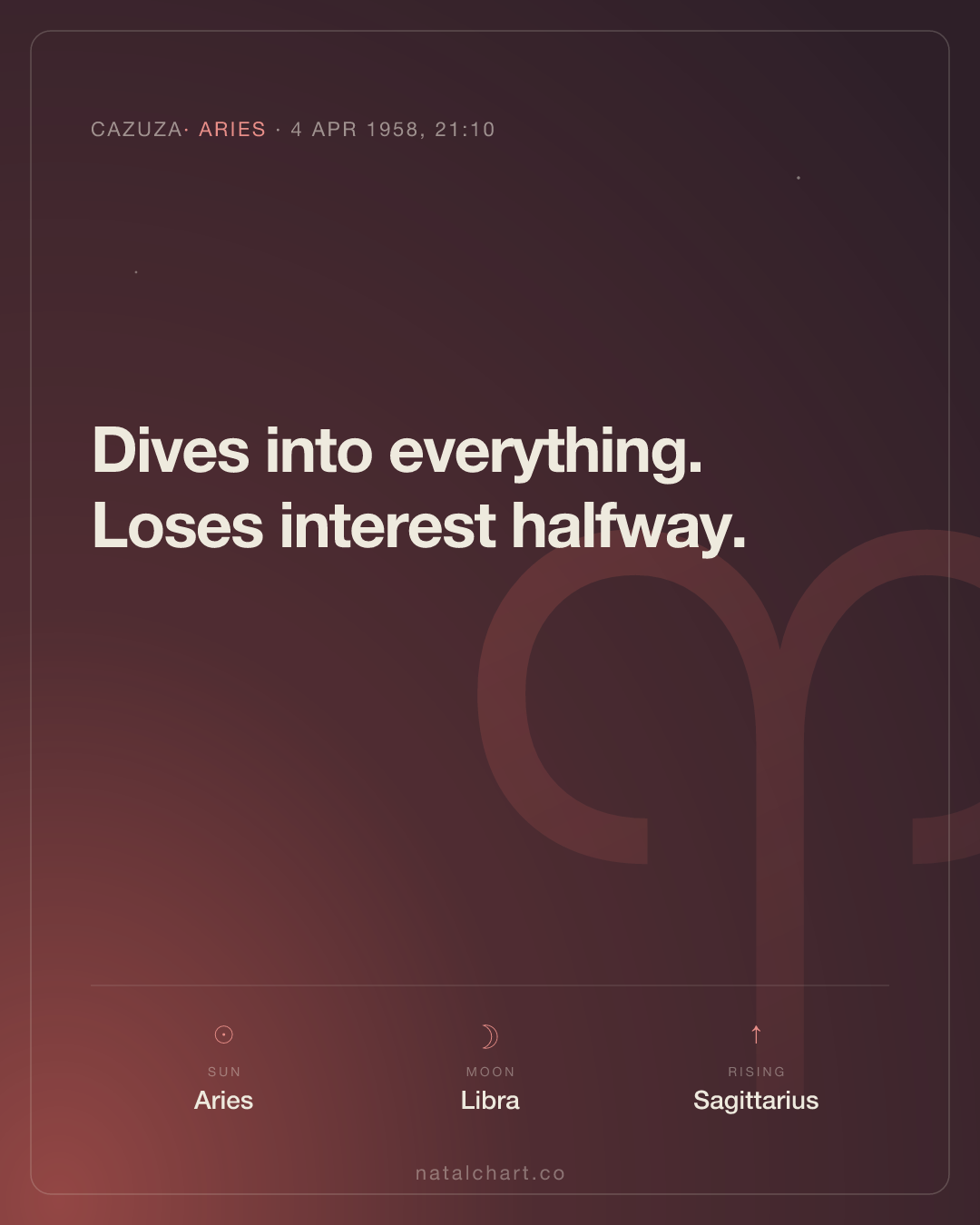 Share
Share
Birth
1958-04-04 · 21:10 · Rio de Janeiro, Brazil Reliability: A · reliable data
The core: fire that knew what it was burning for
Cazuza — born Agenor de Miranda Araújo Neto on April 4, 1958, in Rio de Janeiro — lived only thirty-one years, but in that time he wrote himself into the permanent record of Brazilian popular music. His Sun was in Aries in the fifth house, the sector astrologers associate with creative expression, performance, and the appetite for life. Aries is the sign of the pioneer, the one who goes first without waiting for maps. That Sun landed with clean, energetic flow to Mars, which shared the Aquarius placement of Venus — identity and action working in tandem, rarely misfiring. You can hear it in the recordings: Cazuza performed as though he had something specific to say and not enough time to say it, which, as it turned out, was precisely true.
The Ascendant in Sagittarius — the point that describes how someone meets the world — gave his first impression an expansive, adventurous quality: direct, philosophically restless, someone who arrived in a room already looking for the horizon. Sagittarius rising can seem reckless but is usually just honest in a way that makes others nervous. His band Barão Vermelho emerged in 1982 with that same quality: straightforward rock at a moment when Brazilians wanted something loud and true after the military dictatorship's long shadow.
The Moon: the diplomat who also needed to be witnessed
The Moon in Libra in the eleventh house describes an emotional life oriented toward other people — not in a dependent way, but in the sense that feelings became real when shared. The eleventh house is the house of community, of chosen circles, of the causes and crowds one belongs to. For Cazuza, this was literal: his audience was not just consumers of his music, it was the community through which he processed his interior life. Songs like «Pro Dia Nascer Feliz» — with its mixture of longing, social critique, and exhausted beauty — could only have come from someone whose Moon needed to convert private feeling into collective statement.
Jupiter sat right alongside that Libra Moon, less than two degrees away. Jupiter expands and amplifies whatever it touches: the emotional generosity, the sense that one person's experience speaks for many, the philosophical quality of the lyrics. «Ideologia», the 1988 double album, is full of this Jovian Libra quality — it argues for something, wrestles with contradictions, tries to be fair to complexity while also being emotionally direct. The Moon in flow with Saturn added structural weight: the feelings were real but the craft was disciplined.
Mercury: language from the ground up
Mercury in Taurus in the sixth house described a mind that worked from concrete materials, not from abstraction. Taurus Mercury thinks through the physical and the tangible; the sixth house is the domain of craft, daily practice, the work of making things well. Cazuza was not a theoretical songwriter. His imagery was bodily, sensory, rooted — «Exagerado» (1985) is a study in emotional excess that never loses its feet; «Bete Balanço» is pure kinetic energy given syllables.
That Mercury was in flowing harmony with Pluto in Virgo in the tenth house — Pluto here standing for the capacity to use language as an instrument of transformation, not merely expression. Virgo Pluto made the scrutiny precise: Cazuza's social critique was never vague. «Burguesia» (1989), written as he was already ill, is a methodical autopsy of a comfortable class, using plain words to strip away comfortable assumptions. That precision — the Taurus Mercury grounding, the Virgo Pluto sharpening — gave his most ambitious writing its staying power.
Venus and Mars: love with an ideological edge
Venus and Mars were both in Aquarius in the third house — the house of communication, of how one speaks and moves through the immediate world. Aquarius Venus loves in a way that requires freedom and principle: it is drawn to people who represent something, who stand for ideas, who refuse the ordinary. Mars in the same sign and house meant that creative drive and romantic energy were inseparable and both pointed toward the unconventional.
Venus in Aquarius was in very tight flowing harmony with Jupiter in Libra — one of the tightest aspects in the entire chart. This is the configuration of someone whose emotional world is genuinely pleasurable: warmth, humor, an instinctive capacity to make people feel welcomed and valued. People who knew Cazuza describe exactly this: he was charismatic not through intimidation but through genuine interest in others. The same Venus stood in opposition to Pluto — in tension, as though pulling against each other — which added a darker undertow to the affections. Intensity in relationships, the sense that love was also a site of transformation and sometimes loss.
Jupiter and Saturn: the philosopher and the architect
Jupiter in Libra in the eleventh house, as already noted, sat close to the Moon. But Jupiter here also carried its own weight as the ruler of the Sagittarius Ascendant. This made Jupiter one of the most personally important planets in the chart: it shaped not just mood but direction, not just emotional range but the overall orientation of the life. Cazuza moved through the world as someone for whom ideas mattered as much as feelings, for whom justice and beauty were connected problems.
Saturn in Sagittarius was in the first house — right at the Ascendant. The first house is the most personal sector of the chart, the self one projects and also the self one is still working to become. Saturn here can mean a serious or weighty quality in the personality, a sense of being tested, of having to earn what others seem to receive freely. In Cazuza's case, it may also describe the early awareness of mortality that ran through his work long before his diagnosis: «Pro Dia Nascer Feliz» was written in 1983, when he was twenty-four. Sagittarius Saturn in the first house is also capable of enormous integrity — the willingness to say difficult things publicly, to stand by positions even when they cost something.
Uranus and Neptune: the generation and the hidden depth
Uranus in Leo in the ninth house — the house of philosophy, foreign cultures, and expanded worldview — describes a generation marked by an explosive relationship to authority and tradition in the realm of ideas. For Cazuza, the ninth house placement was personal as well: his lyrics engaged with questions of national identity, political hypocrisy, and what it meant to be Brazilian in the late twentieth century. The final years of the military dictatorship and the political opening of the early 1980s were the water he swam in, and his music reflected the turbulence.
Neptune in Scorpio in the twelfth house is one of the more quietly significant placements in this chart. The twelfth house is the domain of what remains hidden, of spiritual and psychological depth, of what happens below the surface of daily life. Neptune here adds a quality of profound sensitivity to suffering — one's own and others'. Cazuza spoke openly about his AIDS diagnosis and its progression in public contexts that were, in Brazil in the late 1980s, genuinely courageous. That willingness to be transparent about mortality, illness, and loss — to make those themes part of the public artistic record — drew on something very deep.
Midheaven: the craftsman in the public eye
The Midheaven — the career and public vocation point at the top of the chart — was in Virgo, the sign of craft, critical precision, and the work of making things that function well in the world. Pluto sat directly in this Virgo Midheaven from the tenth house. This is a strong configuration: public life marked by transformation, by depth, by impact that does not remain at the surface. It also describes someone whose public identity was inseparable from the quality and seriousness of the work — Cazuza was not a celebrity in the manufactured sense; his reputation rested on the songs.
That Midheaven Mercury harmony — Mercury ruling the mind and voice, flowing easily to the Virgo Pluto at the top of the chart — meant that the craft of language was the direct vehicle for public influence. Not charisma alone, not image, but the words themselves.
Chiron and the North Node: the wound as public document
Chiron — an asteroid that astrologers read as describing an old wound that, over time, becomes the precise place from which one can serve others — was in Aquarius in the third house. The third house is the house of communication, of immediate social connection, of how one speaks and is heard. A Chiron wound here can manifest as a feeling of not being understood in one's immediate world, or of having to work hard to be heard as one truly is. For Cazuza, whose lyrics combined directness with complexity in ways that could be misread or simplified, this resonates: the effort to communicate something true and specific to a wide audience is never without friction.
The North Node in Scorpio — the point astrologers associate with the direction of deepest growth — pointed toward Scorpionic territory: depth, truth-telling without protective layers, the willingness to look directly at what is difficult without softening it. His final recordings, made when he was visibly ill, achieved exactly that quality. «Burguesia» and the songs that followed had a clarity that comes from people who have stopped hedging.
Cazuza
Thirty-one years, four band albums, a string of solo records, and a handful of songs that Brazilians still know by heart. Cazuza's chart describes someone built for creative intensity — the Aries Sun in the fifth house, the Aquarian Mars and Venus in the third, the Libra Moon and Jupiter in the eleventh — but also for consequence. The Virgo Midheaven and Pluto meant that the work was going to matter beyond the moment, that the craft was going to be taken seriously.
What gives his biography its particular weight is not the brevity but the completion. He said what he needed to say. The diagnosis did not silence him; it clarified him. That Saturn in the first house, that North Node in Scorpio, that Chiron in the third — they all pointed toward someone who was moving, from the beginning, toward the hardest kind of honesty. He arrived there.
The chart
How to read it →Frequently asked questions
What is Cazuza's zodiac sign?
Cazuza's Sun sign is Aries — the Sun was in Aries at birth (1958).
What is Cazuza's moon sign?
Cazuza has the Moon in Libra. The Moon sign describes the emotional and instinctive layer of the chart.
What is Cazuza's rising sign?
Cazuza's rising sign (ascendant) is Sagittarius — the sign on the eastern horizon at the moment of birth.
When and where was Cazuza born?
Cazuza was born in 1958 in Rio de Janeiro, Brazil.