Claudia Cardinale — natal chart
What does Claudia Cardinale’s natal chart reveal?
Claudia Cardinale (born 1938) is an Italian-Tunisian actress, a major star of 1960s European cinema. She appeared in landmark films including Fellini's '8 1/2', Visconti's 'The Leopard' and Leone's 'Once Upon a Time in the West', becoming one of Italy's most internationally recognized screen actresses.
 Share
Share
Birth
1938-04-15 · 06:30 · Tunis, Tunisia Reliability: A · reliable data
A Presence That Arrives Before She Speaks
There is a type of screen charisma that cannot be manufactured — not by lighting, not by direction, not by costume. It comes from a face that seems to contain something. Claudia Cardinale had it from the first shot in every film she made, and her birth chart shows exactly why: five planets cluster in Taurus in the first house, the part of the chart that shapes how a person arrives in a room. With Mercury, Venus, Mars, and Uranus all gathered in the sign of endurance and physical beauty — and all in the house of self-presentation — her presence was never a performance. It was simply how she occupied space.
The Ascendant and First House: Taurus as the Face Shown to the World
The Ascendant — the sign rising on the eastern horizon at birth, the quality that meets the world first — is Taurus. Taurus is stillness, groundedness, a kind of unhurried authority. It does not rush to explain itself. On screen, Cardinale's performances carry exactly this quality: she holds the frame without effort, and the camera comes to her rather than needing to chase her. What makes this particularly striking is Venus — the planet that rules Taurus — sitting right in the first house as well. The ruler of the Ascendant is right there, reinforcing everything the Ascendant promises. This is not a woman who had to work to project magnetism; the chart has it baked in at the structural level.
Venus Joined with Uranus: Beauty That Unsettles
The tightest aspect in the entire chart — less than one degree — joins Venus and Uranus in the first house. Venus represents how a person relates, what they find beautiful, how they attract. Uranus (discovered in the modern era, associated with originality and disruption) brings electricity, unexpectedness, something that doesn't quite fit the familiar categories. Together they describe a beauty that is not conventional but arresting — a quality that makes an audience slightly uneasy without knowing why. Cardinale was never the soft ingénue of mid-century Italian cinema; she had an edge, a restlessness, something that made her characters feel like they contained more than the script had written for them. Fellini noticed this when casting 8½ (1963), and so did Visconti for The Leopard the same year.
The Sun in Aries, Twelfth House: The Fire Behind the Veil
The Sun — the core identity, the drive — is in Aries in the twelfth house. Aries is initiative, directness, a willingness to act first and consider later. But the twelfth house is the most private in the chart: it governs what is held back, what operates below the surface, what a person works through quietly rather than displaying. There is a paradox here. Cardinale was one of the most photographed women of the 1960s, recognizable across dozens of countries — and yet by most accounts she was intensely private, guarding her life with notable care. The Aries drive is all there, but it flows inward as much as outward, powering a work ethic and a fierceness that was not always visible on the surface.
Saturn in Aries, Twelfth House: The Weight Carried Without Show
Saturn — the planet of structure, discipline, and what is earned slowly — shares the twelfth house with the Sun, also in Aries. Saturn in this position does not soften the ambition it carries; it insists that the work happen in private, that success be built through sustained effort rather than splash. The Sun and Saturn sitting together here, unseen by the world, accounts for something often noted about Cardinale's career: she kept working, consistently, through decades when many of her contemporaries faded. She appeared in over 180 films and television productions across sixty years — a body of work that reflects exactly the twelfth-house Saturn discipline: not celebrated for the effort itself, but quietly sustained over a lifetime.
Moon in Scorpio, Seventh House: The Emotional Life in Relationships
The Moon — the emotional interior, the needs that run beneath the surface — is in Scorpio in the seventh house, which governs partnerships, close relationships, and collaborations. A Scorpio Moon does not feel things lightly; it goes deep, holds on, notices what others miss, and has a long memory for both loyalty and its absence. In the seventh house, this intensity focuses on the people closest to her — creative collaborators, personal partners, those she chose to let in. The aspect linking the Moon to Pluto (the planet of deep change) in a tense 90-degree angle — a square — reinforces this: significant relationships have carried real psychological weight, not just warmth. The connections that shaped her life tended to be ones that changed something in her permanently. For a woman who built a fifty-year career partly through the force of those collaborations — Fellini, Visconti, Leone — this Moon describes the depth she brought to every working relationship.
Mercury in Taurus: The Mind That Thinks Through the Concrete
Mercury — the planet governing how a person thinks and communicates — sits in Taurus in the first house. Taurus Mercury thinks carefully, builds ideas the way one builds a wall: one stone at a time, with an eye for what will hold. It is not quick or mercurial in the usual sense; it is patient, sensory, committed to what can be demonstrated. For an actress, this translates into a physicality of performance — understanding a character not through abstraction but through how the body moves, how the hands hold still, how the eyes settle. The opposition between Mercury and the Scorpio Moon (just under five degrees) creates a productive friction: the patient, concrete mind and the emotionally intense Moon pulling against each other, generating the complexity that made her performances feel inhabited rather than performed.
Jupiter in Aquarius, Tenth House: The Career as Something Larger Than One Country
Jupiter — the planet of expansion and reach — is in Aquarius in the tenth house (the career and public-legacy point). Aquarius carries the international, the collective, the idealistic. In the tenth house, this describes a public reputation that crosses borders and belongs, in a sense, to a broader culture rather than a single nationality. Cardinale was born in Tunis to an Italian family, moved to Italy in her late teens, and built a career that was equally French, Italian, and Hollywood — she appeared in films in all three industries. The Jupiter-Aquarius-tenth-house combination describes exactly this: a career that didn't belong to one flag, one market, or one set of rules. The tense 90-degree relationship between Mars and Jupiter (just under two degrees) also belongs here: there was friction between the drive to expand and the structures that expansion required navigating, particularly in an industry that was still largely controlled by men.
The Midheaven in Capricorn: The Vocation Earned Through Consistency
The Midheaven — the career point, the apex of the chart, the public face of a person's ambition — is in Capricorn. Capricorn governs long-term building, the reputation that accumulates rather than bursts into existence. Its traditional ruler is Saturn, which sits in the twelfth house here: the effort behind the public reputation is private, sustained, not publicly legible. The Lilith placement in Capricorn, also at the Midheaven, adds a dimension worth noting: Lilith in the chart marks places of refusal, of not fitting neatly into what is expected. A woman building a major career in the 1960s film industry — on her own terms, across multiple national industries — is exactly this: Capricorn persistence combined with a refusal to be categorized.
Chiron in Gemini, Second House: Value and Voice
Chiron — an asteroid that marks an old tender point that, over time, can become a particular gift — is in Gemini in the second house. The second house covers what a person values, what they own, and their sense of material and personal worth. Gemini governs language, communication, duality, the ability to speak across different registers. Chiron here suggests an early uncertainty around self-worth and voice — not always being sure one's words would land correctly, or one's value be seen clearly. For a woman who grew up between languages and cultures (Arabic, Italian, French), this has a biographical resonance that goes beyond the abstract. What tends to happen with Chiron over time is that the tender spot becomes the place of greatest competence: the uncertainty around being understood across cultures likely sharpened the non-verbal, physical eloquence that made her so effective on screen.
The North Node in Scorpio: The Growth Edge
The North Node — the direction the chart points toward as a source of growth, not a guaranteed destination but a pull — is in Scorpio. Scorpio's territory is depth, psychological honesty, the willingness to see what is actually happening rather than what is comfortable to believe. For someone with such a strong first-house Taurus clustering — solid, sensory, steady — the Scorpio North Node pulls toward something less comfortable: real psychological reckoning, intimacy that demands transparency, the courage to go into the more difficult emotional territory. The tense relationship between the Moon and Pluto in this chart suggests that she did not avoid this territory; she moved through it, even when it was costly.
A Portrait in Full
What the chart describes is a woman whose extraordinary visible magnetism — the quality that stopped directors in their tracks — rested on an interior far less visible to the world: the Aries fire held inside the twelfth house, the Scorpio emotional depth in the house of partnership, the Saturn discipline carried quietly beneath the surface. The Taurus first house was the face the world saw: graceful, unhurried, utterly present. Everything that sustained it was somewhere else in the chart, private and patient. Once Upon a Time in the West, The Leopard, 8½ — three of the most enduring films of the twentieth century, each from a different director, each of a different sensibility. The chart that could move between Fellini's dream logic, Visconti's aristocratic precision, and Leone's mythic scale without losing itself is exactly this one.
The chart
How to read it →Frequently asked questions
What is Claudia Cardinale's zodiac sign?
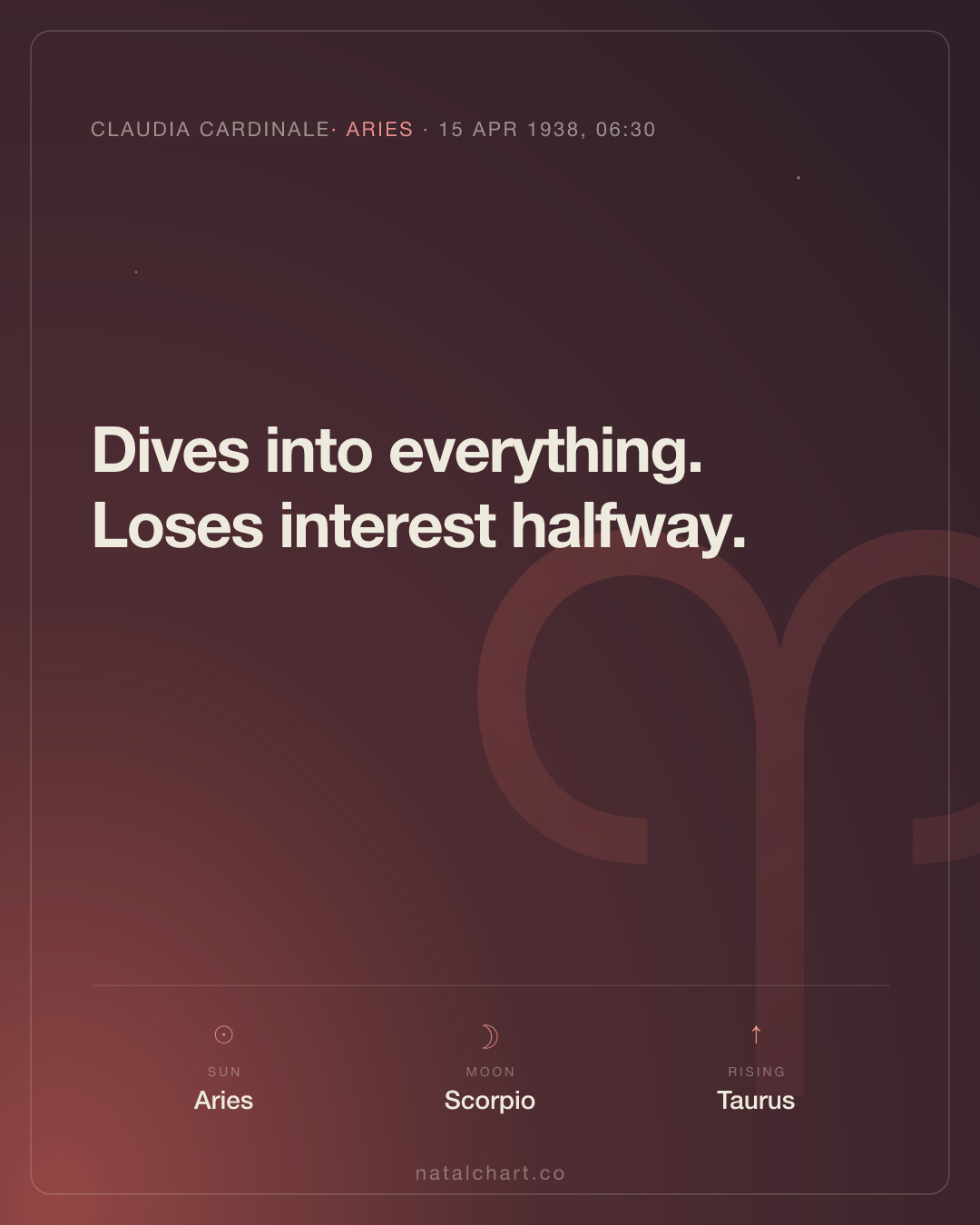
Claudia Cardinale's Sun sign is Aries — the Sun was in Aries at birth (1938).
What is Claudia Cardinale's moon sign?
Claudia Cardinale has the Moon in Scorpio. The Moon sign describes the emotional and instinctive layer of the chart.
What is Claudia Cardinale's rising sign?
Claudia Cardinale's rising sign (ascendant) is Taurus — the sign on the eastern horizon at the moment of birth.
When and where was Claudia Cardinale born?
Claudia Cardinale was born in 1938 in Tunis, Tunisia.