David Bowie — natal chart
What does David Bowie’s natal chart reveal?
David Bowie, born David Robert Jones on January 8, 1947, in Brixton, London, was a musician, actor, and visual artist who constantly reinvented his public identity across a five-decade career. He introduced the androgynous alien persona Ziggy Stardust on the 1972 album The Rise and Fall of Ziggy Stardust and the Spiders from Mars. Later works included Young Americans (1975), Heroes (1977), and Let's Dance (1983). He appeared in films including The Man Who Fell to Earth (1976) and Labyrinth (1986). Bowie's final album, Blackstar, was released two days before his death in New York City on January 10, 2016.
 Share
Share
Birth
1947-01-08 · 09:00 · Brixton, London Reliability: A · reliable data
A mask that becomes the face
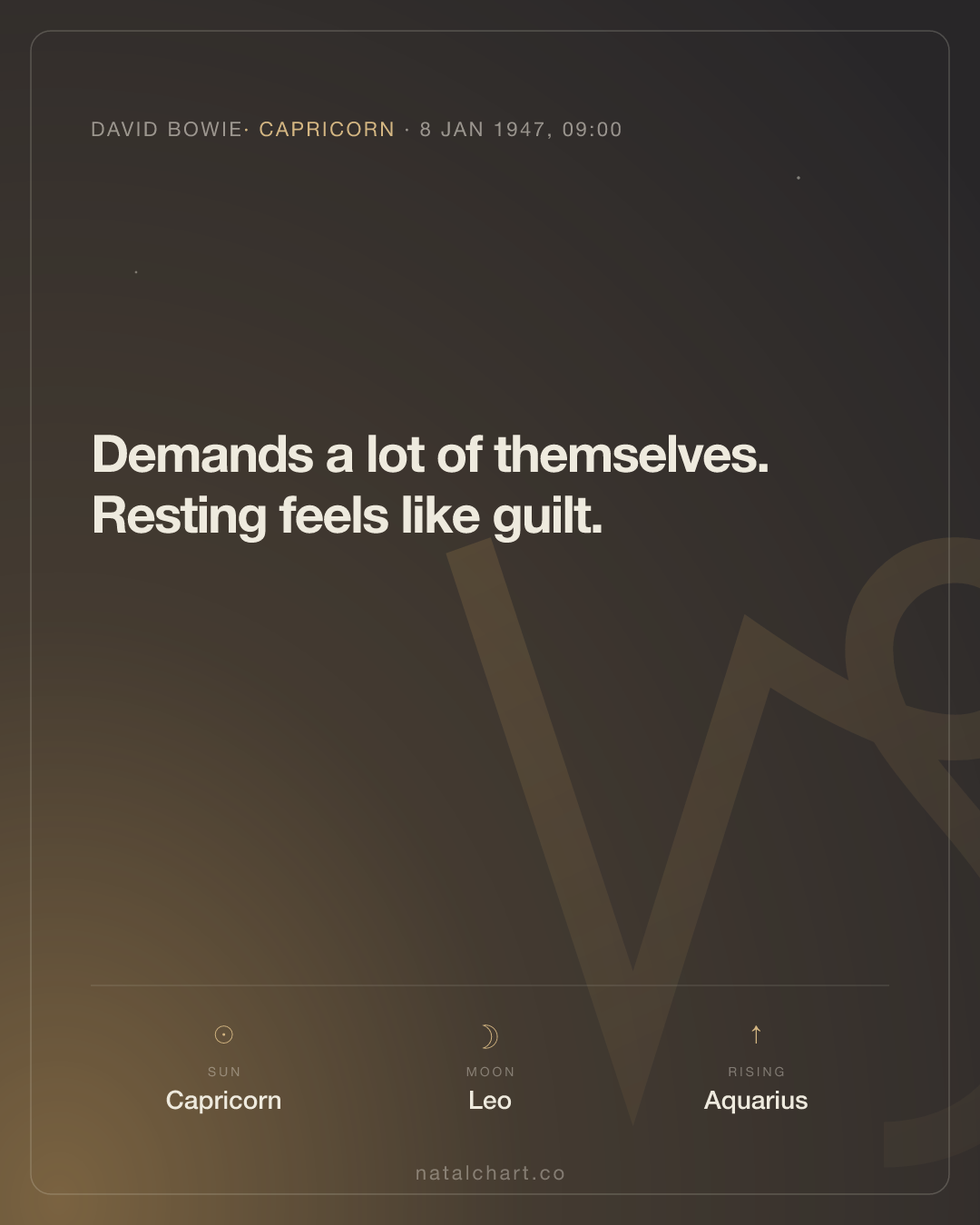
Most performers choose a persona and stick with it. David Bowie chose a different strategy entirely: he made persona-shifting the work itself. The Ascendant — the face a person presents to the world, the first impression they make — was in Aquarius, the sign most comfortable with reinvention, with standing outside convention and observing it from an angle. But underneath that cool, changeable exterior lived a Sun and Mars joined almost exactly in Capricorn in the twelfth house — a pairing of drive and identity that is private by nature, that builds in the dark, that keeps its real engine hidden. The Sun and Mars are only half a degree apart: one of the tightest conjunctions in this chart. Ziggy Stardust, Aladdin Sane, the Thin White Duke, the elder statesman of Blackstar — these were not performances layered over a hollow core. They were different angles on a very concentrated private force.
The emotional life behind the stage
The Moon — the emotional interior, what feeds a person — was in Leo in the seventh house, the house of partnership and the public. Leo's Moon needs warmth, recognition, and full creative expression; it does not thrive in the shadows. And yet this Moon sits in the same house as Saturn and Pluto, both also in Leo. The Moon joins Saturn at about 3 degrees: emotional life structured by discipline, by a kind of internal authority that does not easily show vulnerability. Bowie once described his Berlin years — the Low, Heroes, and Lodger trilogy recorded with Brian Eno — as his attempt to go somewhere unfamiliar, to resist the celebrity comfort zone that was starting to consume him. That is a Saturn Moon speaking: the willingness to subject the emotional life to hard, clarifying work.
How he loved
Venus in Sagittarius in the eleventh house describes someone whose affection moves toward freedom, toward ideas, toward people who open new worlds rather than those who offer security and routine. The eleventh house governs friendship, community, and the networks one builds; Bowie spent decades surrounding himself with collaborators who pushed him — Iggy Pop, Brian Eno, Nile Rodgers, Tony Visconti — and the creative relationships were often the most sustaining ones. Venus in Sagittarius flows harmoniously with the Moon in Leo (at 1.7 degrees), and also with Saturn in Leo. There was in Bowie something that drew warmth from creative companionship more readily than from conventional domestic stability — a person who thrived most fully when the work and the love were not entirely separate.
Mercury and the imagination that could lie beautifully
Mercury — the mind, the voice, the way words form — was in Capricorn in the twelfth house, pulling against Neptune in Libra at about 2.6 degrees. A Mercury-Neptune tension is one of the most creatively charged combinations in a chart: the rational mind is in constant dialogue with something dissolving, with music, with imagery, with ambiguity. For Bowie it produced a lyrical style that never quite explained itself — "This is not America," "I'm afraid of Americans," the Berlin lyrics that left meaning just out of reach. Neptune softens the edges of what Mercury wants to say precisely. The twelfth house placement of Mercury adds a further layer: the inner monologue that doesn't fully translate into public speech, the sense that the real thinking stays private. Interviews with Bowie often had this quality — articulate, fascinating, but ultimately elusive.
The engine that never stopped
Mars in Capricorn in the twelfth house, joined tightly to the Sun, describes an extraordinary work ethic that operated almost invisibly. Capricorn Mars is relentless on a long timeline — not flashy, not impulsive, but impossible to redirect once it has set a course. The twelfth house is associated with what happens behind closed doors, with private labor, with what the public does not see. Bowie was famous among collaborators for being extraordinarily prepared, for arriving in the studio with clear artistic intentions, for working through illness and difficulty with an almost unnerving focus. The Blackstar sessions — completed while he was terminally ill, weeks before his death in January 2016 — are the most extreme expression of this placement: private determination making a final statement in public, the Sun and Mars doing their concentrated work one last time.
Vocation and the public self
The Midheaven — the part of the chart that describes the public calling — was in Sagittarius, the sign of exploration, of philosophical breadth, of the person who spans cultures and disciplines rather than mastering just one. Jupiter, as the traditional ruler of Sagittarius, occupied the tenth house in Scorpio alongside Chiron in Scorpio. Jupiter in Scorpio amplifies depth — the desire to go beneath surfaces, to find what is hidden, to turn transformation into art. The Midheaven in Sagittarius explains why Bowie's career never stopped moving: America, Berlin, the dance-pop of Let's Dance, the experimental work of Outside, the jazz inflections of Blackstar. He didn't circle back; he proceeded outward. Chiron in Scorpio in the tenth house — Chiron marks a wound that over time becomes a teacher's gift — adds an element of having had to work through something painful and public. The outsider status, the glass eye from a teenage fight, the relentless critical questioning of his identity: all of it contributed to a public persona that spoke specifically to people who had never quite fit in.
Uranus, Neptune, and the generation that broke the frame
Uranus in Gemini in the fifth house — the house of creativity, play, and artistic output — is the signature of a creator who cannot leave well enough alone, who needs formal disruption as a condition of expression. Gemini multiplies and connects; Uranus disrupts. The fifth house grounds this in actual artistic work. Every few years, Bowie would take the version of himself that was succeeding commercially and deliberately dismantle it: the Ziggy farewell at Hammersmith in 1973, the American soul pivot of Young Americans, the electronic austerity of the Berlin trilogy. Neptune in Libra in the ninth house suggests the philosophical dimension of this restlessness — an attraction to beauty as a form of inquiry, to art as a way of posing questions about identity, culture, and where bodies and selves can go. North Node in Gemini reinforces the same direction: growth through multiplicity, through the refusal of a single fixed identity.
Chiron, Saturn, Pluto: the weight behind the glamour
The seventh house in Bowie's chart is exceptionally crowded: Moon, Saturn, and Pluto all in Leo. Three major planets in the house of partnership and the public speaks to relationships that carry unusual weight — not necessarily difficult, but transformative, high-stakes, never entirely casual. Saturn and Pluto in the same house, in close proximity, describes a generation that came of age in the shadow of war and its aftermath; in Bowie's personal chart it adds a quality of endurance within intimacy, of commitments that survive upheaval. His thirty-year marriage to Iman, whom he met in 1990, produced by all accounts the stable foundation that the rest of his public life never suggested he needed — and perhaps that is exactly right for a Moon-Saturn person: depth and commitment were always present, quietly, in the house most people couldn't see.
What the work still says
Bowie released Blackstar on January 8, 2016 — his sixty-ninth birthday. He died two days later. The album opens: "Look up here, I'm in heaven." The Sun and Mars in Capricorn in the twelfth house, one last time: private labor made public at the precise moment of departure, the mask and the face finally the same thing. What made Bowie extraordinary was not simply the catalogue — though the catalogue is extraordinary — but the quality of attention he brought to the question of what a person can be. The Aquarian Ascendant that could wear any costume; the Capricorn interior that never stopped working; the Leo Moon that wanted, underneath everything, to feel that the work had been genuinely witnessed. It had been. It still is.
The chart
How to read it →Frequently asked questions
What is David Bowie's zodiac sign?
David Bowie's Sun sign is Capricorn — the Sun was in Capricorn at birth (1947).
What is David Bowie's moon sign?
David Bowie has the Moon in Leo. The Moon sign describes the emotional and instinctive layer of the chart.
What is David Bowie's rising sign?
David Bowie's rising sign (ascendant) is Aquarius — the sign on the eastern horizon at the moment of birth.
When and where was David Bowie born?
David Bowie was born in 1947 in Brixton, London.