Elvis Presley — natal chart
What does Elvis Presley’s natal chart reveal?
American singer, axis of early rock and roll. Sold hundreds of millions of records with Heartbreak Hotel (1956), Jailhouse Rock (1957) and Suspicious Minds (1969). Thirty-one films. Died at Graceland in 1977 at 42.
 Share
Share
Birth
1935-01-08 · 04:35 · Tupelo, Mississippi Reliability: AA · vetted record
The core: ambition dressed as pleasure
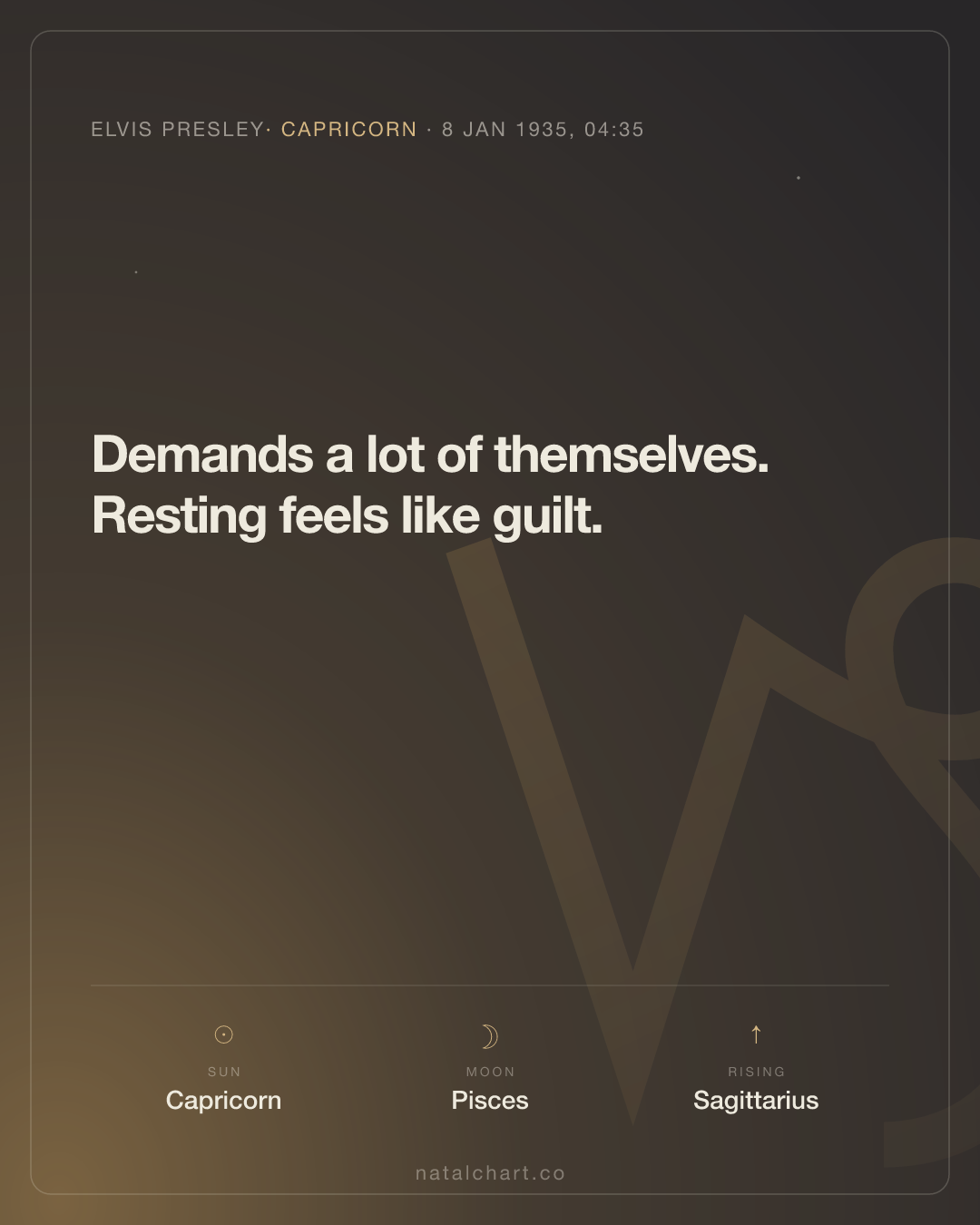
Elvis Presley had Capricorn rising — not his sun sign, but his Ascendant (the face he met the world with) — and that patient, climbing quality ran through everything he did. His Sun, Mercury, and Venus are all in Capricorn in the second house, the house of material reality, possessions, and the voice used to earn a living. Three personal planets stacked in the same sign and house create an almost gravitational pull toward a single direction: building something real, something lasting, something that generates real return. Before he was a phenomenon he was a kid from Tupelo, Mississippi who understood that music was the one vehicle available to him. The Sagittarius Ascendant — the impression he made on a room — gave his Capricorn ambition a warm, expansive face: the smile that undid audiences was genuine, and it sat on top of a very deliberate drive.
The Moon: a feeling nature that needed shelter
The Moon in Pisces in the fourth house (the house of home, roots, and private life) is one of the most emotionally permeable positions in the chart. It describes someone whose interior world is vast, impressionable, and deeply attuned to mood — not just his own but those around him. Elvis was famously generous to a fault, giving away cars and jewelry to people he had just met, which reflects this Piscean Moon's difficulty with boundaries: absorbing others' needs as if they were his own. The fourth house placement makes this even more private — the emotional softness was real but largely hidden from the stage persona. His relationship with his mother Gladys, who died when he was twenty-three, sits entirely in this placement: the loss that restructured his inner landscape for the rest of his life.
Mercury: a mind built for imitation and synthesis
Mercury in Capricorn in the second house pulls in the same direction as the Sun and Venus: practical, oriented toward what works, patient rather than flashy. But Mercury standing in tension with Pluto across the chart (opposition, orb 2.8°) adds a penetrating quality — the ability to go underneath surfaces, to hear what other people were playing and understand not just the notes but the feeling underneath. Elvis didn't invent rock and roll; he heard Black rhythm-and-blues music, gospel, and country and felt where they could meet. That synthesis — across genres and cultural divides — required a listening intelligence willing to transform what it absorbed rather than simply reproduce it.
Venus: the voice as pleasure and as identity
Venus in Capricorn, in the second house, in close company with the Sun: beauty, pleasure, and value are all rooted in the material and the earned. For Elvis, the voice was the instrument through which all of this flowed. Venus in Capricorn values craftsmanship — the way a note is held, the timing of a phrase, the control underneath apparent spontaneity. But Venus pulling against Pluto (opposition, orb 4.2°) and in tension with Uranus (square, orb 1.9°) adds a voltage to that craft: something in the delivery that unsettled people before it seduced them, a quality that the cultural establishment of 1956 correctly identified as dangerous because it was. "Heartbreak Hotel" didn't just chart; it cracked something open.
Mars: the social animal
Mars in Libra in the eleventh house (the house of community, audience, and the groups one belongs to) is a revealing placement. It describes someone whose drive activates most powerfully through other people — through the crowd, through the reaction of a room. Elvis on stage was not performing despite the audience but through them: the energy was genuinely reciprocal, and the wilder the crowd the more he gave back. Libra softens Mars's edge and makes the aggression charming rather than confrontational — which describes the particular quality of Elvis's stage presence, the way the hip movements that caused moral panic were somehow still warm and playful rather than threatening. Mars in the eleventh also points to the loyalty he felt toward his circle: the Memphis Mafia was not just an entourage, it was a social structure he needed.
Jupiter and Saturn: the hidden engine and its constraints
Jupiter in Scorpio in the twelfth house (the house of what remains out of public view) is a quietly significant placement. The twelfth house is where things happen behind the scenes, and Jupiter here suggests that Presley's real expansion happened internally, spiritually, in the private consuming of influence — the gospel records played alone at night, the spiritual searching that never quite resolved itself. The easy flow between the Sun and Jupiter (sextile, orb 0.8°) is the tightest aspect in the chart and describes a natural optimism, a buoyancy that even in hard times convinced him and those around him that things would work out. Saturn in Aquarius in the third house governs the mind, communication, and nearby relationships. Saturn here can feel like a weight on self-expression — the fear that the real thought, the unpolished one, won't be good enough. The gradual retreat from live performance after 1957, replaced by films that controlled and packaged his image, might be read partly through this placement.
The outer planets: the generational charge he carried
Neptune in Virgo in the tenth house (the house of public reputation and vocation) is an exceptional position. Neptune governs what dissolves boundaries, what seeps into the collective imagination — and in the house of public identity, it describes someone whose public image takes on a life far beyond their private reality. By the mid-1970s, Elvis Presley the person was already competing with Elvis Presley the myth, and losing. Neptune in Virgo here also carries a quality of crafted perfection — the Virgo precision applied to an image — and a susceptibility to the mythology being used in ways the person couldn't control. Uranus in Aries in the fifth house (the house of performance, creativity, and self-expression) describes the shock-of-the-new quality his early work carried. Aries breaks rules without apology; the fifth house is pure creative expression. The 1956 television appearances, where cameras were forbidden from showing his hips, were a cultural fault line — and this placement describes the person at that line.
The Midheaven: vocation in service of precision
The Midheaven — the chart's public/career point — is in Virgo, the sign of careful craft, discernment, and service. For Elvis, the vocation required an almost obsessive attention to sound: the producers at Sun Studio noted his ability to feel when a take was right, when the spontaneity was real versus performed. Virgo at the Midheaven also suggests a career defined by what serves — the entertainer who gives the audience exactly what it needs, who refines the performance rather than simply exhibiting himself. The fact that Neptune also sits in the tenth house, right near this Midheaven, means the craftsmanship was always wrapped in myth: the person and the image were never cleanly separable.
Chiron and the North Node: the wound and the direction
Chiron — an old wound that, with time, becomes a gift — sits in Gemini in the seventh house, the house of one-on-one relationships and public partnerships. A Gemini wound in the house of the other suggests difficulty in being truly known: the duality, the sense of two selves (the private Tupelo kid, the global icon), made genuine intimacy complicated. The North Node in Aquarius (the chart's marker of where growth lies) points toward the collective — toward belonging to something larger than personal success, toward using individual talent in the service of a broader human need. In a real sense, Elvis did this: the music he made didn't only sell records, it changed the emotional vocabulary of an entire generation.
A portrait that holds together
Elvis Presley's chart is not the chart of someone for whom fame was accidental. The second-house Capricorn cluster tells the story of a person who understood value and built something real with the instrument he was given. The Piscean Moon explains the generosity, the emotional permeability, the vulnerability that made his ballads feel true. The Neptune-in-the-tenth explains why the myth outgrew the man, and why it has never fully died. The Sun-Jupiter sextile explains why, despite everything, the people closest to him felt lucky to be there. What the chart also holds — in the twelfth-house Jupiter, the Neptune-wrapped Midheaven, the tension between Venus and Uranus — is the difficulty of living inside a phenomenon of that size, without the tools to keep the private self intact. That difficulty was real, and the chart maps it honestly.
The chart
How to read it →Frequently asked questions
What is Elvis Presley's zodiac sign?
Elvis Presley's Sun sign is Capricorn — the Sun was in Capricorn at birth (1935).
What is Elvis Presley's moon sign?
Elvis Presley has the Moon in Pisces. The Moon sign describes the emotional and instinctive layer of the chart.
What is Elvis Presley's rising sign?
Elvis Presley's rising sign (ascendant) is Sagittarius — the sign on the eastern horizon at the moment of birth.
When and where was Elvis Presley born?
Elvis Presley was born in 1935 in Tupelo, Mississippi.