Martin Luther King Jr. — natal chart
What does Martin Luther King Jr.’s natal chart reveal?
American Baptist minister and civil rights activist. Led the Montgomery bus boycott (1955-56) and the March on Washington (1963), where he delivered the I Have a Dream speech. Nobel Peace Prize 1964. Assassinated in 1968.
 Share
Share
Birth
1929-01-15 · 12:00 · Atlanta, Georgia Reliability: A · reliable data
The core: public duty as personal calling
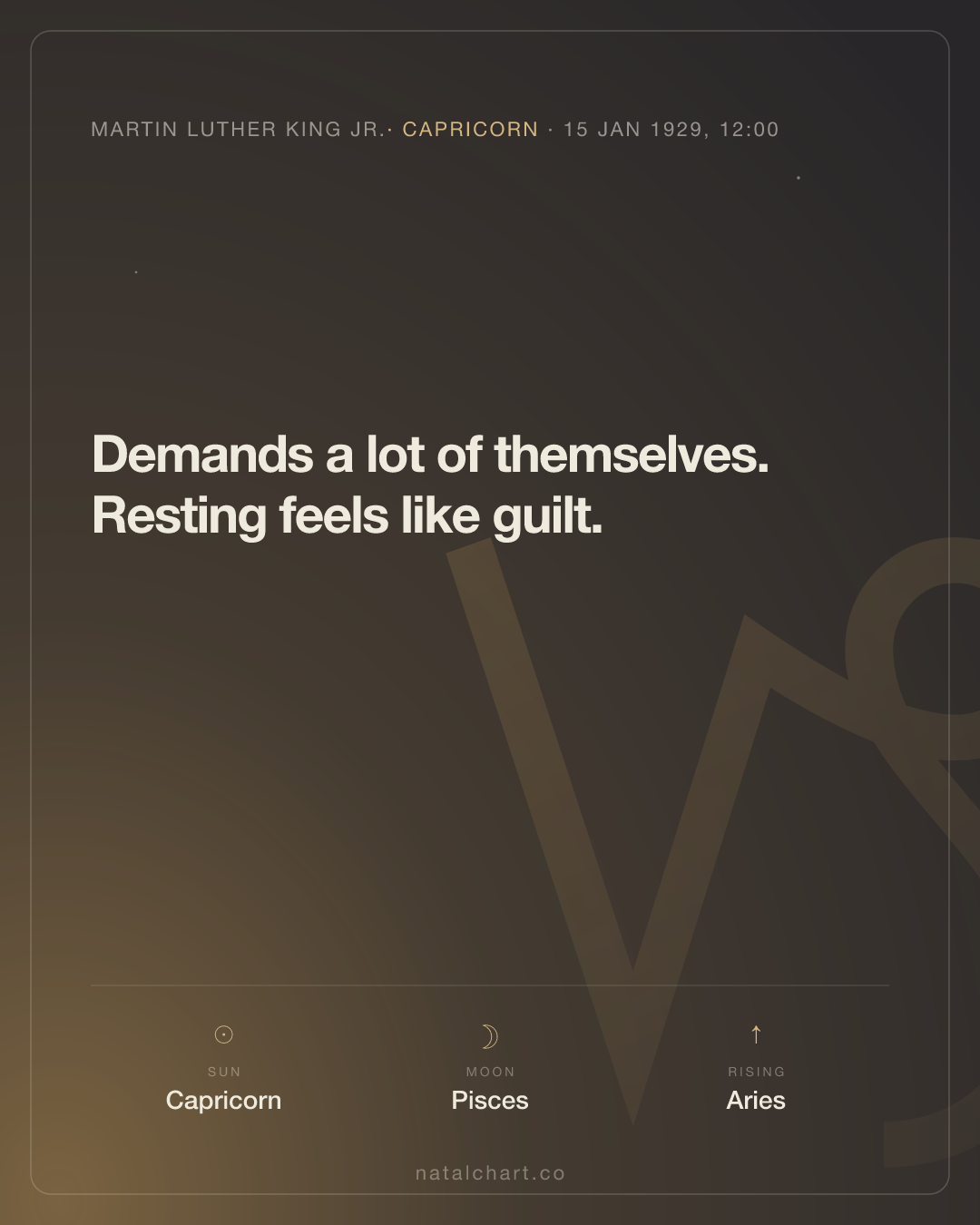
The loudest signal in Martin Luther King Jr.'s chart is not one planet but a pattern: almost everything that defines him publicly sits directly on the line that astrology calls the Midheaven — the career and public-reputation point of the chart — and it is Capricorn, the sign that treats responsibility as a moral obligation, not a career move. The Capricorn Sun in the tenth house describes someone for whom the public role was not separate from the private self but the natural expression of it. He did not become a civil rights leader and then decide to take it seriously; the seriousness was there from the beginning. He was twenty-six years old when he took on the Montgomery bus boycott, and his friends later said he accepted the role with a gravity that made it feel like a burden he had been carrying long before the moment asked him to carry it publicly.
The Aries Ascendant — the face he met the world with, the first thing people felt when he walked into a room — gave that Capricorn seriousness a charge of forward momentum. Aries leads. It steps in before others decide whether to follow. At the 1963 March on Washington, he did not simply deliver a prepared speech; he set aside his notes and went somewhere else, somewhere unrehearsed, because he could feel where the crowd needed to go. That was not Capricorn planning — that was the Aries Ascendant moving.
The emotional interior: compassion that ran deep
Inside that public authority lived a Pisces Moon in the twelfth house — among the most inward and tender placements in the entire chart. The twelfth house is the quiet room, the place for contemplation, for things that aren't spoken aloud. His closest associates spoke of a man who prayed daily for long stretches, who wept privately over deaths in the movement, who wrote letters of extraordinary personal warmth to ordinary people who had written to him. The Pisces Moon describes an emotional life that was genuinely porous to others' suffering — not performed compassion but felt compassion, the kind that costs something.
Venus in Pisces in the twelfth house deepens this picture. In Pisces, Venus reaches toward an almost total identification with the beloved — and the beloved, for King, was not one person but a people. His love letters to Coretta are famous for their tenderness. His public declarations of love for his country and its ideals, even while that country was refusing him a seat at the counter, have the same quality: genuine attachment rather than rhetorical device.
The Moon in Pisces flows easily toward Pluto in Cancer in the fourth house — the home, the roots, the private foundation. Pluto here speaks of a family line shaped by hardship, by the long shadow of racial violence and displacement. That history did not make him bitter — it made him understand, with a precision that statistics alone cannot provide, exactly what was at stake.
The mind: speaking across divides
Mercury in Aquarius in the eleventh house describes a mind that thought in terms of collective futures rather than individual interests. Aquarius sees the pattern beneath the particular case; the eleventh house is where those patterns apply to society, to movements, to what comes after us. King's rhetoric was saturated with this: he didn't speak about the injustice happening today as if it were a local complaint, but framed it against the long arc of history, against the founding documents of the republic, against the universal principles he genuinely believed those documents had articulated even if they hadn't yet honored them.
Mars in Gemini in the third house — Mars is drive and assertion; the third house is communication, words, the immediate exchange — put his primary weapon in language. He moved through speech. The controlled urgency of the Montgomery address, the call-and-response cadences of the southern Black church tradition, the precise legal vocabulary he had absorbed studying theology and then law: all of it was Mars in Gemini in action, working a room the way a skilled craftsman works material.
Jupiter and Saturn: the tension between possibility and constraint
Jupiter in Taurus in the second house describes a man who understood that freedom was not abstract but material — it lived in wages, in property, in the ability to eat at a counter or stay in a hotel. The Poor People's Campaign of 1968 was not a distraction from civil rights; it was the same principle applied to its economic roots. Jupiter in Taurus works patiently toward the tangible and durable, and the campaign King was organizing when he was killed was precisely that: a long-haul effort to address poverty as a structural, not merely moral, problem.
But Jupiter pulled against Saturn in Sagittarius in the ninth house — the ninth is the house of philosophy, law, and distant horizons — and they were in opposition, pulling against each other across the chart. Saturn in Sagittarius in the ninth house had its own gifts: a deep, almost scholarly commitment to legal and philosophical argument. King's doctoral work on systematic theology was not window dressing for an activist; he genuinely believed that the argument for justice had to be won at the level of ideas as much as the level of streets. The tension between Jupiter's practical vision and Saturn's demand for intellectual rigor ran through everything he built.
The Midheaven: vocation as conscience made public
The Midheaven — the public-career point — falls in Capricorn, exactly where the Sun already sits. This is not a chart of someone who stumbled into fame or built a brand; it is a chart where the public role and the deepest self are describing the same thing. Capricorn at the career point describes leadership that is patient, structural, willing to take responsibility for outcomes rather than just intentions. He built institutions: the Southern Christian Leadership Conference, the structure of nonviolent direct action as a replicable methodology, a body of writing and speeches that served as the intellectual architecture for a movement.
The North Node — the chart's growth direction, the point it was aiming toward — sits in Taurus in the second house, right next to Chiron. Chiron is an old wound that becomes, over time, the gift one offers others. Chiron in Taurus in the second house speaks of a wound around material security, around the value of one's own body and labor in a world that had historically refused to honor it. The movement to which he gave his life was precisely an effort to heal, at a collective level, the wound Chiron describes at a personal one.
The tightest aspects: where the planets touch
The most precise connection in the chart is Jupiter in flowing alignment with Neptune — less than a third of a degree of separation. Jupiter expands; Neptune dissolves boundaries and reaches toward the transcendent. Together in this easy, open relationship, they produced a mind that could hold vast ideals without losing its footing in practical reality, that could speak of dreams without sounding untethered from the world. The "I Have a Dream" speech is the most famous single expression of this combination: a vision of impossible scale delivered with a kind of matter-of-fact certainty that made it feel not utopian but inevitable.
Moon and Pluto in easy alignment across the fourth and twelfth houses deepened the emotional intensity that Jupiter-Neptune elevated into vision. The personal grief — for a movement, for a community, for the long dead — was not separate from the public purpose; it was the fuel.
But Moon in tension with Mars in Gemini in the third house added the friction. Words, for King, were not merely beautiful — they were urgent, they were contested, they could wound as well as heal. The tension between Mars's combativeness and the Moon's tenderness shows up in his rhetoric: the passages that move like argument, insistent and relentless, alongside the passages that open into elegy.
Mars in opposition to Saturn across the third and ninth houses — communication versus philosophy, the immediate word versus the long argument — is the internal architecture of his greatest speeches. He was simultaneously the preacher who felt the room and the scholar who had spent years building the intellectual case. Both were real. Neither was performance.
Outer planets: the generation and the individual
Uranus in Aries in the first house gave the Aries Ascendant an additional electric charge. Uranus breaks patterns; Aries acts first. In the first house, this combination shows up as someone who simply walks forward into spaces that the received order says are closed. The sit-ins, the freedom rides, the deliberate act of walking into a church bombing's aftermath and preaching — these were not naive; they were a principled refusal to accept that the existing order was inevitable.
Neptune in Virgo in the sixth house describes idealism that insisted on grounding itself in the practical details of service — in the logistics of a march, in the specific demands of a campaign, in the daily work of organizing rather than just the visionary statement. Virgo does not let Neptune float; it makes it useful.
The warm close
There is a particular quality to charts where the public role and the private person are not in conflict but are the same person, wearing the same face. King's chart is that. The Capricorn Sun-Midheaven line means that the weight he carried publicly was not a burden he resented but a responsibility he had accepted at a level so deep it never required renegotiating. The Pisces Moon and Venus in the twelfth house mean that the compassion was not strategic — it was what he actually felt, for strangers, for adversaries, for the people writing him hate mail alongside the people writing him love letters.
The wound Chiron in Taurus names — the injury to the body's worth, to material dignity — is the wound the movement was built to address. The alignment of Jupiter and Neptune — possibility and transcendence in easy conversation — is the voice that named a dream in front of two hundred thousand people and made it feel real. These are not separate things. They are the same person, from a different angle each time: the minister's son from Atlanta who understood, with both his head and his gut, that justice delayed is not just politically inconvenient but morally catastrophic — and who spent his life saying so, clearly, at full volume, until it cost him everything.
The chart
How to read it →Frequently asked questions
What is Martin Luther King Jr.'s zodiac sign?
Martin Luther King Jr.'s Sun sign is Capricorn — the Sun was in Capricorn at birth (1929).
What is Martin Luther King Jr.'s moon sign?
Martin Luther King Jr. has the Moon in Pisces. The Moon sign describes the emotional and instinctive layer of the chart.
What is Martin Luther King Jr.'s rising sign?
Martin Luther King Jr.'s rising sign (ascendant) is Aries — the sign on the eastern horizon at the moment of birth.
When and where was Martin Luther King Jr. born?
Martin Luther King Jr. was born in 1929 in Atlanta, Georgia.