Elon Musk — natal chart
What does Elon Musk’s natal chart reveal?
Elon Reeve Musk, born on June 28, 1971, in Pretoria, South Africa, is an engineer and entrepreneur who became a central figure in the technology and aerospace industries. He co-founded the online payments company PayPal (1999), which was sold to eBay in 2002. That same year he founded SpaceX, which became the first private company to send a crewed spacecraft to the International Space Station. He joined Tesla Motors as chairman in 2004 and became CEO in 2008, overseeing its expansion into the world's leading electric vehicle manufacturer. In 2022 he acquired Twitter, renaming it X. Musk has ranked as one of the wealthiest individuals in the world since 2021.
 Share
Share
Birth
1971-06-28 · 07:30 · Pretoria, South Africa Reliability: AA · vetted record
The core: a Cancer who builds fortresses and then launches rockets from them
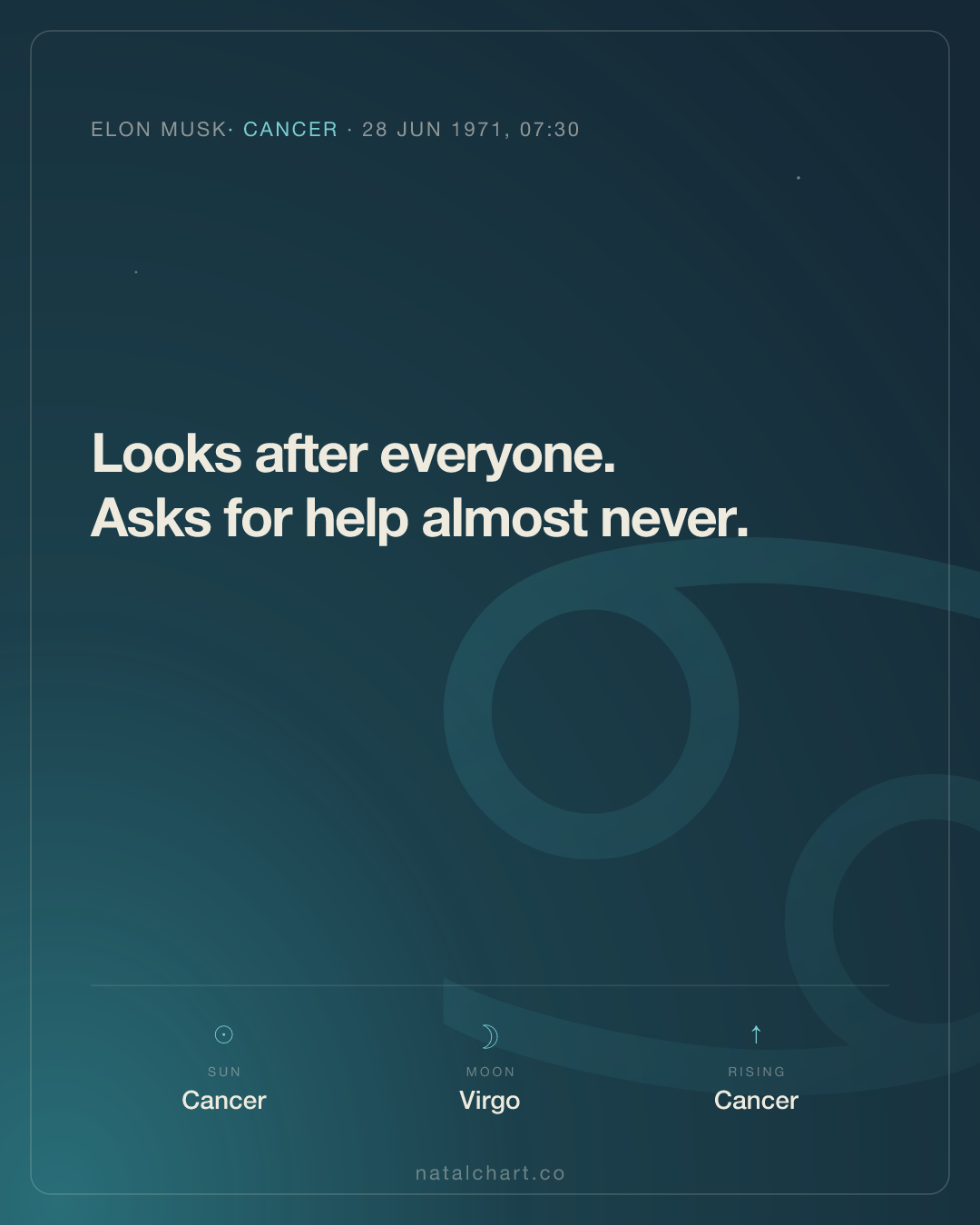
Elon Musk was born with his Sun, Mercury, and Ascendant all in Cancer — the same sign rising, the same sign thinking, the same sign at the centre. Cancer is the sign of the enclosure: the home, the protected interior, the thing you shield with your body. In Musk, this shows up not as domesticity but as a compulsive need to control the container. PayPal was a system he could own end-to-end. Tesla was a company he eventually needed to run himself. SpaceX was a rocket company he founded because no one would sell him a rocket on terms he could live with. The Cancer pattern is: if the world won't give you the security you need, you build it yourself, at any scale required.
With the Ascendant also in Cancer, this is the face he meets the world with — a guarded, watchful, emotionally sensitive surface that often reads as unpredictable to outsiders. Cancer rising can be disarming or difficult depending on how safe the environment feels. The Cancer Sun in the first house doubles down: the identity and the persona are fused, which means any challenge to his projects is processed as a challenge to his person.
The Moon: the analyst behind the wall
The Moon — the emotional interior, what someone needs to feel settled — sits in Virgo in the third house. Virgo processes the world through analysis, categorisation, and fault-finding. The third house is the domain of communication, short-range thinking, and the immediate environment. Put together: Musk's emotional baseline is not warmth and reassurance but information. He feels more settled when he understands the system, when he can break a problem into its components, when the numbers add up. His famous habit of reducing problems to first principles is not just an intellectual method — it is how his Virgo Moon regulates anxiety.
The Moon in easy flow with the Sun (in the first house) suggests that his emotional needs and his public identity are relatively well-integrated: what he wants and what he shows are not as far apart as one might expect. But the Moon shares the third house with Pluto, also in Virgo — and that Pluto conjunction is one of the heaviest signatures in the chart. More on it below.
Mercury: the mind that cannot slow down
Mercury in Cancer in the first house means his thinking is intimately connected to feeling. He does not reason from a distance: ideas arrive with an emotional charge, and the ones that land hardest are the ones that trigger a sense of threat or possibility in his gut. This is why public challenges to his statements — on X, in interviews, in court — produce such immediate and personal responses. For a Virgo Moon, being shown an error should be useful data; for a Cancer Mercury, it lands as an attack.
Mercury joins the Sun in the first house, giving him a quality that anyone who has watched him in a real-time interview will recognise: he speaks from inside the thought as it forms. The result is sometimes brilliant and sometimes jagged — the words arrive before the edit.
Venus and the hidden register
Venus in Gemini in the twelfth house is one of the more privately weighted placements in the chart. The twelfth house is the sector that sits behind the curtain — the part of life that happens offstage, the private register, the things a person keeps to themselves or processes alone. Venus here means that Musk's affective life, his pleasures, his sense of connection, operate largely out of public view. Whatever warmth or aesthetic delight he takes in the world tends to stay quiet, unglamourised, unreported.
Gemini in Venus loves variety, quick stimulus, and the play of ideas. Saturn also occupies the twelfth house in Gemini, and the tight Saturn-Neptune opposition (see below) is the dominant structural tension of the entire chart. What Venus in the twelfth adds quietly is a kind of private restlessness — a need for novelty in personal connections that runs underneath the more visible drive for technical novelty.
Mars: the disruptor with a long-game agenda
Mars in Aquarius in the eighth house is a striking placement. Aquarius is the sign of the system-breaker, the one who sees the existing structure and thinks: this entire thing needs redesigning. The eighth house is traditionally associated with transformation, shared resources, and the deep economy — leverage, debt, institutional power, the transfer of wealth at scale. Mars here does not compete for incremental advantage: it competes to redesign the rules.
SpaceX, which operates on government contracts but has systematically displaced the aerospace incumbents through cost disruption, is a clean expression of Mars in Aquarius in the eighth. Tesla's disruption of the automotive and energy industries operates on the same logic. And Musk's 2022 acquisition of Twitter — financing it with debt, restructuring it radically, renaming it — has the eighth-house flavour of transformation through leverage.
Mars forms an easy flow with Venus: the drive to act and the sense of what's attractive point in roughly the same direction. This gives him a quality rare in highly driven people — genuine enthusiasm for his own projects, not just hunger. He is not grinding through Tesla and SpaceX; he finds them, by every visible account, thrilling.
Jupiter and Saturn: the structural tension at the heart of everything
Jupiter in Scorpio in the fifth house promises deep, leveraged expansion — Scorpio multiplies whatever it touches, and the fifth house is the house of risk, creativity, and speculative bets. Jupiter joined with Neptune (in Sagittarius, sixth house) amplifies this into a drive to expand at the scale of the possible rather than the probable. SpaceX colonising Mars is not a business plan; it is a Scorpio Jupiter in the fifth making the largest possible bet.
But Saturn in Gemini in the twelfth house, sitting in near-exact opposition to Neptune (orb 0.3°), is the restraining counter-force. Saturn opposite Neptune — the tightest aspect in the entire chart — is the signature tension between structure and dissolution, between the urge to make things real and concrete versus the pull toward the visionary and the unlimited. Saturn in the twelfth means this tension is internalised rather than visible: it is the private discipline, the doubt, the engineering reality-check that must continuously push back against the Scorpio Jupiter expansiveness.
Jupiter also opposes Saturn across the chart (orb 3.5°): the optimism and the rigour, the grand vision and the hard constraint. This opposition, running through the fifth and twelfth houses, explains a pattern visible across his career — periods of enormous expansion followed by grinding operational crises where the structure has to catch up with the vision. Tesla nearly went bankrupt in 2018. SpaceX came close to shutting down in 2008 after three failed rocket launches. In both cases, the Saturn-Neptune pressure cooker held.
The outer planets and the fourth house: dislocation as fuel
Uranus in Libra in the fourth house is, biographically, one of the most exact placements in this chart. The fourth house is the house of origin, home, roots, family — the foundational structure of a person's early life. Uranus here, the planet of rupture and sudden change, describes a childhood that was neither stable nor safe. Musk has spoken publicly about the violence of his relationship with his father Errol and the difficulties of growing up in apartheid South Africa. The foundation was disrupted, and Uranus in the fourth often produces adults who compensate by building alternative structures of enormous ambition — who, because the original home did not hold, feel compelled to build something that will, whether that is a company, a colony on Mars, or a child's future.
Lilith in Libra shares the fourth house, adding a dimension of unresolved relational imbalance at the foundation. Uranus squares the Sun (orb 3.6°) — the childhood disruption and the adult identity are in permanent tension; the home wound became the engine.
The Midheaven: the public vocation
The Midheaven — the career and public reputation point — is in Aries. Aries at the Midheaven is not subtle: it wants to be first, to initiate, to push into territory no one has entered before. The first private company to send a crewed spacecraft to the International Space Station. The first mass-market electric vehicle that actually worked. The first orbital-class rocket to land upright after launch. Musk's public identity is shaped by the Aries drive to be the initiator, the pioneer, the one whose name is on the first.
Chiron — the wound that becomes a gift over time — also sits in Aries in the tenth house, directly near the Midheaven. The wound of Aries is the wound of the pioneer: the cost of being first is being misunderstood, dismissed, or attacked before the thing works. Musk has been declared wrong, irresponsible, and deluded by serious people on multiple occasions, and multiple times the thing that was dismissed has subsequently worked. Chiron in the tenth is the figure who is wounded by the very visibility that their vocation demands — and who eventually turns that wound into a teaching.
The North Node and the shape of growth
The North Node — the point that marks the direction of growth and development in the chart — is in Aquarius. Aquarius is the sign of the collective, the systemic, the long view on humanity's trajectory. Musk's stated missions — sustainable energy, multi-planetary civilisation — are not incidental: they are the direction that this chart points toward growth. Whether one finds those missions credible or convenient, the chart is internally consistent: the North Node in Aquarius aligns with Mars in Aquarius, reinforcing the idea that the drive to disrupt systems (Mars) and the direction of personal growth (North Node) are pointing at the same horizon.
The South Node, the point of familiar but limiting patterns, sits in Leo. The Leo shadow is the pull toward personal glorification, toward making the story about the individual rather than the collective goal. The tension between building for humanity's future (Aquarius North Node) and the gravitational pull of the personal brand (Leo South Node) is one of the live tensions of his public life.
The close: the cost of the blueprint
Musk's chart is not a simple portrait of ambition. It is the portrait of someone whose earliest foundation was unstable (Uranus in the fourth) and who responded by building stability through scale — through the compulsive construction of systems so large and so technically demanding that they become, in a way, self-securing. The Cancer Sun and Ascendant provide the emotional ground: the need for the container, the need to be in charge of the walls. The Saturn-Neptune opposition provides the tension that keeps the vision from floating away. The Scorpio Jupiter ensures the bets are always existential, never incremental.
The Chiron in Aries at the Midheaven is the most human note in the chart: the wound of the pioneer who is dismissed before the rocket lands. That wound, visible in how personally he takes public criticism and how intensely he needs the projects to succeed, is also the engine. Without it, the Cancer impulse to protect what he has built might have won out over the Aquarius drive to change the entire system. The chart holds these two things in productive tension — and so, for better and worse, does the life.
The chart
How to read it →Frequently asked questions
What is Elon Musk's zodiac sign?
Elon Musk's Sun sign is Cancer — the Sun was in Cancer at birth (1971).
What is Elon Musk's moon sign?
Elon Musk has the Moon in Virgo. The Moon sign describes the emotional and instinctive layer of the chart.
What is Elon Musk's rising sign?
Elon Musk's rising sign (ascendant) is Cancer — the sign on the eastern horizon at the moment of birth.
When and where was Elon Musk born?
Elon Musk was born in 1971 in Pretoria, South Africa.