Frida Kahlo — natal chart
What does Frida Kahlo’s natal chart reveal?
Frida Kahlo, born Magdalena Carmen Frida Kahlo y Calderón on July 6, 1907, in Coyoacán, Mexico, was a painter whose work drew on autobiography, pre-Hispanic imagery, and Mexican folk traditions. She produced approximately fifty-five self-portraits, including The Two Fridas (1939) and Self-Portrait with Thorn Necklace and Hummingbird (1940). A severe bus accident in 1925 left her with lifelong physical injuries that influenced both her subject matter and her periods of confinement to bed. She was married twice to muralist Diego Rivera. Kahlo died in Coyoacán on July 13, 1954, and her home, La Casa Azul, is now a museum.
 Share
Share
Birth
1907-07-06 · 08:30 · Coyoacán, Mexico Reliability: AA · vetted record
The Core: A Face That Held Everything In
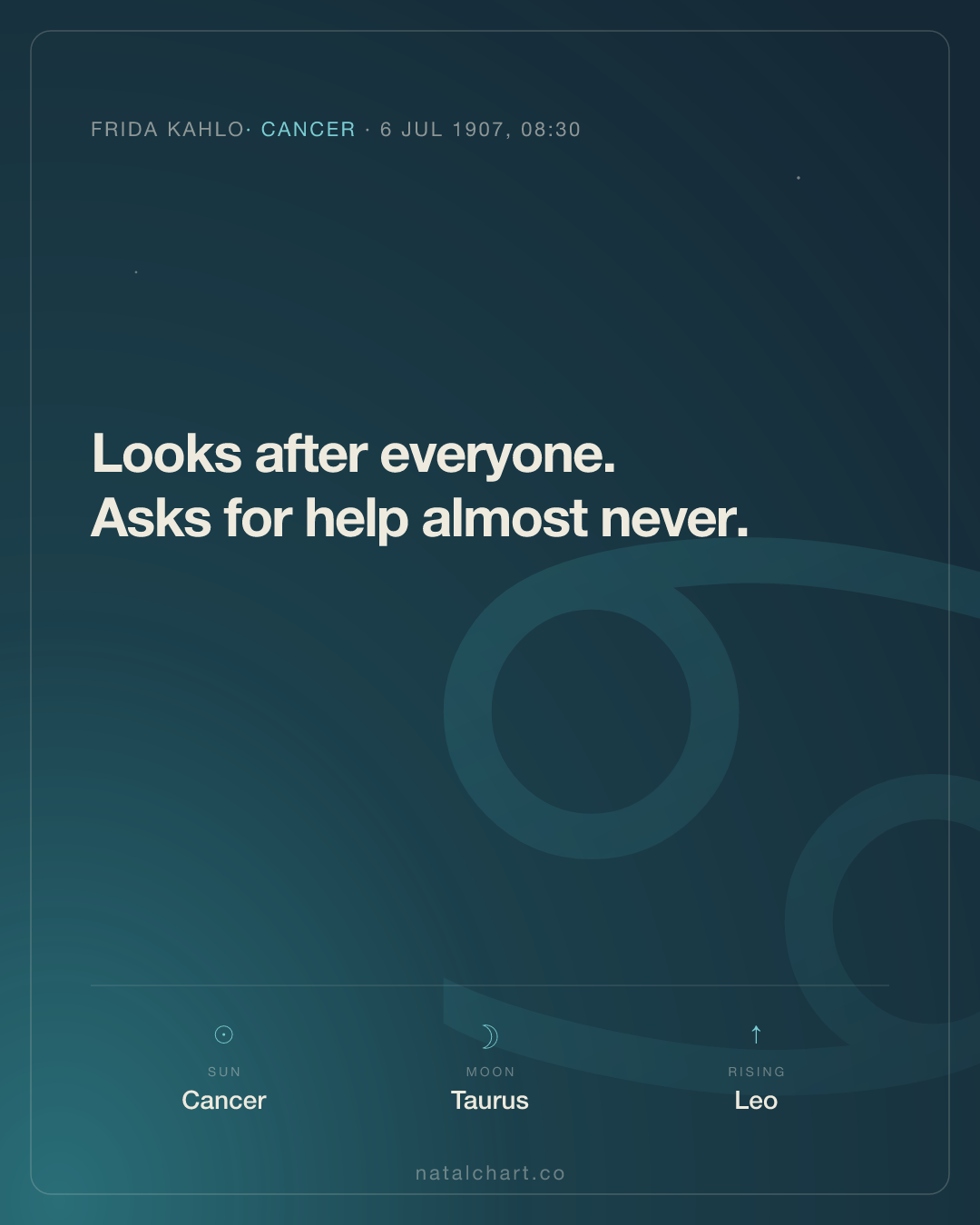
Frida Kahlo met the world with fire and theatre. Her Ascendant — the face she showed the world — was Leo, and Leo is colour, presence, the will to be seen exactly as one is. Anyone who has looked at a single self-portrait knows this: the unibrow drawn with sovereign precision, the traditional Tehuana dress worn like a declaration, the steady gaze that refuses to flinch. That presence was real, not performance — or rather, it was performance in the deepest sense, the kind that says this is the truth of me, and I will not diminish it.
Behind that bold exterior, her Sun — the central identity — sat in Cancer, hidden in the twelfth house. The twelfth house is the room nobody sees: the private hours, the suffering kept out of the public eye, the inner life that runs deeper than any room can hold. A Cancer Sun asks for tenderness and a safe harbour above all else; finding it in the most secluded corner of the chart meant that Kahlo's truest self operated in solitude, in convalescence, in the slow hours in La Casa Azul when she could not stand. The fact that she made those hours into art — turning a bed-bound existence into fifty-five self-portraits — is the whole story of this chart: the wound became the work.
Jupiter and Neptune also gathered in Cancer and the twelfth house, amplifying that interior world to the point of overflowing. Where other artists kept imagination at arm's length, Kahlo let it saturate everything: the bleeding hearts, the animals woven into her hair, the pain rendered with the clarity of a surgical illustration. A porous border between the inner and outer world is not weakness — it is source material.
The Moon: Visible Suffering, Invisible Endurance
Her Moon — the emotional interior, the need that runs below the surface — was in Taurus, in the tenth house, which is the most public point in a natal chart. The tenth house governs what one becomes known for, how the world sees the work. Taurus is fixed earth: patient, stubborn, capable of outlasting almost anything. So Kahlo's emotional life, deeply private by Sun-placement but publicly Taurus, was on display in the most literal sense: her physical endurance, her refusal to stop painting through thirty-five surgical operations, her insistence on being present at her first solo Mexican exhibition in 1953 even when she had to be carried in on a stretcher — these were not stunts. They were Taurus Moon in full expression: I will outlast this. I will not be moved from what I have built.
The Moon and Saturn worked together in an easy, reinforcing flow (a sextile, meaning the two planets helped rather than fought each other). Saturn is discipline, structure, the will to endure. This combination — quiet emotional endurance married to unshakeable discipline — explains something that photographs alone cannot: the sheer technical commitment behind paintings that look like raw feeling but are executed with extraordinary control. Kahlo was not painting at random. She was building.
Mercury: The Self-Portrait as Statement
Mercury, the planet of mind and voice, was in Leo, right at the Ascendant — the very doorway between the private self and the public world. Leo Mercury does not speak to inform; it speaks to declare. Kahlo's communication was always self-referential in the most radical sense: I am the subject. I am also the observer. She said once that she painted her own reality because it was what she knew best, and Mercury in Leo at the Ascendant makes that literal — the mind and the face are the same threshold.
This Mercury sharpened her letters and diary entries too, which are extraordinary documents: witty, defiant, heartbroken, blazingly honest about her body and her love for Diego Rivera. The voice never hedges. Leo Mercury speaks from the centre of the room even when the room is a sickbed.
Venus: Love as Multiplicity
Venus — the planet of love, beauty, and what one values — was in Gemini, in the eleventh house. Gemini is duality, curiosity, the inability to settle for a single version of anything. The eleventh house is the house of community, friendships, and belonging to something larger than the couple. Both facts together describe her love life with ruthless accuracy: the open marriage with Rivera (itself negotiated and renegotiated), the female friendships and affairs she nurtured with equal devotion, the intense feeling of belonging to a political and artistic collective — the muralists, the Marxists, the circle that gathered at La Casa Azul.
Venus was joined — almost exactly — to Pluto, also in Gemini. Pluto intensifies whatever it touches, and it transforms: it takes Venus out of the realm of pleasant feeling and pushes it into obsession, loss, regeneration. Kahlo's paintings of her relationships did not soften them. The Two Fridas shows two versions of herself — one with a whole heart, one with a broken heart — connected by a single vein. That is Venus conjunct Pluto painted in oils.
Mars and Uranus: The Body as Battlefield
Mars in Capricorn in the sixth house is a placement that works. The sixth house governs daily practice, the body, health, work as habit. Capricorn Mars is disciplined, slow, methodical — it builds through repetition over years. For Kahlo, this described the physical act of painting itself: the adapted easel built so she could paint lying down, the ritual of preparing pigments, the sustained effort that her injuries interrupted but never permanently stopped.
Uranus — the planet of rupture and sudden reversal — sat directly alongside Mars in Capricorn, in the same house. The bus accident of 1925 that fractured her spine, her collarbone, her pelvis, and crushed her right foot reads unmistakably here: Uranus shattering the body (Mars, sixth house), without warning, in the most literal, violent way. But Uranus also rules the unexpected gift: the accident forced her into the sickbed where she began to paint, where she discovered what she could do with a mirror above the bed and pigments in her hands. Rupture and vocation arrived on the same bus.
The exact opposition between the Sun and Mars — the tightest aspect in her chart, zero degrees of separation — means these two forces were locked together: the private Cancer self and the disciplined, enduring body in permanent, generative tension. Great works rarely come from comfort.
Jupiter and Saturn: Expansion, Then the Long Hold
Jupiter, the planet of expansion and excess, joined Kahlo's Sun in Cancer and the twelfth house. Jupiter enlarges wherever it lands, and in the house of solitude and inner life, it made her interior world vast — almost oceanic. The mythology, the folk imagery, the pre-Hispanic symbolism she absorbed as emotional nutrition rather than intellectual exercise: this is Jupiter in Cancer at full stretch, turning feeling into cosmology.
Saturn in Pisces in the eighth house is a slower, more serious note. The eighth house is the territory of transformation, what cannot be avoided — illness, surgery, the body's recurring failures. Saturn here is not easy, but it is productive in the way that only sustained difficulty can be: it insists on rigour even where there is pain. Thirty-five operations and the discipline to keep painting across all of them is Saturn in the eighth house, endured.
The Outer Planets: A Generation Turned Personal
Neptune — the outer planet of imagination, dissolution, and the porous boundary between self and world — was joined to her Sun and Jupiter in Cancer and the twelfth house. Where Neptune touches the Sun, the boundaries of ego thin: what is internal and what is external become harder to separate. For Kahlo, this was both difficulty (a hypersensitivity to pain, to rejection, to the failures of her body) and gift (the capacity to translate private suffering into universally recognisable imagery). Anyone who has ever felt betrayed by their body recognises something in Self-Portrait with Thorn Necklace and Hummingbird. That recognition is Neptune's doing.
Uranus opposing Neptune describes the generational tension of her era: the old world and the radically new one in permanent friction. For Kahlo, who wore traditional Tehuana dress as both political statement and personal armour, that tension was lived daily.
The Midheaven: What the World Kept
The Midheaven — the topmost point of the chart, representing public vocation and lasting reputation — was in Taurus. Taurus rules the tangible, the made object, beauty that can be held or hung. It also rules what endures: Taurus does not change its mind easily, and what Taurus builds tends to last. A Taurus Midheaven for an artist means the work survives because it is grounded in the physical world — in bodies, in materials, in things that can be touched and preserved.
Kahlo's reputation, almost suppressed during her lifetime in favour of Rivera's, now outstrips it in every major museum. La Casa Azul draws more visitors than any Rivera mural. Taurus is patient. The career it promised arrived, simply, on Taurus time.
Chiron and the North Node: The Gift of the Wound
Chiron — sometimes called the wounded healer, the point in a chart where an old hurt becomes, over time, the source of what one most meaningfully offers — was in Aquarius, in the seventh house. The seventh house is the house of significant others, of partnership, of the mirror another person holds up. Aquarius is collective, unconventional, concerned with what lies beyond the personal. The wound here was carried in relationships: the two marriages to Rivera, the recurring betrayals, the sense of never quite having the partnership she needed in the form she needed it.
But Chiron in Aquarius in the seventh also points toward what that wound eventually produced: an art rooted in collective recognition. People who have never been to Mexico, never spoken Spanish, never heard Rivera's name still feel personally addressed by Kahlo's paintings. That address — that gift — came from understanding, through her own acute experience of isolation, what it means to need and not have. It is Aquarius: the wound that becomes a bridge to everyone.
The North Node — the direction a life seems to lean toward, the quality it keeps returning to develop — was also in Cancer. Cancer is protection, tenderness, the courage to feel without armour. Everything in Kahlo's chart that was already in Cancer — the Sun, Jupiter, Neptune, Lilith — reinforced this direction. The life was asking her to inhabit her own softness without shame, to make vulnerability the medium, not just the subject. The paintings say she understood this. They are not hard paintings. They are exact ones.
A Closing Note
What stays about Frida Kahlo — beyond the icon, the tote bags, the textbook reproduction — is something the chart confirms without sentimentality: she made the terms of her own suffering. Not in a simple triumphal way, not without cost, but with the Leo Ascendant's insistence on being seen and the twelfth-house Sun's willingness to go very deep, very quietly, to find something true. The bus changed what her body could do. It did not change what she could see. The paintings are what she saw.
The chart
How to read it →Frequently asked questions
What is Frida Kahlo's zodiac sign?
Frida Kahlo's Sun sign is Cancer — the Sun was in Cancer at birth (1907).
What is Frida Kahlo's moon sign?
Frida Kahlo has the Moon in Taurus. The Moon sign describes the emotional and instinctive layer of the chart.
What is Frida Kahlo's rising sign?
Frida Kahlo's rising sign (ascendant) is Leo — the sign on the eastern horizon at the moment of birth.
When and where was Frida Kahlo born?
Frida Kahlo was born in 1907 in Coyoacán, Mexico.