Princess Diana — natal chart
What does Princess Diana’s natal chart reveal?
Diana, Princess of Wales, born Diana Frances Spencer on July 1, 1961, in Sandringham, England, married Charles, Prince of Wales, in 1981. Her public profile grew through advocacy for people affected by landmines, HIV/AIDS patients, and the homeless, work that took her to Angola, Bosnia, and other conflict zones. She was patron of over one hundred charities. After her divorce from Prince Charles in 1996, she continued her humanitarian work independently. Diana died in a road accident in Paris on August 31, 1997, at age thirty-six. Her funeral drew an estimated global television audience of over two billion people.
 Share
Share
Birth
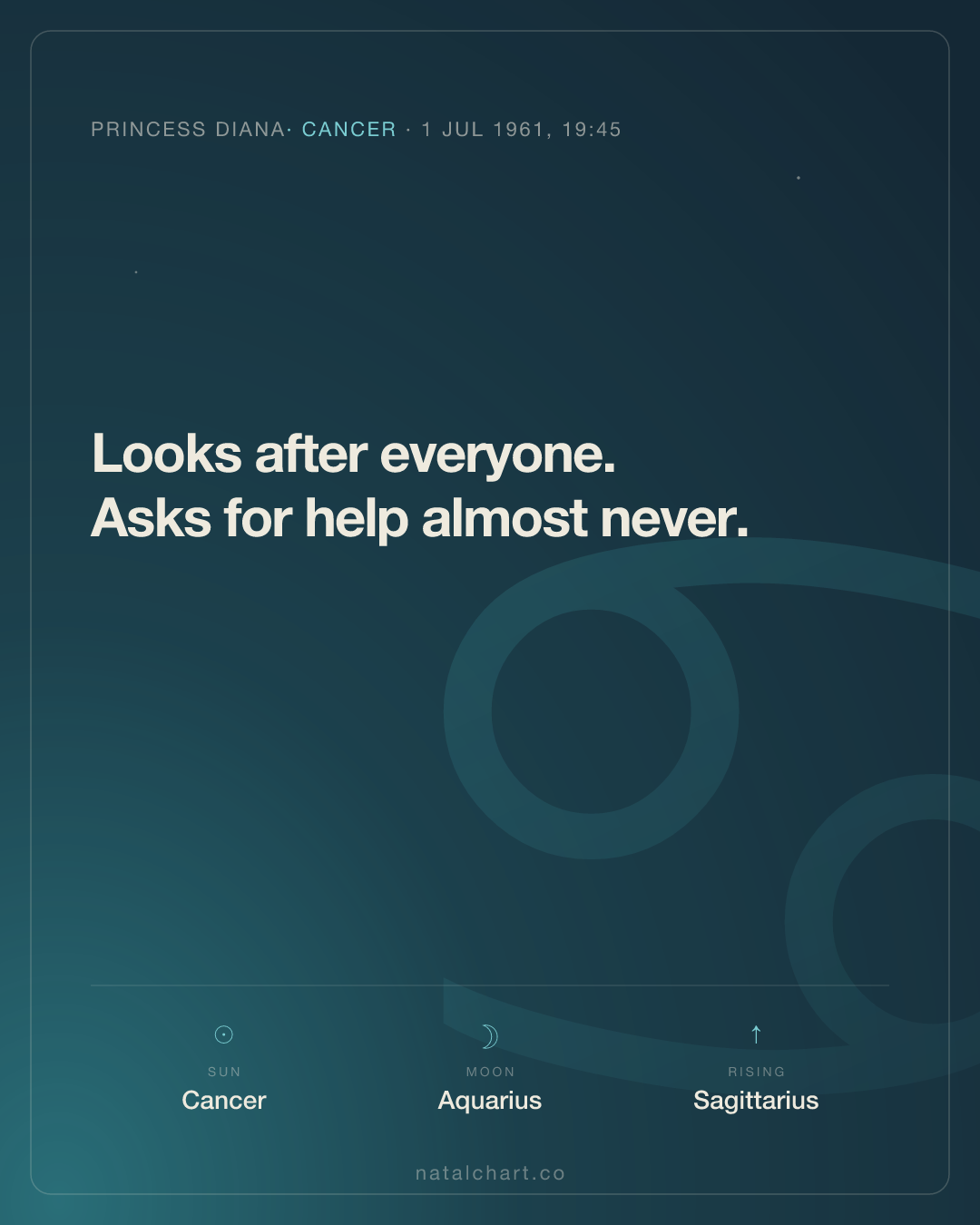
1961-07-01 · 19:45 · Sandringham, England Reliability: A · reliable data
A Cancerian heart in an impossible position
Diana Spencer did not become compassionate because royalty required it. She was compassionate first, and the role found her. The Sun and Mercury in Cancer in the eighth house — the house of what is shared between people, of vulnerability and depth — speak to someone whose mode of understanding was fundamentally emotional and immersive. Cancer feels its way into situations rather than reasoning from a distance. Combined with an eighth-house placement, that quality deepened into something more intense: an ability to enter into genuine intimacy, to sit with suffering rather than manage it from above.
This is the most direct explanation for why her visits to AIDS patients in 1987, when the prevailing culture still treated the disease with fear and social distancing, landed so differently from the standard royal walkabout. She held people's hands. The chart simply describes someone for whom that gesture was natural.
The Sagittarian Ascendant — the adventuring face
The Ascendant — the impression she made on meeting, the face she offered the world — was Sagittarius. Where the Cancer Sun was private and feeling, the Sagittarian front was open, physically restless, and drawn toward horizon and movement. The contrast between the two was real and it was felt: she could walk into a room of strangers in Angola and create immediate warmth, while inwardly operating with a complexity and emotional depth that the breezy exterior rarely signaled.
Sagittarius rising also marks someone who stretches toward the foreign, the cross-cultural, the cause bigger than one's own situation. Her travels to landmine zones in Angola and Bosnia, to leprosy clinics, to HIV wards — these were not PR tours. The chart describes a genuine gravitational pull toward the far and the humanly urgent.
The Aquarian Moon — needing to matter at scale
The Moon — the emotional interior, what a person actually needs to feel well in the world — was in Aquarius in the third house (the house of communication, ordinary contacts, the texture of daily life). An Aquarian Moon is not cold; it simply needs to connect to something larger than the personal. Aquarius finds intimacy through principle, through shared cause, through the sense that what is being done matters to more people than just those immediately present.
The third house placement is telling: the sheer volume of her letters, her personal contact with hundreds of individuals in her charities, the one-to-one conversations at bedsides and in shelters — this was her emotional home. Not the grand gesture, but the continuous, unremarkable contact with real people.
Moon in Aquarius also sat with Jupiter in Aquarius in the third house, which amplified everything: a generosity of attention, a breadth of concern that could genuinely hold a hundred charities without the care becoming thin.
Venus and the cost of constrained affection
Venus in Taurus in the sixth house is Venus at her most sensory and committed — deeply loyal, affectionate through acts of service and physical presence rather than words, reluctant to walk away. The sixth house is the house of daily work, health, and service; Venus here found deep satisfaction in the quiet, unglamorous labor of care.
But this Venus was pulled hard in two directions. In tension with the Moon (barely half a degree), it describes a split between what she felt she owed others emotionally and what she privately needed — a conflict between giving freely and the ache of not receiving in kind. In tension with Uranus (little more than a degree), it describes a hunger for the unconventional in love that ran against the formal structures surrounding her. These were not minor background notes. They were central to everything that made her private life so painful and so difficult to resolve.
Venus trine Saturn (three and a half degrees) provided some ballast: a capacity to honor commitments, to follow through, to be taken seriously in her public duties regardless of inner turmoil. That Saturnian thread of steady reliability was visible to anyone who tracked her patronages over fifteen years.
Mercury and Mars — precise, purposeful action
Mercury in Cancer in the eighth house, in easy flow with Mars in Virgo (in the tenth house — the public, professional sphere), describes a way of communicating that was both emotionally intelligent and practically effective. Cancer's instinctive empathy, sharpened by Virgo's attention to the right detail in the right moment. The sextile between Mercury and Mars says: thought translates quickly into purposeful action.
The most visible expression of this was her landmine campaign. She did not simply show up in Angola for photographs. She briefed herself on the issues, spoke in precise terms about the humanitarian cost, and used her access to apply direct pressure on policy. Mercury sextile Pluto (also present) adds the capacity to locate leverage — to identify where a well-placed word would actually move something.
Mars in Virgo and the Libra Midheaven — a public vocation built on discernment
Mars in Virgo in the tenth house — the Midheaven area, the zone of public vocation and contribution — describes a person whose most visible work was defined by precision and service. Virgo in the tenth does not seek public glory; it seeks to do the thing correctly, to be genuinely useful. Diana's most impactful moments were rarely theatrical. They were practical: the handshake with an AIDS patient, the walk through an active minefield in protective gear that signaled to the world the danger was real and that advocacy required personal witness.
The Libra Midheaven (the career and public-reputation point) adds a specific cast to this: a vocation shaped by the drive toward justice, balance, and making things more equitable. She was patron of over a hundred charities, many focused on populations that were structurally invisible — the homeless, the sick in regions nobody was watching, children in conflict zones.
Neptune, Saturn, and the outer planets
Neptune in Scorpio in the twelfth house is a generational placement, but in the twelfth house — traditionally associated with retreat, sacrifice, and what operates beneath public view — it takes on a particular quality. Neptune here describes a kind of selflessness that can shade into a loss of self: giving so completely that the giver's own needs become systematically invisible. Diana spoke late in life about this pattern directly, and with uncommon candor, particularly in her 1995 Panorama interview.
Saturn in Capricorn in the second house describes a grounded sense of the value of things built slowly — a psychological toughness acquired through difficulty rather than inherited. Her public authority grew incrementally, rooted in demonstrated commitment, not title alone.
Uranus in Leo in the ninth house (the house of foreign cultures, belief, and long-distance travel) reinforces the Sagittarian Ascendant: a drive toward the wider world, the cross-cultural encounter, the foreign cause. The ninth house Lilith in Leo, and North Node in Leo, point in the same direction: a life calling that involved moving toward self-expression, toward occupying one's own authority rather than borrowing it from a structure.
Chiron — the wound that became the method
Chiron in Pisces in the fourth house (the house of family origins, of what formed us before we had words for it) marks a formative wound in the experience of home and belonging. Diana's parents divorced when she was six; she grew up in a household shaped by that rupture. The Pisces quality of Chiron here speaks to a particular kind of early exposure to loss and dissolution that leaves someone more porous to others' grief — not as a personality trait chosen, but as a consequence of formation.
The remarkable thing is how directly this translates into her public work. The capacity to sit with dying patients, with landmine survivors, with people who had lost everything — and to do so without flinching, without managing the distance — this is Chiron in Pisces in the fourth house doing what it does: transforming a wound in belonging into a gift for presence.
The person the chart describes
Diana's chart is not, in the end, a portrait of a tragic figure. It is a portrait of someone whose deepest instincts — toward warmth, toward direct human contact, toward the far and the overlooked — were systematically at odds with the structure she inhabited. The tension between a Cancer Sun's need for private intimacy and a Sagittarian Ascendant's pull toward the world, between a Venus in Taurus that wanted depth and steadiness in love and the restless Uranian challenge to any settled arrangement, between a Moon in Aquarius that needed to serve a cause and the relentless institutional constraint — none of this resolved neatly. It rarely does.
What it produced instead was a public record of extraordinary reach and a private life of real cost. The chart holds both honestly, without making one cancel out the other.
The chart
How to read it →Frequently asked questions
What is Princess Diana's zodiac sign?
Princess Diana's Sun sign is Cancer — the Sun was in Cancer at birth (1961).
What is Princess Diana's moon sign?
Princess Diana has the Moon in Aquarius. The Moon sign describes the emotional and instinctive layer of the chart.
What is Princess Diana's rising sign?
Princess Diana's rising sign (ascendant) is Sagittarius — the sign on the eastern horizon at the moment of birth.
When and where was Princess Diana born?
Princess Diana was born in 1961 in Sandringham, England.