Franklin D. Roosevelt — natal chart
What does Franklin D. Roosevelt’s natal chart reveal?
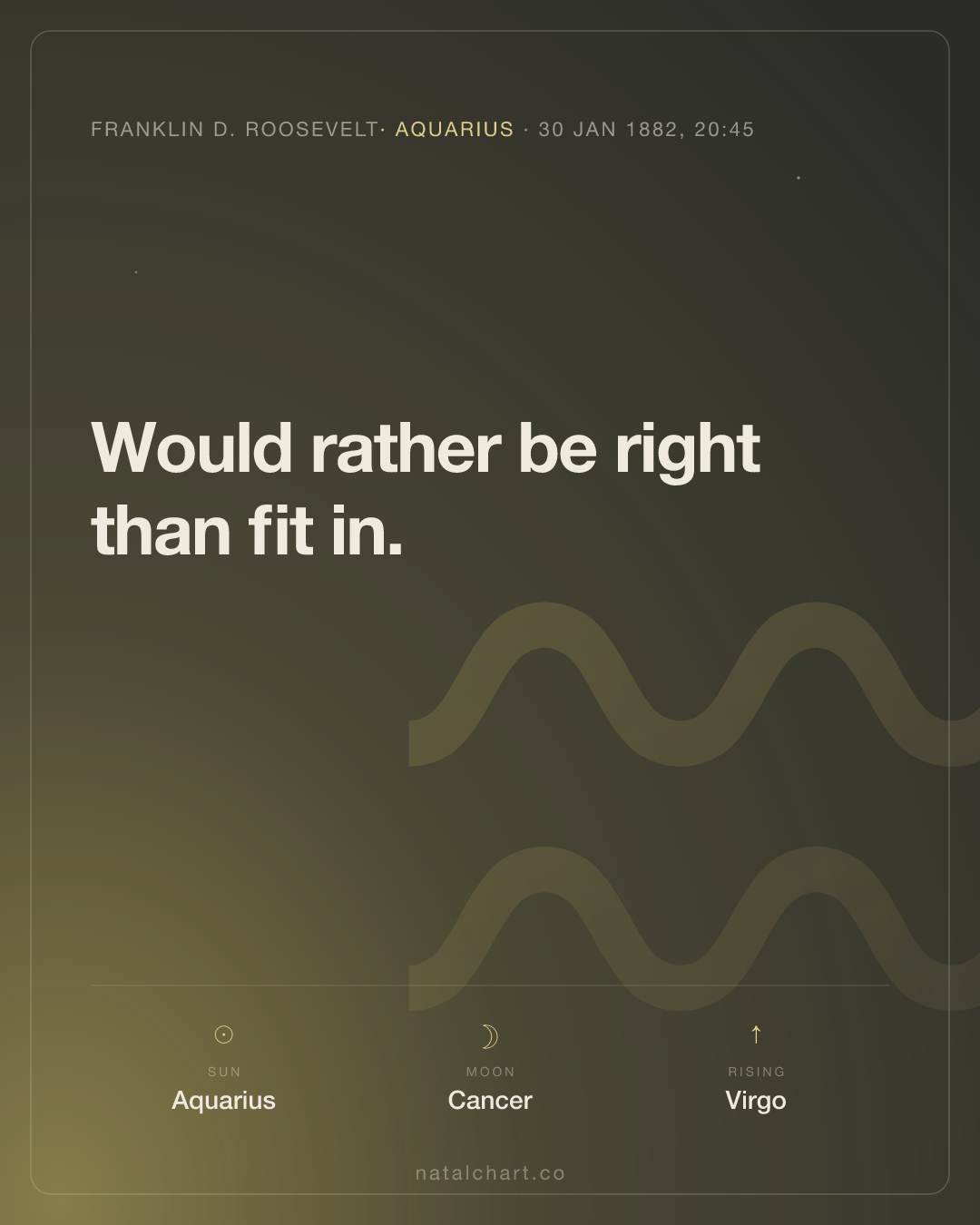
American politician, 32nd President (1933-1945). Democrat. Only one to win four consecutive terms. Launched the New Deal against the Great Depression and led the US through World War II. Died in office in April 1945.
 Share
Share
Birth
1882-01-30 · 20:45 · Hyde Park, New York Reliability: A · reliable data
The Architect of a Nation's Will
Franklin D. Roosevelt governed from a wheelchair for most of his presidency, yet conveyed a sense of forward momentum so convincing that millions never fully registered the fact. That particular tension — the gap between what is visible and what is real, between the face presented to the world and the interior life — runs through every layer of his birth chart. The Ascendant in Virgo, the point of the horizon that shapes a person's physical presence and first impression, projects competence, precision, and a steady grip on practical matters. Virgo on the Ascendant is the administrator's face: calm, organized, and quietly exacting. Roosevelt's famous attention to detail, his delight in logistics, his habit of keeping multiple subordinates each believing they were his closest confidant — all of it fits the Virgoan need to manage the variables, to see the whole machine and know where every lever is.
But the Sun, the core identity, sits in Aquarius in the sixth house — the house of daily service, workload, and the ordinary labor through which purpose gets expressed. Aquarius is the sign of the collective, of systemic reform, of the conviction that society can be rationally reorganized for the common good. Roosevelt did not just manage crises; he believed, at the structural level, that the relationship between government and citizens could be fundamentally rebuilt. The New Deal was not a collection of emergency measures: it was an Aquarian vision made policy.
The Emotional World Behind the Mask
The Moon in Cancer in the eleventh house is among the warmest placements in this chart. Cancer rules the home, the family, the primal bonds that make a person feel safe; in the eleventh house — the house of collective belonging, alliances, and the chosen tribe — it produces someone whose emotional security is bound up with protecting the group, not just the household. Roosevelt's famous radio addresses, the Fireside Chats, were the Moon in Cancer made audible: the voice of a man speaking directly into the living rooms of ordinary families, using the language of reassurance and belonging. "The only thing we have to fear is fear itself" is not the line of a detached strategist. It is the Moon in Cancer addressing the nation as if it were a frightened family that needed to hear a steady, warm voice at night.
The Moon forms a very tight supportive connection with Saturn — almost exact, within a fraction of a degree — and this is the aspect that allowed Roosevelt to be both warm and structurally reliable. The Moon by itself in Cancer can be over-accommodating, too oriented toward pleasing and soothing; the Saturn connection gives it backbone. He could comfort and he could hold firm. Both at once.
A Mind Built for Pressure
Mercury in Aquarius in the sixth house sits next to both the Sun and Venus, forming a tight cluster of personal planets in the same sign. Mercury and the Sun share the same Aquarian orientation: ideas as tools for reform, argument as a form of public service, language used to educate rather than merely to persuade. Roosevelt was not a natural orator in the classical sense; he was something more useful, a communicator. He could translate the abstract — monetary policy, agricultural reform, the architecture of international alliances — into the plain speech of the kitchen table.
Mercury forms an extremely tight harmonious connection with Mars in Gemini in the tenth house (the public and career sector of the chart): the mind and the will work together without friction. Mars in Gemini in the tenth house is the public communicator's signature, someone whose ambition expresses itself through words, ideas, and the capacity to hold multiple negotiating positions simultaneously. It also speaks to the physical energy Roosevelt deployed in public settings long after polio had taken his legs: the visible effort was in the service of the outward mission, and the chart supports the sheer driven quality of that performance.
Values Under Pressure
Venus in Aquarius in the sixth house is one of the most instructive placements in this chart. Venus governs what a person values, how they love, where they find beauty — and in Aquarius, those answers are collective rather than personal. Roosevelt's affections were wide but not always close. The historical record of his marriage to Eleanor, and of his long relationships outside it, reflects something the chart shows plainly: Venus in a very tight tension with Saturn (exactly square, zero degrees of separation) means that love and commitment ran into structural constraints, duty, and the question of what could actually be sustained. The Venus-Saturn tension is not coldness; it is the experience of care that must be rationed, of warmth that competes with obligation. Saturn in Taurus in the ninth house — the house of larger principles and long journeys — adds the sense that his deepest commitments were to abstract values as much as to people.
The Weight of Saturn, the Luck of Jupiter
Saturn and Jupiter are both in Taurus in the ninth house, and Neptune and Pluto join them there, making the ninth house the most crowded sector of this chart. The ninth house governs philosophy, international reach, higher learning, and the long view. Four outer planets in one sector of a chart is unusual: it points to a life defined by large-scale, long-horizon thinking, by questions that operate at the level of civilization rather than the individual. Saturn in Taurus in the ninth builds a philosophy brick by brick, grounded in material reality (Taurus) and tested against the long arc of history. Jupiter expands whatever it touches; in Taurus, that expansion has to be useful, practical, connected to the actual earth. The New Deal's massive infrastructure programs — the Tennessee Valley Authority, the Rural Electrification Administration, the Works Progress Administration — are Jupiter-Saturn in Taurus: grand in scope, grounded in soil and steel.
Jupiter forms a tight harmonious connection with Uranus on the Ascendant, and this is the aspect that explains Roosevelt's intuitive feel for large structural change. Uranus on the Ascendant is the reformer's signature, someone who radiates a willingness to break with precedent — Roosevelt was the only president in American history to win four terms, and he broke the convention without a second thought when the circumstances demanded it.
The Outer Planets and the Shape of an Era
Neptune in Taurus in the ninth house, in a harmonious flow with Uranus on the Ascendant, points to the ability to bring idealistic visions into practical reality — not to dream abstractly but to build the dream into the land. The New Deal was, in this sense, a Neptune-in-Taurus project: the idealist's impulse meeting the farmer's pragmatism. Pluto in Taurus in the ninth house adds the dimension of transformation: the willingness to use power to permanently restructure the economic foundations of a society. What Roosevelt did to American capitalism with the New Deal was not repair; it was fundamental alteration. The regulations, the labor protections, the banking reforms — these were not emergency patches but permanent shifts in the relationship between private wealth and public authority.
Mercury forms a very tight tension with Pluto: the chart's tightest Mercury aspect. This is the mind that sees through surfaces to the structural forces beneath — and that is also capable of using that knowledge as a lever. The Mercury-Pluto tension in a political chart can shade toward manipulation, toward using information asymmetrically. Roosevelt's wartime management of public communications — what was said and, crucially, what was not said — reflects that quality: the information environment was shaped, not merely reported.
Vocation: The Communicator in Public Service
Mars in Gemini in the tenth house is the centerpiece of Roosevelt's vocational signature. The tenth house (the Midheaven area) is the career and public reputation sector; Mars there is driven, ambitious, and projects energy and leadership into the public sphere. In Gemini, that drive expresses itself most naturally through language, debate, and the management of information. The Midheaven in Gemini underlines this: Roosevelt's public image was built primarily through his voice and his words — the Fireside Chats, the war addresses, the Four Freedoms speech. These were not secondary to his presidency; they were the mechanism through which his presidency functioned.
The Sun in Aquarius in the sixth house, in service orientation, supports this vocational picture: his identity was genuinely organized around what he could do for others at scale. This was not performance, at least not entirely — the chart's sixth-house Sun does not seek the spotlight for its own sake but for the sake of the work the spotlight makes possible.
Chiron and the Wound That Became the Message
Chiron — the old wound that with time becomes each person's most particular gift — appears in Sagittarius in the fourth house, the house of foundations, home, and the private self. The fourth house is the bottom of the chart, the roots: childhood, the inherited family legacy, the private life that the public rarely sees. Chiron in Sagittarius in the fourth points to something about the inherited structure of Roosevelt's world — his aristocratic New York background, the enormous expectations attached to the Roosevelt name, the family framework that was both a launching pad and a constraint. The disability imposed by polio in 1921 forced him to rebuild his sense of self from the foundation up; the Chiron placement says this rebuilding was always going to be a central task of his life, polio or not. The North Node in Sagittarius in the fourth house reinforces the direction: the growth was inward and foundational before it could be outward and presidential.
The Closing Note
What makes Roosevelt's chart resonate is the convergence of the personal and the systemic. The Aquarian cluster in the sixth house points to a man whose personal satisfaction was inseparable from collective service; the Moon in Cancer in the eleventh makes that service warm and people-shaped rather than merely ideological; the Saturn-Moon connection gives the warmth structure; and Mars in Gemini at the Midheaven gives the whole enterprise a voice.
The hardest tensions in this chart — Venus square Saturn, Mercury in tension with Pluto — are the tensions of power: love that competes with obligation, intelligence that competes with the uses of power. These are not defects of character but the friction marks of a life lived at the intersection of the personal and the historical. Roosevelt inhabited that intersection for twelve of the most turbulent years of the twentieth century, and the chart held.
The chart
How to read it →Frequently asked questions
What is Franklin D. Roosevelt's zodiac sign?
Franklin D. Roosevelt's Sun sign is Aquarius — the Sun was in Aquarius at birth (1882).
What is Franklin D. Roosevelt's moon sign?
Franklin D. Roosevelt has the Moon in Cancer. The Moon sign describes the emotional and instinctive layer of the chart.
What is Franklin D. Roosevelt's rising sign?
Franklin D. Roosevelt's rising sign (ascendant) is Virgo — the sign on the eastern horizon at the moment of birth.
When and where was Franklin D. Roosevelt born?
Franklin D. Roosevelt was born in 1882 in Hyde Park, New York.