Tom Jobim — natal chart
What does Tom Jobim’s natal chart reveal?
Antônio Carlos Jobim, known as Tom Jobim, was born on January 25, 1927, in Rio de Janeiro, Brazil. He was a composer, pianist, and arranger who co-founded bossa nova alongside guitarist João Gilberto and poet Vinícius de Moraes. His song Garota de Ipanema (The Girl from Ipanema, 1962), co-written with de Moraes, became one of the most recorded songs in history. Other landmark compositions include Chega de Saudade (1958) and Águas de Março (1972). Jobim collaborated extensively with American artists including Frank Sinatra and Elis Regina, bringing Brazilian music to international audiences. He died in New York City on December 8, 1994.
 Share
Share
Birth
1927-01-25 · 12:30 · Rio de Janeiro, Brazil Reliability: AA · vetted record
The Quiet Revolutionary
Some people reshape the world from the center of the stage. Others do it from a piano bench, half-turned toward the window. Tom Jobim — Sun, Mercury, and Venus all gathered in Aquarius in the tenth house, the house of public life and vocation — had the kind of mind that thinks in structures no one has thought in before. Aquarius is the sign that looks at what everyone takes for granted and quietly asks whether it has to be this way. In Jobim's case, the answer was a new musical language: bossa nova, born in the late 1950s in the apartments of Ipanema, where he and João Gilberto and Vinícius de Moraes stripped samba down to its skeleton and rebuilt it with jazz harmony and a whispered, intimate delivery that had never existed in Brazil before.
The Sun joined to Mercury (2°) in Aquarius in the tenth house means the mind and the identity are fused, and both are pointed toward the world. Jobim didn't just compose — he theorized, arranged, wrote lyrics, conducted, and played. His work was his thinking made audible. And with Venus also in Aquarius in the same house, what he considered beautiful was always, at some level, an idea about beauty — not just an impression, but a form.
A Taurus Ascendant: the body that holds the abstract
The Ascendant — the face a person offers the world, the quality of their physical presence — is in Taurus, and it pulls in exactly the opposite direction from the Aquarian mind above. Taurus is the earth, the senses, the patience of something that takes root and grows slowly. People who knew Jobim describe a man of remarkable physical stillness at the piano, a deep love of the Brazilian landscape (he wrote Águas de Março — Waters of March — in 1972, a song that is essentially a sustained act of attention to the specific textures of Rio in the rainy season), and a temperament that was warm, sensuous, and unhurried in person. The abstraction happened inside; what showed on the outside was the body that loved the world it was made of.
Mars in Taurus in the first house — rising, close to the Ascendant — adds physical persistence to this portrait. Taurus Mars is not fast, but it does not stop. Jobim's career stretched over four decades, from Chega de Saudade (1958) to his work with Elis Regina, his collaborations with Frank Sinatra (Francis Albert Sinatra & Antônio Carlos Jobim, 1967), and the studio recordings he was still making when he died in New York in 1994. That kind of longevity requires a particular kind of physical commitment — the patience to keep showing up, to keep refining.
The Moon in Libra: feeling in balance
The Moon — the emotional interior, the register of private feeling — sits in Libra in the sixth house, the house of craft, daily work, and the body. A Libra Moon processes emotions through relation and aesthetic order: something doesn't feel right until it sounds right, until the parts are in proportion, until the harmony resolves. In the house of daily practice, this translates to a life organized around the act of making — the routine of sitting at the piano, working out chord voicings, testing melodies against the Portuguese language's particular music.
The Moon in easy flow with Jupiter (1.8°) and in gentle cooperation with Neptune (3.6°) says that this emotional attunement was genuinely expansive and genuinely porous to the dreamlike. Jobim's melodies have a quality that is difficult to describe technically: they feel inevitable, as if they were always there and he only found them. That sense of discovery rather than invention is very much a Moon-Neptune quality — sensitivity that doesn't manufacture feeling but catches it. And the Moon-Jupiter connection brought a generosity to that emotional register: his music makes people feel welcome in it, not confronted by it.
Mercury and the mind that made saudade audible
Mercury in Aquarius joined with the Sun means the intellect is never fully separate from identity — thinking is being, for Jobim. He was known to be an exceptionally articulate man about music, capable of explaining why a specific chord substitution worked in terms of acoustics, of emotional logic, and of cultural history simultaneously. This is not the polymath who knows a little about everything; it is the person who follows one river to its source and finds that the source connects to everything.
Mercury in easy flow with Saturn (2.9°) adds a structural quality to this nimble Aquarian mind: rigor, long-term thinking, the patience to develop a complex idea rather than sketch it and move on. Garota de Ipanema (1962), written with Vinícius de Moraes, is on its surface a simple song about watching a beautiful woman walk by the beach. Harmonically, it is one of the more sophisticated popular songs of the twentieth century — the bridge modulates to a remote key (G-flat major from F major) in a way that feels like stepping briefly into another world before returning, which is precisely the emotional movement the lyric describes. That level of precision is a Mercury-Saturn gift.
Venus in Aquarius: love as a democratic project
Venus — what one values, how one loves, what one finds beautiful — in Aquarius in the tenth house makes beauty a public matter, an argument about what the world should sound like. Bossa nova was in part a political project in its early years: a reaction against the increasingly commercial and nationalistic direction of Brazilian popular music in the late 1950s, an insistence that intimacy and sophistication were compatible, that Brazilian music could be universal without losing its particularity. That is an Aquarian Venus idea — love extended to the broadest possible audience, without sentimentality.
Venus in tension with Mars (3.3°) introduces some friction between this idealism and the physical, embodied reality of creation. Venus wants harmony; Mars in Taurus wants to build. The friction kept the work from becoming too cerebral — it stayed in the body, in the breath, in the specific physicality of the bossa nova guitar and the low, close microphone technique Jobim helped pioneer.
Jupiter and Saturn: the shape of a life
Jupiter in Pisces in the eleventh house — the house of collective life, audiences, and the future — is in easy flow with Neptune in Leo in the fourth house. This combination speaks to an artist whose emotional reach was genuinely oceanic: his music found listeners in places he had never been, shaped the international reception of Brazilian culture in ways that are still being felt. The Francis Albert Sinatra & Antônio Carlos Jobim album, recorded in Hollywood in 1967, introduced his compositions to the mainstream American audience at a time when few Brazilian artists had crossed that threshold.
Saturn in Sagittarius in the eighth house — the house of depth, shared resources, and transformation — in easy flow with the Sun (0.9°) grounds all this expansiveness in a particular kind of seriousness. Saturn-Sun people carry their work as a responsibility, not merely a pleasure. There is something they are accountable for. Jobim was notoriously demanding about the quality of recordings and arrangements — famously difficult in the studio not out of ego but out of an absolute insistence on getting the thing right. That is Saturn speaking through the Sun.
The outer planets: the generation and the exception
Uranus in Pisces joins Jupiter in the eleventh house, adding an electric quality to the collective reach of the work — the sense that bossa nova arrived as a rupture, a before-and-after moment in music history, which it genuinely was. Neptune in Leo in the fourth house connects the dream-logic of the music back to the roots — to Rio de Janeiro, to the particular light and humidity and melancholy of that city, which is in Jobim's music the way the Atlantic is in Águas de Março: not described so much as present.
Pluto in Cancer in the third house — the house of communication, language, neighborhood — speaks to a transformative relationship with the word. The Portuguese of bossa nova, as Jobim and Vinícius de Moraes shaped it, is a literary Portuguese that nonetheless sounds like speech: syntax that breathes. Águas de Março is on its surface a list — an enumeration of things seen during the rainy season — but it accumulates into something that functions like a philosophical statement about impermanence. That is Pluto in the third house: language that transforms.
The Midheaven in Aquarius: the public mission
The Midheaven — the highest point of the chart, the public face of one's vocation — is in Aquarius, aligned with the Sun, Mercury, and Venus there. The vocation was never just music-making in the private sense; it was always about a vision of what music could be, and what Brazil could offer the world. The Aquarian Midheaven is the visionary who works on behalf of a community larger than herself or himself. Jobim was intensely patriotic in a way that was cultural rather than political — he moved to New York in the 1980s for professional reasons but returned to Rio whenever he could, and his last major project before his death was a collaborative recording of Brazilian popular music in the tradition he had helped define.
Chiron and the Node: the wound that teaches
Chiron — an old wound that, when worked through, becomes a form of expertise — sits in Aries in the twelfth house, the most hidden part of the chart. The twelfth house holds what is not easily spoken: grief, private anxiety, things processed in solitude. A Chiron here in Aries suggests some wound around the right to be direct, to act without apology, to make demands. Jobim was by many accounts a private man, prone to melancholy beneath the warmth, who channeled his most exposed feeling into his music rather than his life. Sabiá (1968), which he wrote with Chico Buarque for the banned São Paulo film festival during the military dictatorship, carries a homesickness so precise it aches. That kind of directness took a protected form — song — to emerge.
The North Node in Cancer orients the life toward emotional rootedness, nurturance, and belonging. Jobim spent his career making music about exactly these things: Ipanema as home, saudade as the feeling of what is loved and absent, Rio as the city one cannot quite leave. This was not nostalgia in the sentimental sense — it was a sustained act of attentiveness to what it means to come from somewhere, to love a place, to feel it in the body when you are far away.
A closing note
What the sky of January 25, 1927 composed for Tom Jobim was a particular kind of tension — between the abstract and the sensuous, between the collective vision and the private feeling, between the rigor of the craftsman and the openness of the dreamer — that turned out to be exactly the tension bossa nova needed to exist. He did not invent a genre the way a carpenter builds a cabinet; he made a space where a particular kind of feeling could live, and the world walked into it. That his music is still being discovered, still being covered, still being heard in airports and apartments and cafés across the world, is not an accident of fame. It is the North Node in Cancer — a life spent making people feel at home — doing its quietest, most lasting work.
The chart
How to read it →Frequently asked questions
What is Tom Jobim's zodiac sign?
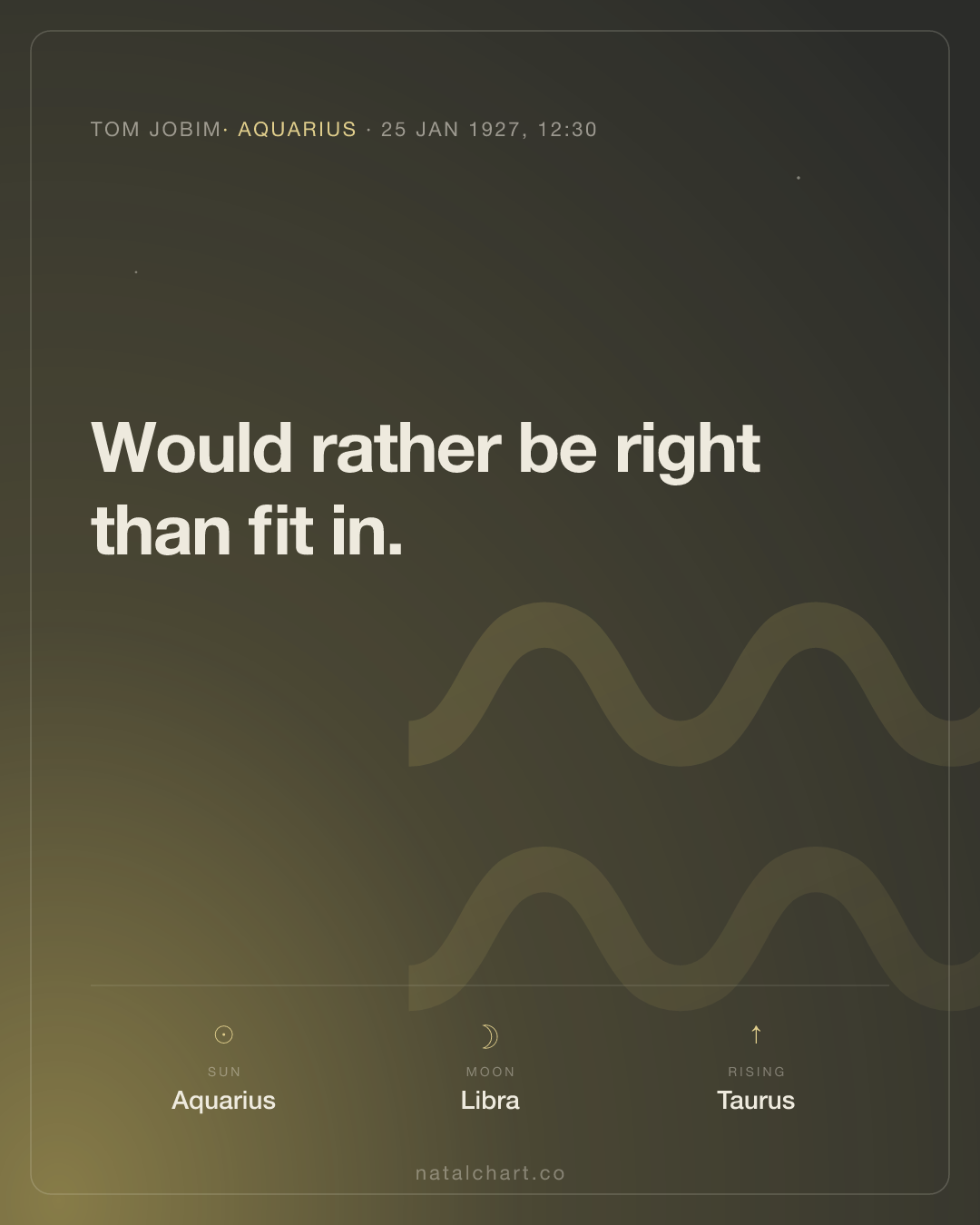
Tom Jobim's Sun sign is Aquarius — the Sun was in Aquarius at birth (1927).
What is Tom Jobim's moon sign?
Tom Jobim has the Moon in Libra. The Moon sign describes the emotional and instinctive layer of the chart.
What is Tom Jobim's rising sign?
Tom Jobim's rising sign (ascendant) is Taurus — the sign on the eastern horizon at the moment of birth.
When and where was Tom Jobim born?
Tom Jobim was born in 1927 in Rio de Janeiro, Brazil.