James Dean — natal chart
What does James Dean’s natal chart reveal?
American actor, teenage icon of the 1950s. Only three lead roles: East of Eden (1955), Rebel Without a Cause (1955) and Giant (1956). Died in a car crash in 1955 at 24. Nominated for the Oscar posthumously.
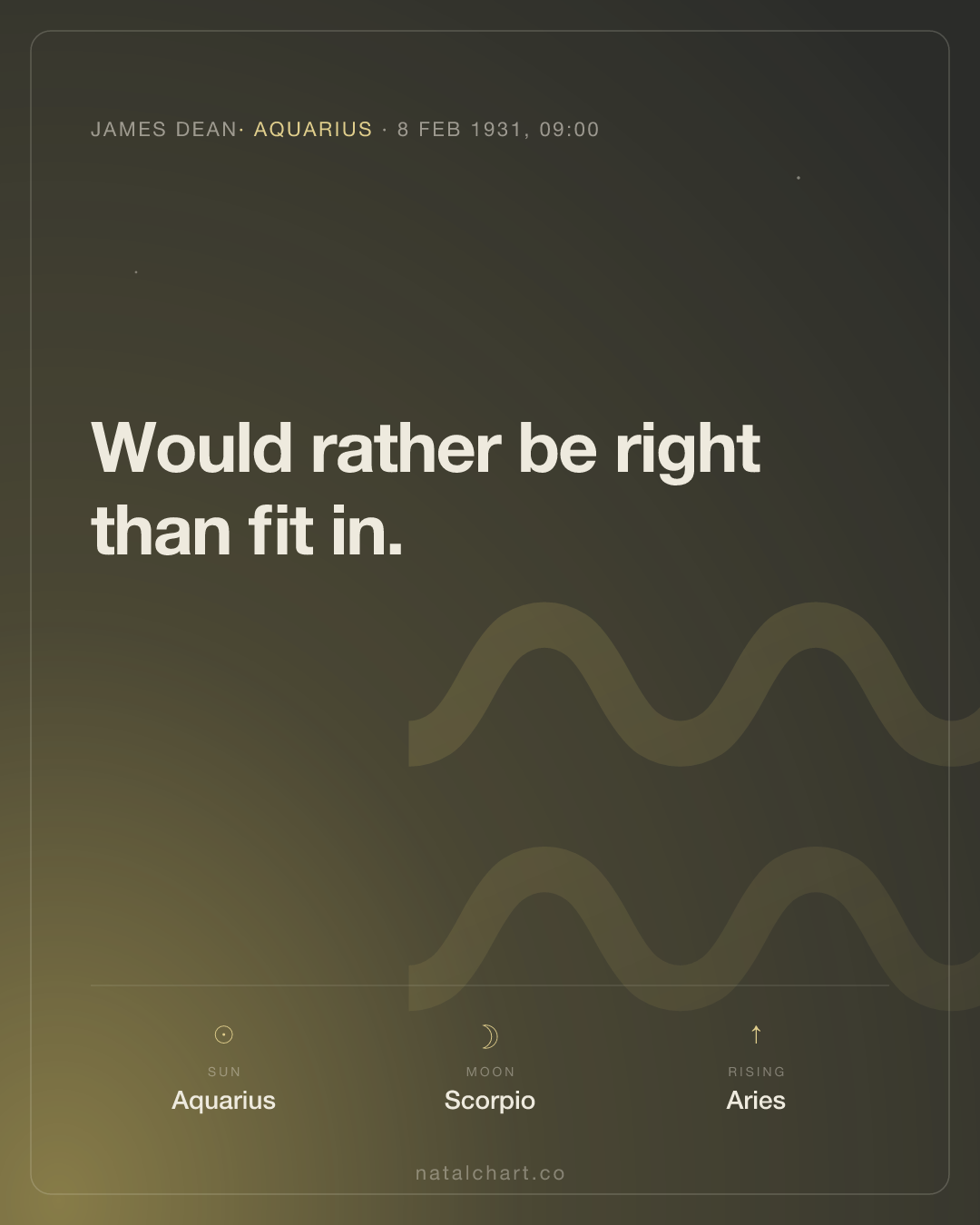 Share
Share
Birth
1931-02-08 · 09:00 · Marion, Indiana Reliability: AA · vetted record
The Rebel Who Was Also a Blueprint
James Dean was born into a chart that looks, at first glance, like a contradiction: Aquarius Sun, Aries Ascendant, Scorpio Moon. A humanitarian idealist, a firecracker physical presence, and an emotional interior that ran fathoms deep. Those three points alone explain why watching him onscreen felt like seeing someone think in real time — and why no director who worked with him ever quite forgot the experience.
Sun in Aquarius: The Outsider by Design
The Sun in Aquarius, sitting in the eleventh house (the house of collectives, peers, and belonging to something larger), is the mark of someone who identifies with a generation rather than just himself. Dean did not simply play teenage rebellion in Rebel Without a Cause (1955) — he was the generation's mirror. Aquarius does not seek to stand out by being louder; it stands out by being truthful in a way that makes everyone else suddenly aware of the performance they have been giving. That is what Dean did in every frame. The paradox of Aquarius is that the person most driven to belong to humanity often feels most alien within a room — and Dean's biographers are unanimous on how profoundly lonely he was offscreen.
Ascendant in Aries: The Body Leads
The Ascendant is the face one meets the world with — the reflex, not the considered self. In Aries, it is physical, direct, and impatient. Dean walked into rooms the way Aries walks: as if already in motion. Every iconic image — the slouch, the cigarette, the defiant squint — was the body thinking before the mind caught up. With Uranus (the planet of disruption and sudden breaks) sitting right on this Aries Ascendant, that physical quality crackled with a kind of electric unpredictability. Aries Ascendant with Uranus on it does not do subtle; it does arresting.
Moon in Scorpio: What Nobody Saw
The Moon describes the emotional interior, the private self that surfaces only in safety or extremity. In Scorpio, in the eighth house (the house of depth, loss, and irreversible change), Dean's emotional life was intense in ways he rarely showed. Scorpio Moon does not handle feeling lightly; it absorbs, holds, and eventually transforms. His mother died when he was nine — a wound the eighth-house Moon carries without language for it, just weight. That weight was not decoration in his performances; it was the material. Cal Trask's hunger for paternal love in East of Eden (1955), shot in close-up by Elia Kazan, was not acting technique. It was the Scorpio Moon given permission to surface.
Mercury and Venus in Capricorn: The Discipline Behind the Instinct
Both Mercury (mind, communication) and Venus (what one values and how one connects) sit in Capricorn in the tenth house, the house of profession and reputation. This is not an obvious pairing with the rest of the chart — Aries body, Scorpio emotions, Aquarius ideals — but it is the structural explanation for why Dean, despite his short career, became permanent. Capricorn takes its work seriously. Dean studied at the Actors Studio under Lee Strasberg, practised the Method with unusual rigour, and brought intellectual preparation to roles that looked effortless. The Venus in Capricorn here also signals that what he loved, he loved with commitment and without sentimentality. He was not casual about art.
Mars in Leo: The Performance Instinct
Mars in Leo in the fifth house (the house of creativity, play, and self-expression) is one of the most naturally theatrical placements in a chart. Mars here drives through performance — not performance as artifice, but performance as the most honest form of being. Dean was not performing in order to become famous; he was performing because Leo's fifth-house Mars makes creation feel like breathing. Giant (1956), his last completed film, required him to age from young man to patriarch across decades of screen time — a physically and technically demanding arc that he tackled with a Leo Mars confidence that apparently unnerved his co-stars.
Jupiter and Saturn: The Tension That Shaped Everything
Jupiter in Cancer in the fourth house (the house of home, roots, and early life) speaks to an expansive emotional root — the idea that home and family were both Dean's deepest resource and his most unresolved territory. Cancer Jupiter wants to nurture and be nurtured; the fourth house is where that plays out. His father gave him up to relatives after his mother died; Dean spent years trying to rebuild that relational ground. Jupiter here also pulls in tension with Uranus at just under one degree — the tightest hard aspect in the chart. Jupiter craving rootedness pulling hard against Uranus demanding freedom is exactly the torque that made Dean impossible to contain. Managers, directors, and studios found him unmanageable because the chart would not let him settle.
Saturn in Capricorn in the tenth house, pulling against Pluto (the planet of irreversible transformation) at barely one degree, is the most structurally serious tension in the chart. Saturn opposite Pluto describes a person whose public standing and deep transformations are locked in a permanent negotiation — authority structures and radical rupture pulling against each other. For Dean, this translated into an ambivalent relationship with the Hollywood system: he needed it for reach, resisted its control, and never resolved the tension because he died at twenty-four.
Outer Planets: The Generation Underneath
Neptune in Virgo in the sixth house shaped how Dean's entire generation approached daily work and craft — with a kind of painstaking perfectionism that sat oddly alongside their rebellion. For Dean personally, the sixth house is where Neptune softened the everyday edges, made the boundary between self and role permeable, and allowed the emotional absorption that the Method demanded. Pluto in Cancer in the fourth house is a generational marker — the children born into Depression-era households carried the deep structural insecurity of that world into their adult emotional lives. For Dean, it reinforced the fourth-house wound.
Vocation: Built to Last, Not to Age
The Midheaven (the chart's career and public-reputation point) sits in Capricorn — the sign of enduring legacy, of structures that outlast their builders. Dean made three films. He was nominated for the Academy Award posthumously — twice, for East of Eden and Giant — and his public image has not diminished in seventy years. A Capricorn Midheaven does not fade. It calcifies into monument. The bitter irony is that this placement describes legacy better than longevity; it does not require the person to grow old, only to build something that can.
Chiron and the North Node
Chiron (the old wound that, when faced, becomes a gift) sits in Taurus in the second house — the house of self-worth, material security, and the body. A Taurus Chiron in the second house often describes someone who built enormous outer confidence while carrying a private question about their own value. Dean's relationship with his physical self — the body as instrument, the body as statement — was central to everything he did, yet accounts suggest he was deeply uncertain about whether he was genuinely talented or simply being used. The North Node (the direction the life is pointing toward) sits in Aries: toward directness, toward the initiated self, toward courage without the need for approval. His three years of lead roles were exactly that arc — moving away from the orphaned seeking of his early life toward something fierce and self-authored.
What Remains
Dean's chart is the portrait of someone built at the intersection of enormous sensitivity and enormous drive, held together by a discipline that looked nothing like discipline from the outside. The Scorpio Moon absorbed more than it showed. The Capricorn Mercury and Venus turned instinct into craft. The Aries Ascendant made all of it visible in a way that was impossible to look away from. He left three performances. They are enough. The Capricorn Midheaven saw to that.
The chart
How to read it →Frequently asked questions
What is James Dean's zodiac sign?
James Dean's Sun sign is Aquarius — the Sun was in Aquarius at birth (1931).
What is James Dean's moon sign?
James Dean has the Moon in Scorpio. The Moon sign describes the emotional and instinctive layer of the chart.
What is James Dean's rising sign?
James Dean's rising sign (ascendant) is Aries — the sign on the eastern horizon at the moment of birth.
When and where was James Dean born?
James Dean was born in 1931 in Marion, Indiana.