Jean-Luc Godard — natal chart
What does Jean-Luc Godard’s natal chart reveal?
Jean-Luc Godard, born 3 December 1930 in Paris, was a French-Swiss filmmaker and a central figure of the French New Wave. He began as a critic at Cahiers du Cinema before his debut feature Breathless (A bout de souffle, 1960) reshaped narrative cinema with its jump cuts and improvisational style. His prolific 1960s output included Le Mepris (1963), Bande a part (1964), Pierrot le Fou (1965) and Weekend (1967). He later turned to overtly political and essayistic work, from the Dziga Vertov Group to Histoire(s) du cinema (1988-1998) and Goodbye to Language (2014). He received an honorary Academy Award in 2010. He died on 13 September 2022.
 Share
Share
Birth
1930-12-03 · 02:00 · Paris (7th arrondissement), France Reliability: A · reliable data
The Eye That Would Not Rest
Jean-Luc Godard began his career as a critic, which is the essential fact. Before he made a single film, he had spent years analysing what cinema was doing to time, to narrative, to the relationship between image and thought. The chart explains why that was the necessary preparation — and why, when he finally got behind a camera, the films came out looking like nothing else.
The Sun and Mercury are both in Sagittarius in the third house, the house of communication, of language, of how thought finds its form in the world. Sagittarius at the Sun is the sign of the wide view, of the search for the principle behind the particular, of the refusal to treat one thing as the whole story. Mercury here — the planet of the thinking mind — moves in the same register: not the precise, sequential logic of Virgo, not the systemic overview of Aquarius, but the nomadic intelligence that follows a question wherever it goes. Breathless does not proceed; it ranges. Histoire(s) du cinéma does not argue; it associates.
The Libra Ascendant: The Intelligence of Balance
The Ascendant — the quality that shapes first impressions, the face the world encounters — is in Libra. Libra at the Ascendant produces people who are instinctively aware of the other side, of what could be argued against what they are saying, of the shape of the opposition. It does not produce neutrality; it produces a particular kind of engaged, dialectical intelligence.
This is visible in how Godard worked: he made films that argued with themselves, that held a thesis and its counter-thesis in the same frame. He was also famously difficult to be with — not because he was cold but because the Libra attention to the other's perspective had its counterweight in the Sun-Mercury Sagittarius that would rather leap to the next idea than settle into the one it had just arrived at. The surface was Libran, considered, aesthetically precise; the interior was Sagittarian, perpetually moving.
Moon in Taurus: The Depth That Held the Restlessness
The Moon — the emotional interior, the register of what a person needs in order to feel settled — is in Taurus in the eighth house. The eighth house governs depth, transformation, what cannot be kept at the surface. Taurus in the Moon is the need for something solid to return to, something sensory and persistent beneath the intellectual velocity.
In Godard's case, this grounding took the form of image itself. His films, however formally disruptive, have a persistent visual beauty — the cinematography of Raoul Coutard in Breathless, the colour in Le Mépris, the Panavision compositions of Pierrot le Fou. The Taurus Moon did not slow him down; it anchored him to the material, to what the eye could actually see, as the intellectual Sagittarius moved around it.
The Moon forms a natural collaboration with Neptune in Virgo — an easy angle that connects the emotional interior to the dissolving of ordinary perceptions. For a filmmaker, this is a potent combination: the emotional and the oneiric were not separate territories in Godard's work. They were the same territory, examined from different angles.
Jupiter and Pluto at the Midheaven: The Public Force
The Midheaven — the public point of the chart (the indicator of professional trajectory and how the world comes to see a person) — is in Cancer. Jupiter and Pluto are both in Cancer in the tenth house, joined within barely a degree — the tightest configuration in the chart. Jupiter expands what it touches; Pluto transforms it. Both at the Midheaven in Cancer, the sign of the collective memory and the shared inheritance.
Godard did not merely make films; he redefined what films were allowed to be. That is a Pluto-at-Midheaven story: the public identity becomes inseparable from transformation, from rupture, from the remaking of a form. Jupiter alongside it amplifies the reach — the jump cut, the direct address to camera, the integration of text and image that he pioneered in 1960 are still the common vocabulary of cinema sixty years later. The Cancer Midheaven roots this legacy in the collective: he became part of how cinema understands its own history.
Saturn Square Uranus: The Creative Tension
Saturn in Capricorn in the fourth house and Uranus in Aries in the seventh house form a sharp tension across the chart. Saturn is the principle of structure, of form, of the constraint that forces precision; Uranus is the principle of rupture, of the form that breaks itself open to show what is underneath. In easy collaboration with each other, these planets produce controlled innovation. In tension — which they are here — they produce the discomfort of someone who cannot simply obey structure and cannot simply abandon it.
Godard's career traces this tension with unusual legibility. The early films (1960–1967) work inside the recognisable forms of the thriller, the musical, the road movie — and detonate them from within. The later films (1968 onward) abandon conventional form almost completely. The break is not a rejection of Saturn; it is Saturn's discipline applied to Uranian demolition. Weekend (1967) is the joint that holds them together — it looks like a film and behaves like an emergency.
The Sun in easy collaboration with Uranus — an angle of natural flow — means the disruption came naturally, not against the grain. He did not work to be radical; radicalism was the honest expression of how the Sun in Sagittarius, restless and wide-ranging, related to the world.
Venus in Scorpio and the Politics of Desire
Venus in Scorpio in the second house governs the values, the things a person holds close and returns to. Scorpio here does not value the surface: it values the real beneath the real, the transaction behind the image, the power relation inside the pleasure. For Godard, this showed up politically and aesthetically — his analysis of how cinema produces consent, how beauty operates as ideology, how desire is always also a market. The Dziga Vertov Group films of the early 1970s are Venus in Scorpio pushed to its logical conclusion: image as transaction, stripped bare.
Venus in easy flow with Pluto deepens this: the capacity to find beauty in precisely the most unsettling places, in the gap between image and meaning, in the pause before the answer.
Mars in Leo and the Public Argument
Mars in Leo in the eleventh house — the house of the wider community, of the public and its movements — is the planet of action in the sign of the stage, in the house of the collective. In Mars in Leo, the drive to act and the drive to be seen performing the action are not entirely separate. Godard was a famously public intellectual: the interviews, the polemics, the refusal to show up to his own honorary Academy Award in person. He knew the gesture was part of the film.
Mars in easy collaboration with Uranus links this public energy directly to the capacity for disruption. The provocations were not random: they were calibrated, Mars-in-Leo, for maximum visibility.
Chiron in Taurus: The Wound in the Image
Chiron — the old wound that becomes, slowly, a source of skill and insight — is in Taurus in the eighth house, the same house as the Moon. The Taurus wound is the wound of the concrete, of the body, of what cannot be abstracted away: the image that cannot be made to mean only what the mind wants it to mean. For Godard, who spent sixty years interrogating the relation between image and meaning, this is the central problem of the work, not incidentally placed.
Goodbye to Language (2014), made in 3D at the age of eighty-three, is the Chiron in the eighth house as late flowering: the attempt to let the image be itself, without the commentary, without the theory — the wound arrived at from the other side.
A Portrait in Motion
What the chart describes is a person for whom the act of thinking was inseparable from the act of making: the Sagittarius mind had to find a form, and the form had to keep pace with the mind. The Libra Ascendant gave him the aesthetic precision to make that visible; the Jupiter-Pluto at the Midheaven gave it historical weight; the Saturn-Uranus tension kept the work honest — never merely beautiful, never merely destructive.
He died in September 2022, by his own choice and in his own time, which is also in the chart: Pluto at the Midheaven in Cancer does not easily cede control of the narrative. He had spent sixty years reminding cinema that the frame is always a choice. It was appropriate that the final frame was his.
The chart
How to read it →Frequently asked questions
What is Jean-Luc Godard's zodiac sign?
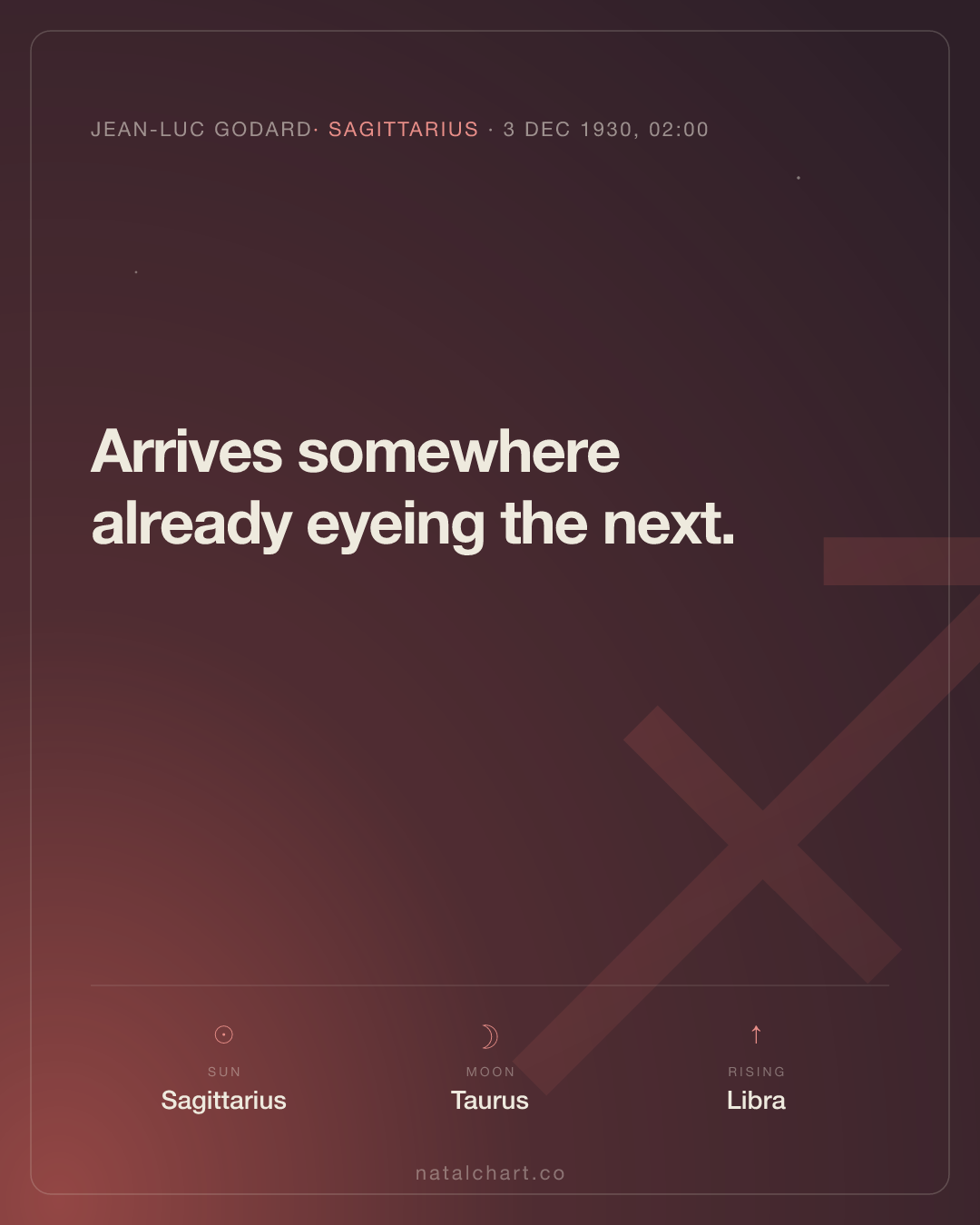
Jean-Luc Godard's Sun sign is Sagittarius — the Sun was in Sagittarius at birth (1930).
What is Jean-Luc Godard's moon sign?
Jean-Luc Godard has the Moon in Taurus. The Moon sign describes the emotional and instinctive layer of the chart.
What is Jean-Luc Godard's rising sign?
Jean-Luc Godard's rising sign (ascendant) is Libra — the sign on the eastern horizon at the moment of birth.
When and where was Jean-Luc Godard born?
Jean-Luc Godard was born in 1930 in Paris (7th arrondissement), France.